Health Psychology
 Call Kai
 Learn
Learn Practice Test
 Spaced Repetition
 Match
Match Flashcards
 Knowt Play
1/22

There's no tags or description
Looks like no tags are added yet.
Name | Mastery | Learn | Test | Matching | Spaced | Call with Kai |
|---|
No analytics yet
Send a link to your students to track their progress
23 Terms
Define Health Behaviours
Any activity undertaken for the purpose of preventing or detecting disease or for improving health/wellbeing (Conner & Norman, 1996)
Protective (positive) vs risky (negative) health behaviours.
Facts about Non-Communicable Diseases (NCD)
NCDs kill over 41 million people each year worldwide (WHO, 2022)
- Cardiovascular diseases (heart attacks and stroke).
- Cancer
- Chronic respiratory diseases (asthma, chronic pulmonary disease).
- Diabetes
Behavioural Determinants of Health and Illness
Health - High fruit and vegetable intake, regular physical activity
Illness - Sedentary lifestyle, smoking, high alcohol consumption.
Changing Health Behaviours
If there is a clear link between health behaviours and morality from NCDs - this should be enough to make people change their behaviour.
So why don’t we?
Some health behaviours can become habits that are difficult to break.
- Often come with immediate costs for long term benefits.
- Some health behaviours are also reinforced by the social environment and peers. (Alcohol consumption, smoking, drug use)
Predicting and Explaining Health Behaviour
Individual Differences
Social cognitive models of health behaviour change
Models of health
Binge drinking
Individual Differences
Emotional, demographics, perceived symptoms, genetic factors, cognition, personality.
Social Cognitive Models of Health Behaviour Change
Individual differences > Health Behaviours > Non communicable diseases
Models of health
- Health Belief Model
- Theory of Planned Behaviour
- Social Norms Theory
- Protection Motivation Theory
Binge Drinking
Defined as having over 8 (men) 6 (women) units in a single session.
More common in Scotland (37%), then Wales, then England (26%)
The highest percentage of binge drinking in England is in the Northwest
Define Theory of Planned Behaviour (Ajzen, 1991)
Behaviours are determined by intentions (proximal predictors of health behaviours).
Norman & Conner (2006)
Applied ToPB to undergraduate students and binge drinking.
Found:
Predicting intentions - attitudes, self-efficacy and perceived control as predictors.
Predicting behaviour - intentions, self-efficacy and past binge drinking as significant predictors.
Norman, Webb and Millings (2019)
Randomly allocated undergraduate to either ToPB messages or none.
Found:
- Exposure to ToPB messages resulted in more negative cognitions about binge drinking.
- But no behaviour change in the frequency of binge drinking.
This did not support the ToPB. Attitudes can be changed, but not necessarily actions.
Social Norms Theory (SNT)
An individual’s behaviour is influences by the perception of how their peers think and act.
Social comparisons are linked to the potential influence of social norms for changing health behaviour.
Norms provide information about which action is desirable, along with how when and where the action will be achieved.
If a peer group engages in health behaviours, then this becomes a source of normative influence.
Social Norms Theory to predict binge drinking
Students tend to overestimate alcohol consumption among other students.
Nearly half of students (42%) incorrectly believe that their peers regularly drink 6 or more drinks in one session.
Students who correctly identify that most students drink less than 6 drinks in a session are more likely to drink responsibly. (Robinson et al, 2014)
Robinson et al (2014)
Found norm messages influences normative drinking perceptions but only among norm believers. Norm messages were ineffective for participants who overestimated peers’ drinking at baseline.
But norm messages were not successful in increasing intentions to drink responsibly.
Neighbors, Larimer & Lewis (2004)
Found that most variance in subsequent drinking was explained by baseline drinking.
SNT to reduce binge drinking
Dotson et al (2015)
Meta-analysis of PNF interventions to reduce alcohol consumption among student drinkers. Found small effects in the PNF for reducing alcohol use.
Smoking in the UK
Smoking begins early (in adolescence) due to - initial experimentation, peer pressure, development of attitudes about smoking.
13.8% of people aged 18+ have smoked. It’s highest among ages 25-34 years.
Protection Motivation Theory (Rogers, 1975)
Designed to help understand what kind of messaging can help changed people’s health behaviour.
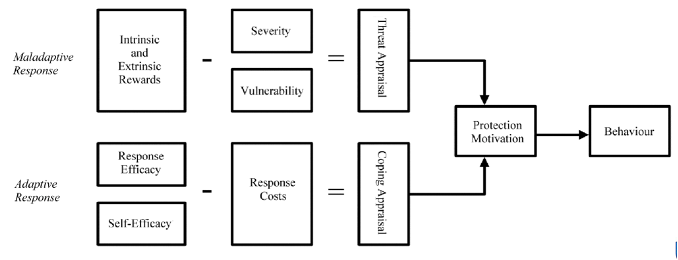
Norman et al (2005)
- PMT components are manipulated via persuasive communication to see the effects on health behaviour e.g. fear appeals
- PMT used as social cognition model to predict health behaviour change e.g. associations with preventative behaviour.
Fear Appeals - three components
- The message
- The audience
- The recommended behaviour
Fear Appeals & Cigarette Packaging
Dijkstra & Bos (2015)
Found that fear appeals + low disengagement beliefs.
Only when disengagement beliefs did not interfere with fear appeals, smokers’ perceived level of threat was increased - led to some effects on behaviour.
Tannenbaum et al (2015)
Fear appeals more effective: when used for one time behaviour, and for women.
Some Caveats
Arousing fear could result in a defensive response or “risk denial”
Severity of possible consequences does not always translate into effective change.
Messages that are too extreme can make people ignore the message.
Fear appeals only work when accompanied by an efficacy message (Witte & Allen, 2000)
Strong fear appeals and high-efficacy messages produce the greatest behaviour change.
Strong fear appeals with low-efficacy messages produce the greatest levels of defensive responses
Need to outline how, why, and when a recommended response eliminates or decreases the chances of experiencing the health threat.