5.10- 5.16 selective breeding, GM
 Call Kai
 Learn
Learn Practice Test
 Spaced Repetition
 Match
Match Flashcards
 Knowt Play
1/13

There's no tags or description
Looks like no tags are added yet.
Name | Mastery | Learn | Test | Matching | Spaced | Call with Kai |
|---|
No analytics yet
Send a link to your students to track their progress
14 Terms
What is selective breeding?
When humans choose organisms to breed in order to produce offspring with a certain desirable characteristic
Process of selective breeding
Parents with desired characteristics are chosen
They are bred together
Offspring with the desired characteristics are bred together
Process is repeated many times until all offspring have desired characteristic
Problems with selective breeding
Can cause inbreeding - breeding those with similar characteristics means you are likely breeding closely related organisms
Results in reduction of gene pool as number of different alleles reduce (most have same)
If environment changes/new disease, species can become extinct (Few have survival advantage)
Small gene pool causes greater chance of genetic defects in offspring
What is genetic engineering?
Modifying the genome of an organism by introducing a gene from another organism to give a desired characteristic
What are restriction enzymes used for?
To cut the required gene out of the DNA - results in pieces of DNA with sticky ends
What are ligase enzymes
Enzymes that are used to join pieces of DNA together
What are sticky ends
Short sections of single-stranded DNA which pair together with another that contains complementary bases
Process of genetic modification
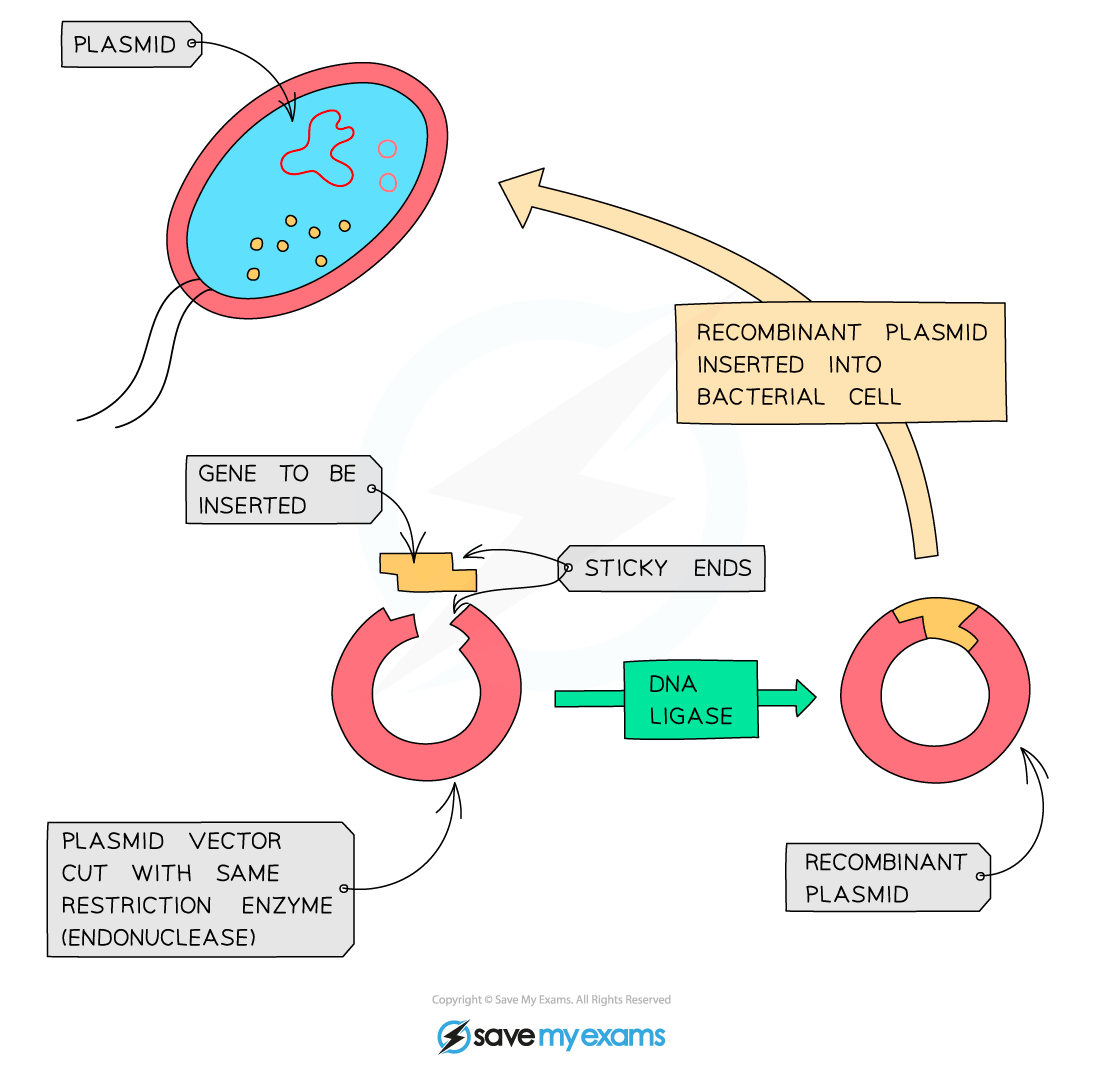
The gene is cut out using restriction enzyme leading sticky ends
A bacterial plasmid (transfer DNA into bacteria or yeast) or virus (transfer DNA into human cells or bacteria) is cut using the same restriction enzyme to create sticky ends that match the gene (acts as vectors)
The sticky ends from the plasmid and the genes are joined together by ligase enzymes creating a recombinant plasmid
The recombinant plasmid is inserted into host bacterium and one allowed to multiply and express new gene
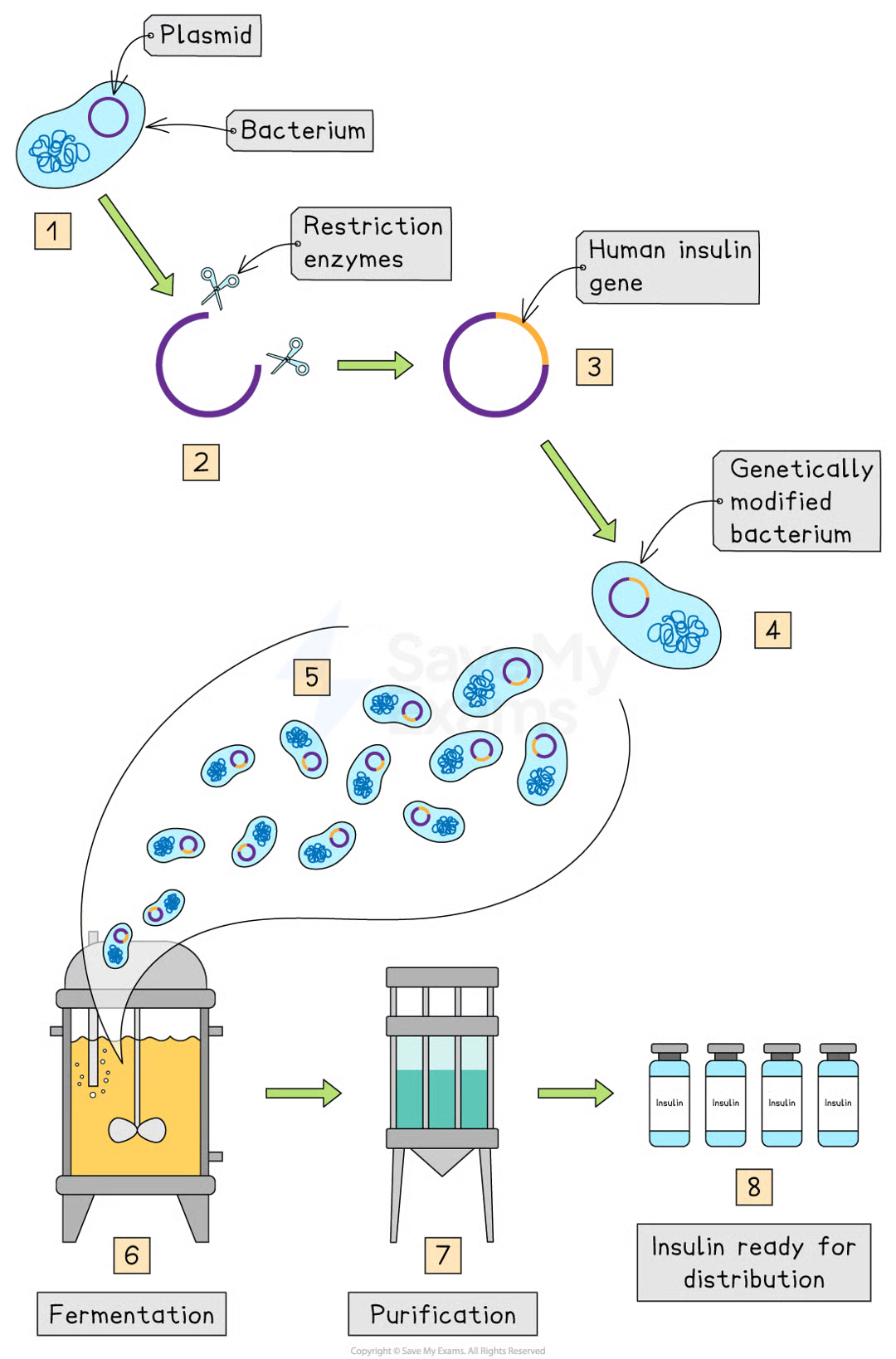
Process of producing insulin from genetically modifying bacteria
gene for insulin production located within human chromosome which restriction enzymes are used to isolate/cut out leaving it with sticky ends
A bacterial plasmid is cut by the same restriction enzyme leaving it with corresponding sticky ends
The plasmid and the isolated human insulin gene are joined together by ligase enzyme
The recombinant plasmid is inserted into a bacterial cell
When the bacteria reproduce, the plasmids are copied as well and so a recombinant plasmid can quickly be spread and will express the human insulin gene, making human insulin protein
It can be placed in a fermenter to reproduce quickly in controlled conditions to make large amounts of human protein
What is manufacturing insulin used for?
For medical use to treat diabetes
What are crops genetically modified to be?
To be resistant to insects and herbicides, increasing yield
To produce additional vitamins
Advantages of GM crops
reduced use of chemicals (pesticides) - better for environment
Cheaper/less time consuming
Increased yields
Disadvantages of GM crops
increased costs of seeds
Increased dependency on certain chemicals
Risk of inserted genes being transferred to wild plants by pollination
Reduced biodiversity
What is transgenic
Transfer of genetic material from one species to a different species