0625 Physics Lecture Notes
 Call Kai
 Learn
Learn Practice Test
 Spaced Repetition
 Match
Match Flashcards
 Knowt Play
1/93

Earn XP
Description and Tags
These flashcards cover key concepts, definitions, and principles from the 0625 physics syllabus, including topics in motion, forces, energy, thermal physics, waves, electricity, magnetism, nuclear physics, and space physics.
Name | Mastery | Learn | Test | Matching | Spaced | Call with Kai |
|---|
No analytics yet
Send a link to your students to track their progress
94 Terms
Scalar Quantity
A quantity that has magnitude only.
Vector Quantity
A quantity that has both magnitude and direction.
Speed
Distance travelled per unit time.
Velocity
Speed in a given direction.
Acceleration
Change in velocity per unit time or rate of change in velocity.
Deceleration
Decrease in velocity per unit time or rate of decrease in velocity.
Mass
Measure of the quantity of matter in an object at rest relative to the observer.
Weight
Gravitational force on a mass or effect of a gravitational field on a mass.
Gravitational field strength
Force per unit mass, equivalent to the acceleration of free fall.
Density
Mass per unit volume.
Spring constant
Force per unit extension.
Limit of proportionality
Point up to which extension is directly proportional to the load.
Hooke’s law
Extension is proportional to the load applied, up to the limit of proportionality.
Centre of gravity
Point where all the weight of an object seems to act.
Moment of a force
The turning effect of a force, product of force and perpendicular distance from the pivot.
Principle of moments
Sum of clockwise moments about a point is equal to the sum of anticlockwise moments about the same point.
Momentum
Product of mass and velocity.
Principle of conservation of momentum
If objects collide, the total momentum before the collision is the same as the total momentum after, provided no external forces act.
Impulse
Product of force and time for which force acts.
Resultant force
Change in momentum per unit time.
Principle of conservation of energy
Energy cannot be created or destroyed; it can only be transformed between energy stores.
Work done
Product of the force and displacement moved in the direction of the force.
Power
Work done per unit time or energy transferred per unit time.
Efficiency
Ratio of the useful power output to the total power input.
Pressure
Normal force acting per unit area.
Absolute zero
Lowest possible temperature (−273°C) where particles have least kinetic energy.
Boyle’s law
For a fixed mass of gas at constant temperature, the product of pressure and volume is constant.
Specific heat capacity
Energy transferred per unit mass per unit temperature change.
Boiling point
Temperature at which liquid becomes a gas.
Evaporation
Process where water molecules with more energy escape from the surface.
Wavefront
Imaginary surface that connects crests or troughs in a wave.
Wavelength
Distance between two adjacent crests or troughs.
Frequency
Number of complete oscillations per unit time.
Amplitude
Maximum displacement of a point of the wave from the equilibrium position.
Wave speed
Distance travelled by the wave per unit time.
Transverse wave
A wave where the direction of vibration is at right angles to the direction of propagation.
Longitudinal wave
A wave where the direction of vibration is parallel to the direction of propagation.
Normal
A line drawn perpendicular to the surface.
Angle of incidence
Angle formed between incident ray and normal.
Angle of reflection
Angle formed between reflected ray and normal.
Law of reflection
Angle of incidence is equal to the angle of reflection.
Refractive index
The ratio of speed of light in vacuum to its speed in a specific medium.
Critical angle
Angle of incidence at which the angle of refraction is exactly 90°.
Total internal reflection
All light is reflected when angle of incidence is greater than critical angle.
Focal length
Distance between centre of the lens and principal focus.
Principal axis
Line passing symmetrically through the optical centre of the lens.
Principal focus (focal point)
The point at which rays of light parallel to the axis converge after passing through a lens.
Virtual image
An image that cannot be projected onto a screen and light only seems to come from it.
Monochromatic light
Light of a single frequency.
Long sightedness
Condition where image focuses behind retina, corrected by converging lens.
Short sightedness
Condition where image focuses in front of retina, corrected by diverging lens.
Digital signal
A signal that consists of two values.
Analogue signal
A signal that varies over a range of values.
Compression
Region where particles are close together or region of higher than normal pressure.
Rarefaction
Region where particles are further apart or region of lower than normal pressure.
Echo
Reflection of sound waves.
Ultrasound
Sound with a frequency higher than 20 kHz.
Magnetic field
Region in which a magnetic pole experiences a force.
Electric field
Region in which an electric charge experiences a force.
Electric current
Charge passing a point per unit time.
Direct current
Flow of electric charge in only one direction.
Alternating current
Direction of the current constantly reverses.
Emf (electromotive force)
Electrical work done by a source in moving a unit charge around a complete circuit.
Potential difference
Work done per unit charge in passing through a component.
Kilowatt-hour
Amount of electrical energy transferred by a 1 kW appliance in one hour.
Potential divider
Circuit arrangement that splits e.m.f. between resistors in series.
Resistance
Ratio of voltage across a component to the current flowing through it.
Ohm’s law
Current through a conductor is proportional to potential difference when at constant temperature.
Nucleon number
Total number of protons and neutrons in a nucleus.
Sources of background radiation (4)
Radon gas. Rocks and buildings. Food and drink. Cosmic rays.
Proton number
Total number of protons in a nucleus.
Nuclear fusion
Process where two small nuclei join to form a bigger nucleus, releasing energy.
Nuclear fission
Process where a large unstable nucleus splits into smaller nuclei, releasing energy.
Isotopes
Same element with different number of neutrons and the same number of protons.
Background radiation
Radiation from natural sources, always present in the environment.
Describe the emission of radiation from a nuceus
Emission of radiation from a nucleus is spontaneous and random in direction
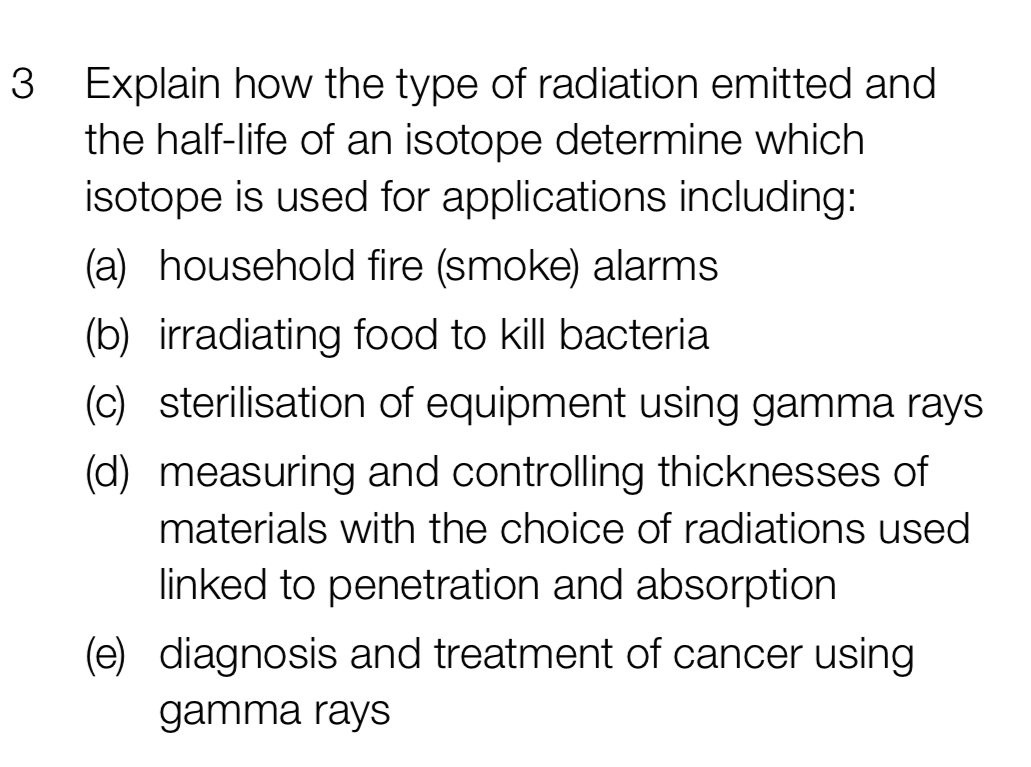
explain each
get explanation from tg
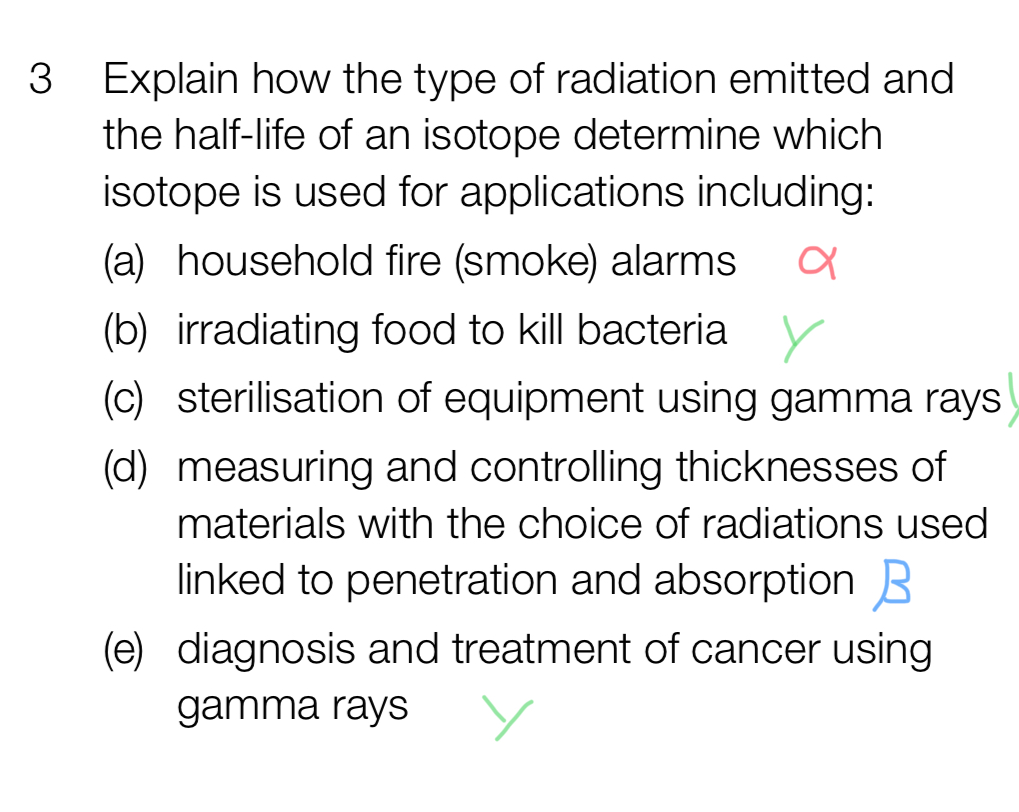
Safety precautions for all ionising radiation (3)
Reduce exposure time. Increase distance between source and living tissue. Use shielding to absorb radiation.
Effects of ionising nuclear radiations on living things (3)
Cell death. Mutations. Cancer.
Half-life
Time taken for half the nuclei of a particular isotope in any sample to decay.
How a protostar is formed (a-b)
A protostar is an interstellar cloud (of gas and dust that contain hydrogen) collapsing and increasing in temperature as a result of its internal gravitational attraction
How a protostar becomes a stable star (c)
When the inward force of gravitation attraction is balanced by an outward force due to the high temperature in the centre of the star.
How red giants / supergiants are formed (d-e)
Once stars eventually run out of hydrogen as fuel for the nuclear reaction in the centre of the star, and most has been converted into helium, they expand to form red giants/supergiants(massive stars).
Red giant path → ? (f)
Red supergiant path → ? (g-h)
Red giant forms a planetary nebula with a white dwarf star at its centre.
Red supergiant explodes as a supernova, forming a nebula containing hydrogen and new heavier elements, leaving behind a neutron star or a black hole at its centre. This nebula may form new stars with orbiting planets.
Milky Way
One of the many billions of galaxies making up the Universe, and it’s diameter is approximately 100 000 light-years
Feature of the Sun
A star of medium size, consisting mostly of hydrogen and helium, that radiates most of its energy in the infrared, visible light, and ultraviolet regions of the electromagnetic spectrum.
Galaxy
Collection of billions of stars.
Light-year
Distance travelled in the vacuum of space by light in one year, used to measure astronomical distances. (9.5×10^15 m)
Redshift
Increase in observed wavelength of electromagnetic radiation from receding stars and galaxys. Is evidence that the universe is still expanding, and supports the Big Bang Theory.
CMBR
Cosmic Microwave Background Radiation: Microwave radiation of a specific frequency is observed at all points in space around us, and was produced shortly after the Universe was formed.
How to determine the:
1) Speed at which a galaxy is moving away from the earth
2) Distance of a far galaxy from earth
1) Change in wavelength of the galaxy’s starlight due to redshift
2) Brightness of a supernova in that galaxy
Hubble constant, H0
Ratio of the speed at which a galaxy is moving away from Earth to its distance from Earth.
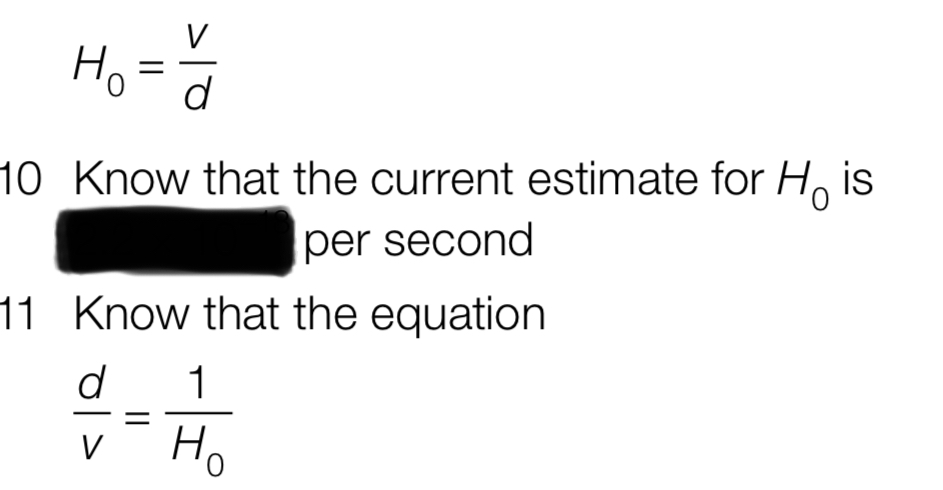
What does formula 2 represent + what is H0
Hubble’s constant = 2.2 × 10^-18
1/H Represents an estimate for the age of the universe and is evidence for the idea that all the matter in the universe was present at a single point