Econ Lecture 6
 Call Kai
 Learn
Learn Practice Test
 Spaced Repetition
 Match
Match Flashcards
 Knowt Play
1/45

There's no tags or description
Looks like no tags are added yet.
Name | Mastery | Learn | Test | Matching | Spaced | Call with Kai |
|---|
No analytics yet
Send a link to your students to track their progress
46 Terms
Definition of a market
A system where goods/services are exchanged voluntarily between agents, transferring ownership.
3 characteristics of markets
reciproqual
voluntary
competitive
reciprocal
transfer of a good/service from one person to another is matched by a transfer in the opposite direction
voluntary
both parties benefit from the transaction
competitive
if a buyer sets a price that is too high, the buyer refuses the transaction and turns to another seller
2 ways to organise an economy
market economy: decentralised, prices coordinate decisions, private ownership
economic planning: centralised, government gathers info to allocate ressources, public ownership
Adam Smith
"invisible hand": individuals pursuing self-interest inadvertently promote the public good.
Hayek
prices contain all necessary information about resource scarcity. But this only works if markets are competitive.
Kerala fish market
Before mobile phones (1997): prices varied wildly between beach markets; fish was destroyed in some, buyers found none in others. After mobiles: price dispersion ÷4, excess supply → 0.
Lesson: information flow → competitive prices → efficient allocation.
What are the 4 conditions of perfect competition?
Homogeneous goods, many firms, no strategic interaction, perfect information.
What is a price-taker?
A firm that takes the market price as given and cannot influence it.
What is the shape of the demand curve for a firm in perfect competition?
Perfectly elastic (horizontal).
Why is the firm’s demand curve horizontal?
Because any price increase leads to losing all customers.
Profit maximisation condition in perfect competition?
P=MC
What is the firm’s supply curve in perfect competition?
The Marginal Cost Curve (above AVC)
Why does supply increase with price?
Higher price makes higher-cost units profitable
How is market supply (aggregate supply) obtained?
Horizontal sum of individual firms’ supply.
What does “horizontal sum” mean?
Add quantities at each price.
What is market equilibrium?
The point where supply equals demand.
What happens if there is excess demand?
Price increases.
What happens if there is excess supply?
What determines equilibrium price?
Intersection of aggregate supply and demand.
Q: What is supply elasticity?
A: Responsiveness of quantity supplied to price changes.
Q: Formula for supply elasticity?
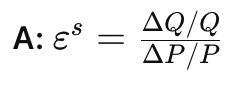
Q: Key rule about elasticity and shocks?
A: Prices move more when the other side of the market is inelastic.
Q: Effect of an increase in supply (demand constant)?
A: Price decreases.
Q: Effect of an increase in demand (supply constant)?
A: Price increases.
Q: What is a supply shock?
A: A change in production conditions shifting supply.
Q: What is a demand shock?
A: A change in consumer preferences/income shifting demand.
Q: What is a price ceiling?
A: A maximum legal price below equilibrium.
Q: What is consumer surplus?
A: Difference between willingness to pay and price.
Q: What is producer surplus?
A: Difference between price and marginal cost.
Q: What is total surplus?
A: Consumer + producer surplus.
Q: What happens to total surplus in perfect competition?
A: It is maximised.
Q: What is deadweight loss?
A: Loss of surplus due to inefficient allocation.
Q: What is Pareto efficiency?
A: No one can be made better off without making someone else worse off.
Q: What does the First Welfare Theorem state?
A: Competitive equilibria are Pareto efficient (under certain conditions).
Q: Conditions for efficiency?
A: Perfect competition, full information, no externalities, complete markets.
Q: What is market power?
A: Ability to set price above marginal cost.
Q: Difference between price-taker and price-maker?
A: Price-taker: P=MCP = MC; price-maker: P>MC
Q: Why is monopoly inefficient?
A: Produces less and sets price above MC → deadweight loss.
Q: Formula for HHI?
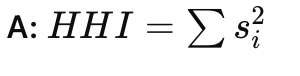
Q: What does HHI measure?
A: Market concentration.
Q: HHI in monopoly?
A: 1
Q: HHI with N equal firms?
A: 1/N
Q: Interpretation of high HHI?
A: Low competition, high concentration.