Accounting 202: Intermediate Accounting II Ch 4. Accounting for Bonds & Notes Payable
 Call Kai
 Learn
Learn Practice Test
 Spaced Repetition
 Match
Match Flashcards
 Knowt Play
1/98

There's no tags or description
Looks like no tags are added yet.
Name | Mastery | Learn | Test | Matching | Spaced | Call with Kai |
|---|
No analytics yet
Send a link to your students to track their progress
99 Terms
annuity
a series of future cash payments that occur at a regular interval
must occur regularly - usually monthly, quarterly, or annually
mortgage payment
a regularly occurring series of payments, or annuity, on a real estate loan
other examples of annuities
life insurance payments
pension payments
regular savings account deposits
some investments
time value of money
money loses its value over time
inflation
during which prices rise and money loses its value
present value of an annuity
the value today of a stream of future payments
PV (Annuity) = c1/ (1 + i)t + c2/ (1 + i)t + c3/ (1 + i)t + …cn/ (1 + i)t
PV (Annuity) = c ⋅ [1 - (1 + i)-n/ i]
Which of the following statements regarding inflation are true?
During inflation, prices rise
During inflation, money gains value
Inflation is independent of supply and demand
Recession is the reason a candy bar cost a nickel fifty years ago and now costs more than a dollar
During inflation, prices rise
What is the definition of an annuity?
Any type of insurance policy that is offered over a long period of time
A series of future cash payments occurring at regular intervals
A life insurance policy that pays a claim in payments instead of lump sums
A loan with a defined payoff date and regular payments due to the lender
A series of future cash payments occurring at regular intervals
Which of the following examples is an annuity?
A lump sum lottery payment
These are all examples of annuities
Mortgage loan payments
A robust portfolio with a lot of volatility
Mortgage loan payments
Which of the following statements is true regarding annuities?
Annuities are always lump sum payments.
Annuities can have either equal payments or different-amount payments, but they must occur regularly.
Annuities can occur regularly or irregularly, and they can have equal payments or different-amount payments.
Annuities can occur regularly or irregularly, but must have equal payments.
Annuities can have either equal payments or different-amount payments, but they must occur regularly.
What is the present value of an annuity if the interest rate is 5% per year for 5 years, and the annual payments are $25,000?
$108,237
$125,000
$244,441
$500,000
$108,237
Annuity
an interest bearing account that either pays you a fixed amount each month or that you pay into each month
Present Value
the value of the annuity today
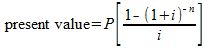
What does the P stand for in this formula?
The number of payments
The fixed payment amount
The present value
The future value
The fixed payment amount
An annuity has fixed monthly payments of $400, an annual interest rate of 8%, and a total number of 12 payments over one year. What is the present value?
$3,723.12
$1,400.23
$4,598.31
1,234.23
$4,598.31
Determine the interest rate that you will use in the formula for present value if the annual interest rate is 15% and payments are on a monthly basis.
0.132
0.432
0.0125
0.213
0.0125
Calculate the present value of annuity with fixed payments of $500, annual interest rate of 4%, and a total of 3 annual payments.
$1,254.23
$1,582.23
$1,387.55
$1,412.32
$1,387.55
The present value of an annuity is the worth of an annuity _____.
10 years ago
At the end
Today
In the future
Today
long-term liabilities
obligations owed by a company for more than a year
bond
similar to an IOU or loan
principal
amount the company borrowed
discount
purchases the bond at a value less than the principal
premium
purchasing the bond at a greater value than the principal
pension
arrangement whereby an employer provides lifetime payments to an employee after they retire
leasing
contractual arrangement between the company and the lessor that gives the company the right to use the equipment in exchange for periodic payments for a specific period of time
capital leases
company retains the equipment after the lease ends
operating lease
lessor keeps the equipment after the lease ends
current
the mortgage payments that will be paid within a year
long-term
payments that will be paid after that year, essentially the balance of the loan
Which of the following statements is accurate when it comes to vesting?
Vesting is not an important factor in classifying pension benefits on the balance sheet.
Vesting is not an important factor in classifying pension benefits on the income statement.
Vesting is an important factor in classifying pension benefits on the balance sheet.
Vesting is an important factor in classifying pension benefits on the income statement.
Vesting is an important factor in classifying pension benefits on the balance sheet.
Which of the following statements is true as it concerns a capital lease?
A capital lease is listed as a liability on the balance sheet.
A capital lease is listed as a liability on the income statement.
A capital lease is listed as an expense on the balance sheet.
A capital lease is listed as an expense on the income statement.
A capital lease is listed as a liability on the balance sheet.
Emily Management Company purchases new computers for its office. It plans to pay for these completely within the next three months. This is an example of a(n):
Current liability
Contingent liability
Direct liability
Long-term liability
Current liability
ABC Computer Firm is currently leasing computers to use for business purposes, but their lease will only run for a five-year period, after which the lessor will take back possession of the computers. How should the cost of this lease be recorded?
As an asset on the balance sheet
As an expense on the income statement
As a liability on the balance sheet
As a revenue on the income statement
As an expense on the income statement
Barber Company purchases a new fleet of company vehicles that it will make payments on over the next five years. This is an example of a(n):
Current liability
Direct liability
Long-term liability
Contingent liability
Long-term liability
long-term liabilities
obligations owed for more than a year
annuity
represent a series of payments
Liabilities
categorized on the balance sheet as current or long term
Principal
the amount borrowed
interest
cost associated with borrowing the money
bond
similar to an IOU
present value
value of a bond now, in present time, discounted by an interest rate
What is an annuity?
An annuity is the cost associated with selling a product or service.
An annuity is an obligation owned.
An annuity is the cost of doing business.
An annuity is a series of payments.
An annuity is a series of payments.
What are long term liabilities?
Long term liabilities are a series of payments.
Long term liabilities are obligations owned.
Long term liabilities are obligations owed for more than a year.
Long term liabilities are obligations owed for less than a year.
Long term liabilities are obligations owed for more than a year.
Which of the following statements is TRUE regarding a bond?
A bond is an asset for the issuer.
A bond is a liability for the issuer.
A bond is considered revenue for the issuer.
A bond is an expense for the issuer.
A bond is a liability for the issuer.
Which of the following statements is TRUE regarding coupon interest payments?
Coupon interest payments are paid periodically.
Coupon interest payments are considered an asset for the bond issuer.
Coupon interest payments are considered revenue for the bond issuer.
Coupon interest payments are optional for bond issuers.
Coupon interest payments are paid periodically.
ABC Paper Corporation is looking to sell $50,000 in bonds with $4,000 in coupon interest payments, and a 6% interest rate due in 10 years. Assume that the 3 digit present value of the bond is .512, and the 3 digit present value of the coupon interest payment is 4.98. What is the present value of the bond?
$45,520
$38,460
$48,790
$42,250
$45,520
Secured Bonds
use collateral to financially safeguard the bondholder against the issuer’s default
Unsecured Bonds a.k.a. Debentures
use the issuer’s general credit rating to back the bond
Term Bonds
mature or become due on one specified date
Serial Bonds
a portion of the outstanding bonds matures or become due at several dates, which typically fall in a series
Registered Bonds
issued in the names and address of their holders
the registered bond demonstrates ownership with a title
Bearer Bonds
payable to whoever bears or holds the bond
anyone could claim ownership of the bond as long as he or she bears it
Convertible Bond
the bondholder has the right to terminate the bond before the stated maturity date
provide the bondholder with the right to exchange the bond for a specific number of shares in the company’s common stock before the maturity date
Callable Bond
issuer has that same right
allow the issuer the opportunity to retire or payoff a bond at a stated dollar amount before reaching maturity
How is an unsecured bond different from a secured bond?
Secured bonds offer higher interest than unsecured bonds.
Secured bonds protect only the principal balance, while unsecured bonds do not protect the principal balance.
Unsecured bonds offer more tangible assets compared to secured bonds.
Unsecured bonds are riskier than secured bonds.
Unsecured bonds are riskier than secured bonds.
X is a type of bond that is payable to whoever holds it. As such, anyone can claim ownership of X. Because of the risk associated with X, very few are in circulation today.
Identify X.
Serial bond
Callable bond
Registered bond
Bearer bond
Bearer bond
Which of these bond types provides the bondholder with the right to exchange the bond for a specific number of shares in the company's common stock before the maturity date?
Convertible bond
Registered bond
Serial bond
Unsecured bond
Convertible bond
Which of these bond types are bonds in which a portion of the outstanding bonds mature or become due at several dates which typically fall in a series?
Unsecured bond
Serial bond
Convertible bond
Registered bond
Serial bond
When does a term bond become mature?
On a date as imposed by the issuer
On the last day of the year
On a specific date as agreed by both the issuer and bondholder
On the first of each term
On a specific date as agreed by both the issuer and bondholder
Bond
investment product where the investor loans a corporation money
Discount
amount less than the borrowed amount
Premium
amount greater than the borrowed amount
Coupon Interest Payments
cost of borrowing the money
Present Value
how much the bond is worth today
Premium
present value of the bond will be greater than the future value
Which of the following statements is true regarding bond coupon interest payments?
Bond issuers are not obligated to pay annual coupon interest payments.
Investors expect annual coupon interest payments.
Investors do not expect annual coupon interest payments.
The annual coupon interest payments must total the future value.
Investors expect annual coupon interest payments.
ABC Engineering is offering to sell you a bond for $50,000, which will upon maturity be worth $75,000. This bond also has an annual $2,000 coupon interest payment, and the time to maturity is 10 years.
XYZ Tech Firm is offering to sell you a bond for $100,000, which will upon maturity be worth $75,000. This bond also has an annual $15,000 coupon interest payment, and the time to maturity is 5 years.
Based on projected profit, which company's bond should you choose and what will the final profit be?
ABC Engineering, $45,000
XYZ Tech Firm, $25,000
XYZ Tech Firm, $50,000
ABC Engineering, $60,000
XYZ Tech Firm, $50,000
Which of the following is true about selling bonds at a discount?
Selling bonds at a discount means the purchase price is equal to the future value.
Selling bonds at a discount means the purchase price is less than the future value.
Selling bonds at a discount means the purchase price is greater than the future value.
Selling bonds at a discount means family or friends of the employee can purchase the bond at a lower price.
Selling bonds at a discount means the purchase price is less than the future value.
What are the characteristics of bonds?
Long term, lower risk, coupon interest payments
Risky, short term, dividends
Risky, long term, voting rights
Short term, lower risk, coupon interest payments
Long term, lower risk, coupon interest payments
Which of the following statements is true about bonds selling at a premium?
Selling bonds at a premium means the purchase price is equal to the future value.
Selling bonds at a premium means the purchase price is less than the future value.
Selling bonds at a premium means the purchase price is greater than the future value.
Selling bonds at a premium relates to the type and class of bond.
Selling bonds at a premium means the purchase price is greater than the future value.
face value
the value of the bond to be paid at maturity
coupon rate
the amount of interest to be received annually
discount rate
required return rate for an investor
majority date
the date the bond will be paid to the investor
premium
when the coupon rate is greater than the discount rate
discounted
when the coupon rate is less than the discount rate
hurdle rate
the minimum return established for investments
weighted average cost of capital
the company’s cost of acquiring the funds used to invest
Smith Darby has issued a five-year bond with a coupon rate of 8% and a face value of $5,000. As a personal investor, you require a rate of return of 10%. What is the value of the bond?
$5,000.00
$4,620.94
$5,399.37
$3,050.00
$4,620.94
Kirby Clean has issued a $1,000, three-year bond with a coupon rate of 15%. The investor's required rate of return is 10%. What is the value of the bond?
Greater than face value
None of the answers are correct
Face value
Less than face value
Greater than face value
An investor purchased a ten-year bond with a face value of $5,000 seven years ago. The coupon rate is 10% and the discount rate is 5%. The investor now has an opportunity to purchase a second bond with a coupon rate of 15%. The discount rate of similar types of bonds has increased to 10%.
He plans on selling the first bond. What is the value of the first bond if it is sold to a new investor (remember to use the most recent discount rate in the calculation regardless of the original discount rate)?
$5,000
$5,624.94
$6,396.10
$5,680.81
$5,000
When the coupon rate is above the discount rate, the bond value is _____ the face value and is considered to be at a _____.
Above; premium
Above; discount
Below; discount
Below; premium
Above; premium
The value of a bond is calculated using the present value of discounted cash flows. What is the discount rate?
The discount rate is the amount above the face value an investor is willing to pay for the bond.
The discount rate is the interest paid to the investor.
The discount rate is the difference between the face value and the purchase price expressed as a percentage.
The discount rate is the rate of return required for an investor to purchase the bond.
The discount rate is the rate of return required for an investor to purchase the bond.
bond
an investment instrument whereby an investor loans a company money in return for periodic interest payments
maturity date
agreed upon date the bond will be paid back
interest
cost of borrowing the money
retired
once the bond reaches maturity, the investors are repaid in full and the liability is removed from the balance sheet
callable
bond allows the issuer to retire the bond early
Which of the following is true about a bond issuer?
A bond issuer pays coupon payments to the investor.
A bond issuer is not required to pay coupon payments to the investor.
A bond issuer is not required to pay dividends to the investor.
A bond issuer pays dividends to the investor.
A bond issuer pays coupon payments to the investor.
How do you report a loss at the early retirement of a bond?
Report the loss on the balance sheet as an extraordinary item.
Report the loss on the income statement as an expense.
Report the loss on the balance sheet as an expense.
Report the loss on the income statement as an extraordinary item
Report the loss on the income statement as an extraordinary item
ABC Tech Firm has issued callable bonds for $5000 at a 10% interest rate with a maturity date of 10 years from the date of issue. In year 8, market interest rates have dropped to 4%. What will ABC Tech Firm likely do in this situation?
Retire the bond early to issue new bonds which take advantage of the lower interest rate.
Wait until the bond reaches maturity and continue to monitor interest rates.
Do nothing as a higher interest rate is better for the bond issuer.
Wait until the bond reaches maturity to avoid paying extra to retire the bond early.
Retire the bond early to issue new bonds which take advantage of the lower interest rate.
What is the term for the agreed upon date a bond will be paid back?
Liability date
Payoff date
Maturity date
Termination date
Maturity date
Which of the following statements is true regarding a callable bond?
A callable bond allows the issuer to call the investor about changes in the bond's contract.
A callable bond allows the issuer to turn the bond into stock.
A callable bond allows the issuer to retire the bond early.
A callable bond allows the investor to buy the bond early.
A callable bond allows the issuer to retire the bond early.
note payable
a liability
What accounting term will you see in the journal entries of non-interest bearing notes but NOT in the journal entries for interest-bearing notes?
Interest Expense
Discount on Note Payable
Note Payable
Cash
Discount on Note Payable
What is the best way to calculate the difference between an interest-bearing note and a non-interest bearing note?
Ask your accountant
Write some accounting entries
Interest-bearing notes are always less
Non-interest bearing notes are always less
Write some accounting entries
For which kind of note is there no direct interest payment?
Neither
Both
Interest bearing note
Non-interest bearing note
Non-interest bearing note
What is an implicit interest rate?
Future compensation for the money you borrow
Flexible interest
A non-binding interest rate
Suggested interest
Future compensation for the money you borrow
On an interest-bearing note, what will your income statement show before interest begins accruing?
The amount of interest you wish to pay
The amount of interest you intend to pay
The amount you've been lent
Nothing
Nothing