Unit 3 AOS3 - Operations Management
 Call Kai
 Learn
Learn Practice Test
 Spaced Repetition
 Match
Match Flashcards
 Knowt Play
1/31

There's no tags or description
Looks like no tags are added yet.
Name | Mastery | Learn | Test | Matching | Spaced | Call with Kai |
|---|
No analytics yet
Send a link to your students to track their progress
32 Terms
Operations management
All the activities in which managers engage to produce goods or services.
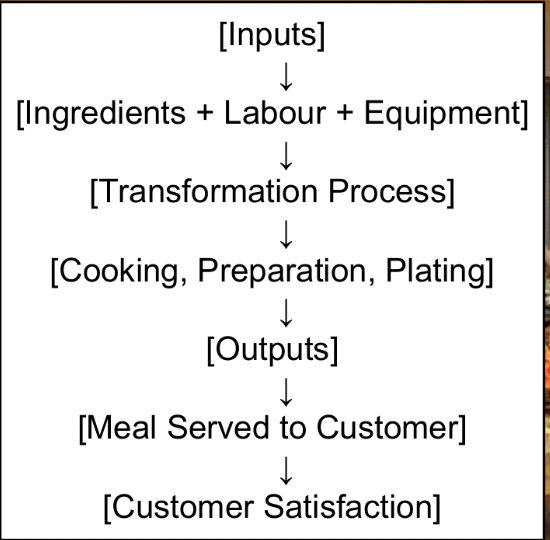
Involves transforming inputs (e.g. materials, labour, equipment) into outputs (goods or services).
All businesses must manage this transformation process to meet customer demand.
Inputs
Resources used in the process of production.
Outputs
The end result of a business's efforts - the service or product that is delivered or provided to the consumer.
Transformation process
The conversion of inputs (resources) into outputs (goods or services).
Waste minimisation
The process involving the reduction of the amount of unwanted or unusable resources produced by a business in attempt to improve the efficiency and effectiveness.
Business competitiveness
The ability of a business to sell products in a market.
Operations managers use key strategies such as:
Materials management
Quality management
Waste minimisation
Use of technology
Operations in a restaurant:
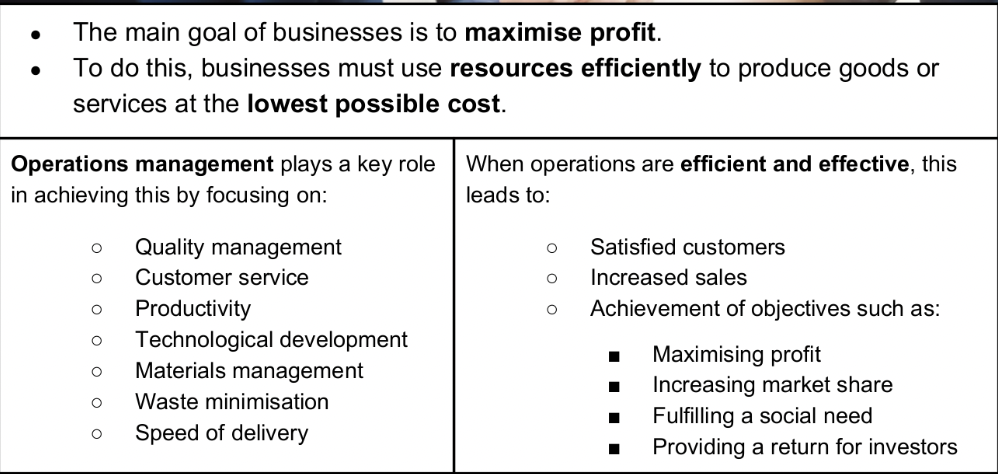
Relationship between operations and business objectives
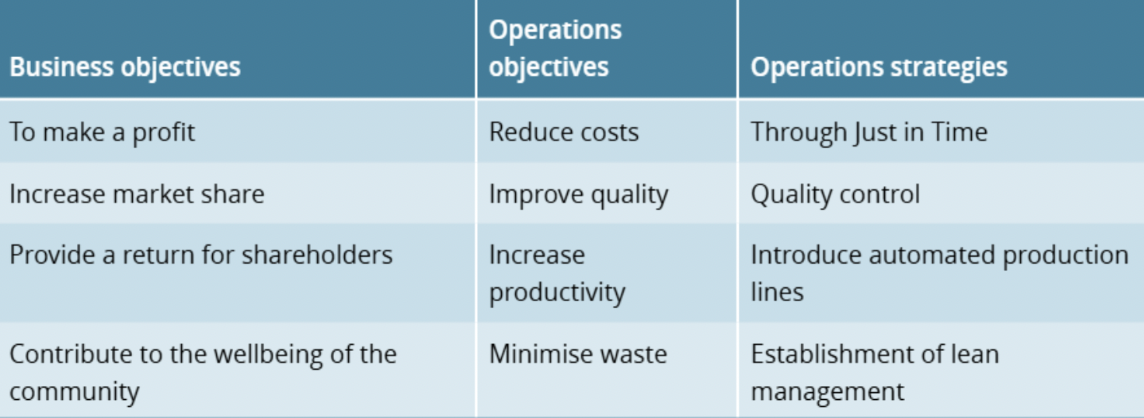
How operations objectives and strategies can support business objectives
The key elements of an operations system

These elements differ between manufacturing and service businesses.
The management of the operations system is important because it will determine how efficiently and effectively the business produces goods or services to meet the needs of customers.
Inputs
Natural resources & materials: Raw materials, components and parts consumed or converted during the transformation process. These include both things the business owns and those procured from suppliers.
Physical resources: The plant, machinery, equipment and property required to carry out operations-essential for transforming inputs into finished goods or services.
Human resources: All people involved in the operations function, from shop-floor labour to operational managers, whose skills and labour drive the transformation process.
Financial resources: The funds necessary to start, maintain and expand operations, covering capital investment, working capital and cash flow management.
Information resources: Data and knowledge from internal and external sources (e.g. market research, supplier reports) used to guide decision-making, though often not recorded as a quantifiable asset.
Time: The scheduling and efficient use of all inputs.
Effective time management and coordinating tasks from multi-year projects down to hourly production schedules, minimises costs and waste.
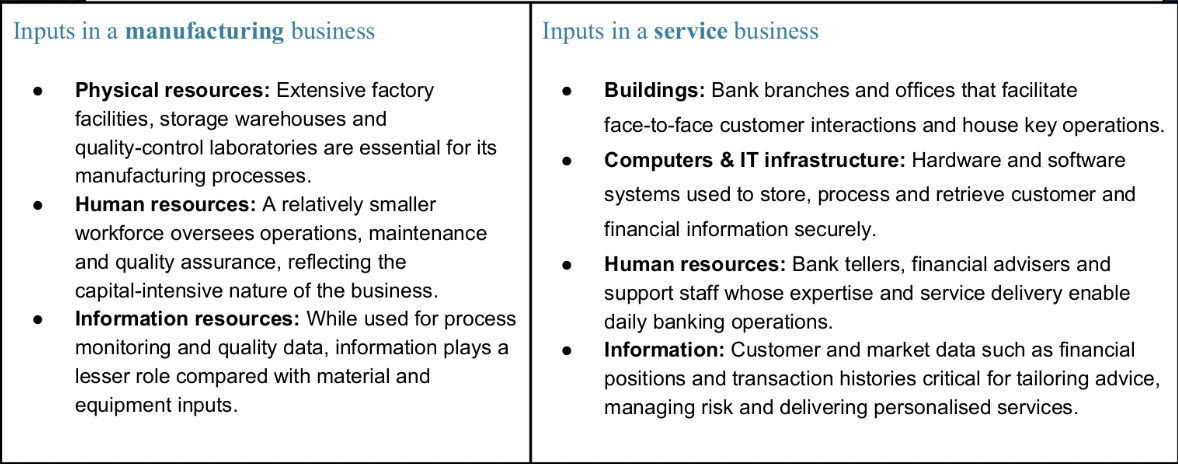
Differences between the inputs of manufacturing and service businesses
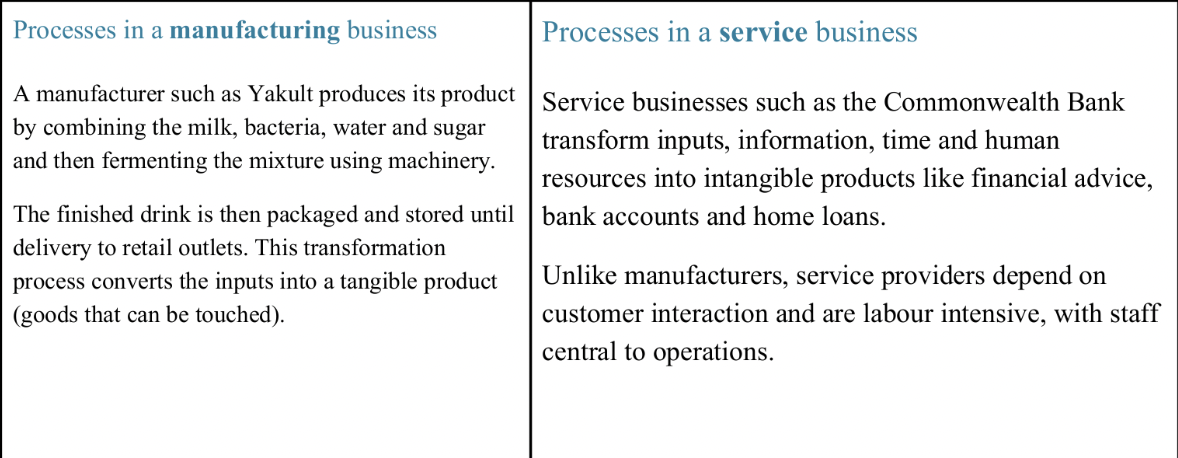
Differences between the processes of manufacturing and service businesses
Outputs in a manufacturing business vs a service business
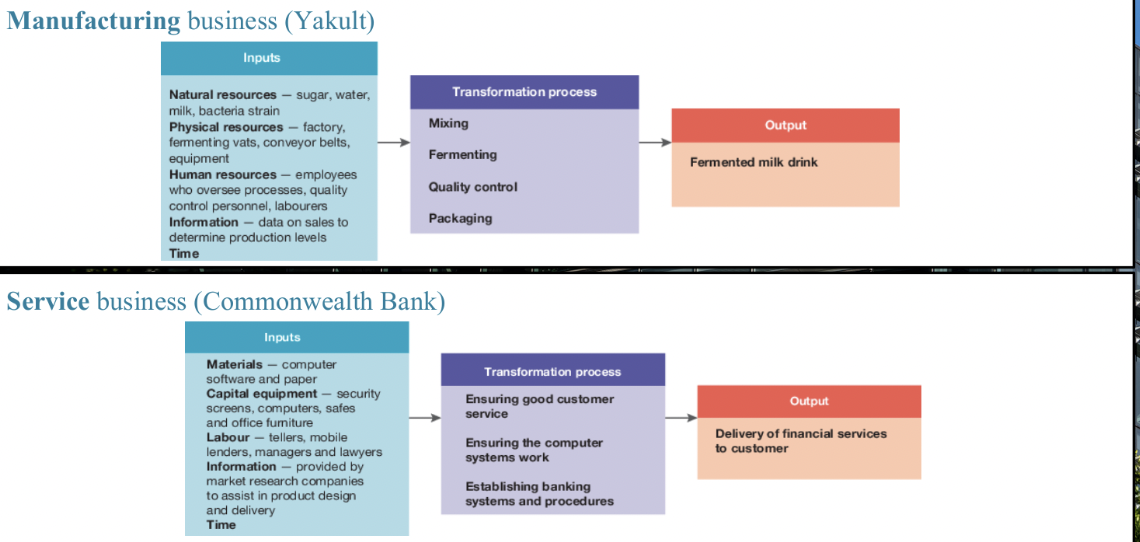
Manufacturing and service businesses
Many businesses perform both manufacturing and service operations; eg. Toyota separates vehicle production and customer service yet both are vital to success.
Roles such as actuaries in insurance companies support operations without direct customer contact by using formulas to assess risk and set premiums.
Operations managers must connect the transformation process with other areas of the business to ensure coherence and alignment.
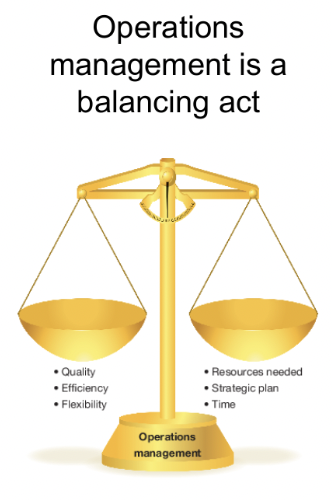
Outputs need to meet customer demand, requiring a balance between quality, efficiency and flexibility that aligns with available resources and the organisation's strategic plan.
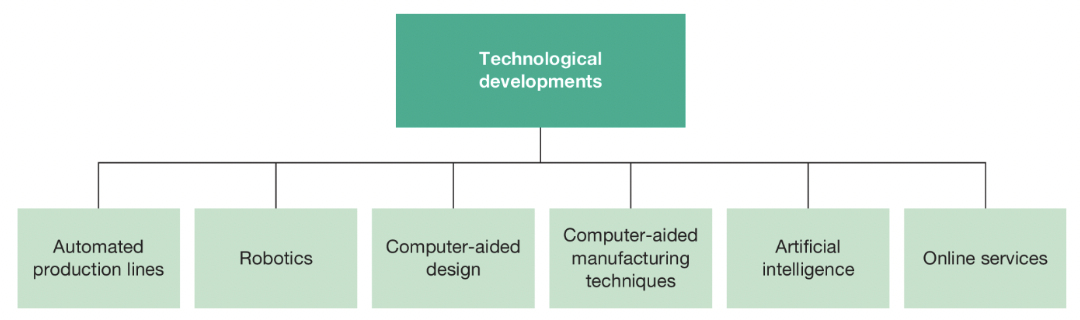
Automated production line comprises machinery and equipment arranged in a sequence with components added to a good as it proceeds through each step, with the process controlled by computers
Robotics highly specialised form of technology capable of complex tasks
Computer-aided design (CAD) a computerised design tool that allows a business to create product possibilities from a series of input parameters
Computer-aided manufacturing (CAM) the use of software to direct and control manufacturing processes
Automated production line
Comprises machinery and equipment arranged in a sequence with components added to a good as it proceeds through each step, with the process controlled by computers.
Robotics
Highly specialised form of technology capable of complex tasks.
Combines science, engineering and technology to create machines called robots.
These machines are used in specialised research and automated production lines to perform various tasks.
Robots are seen as intelligent machines that assist humans, often working continuously without needing breaks or wages, even in challenging conditions.
Computer-aided design (CAD)
A computerised design tool that allows a business to create product possibilities from a series of input parameters.
Is software used to create detailed three-dimensional models and drawings based on input data.
It allows designers and clients to visualise a product from different angles and make changes before production begins.
CAD helps estimate materials, time, and costs, and is widely used in fields such as architecture, automotive design, and fashion.
It offers speed, accuracy, and flexibility that traditional drafting methods cannot match.
Computer-aided manufacturing (CAM)
The use of software to direct and control manufacturing processes.
On the other hand, uses the data and models created in CAD to control machinery and automate the manufacturing process.
CAM systems direct tools and equipment to produce parts with precision, often with minimal human involvement.
This technology improves efficiency, reduces waste, and ensures consistent quality in production.
Together, CAD and CAM streamline the design-to-production process, saving time and resources.
6 strategies related to technological developments
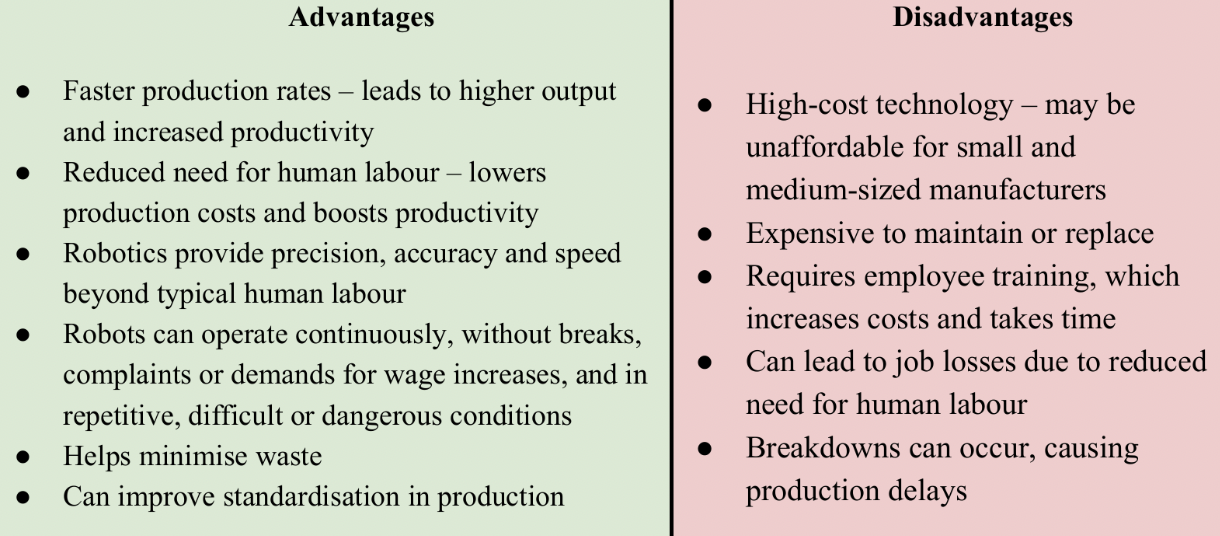
Pros and cons of Automated production lines
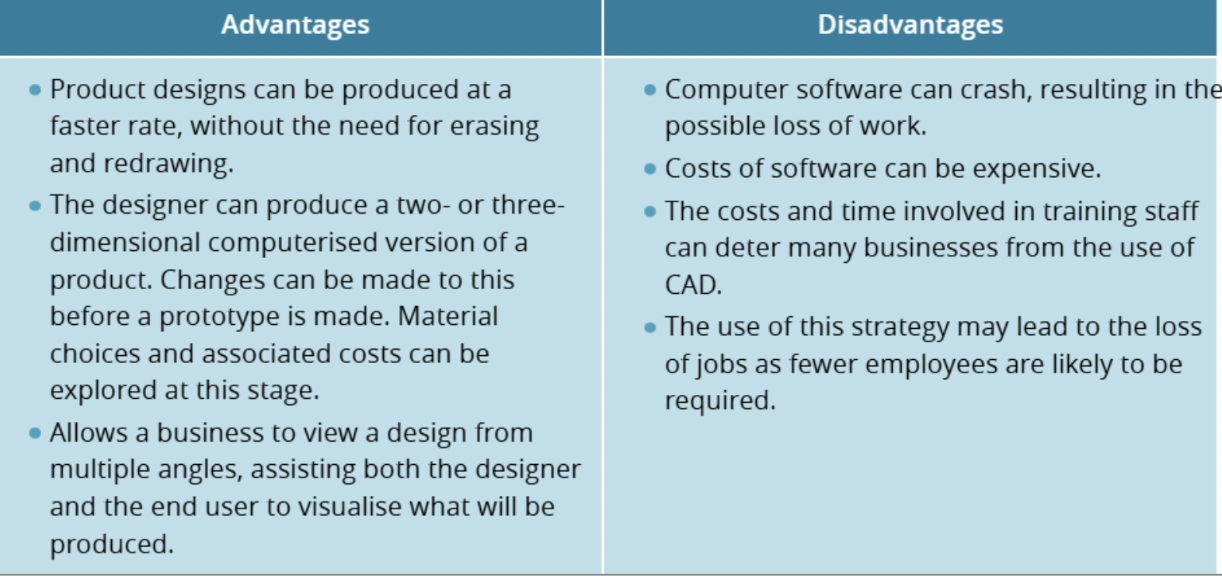
Pros and cons of CAD
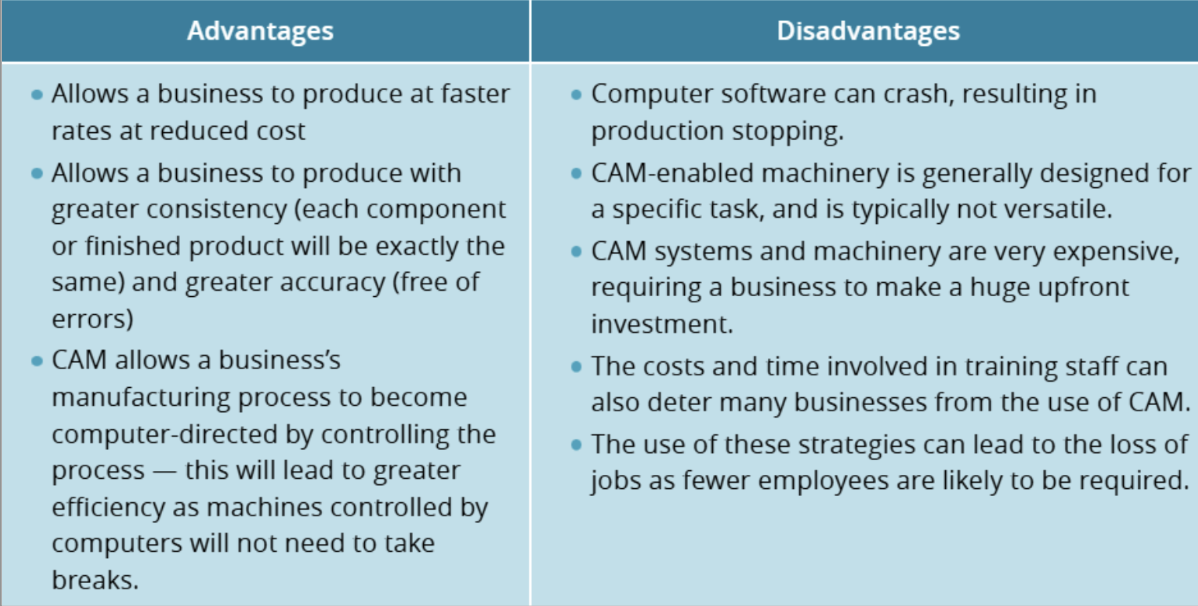
Pros and cons of CAM
Artificial Intelligence (AI)
Refers to the ability of computers or robots to perform tasks that usually require human intelligence.
Common examples include:
search engines
recommendation algorithms on platforms like Netflix and YouTube
voice recognition apps such as Siri and self-driving cars.
text editors to detect grammar errors, suggest improvements, and provide readability and plagiarism scores.
Airports also use Al-powered facial recognition to streamline the arrival process.
chatbots that mimic human conversation
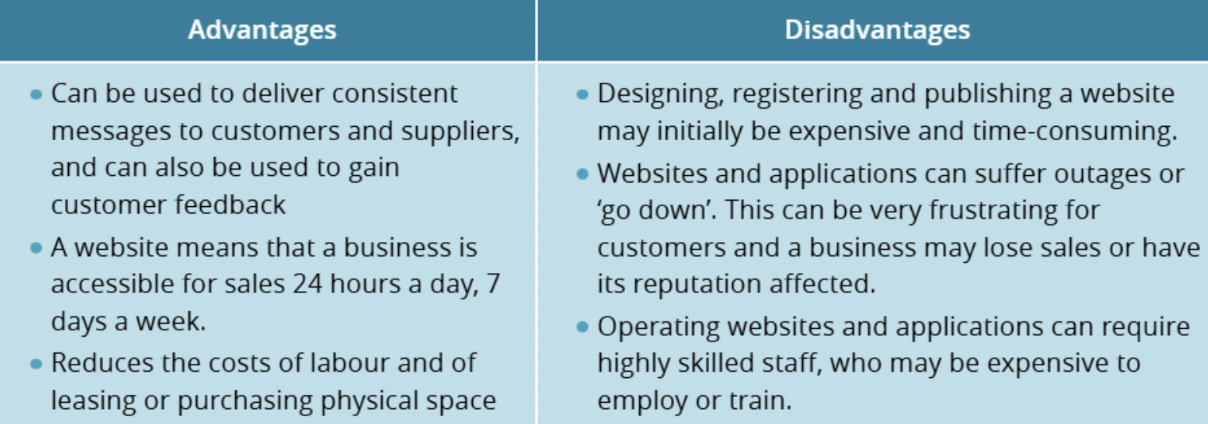
Pros and cons of online services