PSY270 Lec 10
 Call Kai
 Learn
Learn Practice Test
 Spaced Repetition
 Match
Match Flashcards
 Knowt Play
1/53

There's no tags or description
Looks like no tags are added yet.
Name | Mastery | Learn | Test | Matching | Spaced | Call with Kai |
|---|
No analytics yet
Send a link to your students to track their progress
54 Terms
Reasoning
the process used to draw conclusions and make inferences from available facts, evidence, or premises
Deductive reasoning
involves using general knowledge to reason about specific examples
valid
Drawing conclusions via deductive reasoning means that when an argument's premises are assumed to be true, the conclusion is guaranteed to be true, or ____
sound
If the premises are actually true in the real world and the argument is valid, then the argument is _______
syllogism
a deductive argument composed of a set of statements (premises) that lead to a logical conclusion
categorical syllogism
We can infer properties about one member of a broader class
Premise A (p): All deciduous trees shed their leaves annually
Premise B (q): Maples are deciduous trees
Conclusion: Therefore, maple trees shed their leaves annually
conditional syllogisms
Syllogism with two premises and a conclusion, like a categorical syllogism, but whose first premise is an "If . . . then . . ." statement.
e.g., If it rains, then the sidewalk will be wet.
Antecedent (p): If it rains...
Consequent (q): then the sidewalk will be wet
Modus ponens (p is true)
If p is true, then q MUST be true - aka affirming the antecedent
Premise 1: If it rains, then the sidewalk will be wet
Premise 2: It rained (confirms p)
Conclusion: The sidewalk is wet (confirms q)
Modus tollens (q is false)
If q is false, then p MUST be false - aka denying the consequent
Premise 1: If it rains, then the sidewalk will be wet
Premise 2: The sidewalk isn't wet (disconfirming q)
Conclusion: It didn't rain (disconfirming p)
Affirming
______________ the consequent doesn't entail the antecedent being true
Premise 1: If it rains, then the sidewalk will be wet
Premise 2: The sidewalk is wet (q)
Conclusion: It rained -> INVALID
Denying
_____________ the antecedent doesn't entail the consequent being false
Premise 1: If it rains, then the sidewalk will be wet
Premise 2: It didn't rain
Conclusion: The sidewalk isn't wet -> INVALID
Wason Selection Task
highlights how we consistently commit deductive reasoning errors (<10% of participants got it correct)
If a card has an A on one side, it has a 3 on the other
Most selected A (valid) and 3 (invalid)
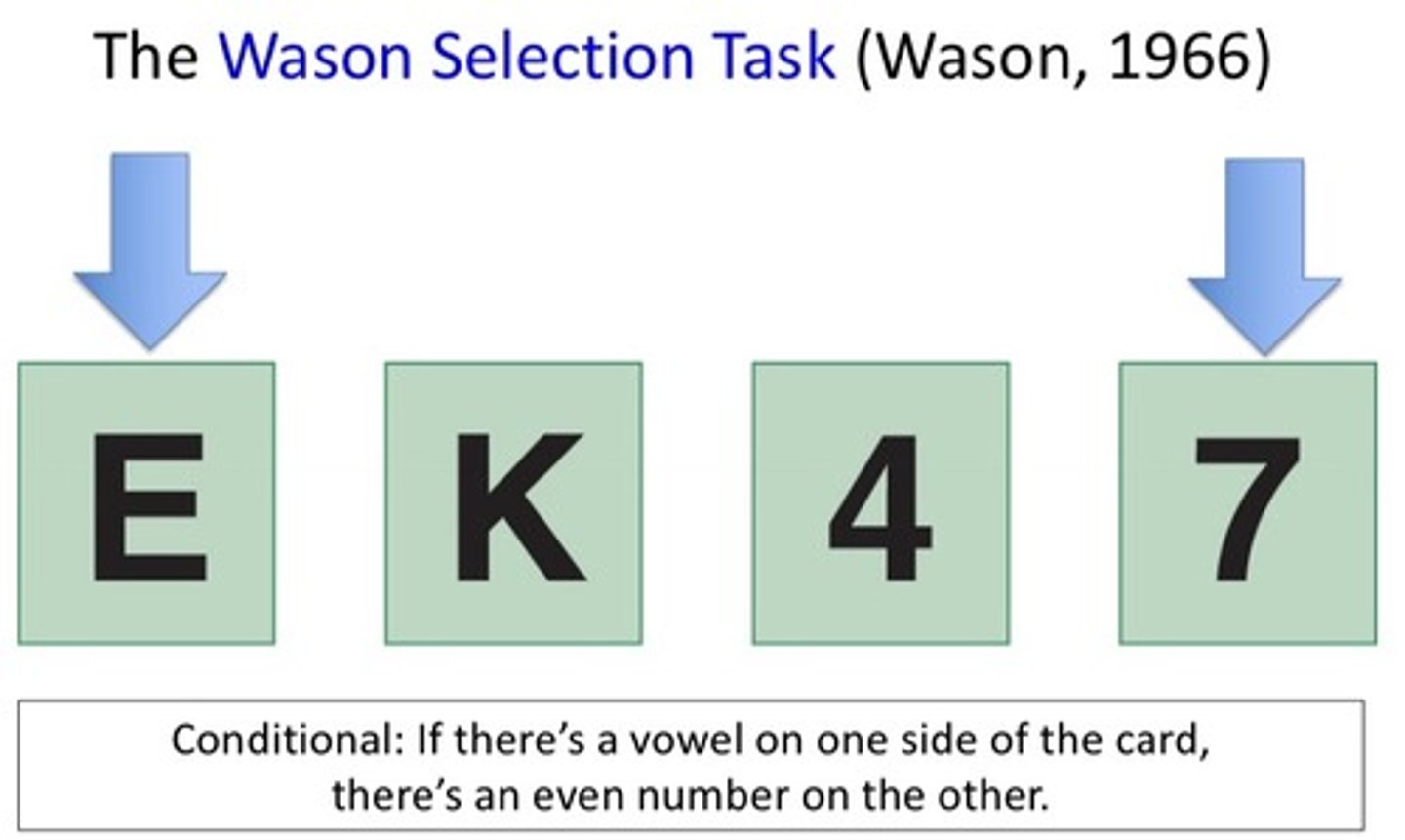
Social context version
Cosmides & Tooby (1992) reframed the task in a social context. Social contracts now give this task a concrete goal to detect the cheater, thus bypassing abstract reasoning.
If you are drinking alcohol, then you must be over 19. 75-90% of participants got it correct
Inductive reasoning
involves making generalizations about a broader group based on specific examples. The conclusions are probabilistic, meaning they are likely but not guaranteed to be true, even if the premises are correct.
strong
If the conclusion follows from the premises with high probability, it is a ________ argument
weak
If the conclusion follows from the premises with low probability, it is a _____ argument
cogent
If the premises are actually true in the real world and the argument is strong, then the argument is _______ (logical and convincing)
property induction
a form of inductive reasoning where we generalize properties from one exemplar of a category to other members of the category
(e.g., Crows have an anatomical part called slabido. Do all birds have slabido? → most likely to say yes when the exemplar is a crow)
Premise-conclusion similarity
high similarity between premise and conclusion entails a stronger argument
Premise typicality
premises that are more representative of the category lead to stronger inductions (e.g., crow vs. penguin)
premise diversity
the principle that an inductive argument is stronger when the examples come from diverse subcategories within a broader category. More varied examples suggest the property applies across the whole category, not just a narrow subgroup.
premise monotonicity
the principle that adding more premises (examples) that share a property strengthens an inductive argument, increasing confidence that the property applies to the broader category.
confirmation bias
the inclination to favour evidence in support of our beliefs, expectations, or hypotheses in the process of reasoning
Causal Reasoning
our ability to understand the relationship between a cause and effect
directionality
Causal relationships have _____________, where causes precede effects (e.g., A causes B)
(Red ball hits blue ball (A) -> Blue ball rolls away (B)
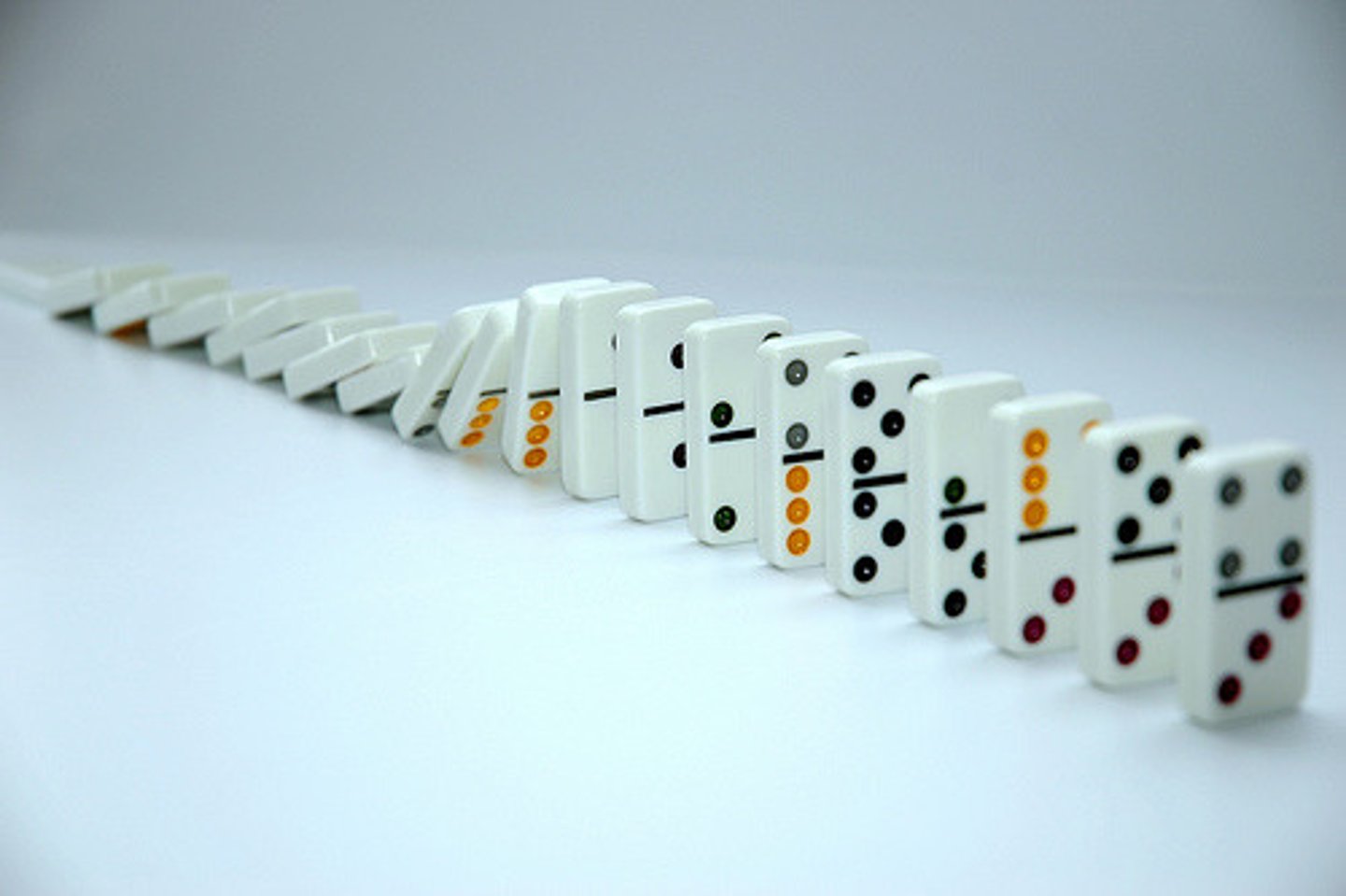
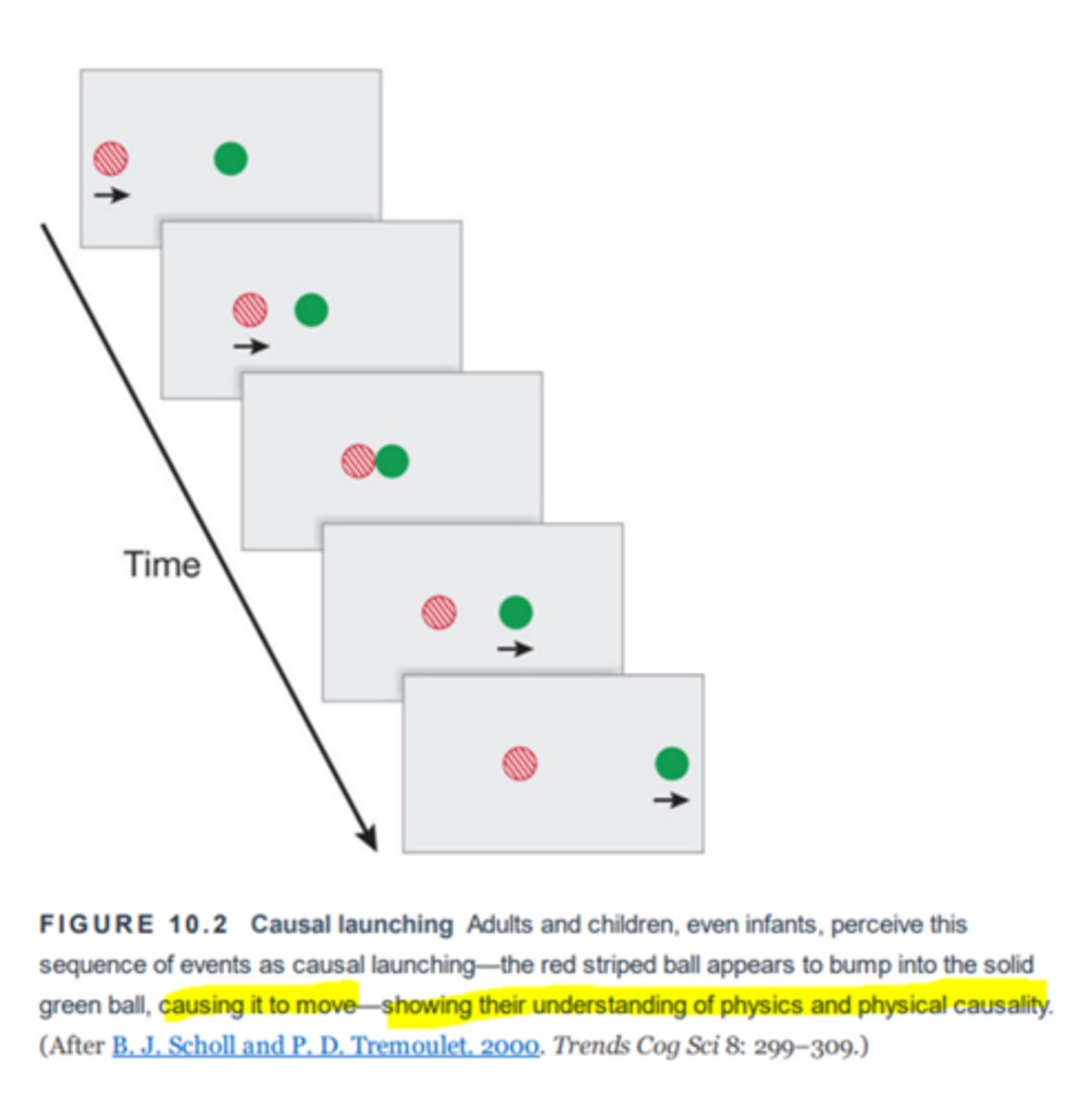
Causal launching
Causation associated with a direction
In an animated display, the perception that one moving stimulus causes a stationary one to move (or "launch") when it collides with it
Both adults and children (even infants) perceive the stills as a sequence of events demonstrating causal launching
Cause-effect relations
depict causal relationships which allows us to assign probabilistic weights to the strength of the relation
Probabilistic weight
the strength of a relation between 0 (no causal relation) and 1 (guaranteed causal relation)
causal induction
We learn cause-effect relationships through observations through ________ ____________ (inferring causal relationships) We consider many cues such as covariation, temporal order, intervention, prior knowledge
covariation
the likelihood that two events covary, or occur together
e.g., Being happy (A) -> Sleeping 7+ hours a night (B) vs. Sleeping <7 hours a night (C)
A has a higher covariation with B
Temporal Order
the arrangement of events over time. causal features are more important because earlier features are seen as the underlying basis that generates the rest of the chain, making them more essential for category membership.
e.g., Eats fruit (A) -> Has sticky feet (B) -> Builds tree nests (C)
People view A as more important than C
Intervention
considering an external independent cause to an event sequence, rather than simply observing the event sequence as is (e.g., considering weather as a factor in the relationship between ice cream sales and murder rates)
prior knowledge
our background knowledge influences how we determine the causes of events (e.g., Roosters crowing at sunrise provides covariation and temporal order cues, but we do not infer that the rooster causes the sunrise)
Illusory correlations
making connections between variables that have no relation to each other (e.g., superstition: You have a "lucky" shirt you wear for your favourite team's playoff games because you were wearing it when they won last time)
Counterfactual reasoning
we often think about alternative scenarios when trying to understand why something happened (e.g., would i have gotten the midterm questions about attention right if i attended lecture 2?)
Bayesian inference
allows us to estimate the probability of a hypothesis being true based on the evidence we have and our knowledge of the world
Bayes Theorem
The probability of an event occurring based upon other event probabilities.
P(H|E) = P(E|H) x P(H) / P(E)
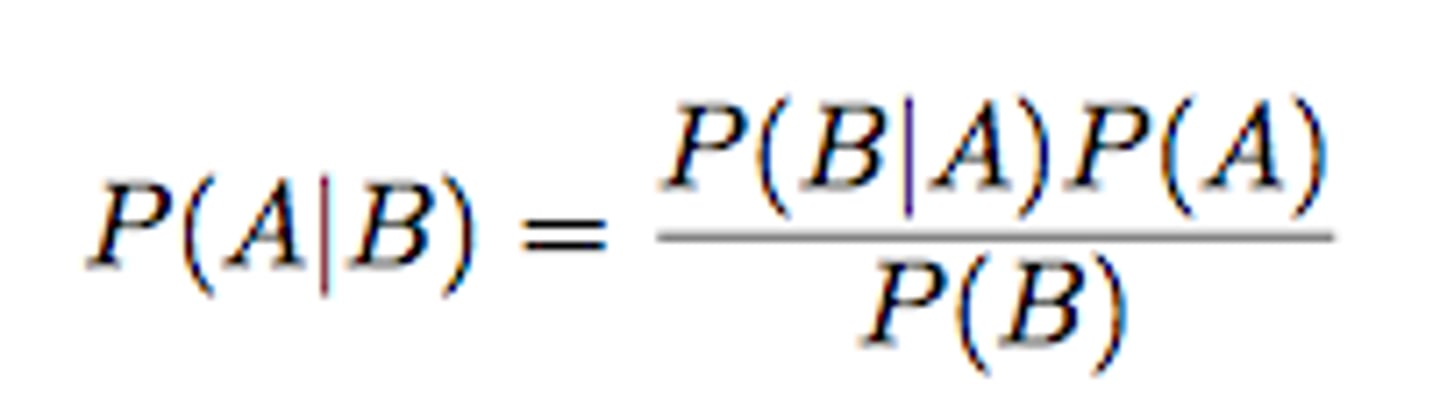
Posterior Probability
P(H|E) = the probability that a hypothesis H is true after consideration of the E evidence
likelihood
P(E|H) = if the hypothesis is true, how likely is this evidence?
Prior Probability
P(H) = How likely was this before I saw any evidence?
probability, evidence
P(E) = _________ of the ________ you have
Bayesian estimation
updating probabilities based on new evidence, combining prior beliefs with observed data to estimate the likelihood of outcomes (e.g., perception, causal reasoning, predictions like sports or disease spread).
Problem solving
concerns finding ways to obtain one's goals, whether the agent is a person, animal, or machine
goal state
where the agent wants to be
actions/operators
agent uses _______/________ to move from current to goal state
routine problems
A problem that is familiar and has a known solution (e.g., how many $20 bills in $80)
nonroutine problems
unfamiliar problems with no clear solution. the current and goal states are clear but the actions are not (e.g., how can we get more people to eat more vegetables?)
well-defined problems
contain clear, specific given/goal states and actions/operators (e.g., 1019 + 21903)
ill-defined problems do not (e.g., How can I be happier in my life?)
Insight
the process of suddenly gaining a solution to a problem, like an aha moment
Transfer
learning how to solve one problem generalizes to solving others (e.g., writing skills from one class can transfer to many others)
random trial and error
randomly selecting and applying different solutions until the problem is solved (might eventually work for a Rubik's cube, but is often unsuccessful for more complex problems)
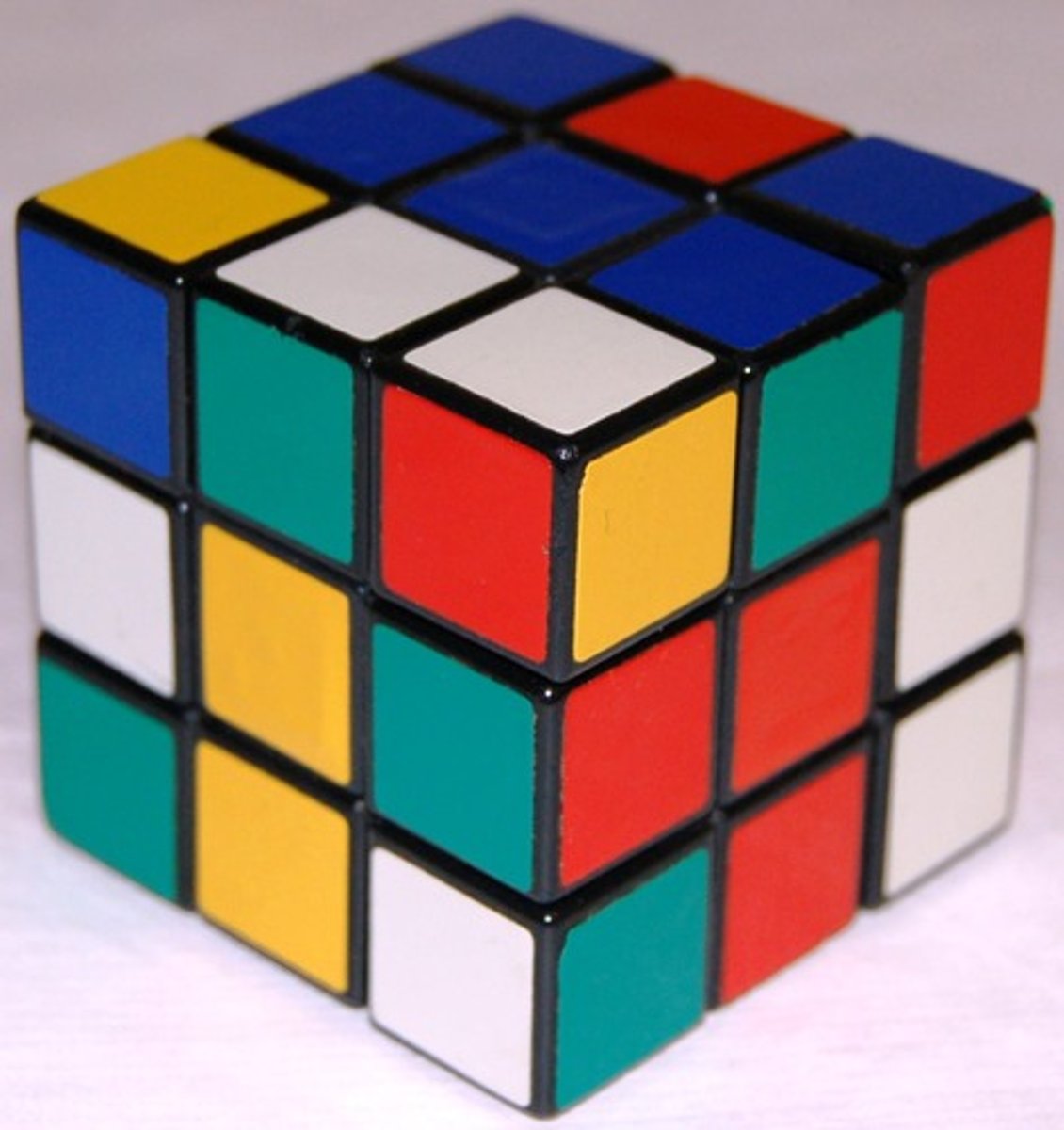
means-ends analysis
being specific about goals and subgoals to find moves that solve the problem (Ideally, you don't write a research paper in one sitting. Instead, you break it up into smaller steps: select the topic, do a literature review, write a section, and address multiple rounds of feedback at each stage)
Expert problem solving
Experts organize knowledge around deep underlying principles, allowing them to recognize meaningful patterns and solve problems efficiently. In contrast, novices focus on superficial features. Expertise is domain-specific and develops primarily through experience and practice.
Chess expertise
Shows that experts can recall real game positions better than novices because they use chunking. In random positions, experts lose this advantage because there are no patterns to chunk