FINM3406 Mid Semester Exam Study
 Call Kai
 Learn
Learn Practice Test
 Spaced Repetition
 Match
Match Flashcards
 Knowt Play
1/81

There's no tags or description
Looks like no tags are added yet.
Name | Mastery | Learn | Test | Matching | Spaced | Call with Kai |
|---|
No analytics yet
Send a link to your students to track their progress
82 Terms
Tangible vs Intangible Real Estate
TANGIBLE:
Land
+ Improvements on land
Not including fittings, plants or equipment on land
INTANGIBLE:
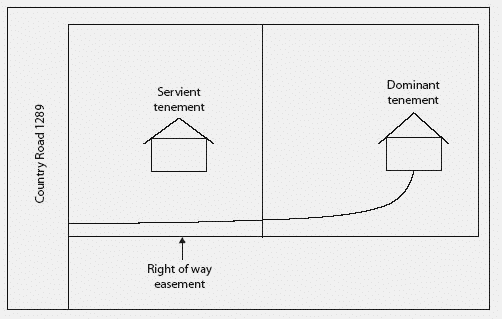
Easements
Profit-a-prendre (right to take something off land that is another persons)
*Easement
right to use another person’s land for specific purposes
driveway access, drainage utility
Bundle of Rights Theory
Ownership (private right enforceable on strangers)
Possession
Control (what is built/what happens)
Enjoyment
Exclusion
Disposal (sale/lease) / Destruction
Constraints/limits to Bundle of Rights Theory
Rights are ultimately constrained:
Government controls ( Heritage and property law, compulsory acquisition)
Common law (nuisance)
Self Imposed (Contracts, leases, mortgages)
Additional out of scope
Eminent Domain: The government has the right to acquire private property for public use, provided just compensation is paid.
Escheat: If a property owner dies without a will and heirs, the property reverts to the state
Why do we need property?
Enclosure/Delimitation of Space
Climate Barrier/Modifier
Protection/Privacy
Characteristics of Real Estate Market
heterogenous products
Immobile product: land is immovable
Localised market
Segmented market (use/size/location etc)
Private negotiations with high transaction costs (time consuming, costly, complex)
Ownership objectives for corporate property vs investment property
CORPORATE
Business base
Enabler of business (short/long term property solutions)
Infrastructure facility
INVESTMENT
ROI
Diversification (location,sector,size)
Direct
Indirect (Real estate investment trusts)
Property Sectors
Residential (houses, affordable housing, retiring)
Industrial (warehouse, factories, plants)
Commercial (CBD, various grade accomodation)
Retail (regional/subregional, shopping centres)
Leisure (hotels, theme parks)
Agricultural (farming, mining)
Infrastructure (roads, hospitals, airports)
Public vs Private Real Property
PUBLIC
Infrastructure (roads, rails)
Services (Health, defence, law, education, recreation)
PRIVATE
Corporate
Investment
Reason property decision is MORE TIME CONSUMING and COMPLEX compared to other assets
Large capital requirements
High degree of regulatory control
Uniqueness —
Timeline (long term from purchase to use)
Wasting asset —
Limited liquidity —
Management quality impacts value
Define an asset class
grouping of investments
similar characteristics
subject to same laws and regulations
made up of instruments with similar behaviour in market
Defensive Asset Classes vs Growth
DEFENSIVE
Assets which broadly held their capital value and invested in for their reliable income streams
GROWTH
invested in to provide potential capital growth
Various Asset Classes
DEFENSIVE
Fixed interest bonds
cash
commodities
futures
financial derivatives
GROWTH
property (although also wasting)
Equities (stocks/shares)
Similarities between real estate and other asset classes
Potential for appreciation
Income generation
Liquidity (not as liquid as others)
Risk and Volatility
Diversification
Use of leverage
Supply and demand
WEEK 2
2
Under the feudal system established after the norman invasion of 1066, what was the primary mechanism that allowed landowners to transfer property without requiring consent from the overlord?
Describe general nature of property
Any "thing" that can be used, enjoyed, possessed and has utility or value
Real property
Personal property
Interests in Property
"Interest" is a broad legal term used to denote a property right
Can be created by owner who pledge/encumber their property to achieve an objective without giving up full ownership
The holder of an "interest" in real estate has some right/degree of control
they may receive payment for the sale of such an interest
The interest (if evaluated) may be bought, sold, used as collateral
Intangible Real Property
Easements (the right to enter or use a section of land for a particular purpose by someone who is not the land owner)
Volumetric Sub-division
Leasehold of Airspace
"estate" defined in context of real property
All a person owns
Real estate: All real property (realty) owned as part of ones estate
Evolved, based off English Property Law:
Describes the collection of rights/interests as part of a transaction
Fee simple estate -> most complete form of ownership
Leasehold estate ->rights/interests of tenants
Types of Freehold Estates
1) FEE SIMPLE ABSOLUTE POSSESSION
Holder of fee simple estate able to:
divide fee into lesser estates
buy, sell, borrow against
subject to state laws which property is located
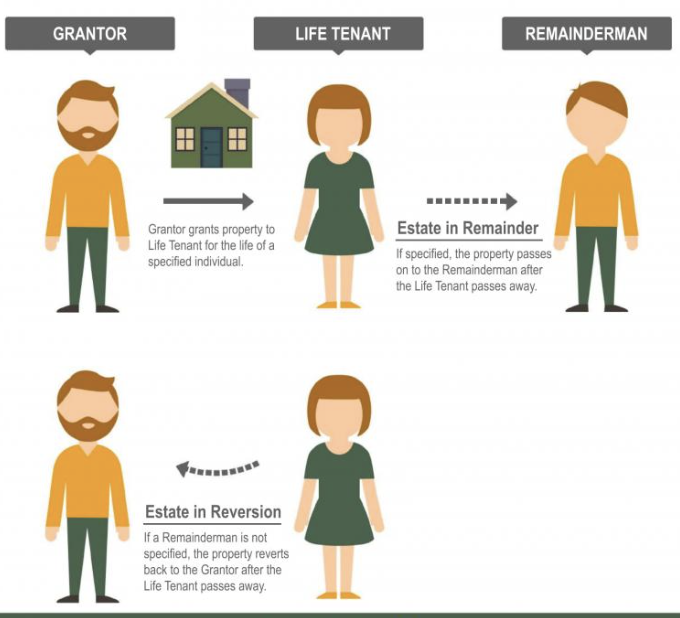
2) LIFE ESTATE:
Freehold estate lasting only as long as life of owner of estate or life of other defined person
Parties to a Life Estate
Grantor: person who creates life estate
Life tenant (grantee): a person receiving a life estate in their possession for remainder of life — they can sell their possession but will be reverted back to remainderman after grantee passes
Remainderman: person who has a future interest in the estate specified by grantor.
Leasehold
Crown leases: State grant of leasehold tenure
Private leases: From an owner of fee simple
Types of leasehold tenure:
Tenant for a term (specific tenancies, periodic tenancies)
Tenant at will (outgoing until immediate termination from either party)
Tenant at sufferance (one who comes in with right and holds over without right, bound by terms of previous lease)
Differences between Freehold Estates vs Leasehold Estates
Distinguished off the definiteness or certainty of duration
Freehold Estate: Lasts for an indefinite period, allowing the owner to hold the property without a set expiration date. This type of estate provides the owner with full control over the property rights and the ability to transfer or bequeath the property to heirs.
Leasehold Estate: Has a definite end date, determined by the lease agreement. The lessee holds the right to use and possess the property for the duration specified in the lease, after which the rights revert back to the lessor (the property owner).
Ownership Connotation:
Freehold connotes ownership of property by estate holder
Reversion vs Remainder (LIFE ESTATE)
Both examples of a future estate
Reversion: holder of estate (grantor) conveys to a grantee a present estate in the property
has fewer ownership rights than the grantor's own estate
and grantor/grantor's heir retain right to take back in future the full estate once held by grantor
Remainder: rather than go back to grantor, the future estate will go to a third person
Doctrine of Tenure
Individuals or groups that own land hold it by way of grant from the crown (state)
Land ownership is hierarchical: monarch ultimate owner of land, landowners hold by way of tenure meaning they have certain rights and obligation attached to ownership (taxes, military service)
Doctrine of Tenure applicable in Australia
Crown in Australia only have radical title due to Native Title
Granting of land by the State is held by States not commonwealth
Provides legal framework for ownership and use of land
Provides a mechanism for spatial allocation of land:
one parcel of land comes from State to grantee
Grantee can grant to someone else, so on
Can be contrasted with doctrine of estates (temporal allocation of land tenure)
3 Sources of Rights and Obligations under a lease
Written contract (primary source)
Part 8 of Property Law Act:
Tenants obligation to pay rent, keep in repair
Landlord's right to enter
Common Law:
Tenant right: quiet enjoyment
Landlord obligation: Non-derogation of grant
Lease vs License
Lease creates both property and contractual rights
License creates only contractual rights
Lessee's rights to use of property can be enforced against world
Licensee's rights in relation to use of property can only be enforced against licensor
Lessees can assign lease to third party (subject to provision)
License cannot be assigned (unless associated with lease)
Lease grants exclusive possession of a premises
License non-exclusive
Impacts security of tenure if you need to occupy a property and makes your income stream as an investment less secure.
Lease > License
Sources of Risk
Market Risk:
Drop in Demand
Oversupply
Unexpected inflation
Financial Risk:
Interest rates
Renewal terms
Insolvency
Property Risk:
Locality
Building
Tenants
Systematic risk vs Unsystematic risk
SYSTEMATIC (beta)
Variance attributable to the market and influences all assets
Cannot be diversified in away
UNSYSTEMATIC
Asset/firm specific risk
Unrelated to market
Diversification is key
Wholesale Investor Types
Sophisticated Investor:
Sufficient knowledge and experience in investment opportunities
Net assets of atleast 2.5M
Gross income of atleast 250k for each of last 2 FY
Professional Investor:
Australian financial services licensee
a body regulated by APRA outside of super
body registered under financial corps act
Trustees of super funds with over 10M
Wholesale Funds
20-50 investors
$500K min investment
Diversify with 10+ Assets
Open ended
Gearing:
0-30% for "core" funds
Wholesale unlisted trust funds are aimed at institutional investors
Predominantly AU super funds
High net worth individuals
Specific strategy takes 2 forms:
Open ended vehicles (no fixed life, target core real estate assets, industrial, retail, office)
Closed- end fixed life vehicles (higher risk , value added opportunities or development projects)
Clubs/Mandates Overview
Clubs: Less than 5 investors
Mandates: 1 investor
Typical Investor:
large super funds
insurance companies
international institutions
$50M min investment
Diversify through 5+ Assets usually strategy specific
Term: opportunity specific
Gearing: opportunity specific (usually zero or low)
More hands on and tailored to investor
Syndicates Overview
Size: $5-$50M
100+ Investors
Typical Investors: Private investors, SMSF
'
$1K-10K min investment
Diversification ranges from 1-10+ assets
Fixed term (5-7 years)
Gearing: 40-60%
Investors hold their interest until property is sold or rolled over
Repetitive process:
identify opportunity
negotiate structure and investment
purchase building
raise debt and pool investor equity
":CORE" Fund investment strategies
Primarily invest in:
stablised existing properties
current cash flows
low vacancy
located in major areas
Wide variety of property types
Use limited leverage- low risk
CORE plus
minor component of "CORE"
core assets in need of minor improvements
B property in A location
core property that includes undeveloped land
Value Add: Fund investment strategy
More risk by investing in properties:
carry current vacancy
upcoming major tenant roll overs
in need of renovations
Funds create value through renovating and leasing up property
Use more leverage
Opportunistic: Investment strategy
Take on high risk by doing ground up development projects
Exposing fund to construction risks:
entitlements
construction delays
cost overruns
High financial leverage
Less diversified and focus in on certain geographic areas/property types
Purchase distress property assets
Investment Management fees
Acquisition fees (% of cost)
Disposition fees (when asset is sold)
Performance fees (paid to fund managers when returns exceed "hurdle rate of return")
Management fees
(charged to the investor for entire term of fund
(Core funds charge base fees on equity capital
(Expressed annually as a %
Management fees calculated off:
invested capital
% cash flow distributions
project revenues
project costs
A-REITS (Australian Real Estate Investment Trusts)
Generate wealth in 2 ways:
-capital growth on property assets trust owns
-rental income
Fund manager is responsible for everything
Make up one of the largest sectors on the ASX
Pros and Cons of investing A-REITS
BENEFITS
-Exposure to high quality assets
-Diversification
-High yielding
-Liquidity
-Management efficiency and quality
-Low transaction cost (avoid stamp duty)
NEGATIVES
-Volatility
-Fee leakage
Australian REIT characteristics
LEGAL
-Must be registered as a Managed Investment Scheme
CAPITAL REQ
-No cap req if listed on ASX
-Cap req for a manager
LISTING
-Can be listed or unlisted
No investment restrictions
No restrictions on foreign assets
DISTRIBUTION REQ
-undistributed income on gains taxed at 46.5%
-full distribution on income and gains by REITS
REIT Distributions
-Distribute 90-100% of earnings
-No franking credits, income is not taxed at trust
-Taxed at individual income tax rate
-include a tax deferred component (represents return of capital rather than income)
-manager can decide if payments to investors are income or capital collected
Stapled vs Externally Managed (A-REIT Forms)
STAPLED (ACTIVE)
-consist of one trust unit and one share in the fund management company
-stapled, meaning cannot be traded separately
-Trust holds assets, company carries out funds management functions
-company and trust valued seperately
-company valued on EBITDA
EXTERNALLY MANAGED (PASSIVE)
-Management taken on by seperate entity to trust
-slowly collapsing
-often conflicts of interest between trust and company
-Can provide better resourcing and management services
Modern Portfolio Theory (MPT)
MPT assumes investors are risk averse:
-Investors will choose investment with lower risk
-Investors will accept higher risk if there is higher return
Total (accumulation) Return
Accounts for two categories ( income and capital)
-Income: interest paid by fixed income investments, distribution dividends, or net income of direct property
-Capital return: Change in market price of asset
Capital Return
Cap Return = (Current Price - Initial Price / Initial) x100
Income Return
Income Return = (Net Income over period held / Cap Value at beginning of period) x100
Total Return
Capital and Income Return over Cap Value at beginning period
True return to the investor of their money
Initial Yield
Income yield for the asset
Ratio of current passing rent to the current property value
IY= Passing rent/ Property Value
Reversionary Yield
market yield for the asset
Ratio of market rent to the current property value
RY= Market rent/ property value
Asset Yield vs Asset Return
Yield does not take into account capital loss/gain
Return gives a clear financial position indicator to investor
Yield used to indicate market value of investment
Return is used to compare financial attractiveness of different investments
Portfolio Returns
Weighted average of expected returns from each asset in portfolio
Acquisition Process
1st step: Initial Review of an asset
Purpose of Due Diligence Provess
4-6 weeks
Allows for detailed analysis of financial, legal and technical review of asset
Divestment Criteria
Reposition of fund
Cyclical Play (buy low, sell high)
Closed end fund (divest of asset at end of fund)
Cap requirements
Disposal Process
1st: Internal Approvals
WEEK 4
4
Aim and Importance of Real Estate Valuation
To establish and accurate and reliable assessment on the value of the bundle of rights that a person has in a property
Why is it important?
Buying or selling property
Financing
Property tax assessment
Insurance
Annual Reporting
property valuer
Will evaluate property as at date they were asked to assess it
Do not give predictions of future pricing, only present or past
Value is property valuer's opinion
The valuation report
Include:
Certificate of Valuation
Outline of primary method of valuation
Detailed description of any sales evidence relied upon
Outline of any assumptions/ limitations
Most comprehensive part is usually about the subject property:
includes land, location, zoning, title, condition etc
Land Value Components
Comprises:
Private benefit infrastructure, services individual properties paid for by local gov (e.g roads, parks, sewerage)
Social infrastructure paid for by gov through tax (schools, hospitals, public transport)
Urban externalities
Impacted by external factors:
Betterment: capitalised value of urban externalities and social infrastructure
Blight: infrastructure development or planning policy decisions that diminish land value
Real Estate as an "inelastic asset"
Scare and limited resource
long lead time to increase supply to respond to increased demand
changes in price don't always have direct impact on supply or demand
Real estate market as "imperfect market"
Information asymmetry
High transaction costs
Limited competition (zoning restrictions and availability of infrastructure)
Emotional factors
Price paid for real estate may not be its true market value
Different Types of Values
FAIR MARKET VALUE
price a willing buyer will pay a willing seller in a transaction in an open market
LIQUIDATION VALUE
takes into account the costs of getting property in condition to sell as well as disposal activity
Determined under two conditions:
(orderly transaction with a typical marketing period
(forced transaction with shortened marketing period
MARKET VALUE
Estimated amount for which an asset should exchange on valuation date in an arm's length transaction after proper marketing
EXISTING USE VALUE
Current way an asset is being used
May be the highest/best use
tends to be for specialised properties with limited market and used for financial reporting (e.g plants, mills, roads, airports)
STATUTORY VALUATION
Assessment of notional "unimproved" value to assess rates and land tax
Compulsory acquisition compensation assessments
Steps to conduct a valuation
1 - Define the Problem (everything being valued)
2- Determine most probable use (highest and best use?)
3- Define most probable buyer (Likely buyers and behaviour)
4- Select valuation Method (how its likely to be valued, e.g acitivity, income cost etc.)
5- Review/Adjust for external factors (accurate property and market data)
6- Value Conclusion and Limiting Conditions (Final estimate with assumption and limitations defined)
Direct Comparison Method of Valuation
Simplest
Used when evidence is comparable enough to allow direct comparison
most popular in non income producing properties
Challenge is adjusting for items not comparable
Summation Method of Valuation
Collation of value through addition of components of property
(e.g land, building, other improvements)
Used mainly as a check method
Land valued as if it was vacant
Building and improvements is their added value to land
Before and After Method of Valuation
Used to assess compensation in compulsory acquisition/easement
the difference in value before and after the imposition
Requires two seperate valuations
Can also be used in sub-dividing properties
Hypothetical Development Method of Valuation
Used for under-developed land with potential for development:
highest and best use as development site
Method starts at end and works backwards
Suitable only for single phase development
Hypothetical Calc:
Value of finished product = land value+development costs+finance costs+profit
Discounted Cash Flow Method of Valuation
Present Value of future cash flows
based on subjective assumptions
allows cash flow flexibility
for complex and variable income properties
dangerous due to lots of assumptions
Units of Production Method of Valuation
Common for rural properties
Carrying capacity, best area value
Applied to specialised commercial properties
room rate in hotel
hotel liquor consumption
Capitalisation Method of Valuation
Used for investment class properties (widely accepted for estimation of market value)
Future sustainable annual net income of property is converted to a value by a market derived multiplier
Assumption that level of income will remain constant in perpetuity
Capitalisation Rate Overview
Also referred to as yield or "all risk rate"
Represents all current and future expectations to be derived from a property
Can be used as a benchmark for the comparison of investments
BENEFITS: simple to use and easy to compare with other assets
CHALLENGES: integrity/ availability of market data to derive rate
Capitalisation Method Calculation Process
CV= Net Annual Sustainable Income / cap rate
Valuer needs to establish:
open market rental rate applicable to property
cap rate through recent sales evidence
Cap Rate relationship with Years purchase
Years purchase is the reciprocal of cap rate
1/cap rate = Years purchase
Property Income
Net Rent:
Gross rent payable less outgoings incurred
Leasee will pay additional sum for outgoings specified in lease
Some costs are responsible of owner (land tax, capital costs)
Establishing Annual Net Sustainable Income
Critical examination of lease documents to establish the passing rental rates
Compare those rates to that market rent applicable if being let at time of valuation
Market rental considered as potential/future sustainable income and is this rental used to calculate net income
Valuer must also capture potential other income property is capable of producing (e.g parking, naming rights etc.)
Establishing the Cap Rate
Through analysis of comparable recently sold properties
If 2 of 3 factors of the basic capitalisation formula are known, the third can be calculated (CV=NI/i)->(i=NI/CV)
Therefore, if sale amount (CV) or Net operating income (NI) is known for comparables, cap value (i) can be calculated
Shortcomings of capitalisation method
DATA ERRORS (much data for comparables are confidential, highly sensitive to data errors)
RELIABILITY OF INFO (limited scope of truly reliable info from valuer/colleagues, other available data may come from buildings with different age, condition, location etc.)
ASSUMPTION OF SUSTAINABLE NET INCOME (assumes income level will "settle down" in perpetuity)
SELECTION OF CAP RATE (minor error in process has major impact)
What is WALE?
Weighted Average Lease Expiry
measures the average time remaining on leases in a property or portfolio, weighted by rental income or area.
A higher WALE indicates lower vacancy risk, stable cash flow, and higher valuation. — Preferred
For investors, landlords, and lenders to assess income security