Physiology lecture 25

0.0(0)
Studied by 0 people
call kaiCall Kai
learnLearn
examPractice Test
spaced repetitionSpaced Repetition
heart puzzleMatch
flashcardsFlashcards
GameKnowt Play
Card Sorting

1/28

flashcard set

Earn XP

Description and Tags

Hearing and the ear

Last updated 8:50 AM on 5/1/26
Name
Mastery
Learn
Test
Matching
Spaced
Call with Kai

No analytics yet

Send a link to your students to track their progress

29 Terms

1
New cards

LOs

  • Explain the basic concepts of sound​

  • Describe the role of the outer and middle ears in hearing ​

  • Describe the organisation of the cochlea​

  • Explain how sound frequencies are analysed on the basilar membrane​

  • Describe the roles of inner and outer hair cells in sound transduction

2
New cards

Why is hearing important?​

  • Early warning system

  • 360 degree coverage​

  • Works at a distance​

  • No line of sight needed​

  • Information

  • Environment sounds - knowledge of world around us​

  • Sophisticated means communication in humans and animals​

  • Speech - most highly developed form​

  • Music - originally perhaps form of social cohesion

3
New cards

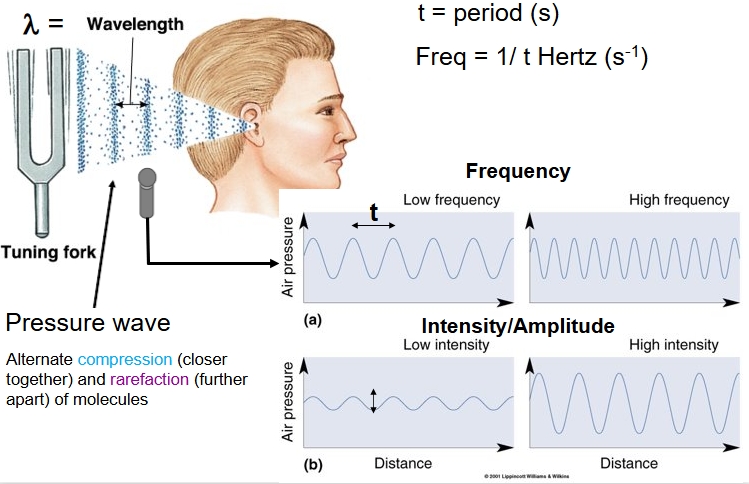
What is sound and what is it defined by?

  • Longitudinal pressure wave travelling through air or other

  • Defined by​:

  • Frequency

  • Pitch (Tone) of sound​

  • measured in Hertz (Hz) = cycles per second​

  • Amplitude (intensity)

  • Loudness​

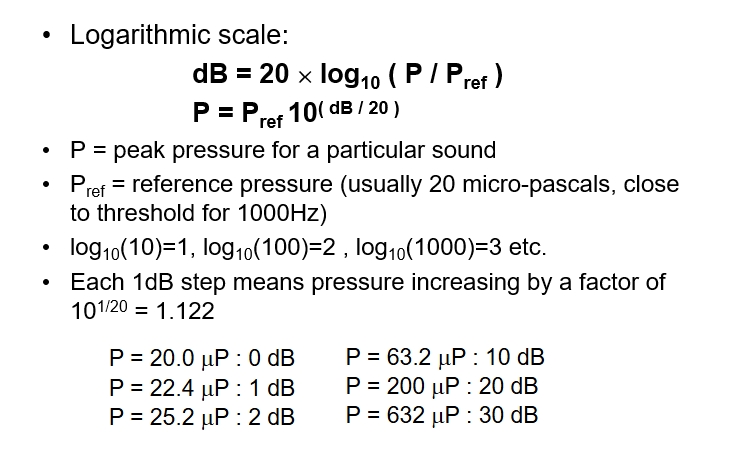
  • Measured in dB (deciBels)​

  • log scale – to better match perception medium​

4
New cards

Sound frequency and intensity (i.e., amplitude)​

t = period (s)​

Freq = 1/ t Hertz (s-1)​

<p><span style="line-height: 0px;">t = period (s)​</span></p><p><span style="line-height: 0px;">Freq = 1/ t Hertz (s</span><span style="background-color: inherit; line-height: 0px;">-1</span><span style="line-height: 0px;">)​</span></p>
5
New cards

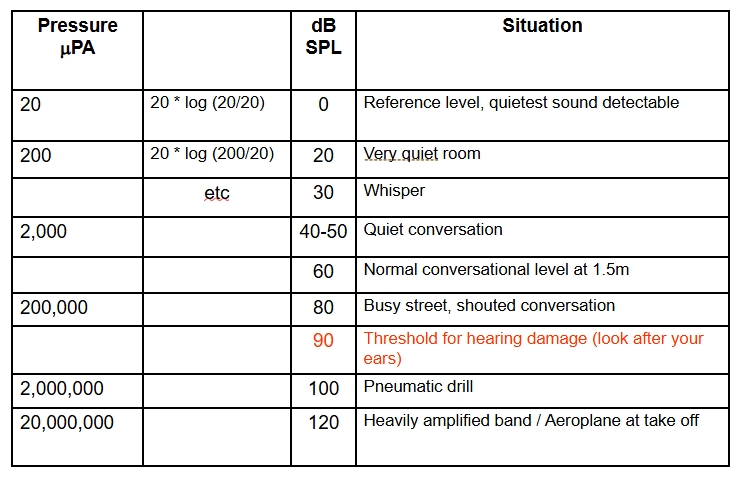
Sound levels in common situations​

knowt flashcard image
6
New cards

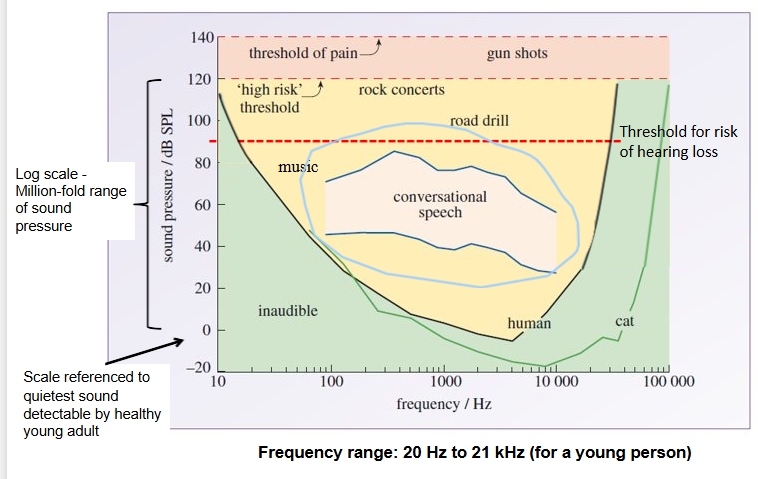
Human hearing: range of sound frequency and level​

knowt flashcard image
7
New cards

The ear​

three parts - outer, middle, inner

all have diff functions
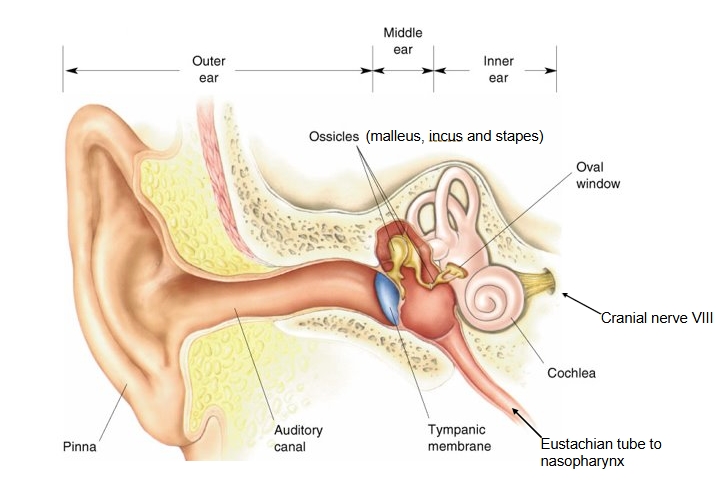
<p>three parts - outer, middle, inner </p><p>all have diff functions</p>
8
New cards

The outer ear​

  • Pinna​

  • not (significantly) mobile in humans​

  • In other species, sound gathered by orientation towards source​

  • Externalisation of sounds​

  • Listen without pinna, e.g. over headphones​

  • Sound perceived inside the head​

  • Localisation of sounds in vertical plane​

  • Sounds waves interfere on surface of pinna​

  • Acoustic gain (amplification of sound) due to ear canal resonance (28mm in length)​

  • 10 to 15 dB amplification for 1.5 kHz to 7 kHz

9
New cards

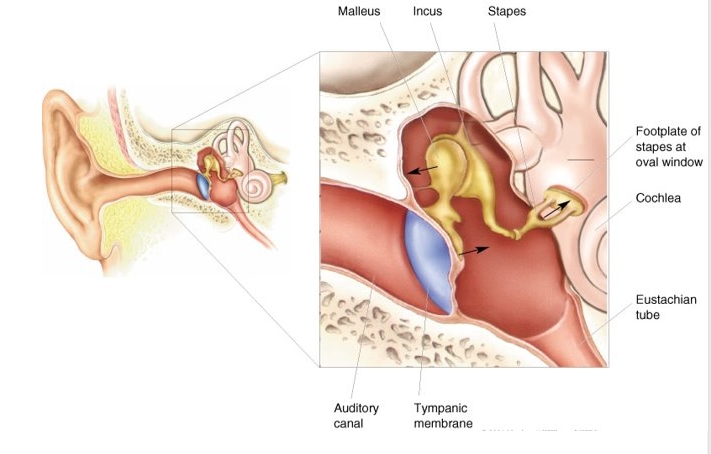
The middle ear​

  • Middle ear – air filled space​

  • Need equal pressure either side of tympanic membrane​

  • Air travel, diving, blocked Eustachian tube​

  • Consequences of unequal pressure across tympanic membrane, hearing is impaired

Contain three bones

Movement via sound waves affects the liquid inner ear
<ul><li><p class="Paragraph WhiteSpaceCollapse SCXP85009579 BCX8" style="text-align: left;"><span style="line-height: 0px;">Middle ear – air filled space​</span></p></li><li><p class="Paragraph WhiteSpaceCollapse SCXP85009579 BCX8" style="text-align: left;"><span style="line-height: 0px;">Need equal pressure either side of tympanic membrane​</span></p></li><li><p class="Paragraph WhiteSpaceCollapse SCXP85009579 BCX8" style="text-align: left;"><span style="line-height: 0px;">Air travel, diving, blocked Eustachian tube​</span></p></li><li><p class="Paragraph WhiteSpaceCollapse SCXP85009579 BCX8" style="text-align: left;"><span style="line-height: 0px;">Consequences of unequal pressure across tympanic membrane, hearing is impaired</span></p></li></ul><p>Contain three bones </p><p>Movement via sound waves affects the liquid inner ear</p>
10
New cards


Why we need a middle ear​?

  • Problem of transferring energy from one medium to another​

  • Sound waves travelling from air to water mostly reflected​

  • Inner ear is fluid filled​

  • Without middle ear, poor transfer​ of energy from air to cochlear fluid​

  • Middle ear is impedance transformer​

  • Fish don’t have an outer or middle ear!
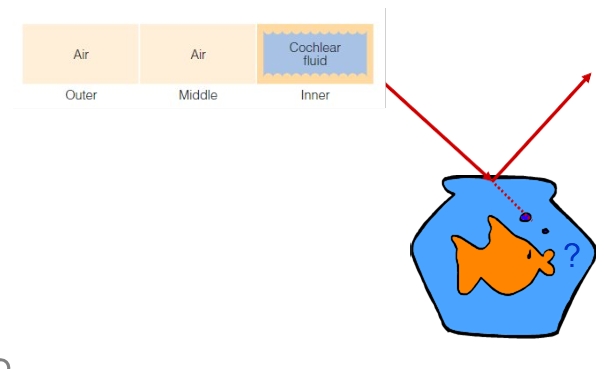
<ul><li><p class="Paragraph WhiteSpaceCollapse SCXP233400238 BCX8" style="text-align: left;"><span style="line-height: 0px;">Problem of transferring energy from one medium to another​</span></p></li><li><p class="Paragraph WhiteSpaceCollapse SCXP233400238 BCX8" style="text-align: left;"><span style="line-height: 0px;">Sound waves travelling from air to water mostly reflected​</span></p></li></ul><ul><li><p class="Paragraph WhiteSpaceCollapse SCXP233400238 BCX8" style="text-align: left;"><span style="line-height: 0px;">Inner ear is fluid filled​</span></p></li></ul><ul><li><p class="Paragraph WhiteSpaceCollapse SCXP233400238 BCX8" style="text-align: left;"><span style="line-height: 0px;">Without middle ear, poor transfer​ of energy from air to cochlear fluid​</span></p></li></ul><ul><li><p class="Paragraph WhiteSpaceCollapse SCXP233400238 BCX8" style="text-align: left;"><span style="line-height: 0px;">Middle ear is impedance transformer​</span></p></li><li><p class="Paragraph WhiteSpaceCollapse SCXP233400238 BCX8" style="text-align: left;"><span style="line-height: 0px;">Fish don’t have an outer or middle ear!</span></p></li></ul><p></p>
11
New cards

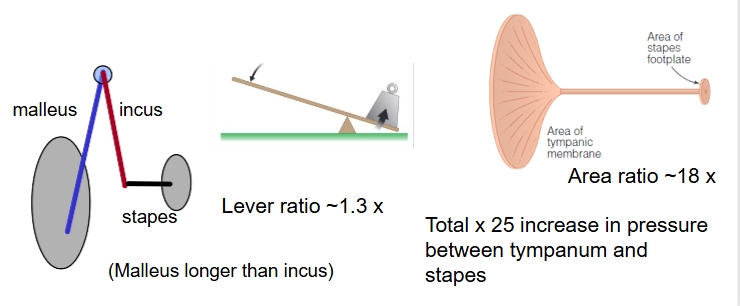
Function of the middle ear​

  • Middle ear overcomes air - fluid mismatch​

  • Area of tympanic membrane greater than footplate of the stapes​

  • Force on tympanic membrane acts over smaller area of stapes footplate​

  • (increases the pressure = force/surface area)​

  • Ossicles also act as levers

<ul><li><p class="Paragraph WhiteSpaceCollapse SCXP151230838 BCX8" style="text-align: left;"><span style="line-height: 0px;">Middle ear overcomes air - fluid mismatch​</span></p></li><li><p class="Paragraph WhiteSpaceCollapse SCXP151230838 BCX8" style="text-align: left;"><span style="line-height: 0px;">Area of tympanic membrane greater than footplate of the stapes​</span></p></li><li><p class="Paragraph WhiteSpaceCollapse SCXP151230838 BCX8" style="text-align: left;"><span style="line-height: 0px;">Force on tympanic membrane acts over smaller area of stapes footplate​</span></p></li><li><p class="Paragraph WhiteSpaceCollapse SCXP151230838 BCX8" style="text-align: left;"><span style="line-height: 0px;">(increases the pressure = force/surface area)​</span></p></li><li><p class="Paragraph WhiteSpaceCollapse SCXP151230838 BCX8" style="text-align: left;"><span style="line-height: 0px;">Ossicles also act as levers</span></p></li></ul><p></p>
12
New cards

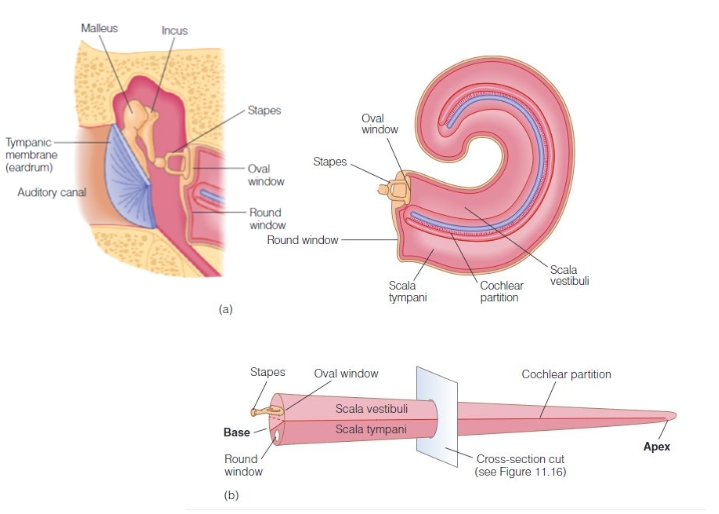
The inner ear - Inside the cochlea​

In reality, uncoiled cochlea is a cylinder 2mm in diameter and 35mm long.​

<p>In reality, uncoiled cochlea is a cylinder 2mm in diameter and 35mm long.​</p>
13
New cards

Inside the cochlea​

scala - cavities

red = into cochlea

blue - out of cochlea

This stimulates the cochlear nerve allowing you to hear
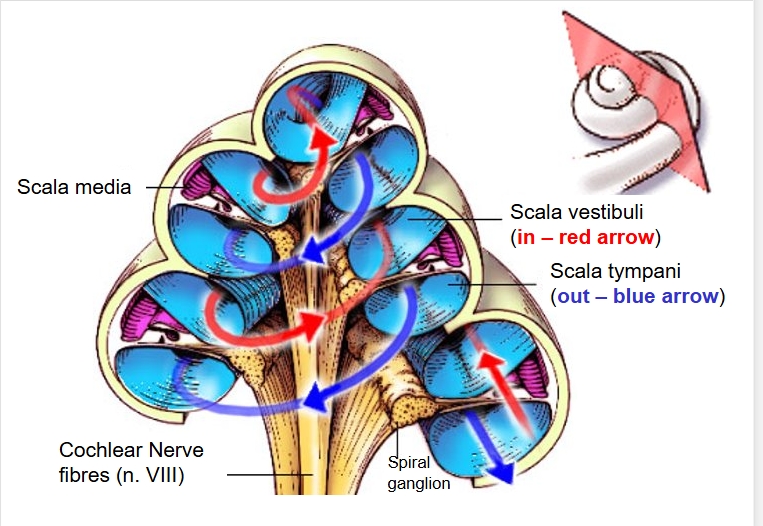
<p>scala - cavities </p><p>red = into cochlea</p><p>blue - out of cochlea </p><p>This stimulates the cochlear nerve allowing you to hear </p>
14
New cards

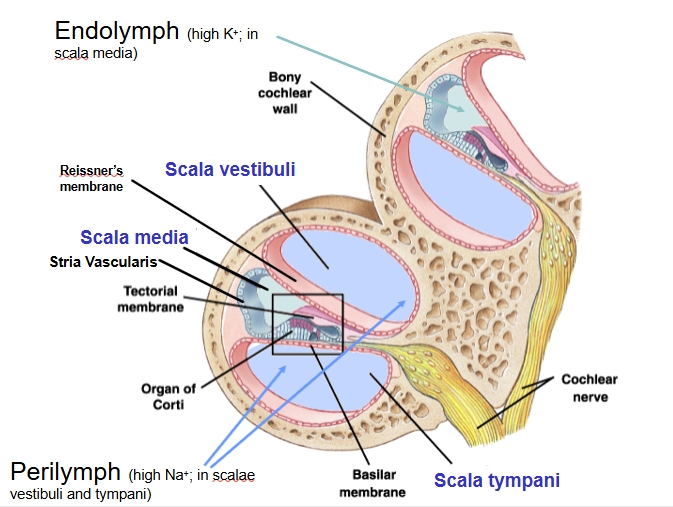
Cochlea in cross section​

three scala

diff membranes and spaces

<p>three scala </p><p>diff membranes and spaces </p>
15
New cards

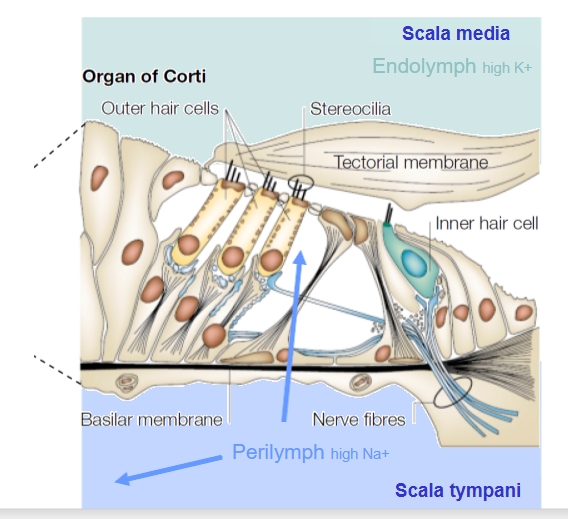
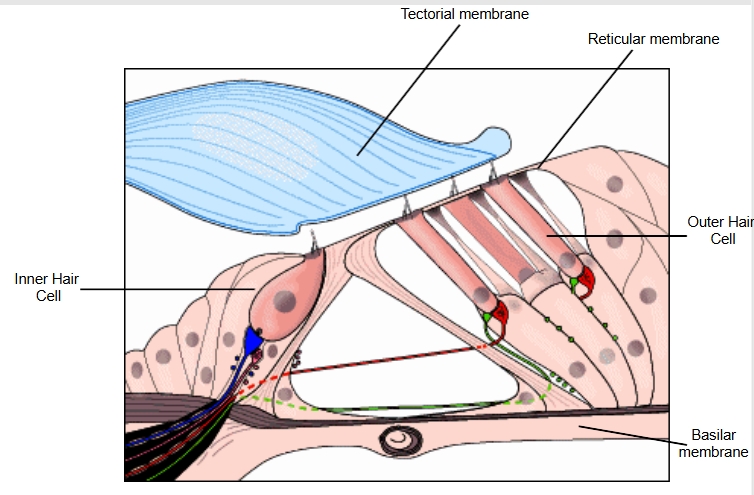
Cross section through the organ of Corti​

need to propagate sound

<p>need to propagate sound </p>
16
New cards

human hair cells

  • Human ears have ​

  • 1 row of inner hair cells (3500)​

  • ~3 rows of outer hair cells (12,000)

More outer than inner
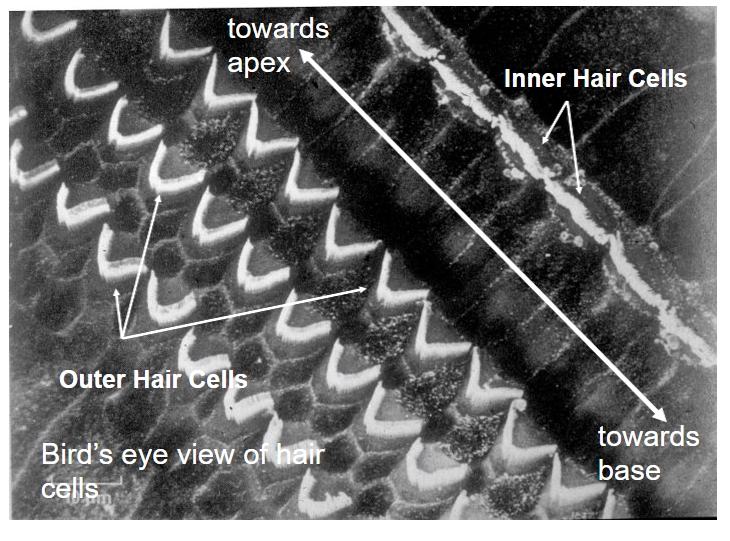
<ul><li><p class="Paragraph WhiteSpaceCollapse SCXP265582635 BCX8" style="text-align: left;"><span style="line-height: 0px;">Human ears have ​</span></p></li></ul><ul><li><p class="Paragraph WhiteSpaceCollapse SCXP265582635 BCX8" style="text-align: left;"><span style="line-height: 0px;">1 row of <u>inner hair cells </u>(3500)​</span></p></li><li><p class="Paragraph WhiteSpaceCollapse SCXP265582635 BCX8" style="text-align: left;"><span style="line-height: 0px;">~3 rows of <u>outer hair cells </u>(12,000)</span></p></li></ul><p>More outer than inner </p>
17
New cards

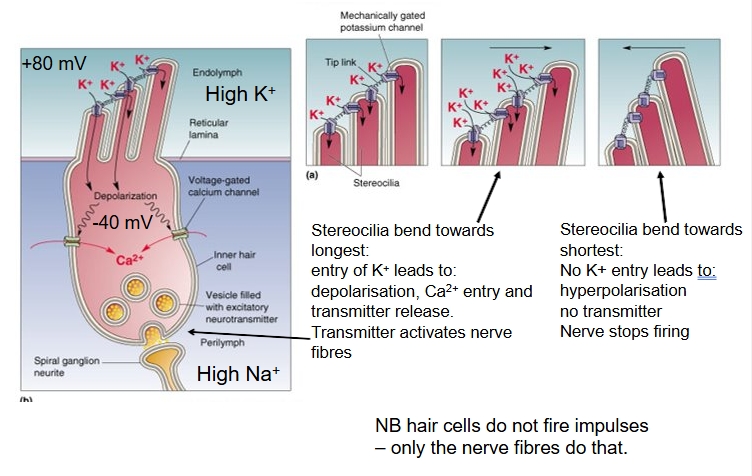
what are at the tips of hair cells?

small processes called stereocilia

​- Stereocilia bend in response to pressure changes

​- Stereocilia of the tallest row of outer hair cells are embedded in the tectorial membrane

18
New cards

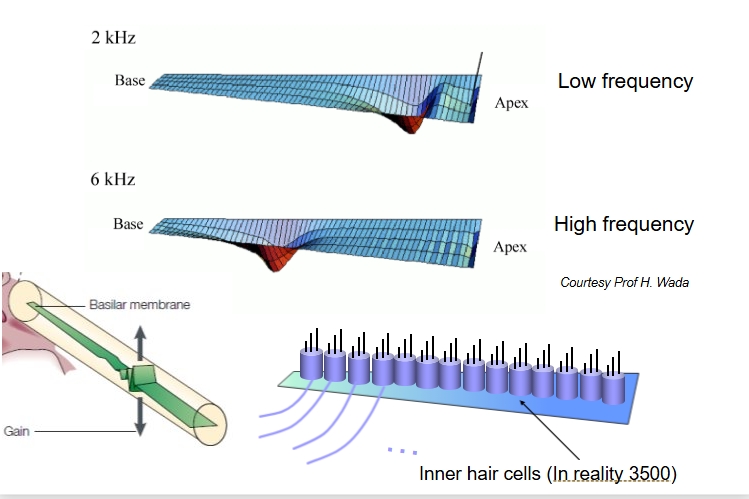
Separation of sound frequencies in the cochlea

(NB for clarity scala media shown as single line)​

Stapes acts on membrane and the fluid causing movement

High frequency at base, lower at apex
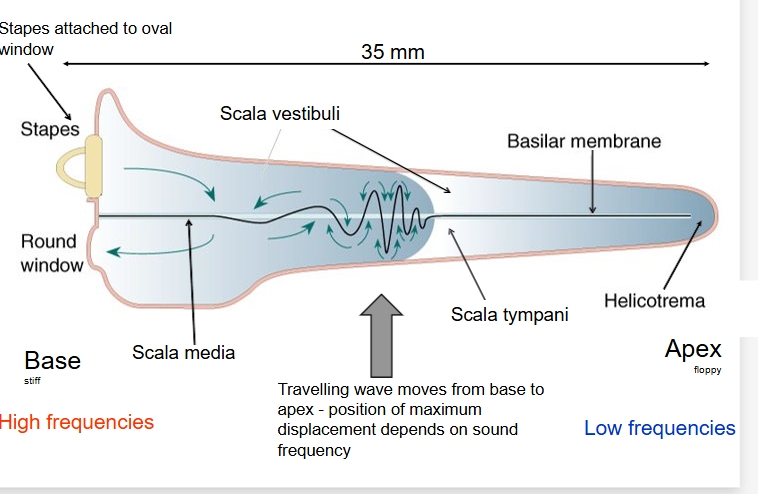
<p><span style="line-height: 0px;"> (NB for clarity scala media shown as single line)​</span></p><p><span style="line-height: 0px;">Stapes acts on membrane and the fluid causing movement</span></p><p><span style="line-height: 0px;">High frequency at base, lower at apex</span></p>
19
New cards

Travelling wave on the basilar membrane

position of maximum displacement depends on frequency​

<p> position of maximum displacement depends on frequency​</p>
20
New cards

Frequency analysis by the cochlea​

When sound enters cochlea:

  • Causes basilar membrane to vibrate​

  • Travelling waves travel up basilar membrane from base to apex​

  • Position of maximal displacement depends on frequency of sound​

  • Low frequencies produce maximal displacement at apex of cochlea​

  • High frequencies produce maximal displacement at the base​

  • Displacement of basilar membrane excites hair cells

21
New cards

what does movement of basilar membrane relative to tectorial membrane do?

causes bending of hair stereocillia which can stimulate the cranial nerve
<p>causes bending of hair stereocillia which can stimulate the cranial nerve </p>
22
New cards

what does Excitation of inner hair cells lead to?

transmitter release and excitation of auditory nerve fibres​

<p>transmitter release and excitation of auditory nerve fibres​</p>
23
New cards

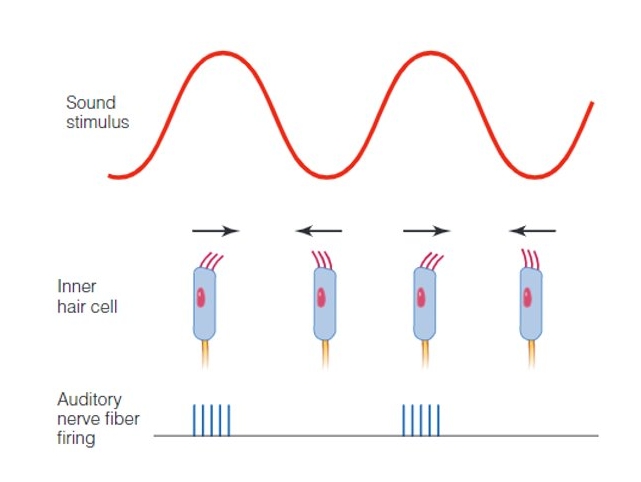
bending of hairs

only when it bends in certain directions is a nerve impulse stimulated

in other bend the hair cell is hyperpolarised and cannot fire
<p>only when it bends in certain directions is a nerve impulse stimulated</p><p>in other bend the hair cell is hyperpolarised and cannot fire </p>
24
New cards

Activation of hair cells​

This applies to both inner and outer hair cells

  • Movement of basilar membrane + interaction with tectorial membrane​

  • causes bending of stereocilia of inner and outer hair cells​

  • Bending towards tallest stereocilium​

  • Increased inflow of potassium ions - depolarisation​

  • Bending towards shortest stereocilium​

  • Reduced inflow of potassium ions - hyperpolarisation​

  • Inner hair cells only

  • release neurotransmitter​

  • activate cochlear nerve fibres associated with the hair cell

25
New cards

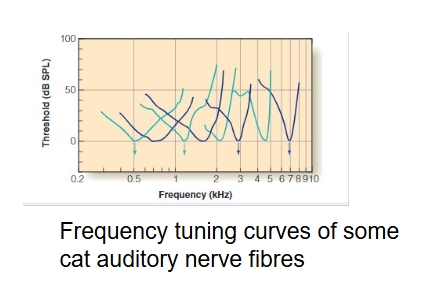
Frequency analysis​

Cochlea filters by frequency in two ways:​

1. Each neuron responds best to one frequency​

2. Each location along the cochlea amplifies one frequency
<p><span style="line-height: 0px;">Cochlea filters by frequency in two ways:​</span></p><p class="Paragraph WhiteSpaceCollapse SCXP70346662 BCX8" style="text-align: left;"><span style="line-height: 0px;">1. Each neuron responds best to one frequency​</span></p><p class="Paragraph WhiteSpaceCollapse SCXP70346662 BCX8" style="text-align: left;"><span style="line-height: 0px;">2. Each location along the cochlea amplifies one frequency</span></p>
26
New cards

what are outer hair cells?

cellular motors

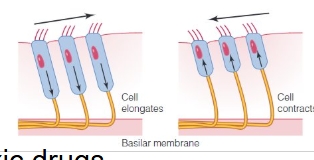
  • Outer hair cells (OHC)​

  • change length as stereocilia bend back and forth​

  • shorten and lengthen in response to sound stimulation​

  • driven by motor protein in OHC membrane – Prestin​

  • inject energy and amplify basilar membrane (BM) movement​

  • Reason hearing is so sensitive - detect BM movements innm range.

27
New cards

what are OHCs damaged by?

  • Damaged by ototoxic drugs​

  • some antibiotics, e.g. aminoglycosides​

  • other drugs, e.g. cisplatin (cancer drug), furosemide (diuretic),salicylate (aspirin)

Can impact upon hearing
<ul><li><p class="Paragraph WhiteSpaceCollapse SCXP94085591 BCX8" style="text-align: left;"><span style="line-height: 0px;">Damaged by ototoxic drugs​</span></p></li><li><p class="Paragraph WhiteSpaceCollapse SCXP94085591 BCX8" style="text-align: left;"><span style="line-height: 0px;">some antibiotics, e.g. aminoglycosides​</span></p></li><li><p class="Paragraph WhiteSpaceCollapse SCXP94085591 BCX8" style="text-align: left;"><span style="line-height: 0px;">other drugs, e.g. cisplatin (cancer drug), furosemide (diuretic),salicylate (aspirin)</span></p></li></ul><p>Can impact upon hearing </p>
28
New cards

Amplification of basilar membrane motion

by motor proteins in outer hair cells​

Elongation and shortening of outer hair cells increases displacement of basilar membrane

Increased displacement of basilar membrane. Enhances hearing sensitivity and frequency selectivity
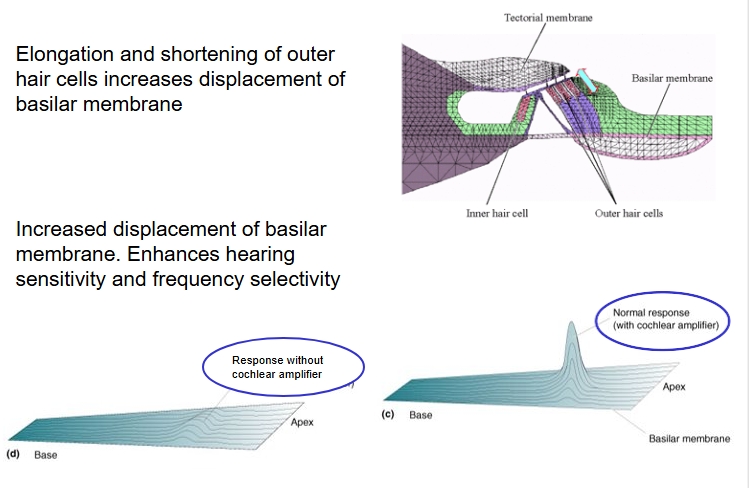
<p> by motor proteins in outer hair cells​</p><p><span style="line-height: 0px;">Elongation and shortening of outer hair cells increases displacement of basilar membrane</span></p><p class="Paragraph WhiteSpaceCollapse SCXP195682700 BCX8" style="text-align: left;"><span style="line-height: 0px;">Increased displacement of basilar membrane. Enhances hearing sensitivity and frequency selectivity</span></p>
29
New cards

deciBels​

knowt flashcard image