microbial behaviour
 Call Kai
 Learn
Learn Practice Test
 Spaced Repetition
 Match
Match Flashcards
 Knowt Play
1/22

There's no tags or description
Looks like no tags are added yet.
Name | Mastery | Learn | Test | Matching | Spaced | Call with Kai |
|---|
No analytics yet
Send a link to your students to track their progress
23 Terms
traditional food preservation
stored in cool caves - cheese, fruit and veg
frozen/ freeze driend at high latitudes and altitudes - meat, potato
dried in sun - tomato, fish, meat, biltong
smoked/dried over fires - kipper
salted and dried - bacaalhau
fermented - tempeh, cheese, wine, beer, yogurt, kefir
veterinary public health approach
characteristics of the original product and aspects of the processes that may represent hazards to health (public and animal)
Biological agents and their toxins
Environmental effects
Human interventions
Establish standards and procedures that protect consumer health and secure food trade
how do different methods contribute to meat preservation
principles of food microbiology
different factors that affect microbial growth
food/meat characteristics
raw meat and post-mortem changes
raw milk and further processing
food processing methods
Fate of microorganisms in the food products
Consideration should be given to:
contamination events during primary production;
contamination events during meat processing;
whether processing includes a microbicidal step and if any survivors exist;
whether post-microbiocidal step contamination can occur;
identification of antimicrobial factors acting in the final product, and their interaction;
whether conditions during storage and retail stages may enable growth of, or toxin production by, pathogens;
usual pre-consumption practices by consumers relevant to behaviour of pathogens; and
infective dose for given pathogen(s).
different kind of microorganisms affecting food
spoilage microorganisms
pseudomonas, bronchotric, proteus, clostridia and bacilli
penicillium, aspergillus
food poisoning microorganisms - foodborne pathogens
bacteria - salmonella, campylobacter spp, listeria, E.coli
fungi
viruses
toxins
probiotics and fermentation agents
useful - can use to advantage to make new products e.g cheese, wine etc
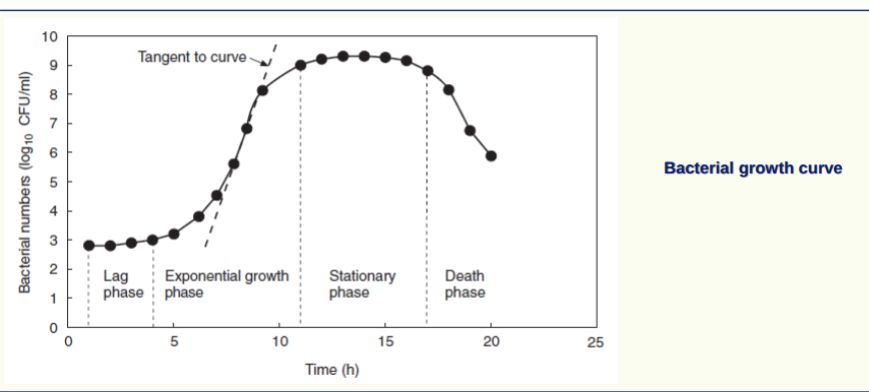
phases of bacterial growth
Iag phase - (short) period of adjustment to environment
can be few mins to yrs
logarithmic growth phase - growth and accelerated to a phase of rapid, constant exponential growth
stationary phase - depletion of nutrients and accumulation of toxic metabolic products growth is slowed to a point where all cell division and cell death are in balance
death phase - population decreases due to death of cells
bacterial death
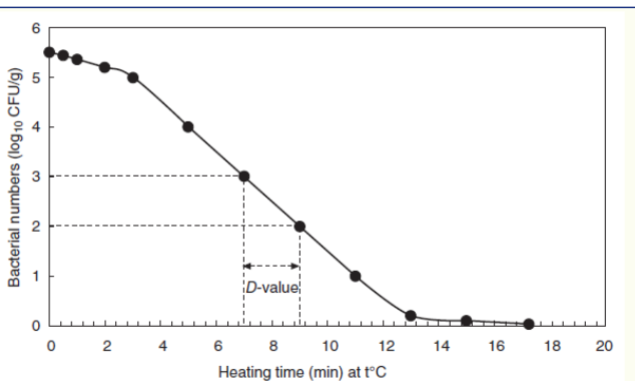
usually logarithmic in vitro(in broth) and in foods if not instantaneous
D-value (decimal reduction time) = time required to destroy 90% of population at given temp
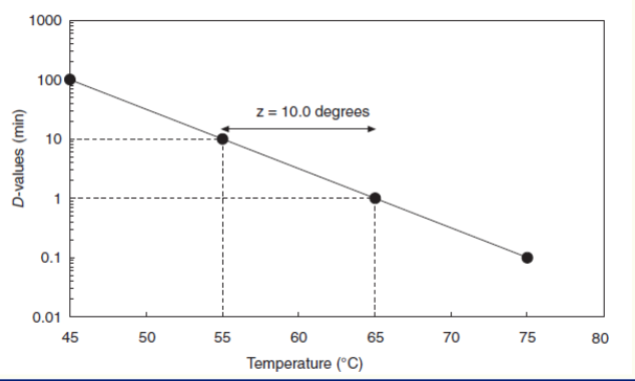
Z-value = number of degrees required for thermal death time curve(D-value) to decrease by 1 log cycle(10 times) in other worlds
increase in temperature required for 10 fold decrease in D value
D-value
Z-value
saves time and efficiency
factors that affect microbial growth in food
intrinsic - physiochemical properties of food
extrinsic - storage environment
implicit - properties and interactions of micro-organisms
processing factors - can modify all or some of above
intrinsic factors in food
nutrients
pH and buffering capacity
redox potetnial
water activity
presence of antimicrobial factors
nutrient content
are available nurtients suitable for growth?
which micro-organisms are favoured
high sugar content(fruit addition in yogurt) increases risk of fungal growth
different microorganisms have different enzymes allowing them to grow on different media
knowledge of composition of food will help predict the micro-organisms to control
pH and buffering capacity
pH = negative logarithm of H+ capacity
affects transmembrane transport of nutrients, ATP synthesis
affects stability of enzymes and consequently the growth and metabolism of micro-organism growth
different micro-organisms like different pH
bacteria - 6-8
yeasts - 4.5-6
filamentous fungi - 3.5-4
different food commodities have differnt pH
muscle -5.6
fish - 6.4-6.6
milk - 6.4-6.6
egg white - 9.2
redox potetnial Eh
tendency of medium to accept or donate electrons to oxidise or to reduce is termed redox potential
different kind of microorganisms are favoured in different potentials
obligate aerobes need high redox potential
obligate anaerobes grow in low or negative redox potential but depends in presence of oxygen and ability to destroy superoxides
different food commodities have differnt redox potential
Meat E(mV) @ pH:5.6=-200
Mince meat E(mV) @pH:5.9=+225
Cooked sausages E(mV) -20 to -150
Lemon E(mV) @pH:2.2 =+383
water activity
Water activity (aw) is defined as the ratio of the water vapour pressure of a food (p) to that of pure water (p0) at the same temperature: aw = p / p0”
or:
Amount of free (available) water for microorganisms and their metabolic needs
On a scale from 0 (absolute dry matter) to 1 (distilled water)
aw of a food may be affected by the relative humidity of the atmosphere
Methods of reducing aw:
Drying
Freezing
Addition of solutes (NaCl, sugars) to food
Altering the microstructure of a food (for example, butter is a water-in-fat emulsion prepared from cream, a fat-in-water emulsion)
3 types of microorganisms based on aw requirements
halophilic microorganisms - can grow in higher salt concentrations - NaCl
osmophilic - can grow in high concentration of ionised substances - sugars
xerophilic - can grow in dry food - staph. aureus, some fungi and yeasts
presence of antimicrobial factors
egg-white proteins - ovotransferrin
milk proteins - lactoferrin, lysozyme
egg shell and cuticle contain some antimicrobial factors too
nitrites - added to cured meat products to stabilise red colour and inhibit cl. botulinum
woodsmoke compounds - phenols, low-molecule acids
extrinsic factors that affect food
relative humidity
gaseous atmosphere
temperature
relative humidity
affects water activity -
takes long time for all product to get affected
affects surface of food -
white spots by sportrichium carnis which affects only the white surface of meat
black spots by cladosporium herbarum often on imported chilled carcases
usually accompanied by decomposition
penicillium gives green-blueish mould
gaseous atmosphere
oxygen concentration affects redox potential
CO2 and N2 used as basis of modified atmosphere packaging
affects pH - produces carbonic acid with water, reduces surface contamination
acts as a weak organic acid penetrating membrances, affecting nutrient transport and enzyme availability
extends shelf-life
Four types of microorganisms based on gaseous atmosphere requirements:
Aerobic microorganisms – grow in the presence of O2 (Pseudomonas);
Facultatively anaerobic – can grow in the presence and absence of O2 (most foodborne pathogens, particularly from Enterobacteriacea family);
Strictly anaerobic – grow only in the absence of O2 (Clostridium);
Micro-aerophilic – grow preferentially in atmospheres with reduced O2 tension (usually with other gases such as CO2, Campylobacter)
temperature
different micro-organisms like differnt temps
membrane integrity is affected in high temp, nutrient availability in low temp
thermophiles - 40 to 90 degrees
mesophiles - 5 to 47 degrees
psychophiles - -5 to 20 degrees
mesophiles and psychotrophs the most important in food preservation
implicit factors
properties and interactions of microorganisms
specific growth rate - bacteria grow faster than moulds in fresh meat
mutualism - growth of one organism helps another
antagonism - lactic acid bacteria restricts bacterial growth of pathogens
physiological status, strain diversity and adaption
implicit factors - bacterial stress response
Bacteria “feel” a change in the environment
The stress response can alter bacterial behaviour = survival:
High temp. (sub-lethal heat) → response→ change in cell’s membrane lipids
Simple attachment can induce response
~ 30% Salmonella genome has ‘stress-response’ genes, making bacteria more:
fast-growing; max growth rate can be increased even if the lag phase is lengthened;
toxigenic/virulent, and therefore more likely to cause food-borne disease;
resistant to the factor that initially caused injury; and
able to adapt to other adverse factors subsequently imposed along the food chain.