Consumer Behavior Exam 3
 Call Kai
 Learn
Learn Practice Test
 Spaced Repetition
 Match
Match Flashcards
 Knowt Play
1/108

There's no tags or description
Looks like no tags are added yet.
Name | Mastery | Learn | Test | Matching | Spaced | Call with Kai |
|---|
No analytics yet
Send a link to your students to track their progress
109 Terms
WOM
product information transmitted by individuals to individuals
negative > positive
weigh negative WOM more
Why care about post-purchase?
repeat purchases
low involvement purchases
WOM
Consumer Reactions to Consumption
satisfaction and dissatisfaction
response to product/ service failures : attribution Theory
post - decision dissonance
post decision regret
satisfaction with process of choice
satisfaction
repeat purchase intentions
increased positive WOM
basis for positive emotional connection to the brand and loyalty
dissatisfaction
voice response
private response
thrid-party response
voice response
complain to firm
product returns
private response
complain to friends (negative WOM), boycott firm
third-party response
file officials complain, take legal action
expectancy disconfirmation model of satisfaction
satisfaction = actual performance - product expectations
dissatisfied
actual is below expectations
satisfied
actual is equal to expectations
delighted
actual is above expectations
satisfaction is weighted differently
12 positive experiences = 1 negative experience
two paths to satisfaction
manage outcome (actual)
manage expectations
manage outcome (actual)
deliver the goods
manage expectations
set expectations accurately
communicate consistent messages
clear, definitive, and simple messages to customers
attribution theory
people want to blame someone
fundamental attribution error
it is perception that matters, not reality
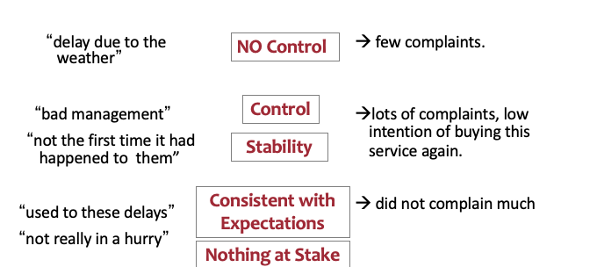
three factors influence dissatisfaction level
stability
focus
controllability
stability
is the cause of temporary and permanent
focus
marketer/ brands fault or my own
controllability
market/ brand control
BAD=
permanent, marketer- related, and marketer- controlled
Dissatisfaction and Attribution Theory
post-decision dissonance examples
did i buy the right brand?
should i have searched more?
could i have found a lower price?
post-decision dissonance
anxiety experienced post-purchase when a consumer wonders whether they made the right choice (even when the choice turns out positive), particularly under approach- approach conflicts
reducing dissonance
make the customer feel good about the purchase, ex. follow up emails or return policies to make them feel confident
post- decision regret
unfavorable comparison between chosen and unchosen alternatives, based on cognitions and affect
regret
regret= unchosen-chosen
in the short run,
we regret our actions more
in the long run
we regret our inactions more: the things we have’nt done in life
post-purchase: disposal
lots of money in it
self storage
donation
second- hand markets
recycling
public policy implications of product disposition
what leads to a willingness to dispose of possessions?
major life events
moving or role transitions (marriage/divorce)
consumer satisfaction/ dissatisfaction is
based on perceptions
companies need to manage
expectations
product failures are often
attributed to the firm
uncertainty about having made the correct choice leads to
post-decision dissonance
wishing you had bough another option leads to
post-decision regret
deliberation and choice sets
contribute to post-decision
information search
consumers need information to solve problems
two types of search
internal search : scanning memory
external search: experiential search, interpersonal sources (family and friends)
Typically:
start with internal and continue with external
what do consumers search for?
brands
attributes
evaluations / attributes
expereinces
what affects brand recall?
prototypically
familiarity
goals/ usage situations
brand preference
retrieval cues
what affects attribute recall?
accessibility/ availability (strong associative links)
diagnostically (differentiating)
salience/ prominence
vividness
goals
The economics of information
how much consumers search
Do consumers get full information and then optimize their decision?
gather as much data as needed to make informed decisions, then stop
we will collect the most valuable information first
we continue to search until the costs exceed the utility of the information search
Influence of Consumers Prior Expertise on Search
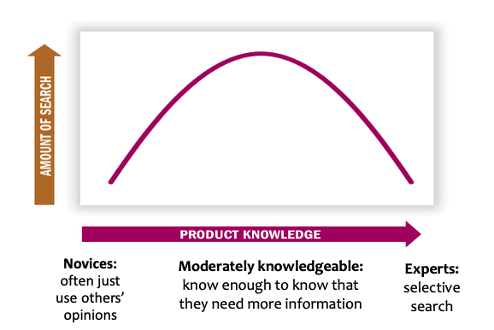
for how much and how long do we search?
depends on motivation, ability, opportunity
motivation
importance of the task
involvement
perceived costs/ benefits
discrepancy of information
ability
expertise
opportunity
availability of information
time
Do people search enough?
generally, people under-search
look at only 1-2 sources before buying a car or major appliance
over search
can lead to less satisfaction
especially in ordered environments
why horoscopes are always right!! “specially vague”
mood effects on information search
confirmation bias
the tendency to “see what you expect to see”
people will interpret information in a way that supports or confirms their prior expectations
we search for evidence that confirms our attitudes
confirmation bias in marketing
unhealthy = tasty intuition
confirm hypotheses generated by ads
consumers conduct both
internal and external search to find information about how to move their actual to ideal state
most consumers undersearch
marketers need to find a way to be top of mind (using availability heuristics)
most consumers conduct biased search (confirmation bias)
marketers need to find a way to have an image that fits with target market ideals (using perceptual and preference maps)
Rule 1 of Decision Making
People act differently when something is framed as a loss vs a gain (risk seeking for losses and risk averse for gains)
Rule 2 for decision making
losses bloom larger than gains (loss aversion)
rule 3 of decision making
evaluations are driven by individual events, not total outcomes (seperate gains, aggregate losses)
visual illusions
decision illusions
risk seeking
when the choices are perceived as losses (deaths)
risk averse
when the choices are perceived as gains (lives saved)
loss aversion: status quo bias
preference for current sate of affairs (status quo) over change
manifests as resistance to change
status quo = reference point
encourages brand loyalty
risk of loss psychologically outweighs the potential for gains
loss aversion
people tend to be more sensitive to losses than to gains
sunk cost effect
want to avoid calling it a loss
gain framing
same situation framed as a gain is more favorable
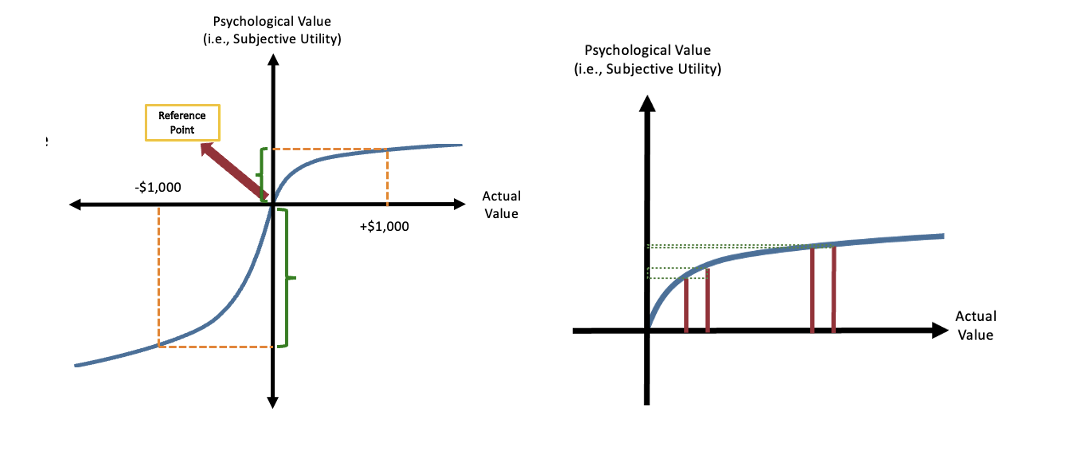
Rules of DM into 1 model prospect theory
replaces expected utility (objective) with subjective utility (how we see things) incorporates the human element of evaluations
Prospect theory reference points
determine losses vs gains
prospect theory loss aversion
losses loom larger than gains (PT)
prospect theory diminishing returns to psychological value
diminishing marginal utility/ disutility
Types of reference points
status quo
subset: reference prices
salient numbers in the environment - as in anchoring and adjustment
the exemplar/ prototype price
mental accounting
money is not 100% fungible
although money has an objective value, its subjective value can change based on the situation
we put money into different “mental accounts” - rent money, car money
sunk cost effect
situational factors can change what you’re willing to pay
Managerial Implications: Compromise Effect
especially important for service businesses selling an intangible product that is not easily comparable
what about retail bsuinessses
give customers three related choices at three different prices
avoid one of a kind items sitting on shelves isolated form comparable products especially if your product is “average”
Vacation Choice
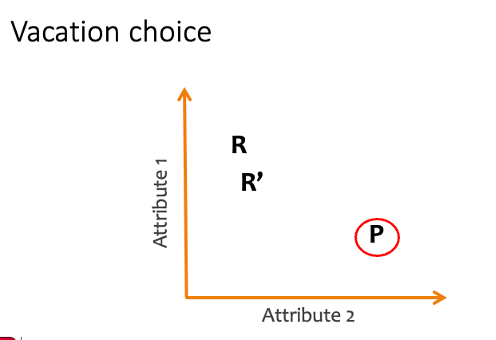
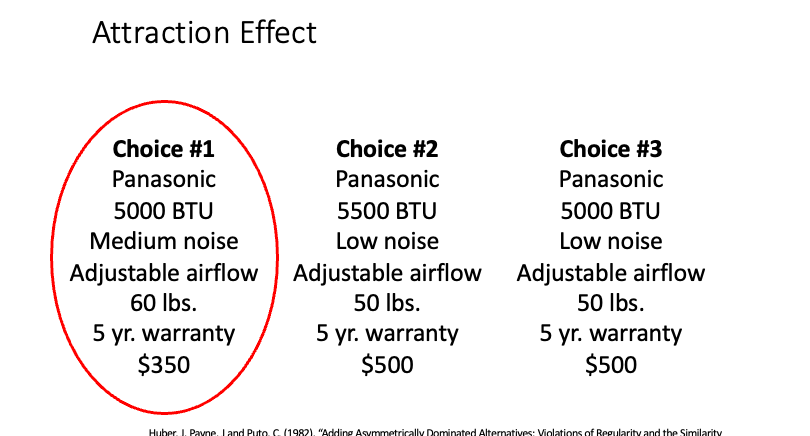
Attraction Effect
Prospect Theory
the overarching framework for the three rules of decision making
loss vs gain framing
loss aversion
individual events (vs total outcomes) are what matters
People, like organizations do accounting!
money is not “fungible as a result of mental accounting
context is key
judgments/ evaluations are not independent
compromise and attraction are context effects
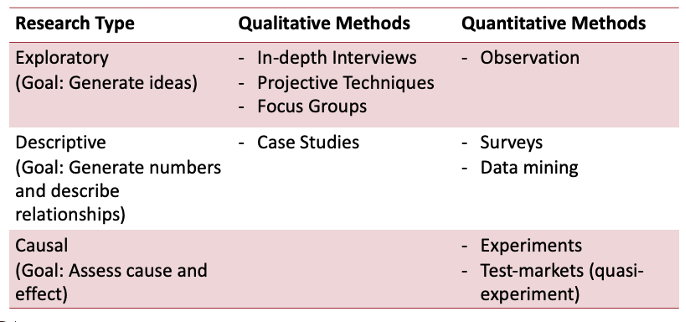
Qualitative Methods
in depth interviews
projective techniques
focus groups
Quantitative Methods
Observation
Surveys
Experiments
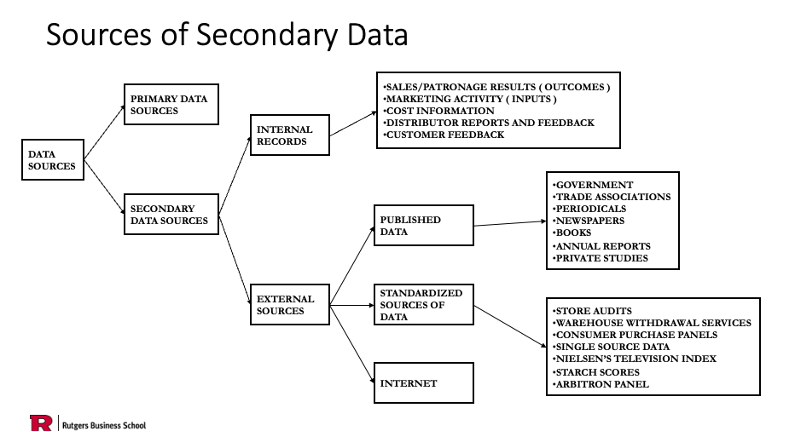
Sources of Secondary Data
General Simplified Rule
collect secondary data first then turn to primary data
advantages of secondary data
time savings, low costs
disadvantages of secondary data
may be out of date
definitions or categories might not be what you’re looking for
might not be specific enough for your project
tools for primary date
Advantages of survey data
useful for measuring a lot of things
attitudes
knowledge
intentions
brand awareness
customer satisfaction
disadvantages of survey data
subject to sampling bias
subject to social desirability bias
can measure correlation but not causation
observational research
making observations of behavior and recording those observations in an objective manner
natural (home) vs artificial (lab) settings
most useful when investigating complex social settings; less useful for studying well- defined hypotheses under specific conditions
Observation Basics- what can be observed
human behavior or psychical action
verbal behavior
etc
how can we observe?
cameras
eye tracking
popilometer
in depth interviews
conducted a face-to-face with one respondent with the objective of exploring the subject matter in detail - laddering (what is that important to you)
projective techniques
when direct questions fail - word association, cartoon test, consumer drawings
when should you resort to projective techniques
the issue is unimportant to the respondent
group norms and social pressures are significant
consumer doesn’t want to appear ignorant
need for privacy
respondent may not be fully aware of their “true” motivation
Focus groups
a group of respondents discusses a marketing problem by responding and reacting to each other