Module 3 - Instrument grasp

0.0(0)
Studied by 0 people
call kaiCall Kai
learnLearn
examPractice Test
spaced repetitionSpaced Repetition
heart puzzleMatch
flashcardsFlashcards
GameKnowt Play
Card Sorting

1/14

encourage image

There's no tags or description

Looks like no tags are added yet.

Last updated 12:30 AM on 6/2/26
Name
Mastery
Learn
Test
Matching
Spaced
Call with Kai

No analytics yet

Send a link to your students to track their progress

15 Terms

1
New cards

Modified pen grasp

The correct instrument grasp

2
New cards

Parts of periondontal instrument

Handle

  • Part of instrument used for holding

Shank

  • Smooth, smaller, straight or bent

Working end

  • Does the work, meets with shank

  • Shaped, flattened, wire—like, scoop/ mirror

A. Handle

B. Shank

C. Working end
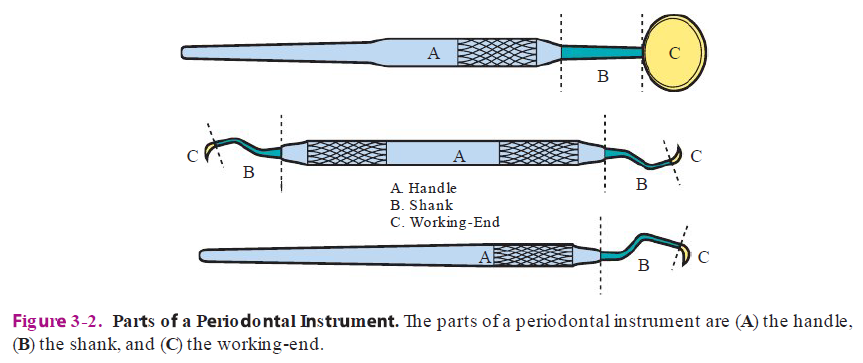
<p><strong>Handle</strong></p><ul><li><p>Part of instrument used for holding</p></li></ul><p></p><p><strong>Shank</strong></p><ul><li><p>Smooth, smaller, straight or bent</p></li></ul><p></p><p><strong>Working end</strong></p><ul><li><p>Does the work, meets with shank</p></li><li><p>Shaped, flattened, wire—like, scoop/ mirror </p></li></ul><p></p><p>A. Handle</p><p>B. Shank</p><p>C. Working end</p><p></p>
3
New cards

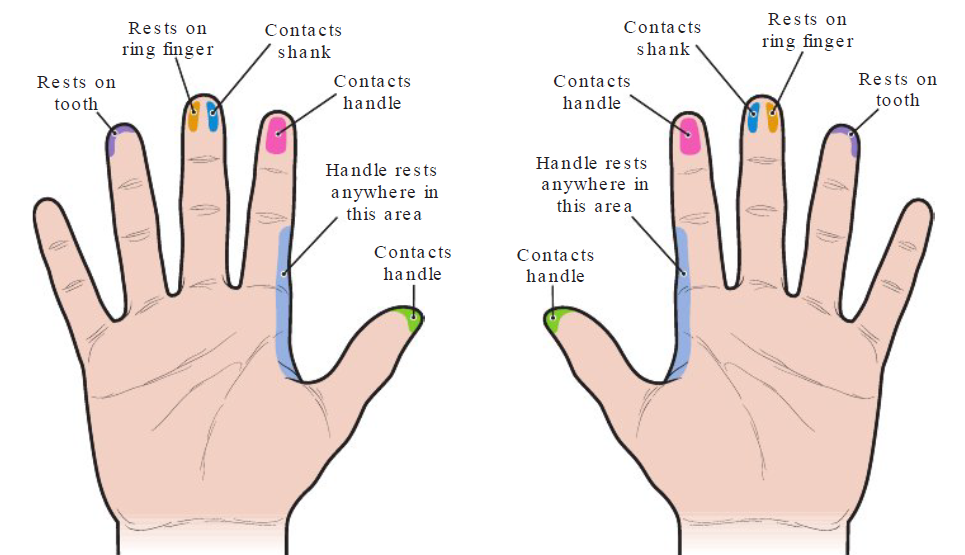
Finger identification for the instrument grasp

Thumb and Index

  • Placement: On instrument handle

  • Function: hold the instrument

Middle finger

  • Placement: Rest lightly against shank

  • Function: Helps guide working end, feel vibration from working end to shank

Ring finger

  • Placement: On oral structure (often tooth surface), advance ahead of other fingers

  • Function: Stabilize and support hand for control

Little finger

  • Placement: Near ring finger, neutral relaxed position

  • Function: No function in grasp

<p><strong>Thumb and Index </strong></p><ul><li><p><strong>Placement: </strong>On instrument handle</p></li><li><p><strong>Function</strong>: hold the instrument </p></li></ul><p></p><p><strong>Middle finger</strong></p><ul><li><p><strong>Placement: </strong>Rest lightly against shank</p></li><li><p><strong>Function: </strong>Helps guide working end, feel vibration from working end to shank</p></li></ul><p></p><p><strong>Ring finger</strong></p><ul><li><p><strong>Placement</strong>: On oral structure (often tooth surface), advance ahead of other fingers </p></li><li><p><strong>Function</strong>: Stabilize and support hand for control </p></li></ul><p></p><p><strong>Little finger</strong></p><ul><li><p><strong>Placement</strong>: Near ring finger, neutral relaxed position</p></li><li><p><strong>Function</strong>: No function in grasp</p></li></ul><p></p>
4
New cards

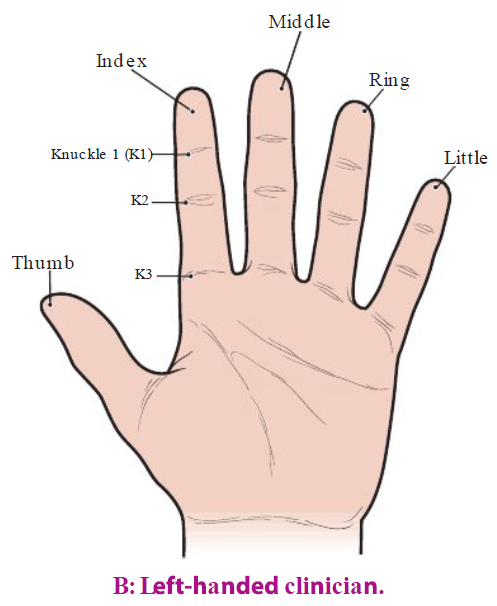
Modified pen grasp left handed clinician

Study picture
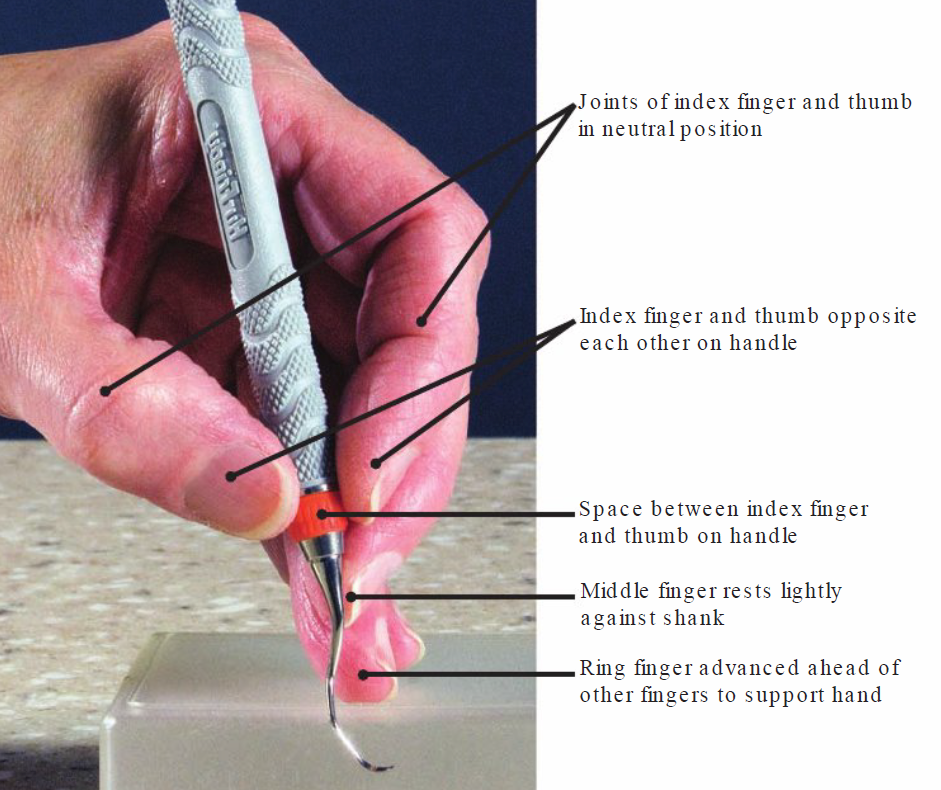
<p>Study picture</p>
5
New cards

Correct finger placement

Thumb and index

  • Opposite of each other at handle and shank

  • Fingers do not overlap

  • Holds handle in relaxed manner

  • If fingers blanched (Turn white), you are holding too tightly

Middle finger

  • Left side rest on instrument shank. Other side rest against or overlap ring finger

  • Not used to hold instrument

  • Should be able to lift middle finger w/o dropping instrument.

Ring finger

  • Fingertip balance firmly on tooth to support weight of hand

  • When holding dental mirror, ring finger can rest on tooth or against patient’s lips or cheek area

  • Dominant hand ring finger advances ahead

  • Held upright and rigid as support beam

  • Finger should not feel tense, held limply against tooth

  • Fingernail length must not impede ability to keep ring finger upright and rigid

Little finger

  • Relaxed

<p><strong>Thumb and index</strong></p><ul><li><p>Opposite of each other at handle and shank</p></li><li><p>Fingers do not overlap</p></li><li><p>Holds handle in relaxed manner</p></li><li><p>If fingers blanched (Turn white), you are holding too tightly</p></li></ul><p></p><p><strong>Middle finger</strong></p><ul><li><p>Left side rest on instrument shank. Other side rest against or overlap ring finger</p></li><li><p>Not used to hold instrument</p></li><li><p>Should be able to lift middle finger w/o dropping instrument. </p></li></ul><p></p><p><strong>Ring finger</strong></p><ul><li><p>Fingertip balance firmly on tooth to support weight of hand</p></li><li><p>When holding dental mirror, ring finger can rest on tooth or against patient’s lips or cheek area</p></li><li><p>Dominant hand ring finger advances ahead</p></li><li><p>Held upright and rigid as support beam</p></li><li><p>Finger should not feel tense, held limply against tooth</p></li><li><p>Fingernail length must not impede ability to keep ring finger upright and rigid</p></li></ul><p></p><p><strong>Little finger</strong></p><ul><li><p>Relaxed</p></li></ul><p></p>
6
New cards

Impact of finger lengths on the grasp

People need to adjust finger rest and grasp according to hand size and finger lengths

Short fingers

  • Knuckle of index and thumb more curved

Long fingers

  • Knuckle of index and thumb less curved
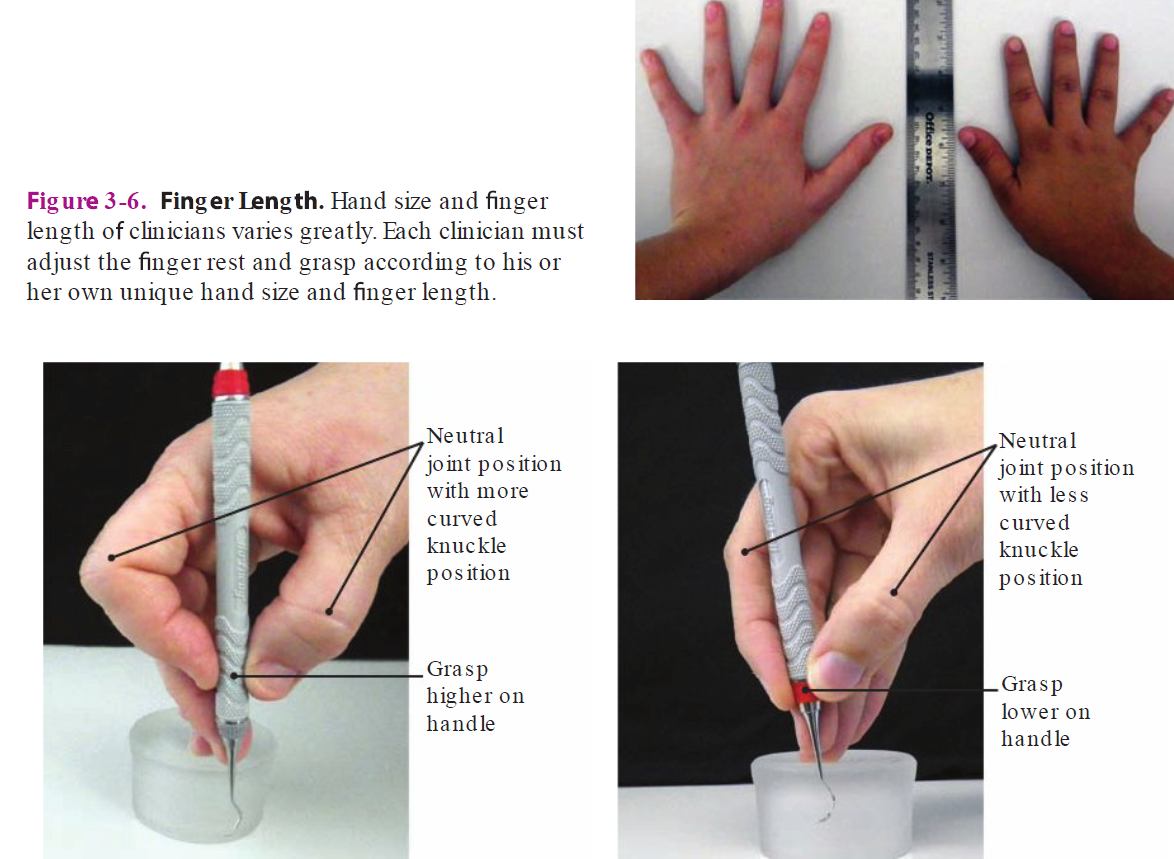
<p>People need to adjust finger rest and grasp according to hand size and finger lengths </p><p></p><p><strong>Short fingers</strong></p><ul><li><p>Knuckle of index and thumb more curved </p></li></ul><p></p><p><strong>Long fingers</strong></p><ul><li><p>Knuckle of index and thumb less curved </p></li></ul><p></p>
7
New cards

Proper glove fit for periodontal instruments

  • Loose fitting across palm and wrist

  • Improper fitting gloves = surgical glove induced injury = MSD

  • Best to wear right and left fitted gloves instead of ambidextrous gloves

  • Tight ambidextrous gloves = hand pain

  • Thin gloves = more tactile sensitivity and touch perception

  • Nitrile gloves = More grip function than latex
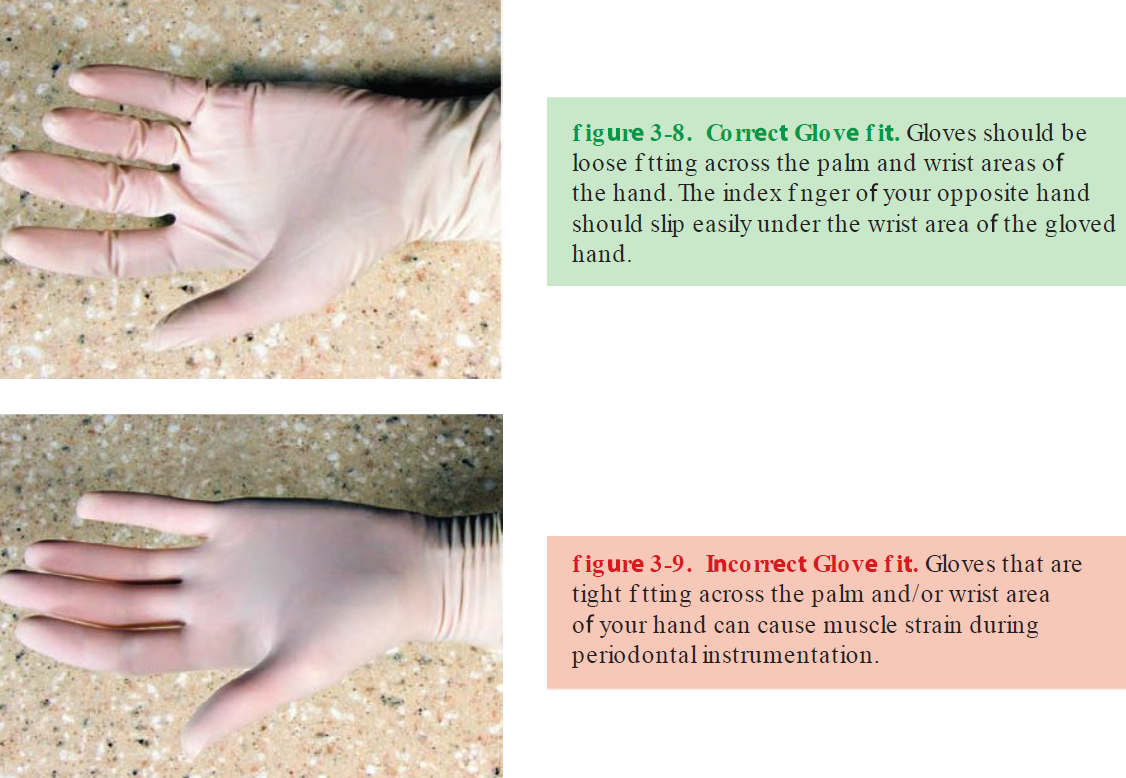
<ul><li><p>Loose fitting across palm and wrist</p></li><li><p>Improper fitting gloves = surgical glove induced injury = MSD </p></li><li><p>Best to wear right and left fitted gloves instead of ambidextrous gloves</p></li><li><p>Tight ambidextrous gloves = hand pain </p></li><li><p>Thin gloves = more tactile sensitivity and touch perception</p></li><li><p>Nitrile gloves = More grip function than latex</p></li></ul><p></p>
8
New cards

Joint hypermobility (Joint laxity)

  • Flexible or loose joints

  • Also known as double jointed

  • 4—13% of children have hypermobile joints (move beyond normal range)
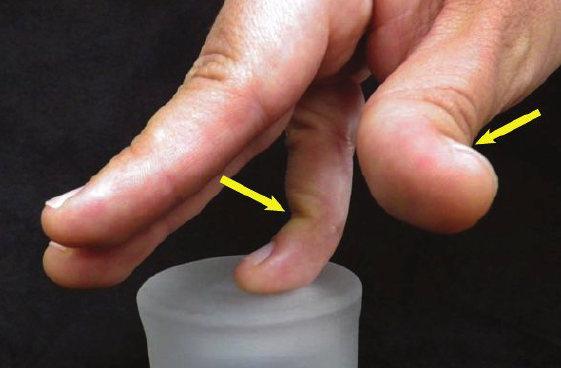
<ul><li><p>Flexible or loose joints</p></li><li><p>Also known as double jointed </p></li><li><p>4—13% of children have hypermobile joints (move beyond normal range) </p></li></ul><p></p>
9
New cards

Proprioception

Person can touch nose with eyes closed

  • Sense of position and movement of our limbs, trunks, sense effort, force, heaviness.

  • Works due to sensory receptors within muscles and joints

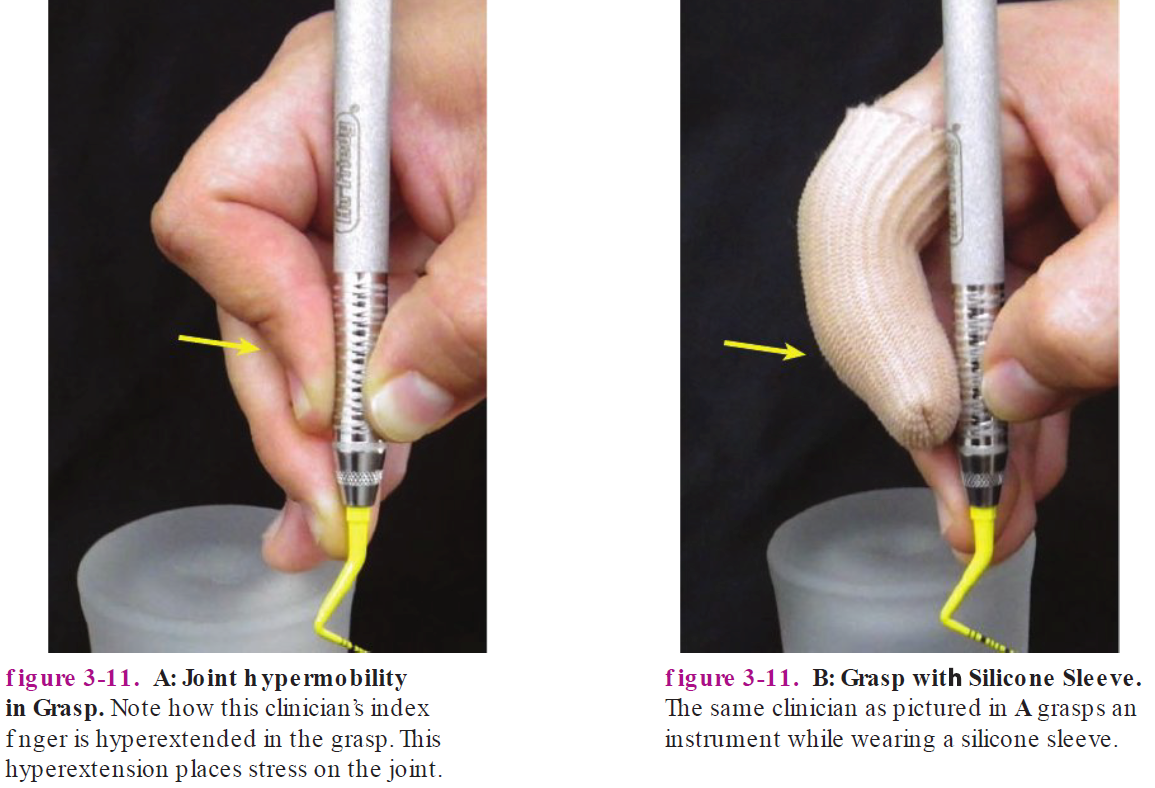
  • People w/ joint hypermobility have reduced proprioceptive sensitivity in joints of hands

    • Cause greater power = tighter gripping = joint more stressed
10
New cards
<p><strong>Joint stabilizing devices for hypermobility clinicians</strong></p>

Joint stabilizing devices for hypermobility clinicians

Hypermobile fingers = less stable = more muscles used to grip

  • Clinicians must learn to grip instruments w/o fingers collapsing inward

  • Reduce proprioceptive sensitivity = clinician should learn not to grip instrument w/ too much force

Lycra or silicon sleeve (silipos sleeve), can help w/ proprioceptive retraining

  • Orthopedic hand specialist should evaluate those with pain and weakness due to joint hypermobility

  • Ring splints helps joint hyperextension and retrain proprioceptivity (perception) of finger position
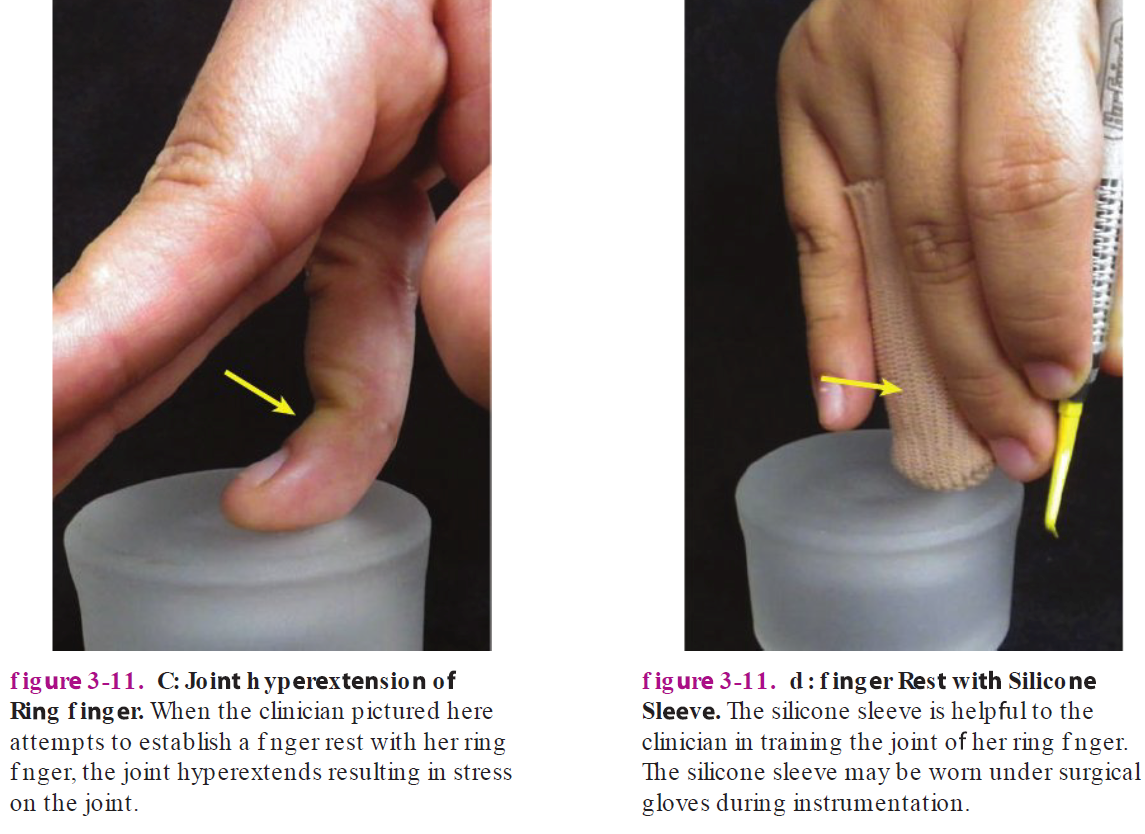
<p>Hypermobile fingers = less stable = more muscles used to grip </p><ul><li><p>Clinicians must learn to grip instruments w/o fingers collapsing inward</p></li><li><p>Reduce proprioceptive sensitivity = clinician should learn not to grip instrument w/ too much force </p></li></ul><p></p><p><strong>Lycra or </strong><span style="color: rgb(255, 0, 0);"><strong>silicon sleeve</strong></span><strong> (silipos sleeve), can help w/ proprioceptive retraining</strong></p><ul><li><p>Orthopedic hand specialist should evaluate those with pain and weakness due to joint hypermobility</p></li><li><p><span style="color: rgb(255, 0, 0);"><strong>Ring splints</strong></span> helps joint hyperextension and retrain proprioceptivity (perception) of finger position</p></li></ul><p></p>
11
New cards

Arthritis

  • May cause hygienist to reduce work hours or leave profession

  • Ergonomic principles (grasp, grip force, relaxation) can make a difference on whether a hygienist w/ arthritis can practice dental hygiene

12
New cards

Muscle strength

  • Hand weakness most common in female clinicians w/ petite hands

  • Device for grip — hand size is correlated in women, not men (Men with bigger hand have better grip strength)

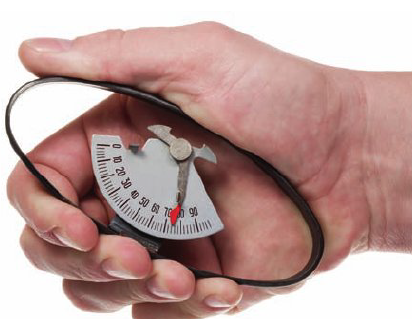
  • Dynamometry device = measures grip/ hand strength

  • Weak hand strength = pain

<ul><li><p>Hand weakness most common in female clinicians w/ petite hands</p></li><li><p>Device for grip — hand size is correlated in women, not men (Men with bigger hand have better grip strength)</p></li><li><p>Dynamometry device = measures grip/ hand strength</p></li><li><p>Weak hand strength = pain</p></li></ul><p></p>
13
New cards

Fingernail length

  • Any fingernail length beyond fingertip = decrease pinch grip strength

  • 1—2 cm past = decrease in flexion of finger joints (metacarpophalangeal joints)

  • Long fingernails = can’t stabilize dominant hand in patient’s mouth & may pinch patient’s oral cavity
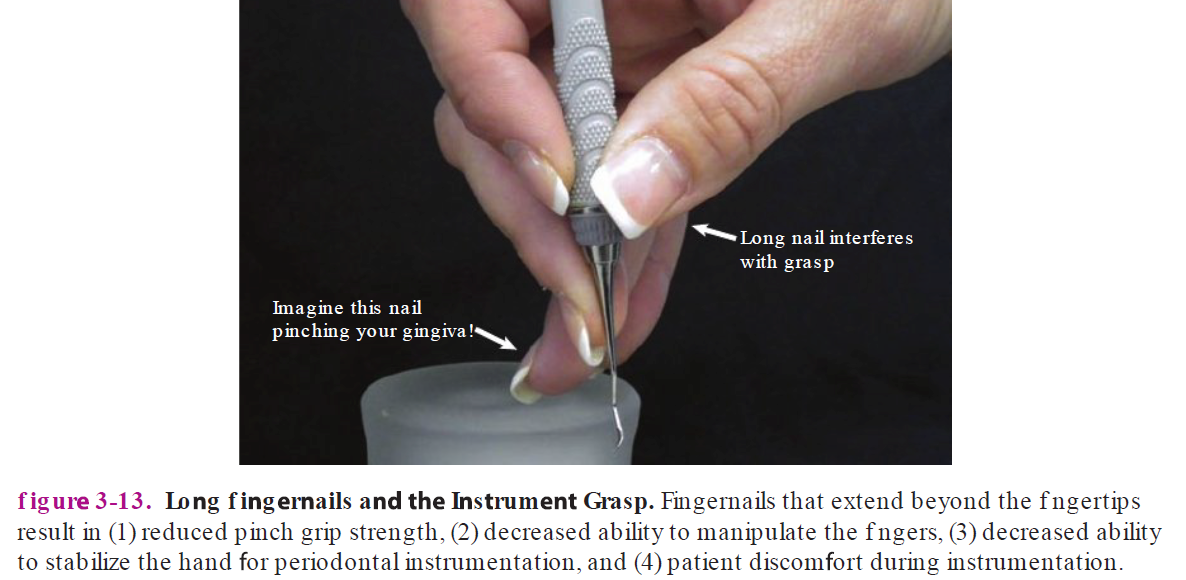
<ul><li><p>Any fingernail length beyond fingertip = decrease pinch grip strength </p></li><li><p>1—2 cm past = decrease in flexion of finger joints (metacarpophalangeal joints)</p></li><li><p>Long fingernails = can’t stabilize dominant hand in patient’s mouth &amp; may pinch patient’s oral cavity </p></li></ul><p></p>
14
New cards
<p><strong>Exercises for improving hand strength </strong></p>

Exercises for improving hand strength

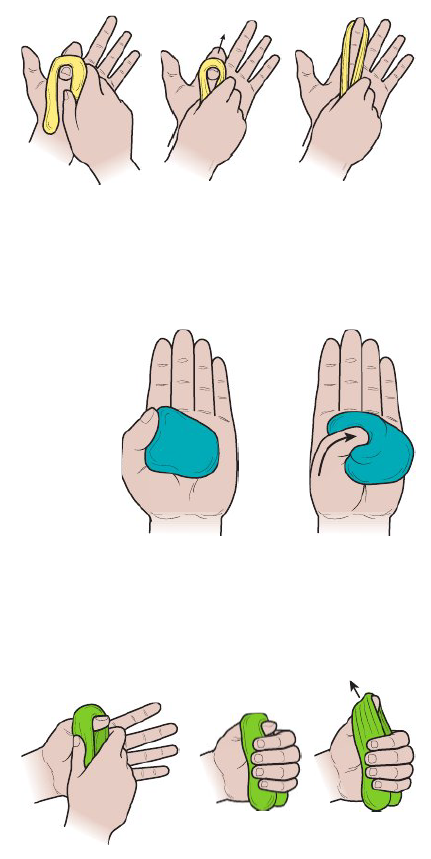
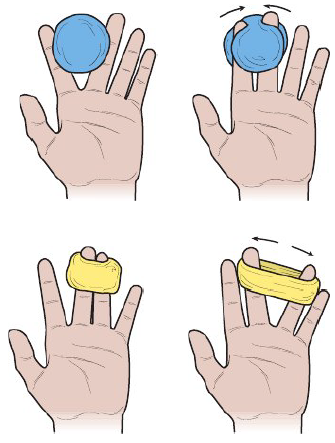
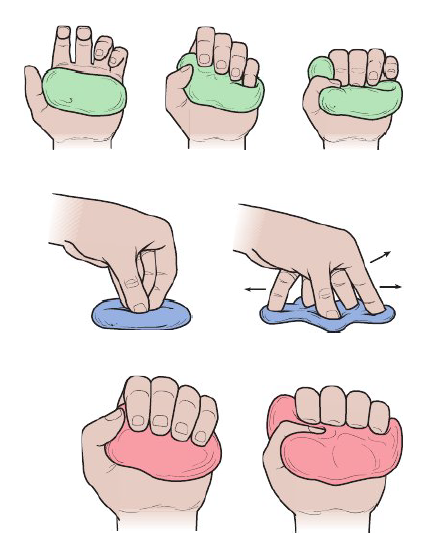
  1. Full grip (Flexor muscles)

  • Squeeze putty with fingers against palm, roll over and repeat with as much strength as possible

  • 10 reps

  1. Finger spread (Extensor and abductor muscles)

  • Pancake putty, bunch finger together and spread as fast as possible

  • 3 reps

  1. Finger dig (Flexor muscles)

  • Place putty in palm and dig fingertips into it. Release, roll over and repeat

  • 10 reps

  1. Finger extension (Extensor muscle)

  • Close 1 finger into palm, wrap putty over, and hold loose end with other hand. Quickly extend finger to fully opened position. Regulate difficulty by increasing or decreasing putty thickness over fingertip. Repeat w/ each finger.

  • 3 reps

  1. Thumb press (Flexor muscles)

  • Put putty in palm, press with thumb with max force.

  • 5 reps

  1. Thumb extension (Extensor muscles)

  • Bend thumb towards palm, wrap putty over thumb. Hold loose ends down and extend thumb out quickly. Regulate difficulty by increasing or decreasing putty thickness over thumb.

  • 3 reps

<ol><li><p><strong>Full grip (Flexor muscles) </strong></p></li></ol><ul><li><p>Squeeze putty with fingers against palm, roll over and repeat with as much strength as possible</p></li><li><p>10 reps </p></li></ul><p></p><ol start="2"><li><p><strong>Finger spread (Extensor and abductor muscles) </strong></p></li></ol><ul><li><p>Pancake putty, bunch finger together and spread as fast as possible</p></li><li><p>3 reps </p></li></ul><p></p><ol start="3"><li><p><strong>Finger dig (Flexor muscles)</strong></p></li></ol><ul><li><p>Place putty in palm and dig fingertips into it. Release, roll over and repeat</p></li><li><p>10 reps </p></li></ul><p></p><ol start="4"><li><p><strong>Finger extension (Extensor muscle) </strong></p></li></ol><ul><li><p>Close 1 finger into palm, wrap putty over, and hold loose end with other hand. Quickly extend finger to fully opened position. Regulate difficulty by increasing or decreasing putty thickness over fingertip. Repeat w/ each finger. </p></li><li><p>3 reps </p></li></ul><p></p><ol start="5"><li><p><strong>Thumb press (Flexor muscles)</strong></p></li></ol><ul><li><p>Put putty in palm, press with thumb with max force.</p></li><li><p>5 reps </p></li></ul><p></p><ol start="6"><li><p><strong>Thumb extension (Extensor muscles)</strong></p></li></ol><ul><li><p>Bend thumb towards palm, wrap putty over thumb. Hold loose ends down and extend thumb out quickly. Regulate difficulty by increasing or decreasing putty thickness over thumb. </p></li><li><p>3 reps</p></li></ul><p></p><p></p><p></p>
15
New cards
<p><strong>Exercises for improving hand strength        [continue]</strong></p>

Exercises for improving hand strength [continue]

  1. Fingers only (Flexor muscles)

  • Lay putty on fingers & squeeze w/ fingertip only. Keep palm flat and open

  • 10 reps

  1. Finger scissors (adductor muscles)

  • Place putty ball between 2 fingers, squeeze fingers together in scissor motion. Repeat for each pair of fingers

  • 3 reps

  1. Finger splits (Abductor muscles)

  • Wrap putty around fingers while closed together. Pull apart quickly. Repeat.

  • 3 reps

<ol start="7"><li><p><strong>Fingers only (Flexor muscles)</strong></p></li></ol><ul><li><p>Lay putty on fingers &amp; squeeze w/ fingertip only. Keep palm flat and open</p></li><li><p>10 reps</p></li></ul><p></p><ol start="8"><li><p><strong>Finger scissors (adductor muscles)</strong></p></li></ol><ul><li><p>Place putty ball between 2 fingers, squeeze fingers together in scissor motion. Repeat for each pair of fingers</p></li><li><p>3 reps</p></li></ul><p></p><ol start="9"><li><p><strong>Finger splits (Abductor muscles)</strong></p></li></ol><ul><li><p>Wrap putty around fingers while closed together. Pull apart quickly. Repeat.</p></li><li><p>3 reps </p></li></ul><p></p>