geog 1000 exam 4
 Call Kai
 Learn
Learn Practice Test
 Spaced Repetition
 Match
Match Flashcards
 Knowt Play
1/37

There's no tags or description
Looks like no tags are added yet.
Name | Mastery | Learn | Test | Matching | Spaced | Call with Kai |
|---|
No analytics yet
Send a link to your students to track their progress
38 Terms
What is the difference between weather and climate?
Weather is day-to-day variations in temperature and precipitation; climate is the long-term average weather conditions.
How does distance from the equator affect climate?
The further away from the equator, the cooler the climate, because less sun is received.
What is the relationship between elevation and temperature?
As elevation increases, atmospheric temperature decreases.
How does topography affect precipitation?
Mountains can block precipitation from moving between regions.
Which temperature of air can hold more water, warm or cold?
Warmer air can hold more water than cold air. As air temperature increases, its capacity to hold water vapor increases exponentially
What do we usually see on the windward side of a mountain?
Rainforests, because the mountain blocks rain from reaching the leeward side. This happens because moist air hits the mountain and is forced upward, where it cools, condenses, and releases moisture.
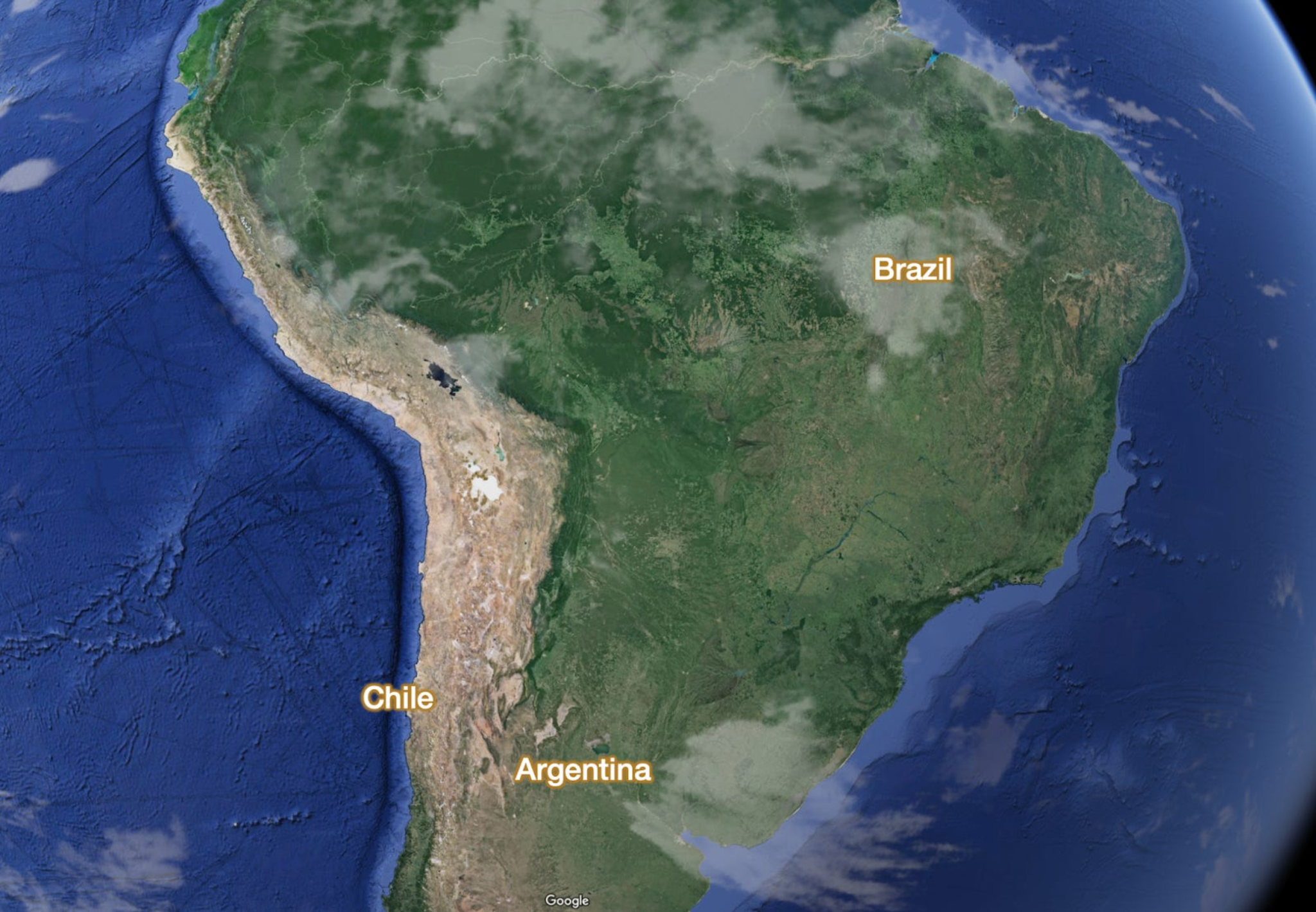
What is a rain shadow? What do we usually see in a rain shadow?
The side of a mountain that is blocked from rain, typically resulting in deserts. Because the mountains force air to rise and release moisture on one side, leaving it too dry to produce rain on the other
Why do oceans heat up and cool down more slowly than land?
Oceans store and disperse heat, unlike land. Primarily because water has a much higher specific heat capacity than soil or rock
How does distance from the ocean affect climate?
Coastal locations have more moderate temperatures, while distant locations experience extreme temperatures.
What is an ocean current?
The continuous, directional movement of water in the ocean. Ocean currents affect the amount of precipitation
What are the directions of warm and cool ocean currents?
Warm currents off the east coast flow clockwise; cold currents off the west coast flow counter-clockwise.
How do ocean currents affect precipitation on a continent's east and west coasts?
The west coast gets 110 inches of rain/year; the east coast gets 420 inches of rain/year.
What are the 5 broad categories of Köppen Climate Classification?
Type-A = Tropical, Type-B = Dry, Type-C = Temperate, Type-D = Continental, Type-E = Polar.
What is the Tropical (Rainforest & Monsoon) climate?
Zones around the equator. Warm and rainy all year long, must have 2.4 inches of rain each month. It has at least one dry month. Warm all year with wet and dry seasons.
What is the Subtropical (Arid & Semi-arid) climate?
Very little rain, hot and sunny. No precipitation and no vegetation. Semi: Little with some hardy vegetation.
What is the Temperature (Mediterranean, Marine West Coast, Humid Subtropical) climate?
Warm mid-latitude areas which have relatively mild temperature ranges year round. M: Long, hot, dry summers and short, cool, rainy winters. MWS:As wet as a tropical rainforest, mild summers and winters with heavy precipitation. HS: Hot, humid, summers & mild winters; rain throughout year
What is the Continental (Humid Continental & Subarctic) climate?
Cold mid-latitude areas with a large range of temperature. Cold winters; warm to hot summers; lots of precipitation. Long, severe winters and short cool summers.
What is the Polar (Tundra & Ice Cap) climate?
Areas which are extremely cold and dry all year around. Near or at the poles of the earth. Temperature never rises above freezing; year-round ice. T:Short “summer”; some vegetation; between 60-75 degree latitude. I:between 75-degree latitude and the poles; Temperature never rises above freezing; year-round ice and snow cover, Almost no precipitation or vegetation
What is the Arctic (tundra) climate?
Short summer with some vegetation, found between 60-75 degrees latitude.
What is climate change? How is it caused
Long-term shifts in global temperatures and weather patterns, driven by increase in greenhouse gases (carbon dioxide, methane, or nitrous oxide) in the atmosphere Natural: Volcanoes, Tectonic Plates, Shifts in orbit. Can also be caused by human activities - any activity that releases and traps greenhouse gases
Why is climate change a big issue today?
We are seeing its effects on Earth, caused by humans. Earth’s average temperature has risen faster than ever before. Also: Rising seas, animal migration, more wildfire, intense heat waves, etc.
What is the greenhouse effect?
Greenhouse gases act like a blanket around the Earth.
What are the different views on climate change?
Alarmed: Believes global warming is happening, takes measures to help prevent it
Concerned: Very sure it's happening, but less threatened.
Cautious. Somewhat sure that global warming is happening
Disengaged: Thinks it may be happening, but isn't sure
Doubtful: Does not know if real or not
Dismissive: Does not believe in global warming
What is the definition of natural resources? Examples
Anything created through natural processes that people use and value. Sunlight, air, water, soil, minerals, metals, fossil fuels (coal, oil, natural gas), vegetation, and wildlife. Characteristics: Cultural values, technology, and economic systems.
What is sustainability?
Resource use that meets the needs of the present without compromising the ability of future generations to meet theirs
What are the characteristics of nonrenewable and renewable resources?
Non-renewable resources (fossil fuels & natural gas) are not replaced in a practical time span; renewable resources (solar energy & air, wind, water) are continually replaced. Both can still be depleted
What are fossil fuels and how are they distributed across the world?
Coal, natural gas, and oil created from remains of plants and animals millions of years ago. Supplying ~80% of global energy, they are primarily used for electricity generation, transportation fuel (gasoline/diesel), and industrial processes. They are unevenly distributed, with large, concentrated deposits in the US, Russia, China, and the Middle East
How can we make more fossil fuels available to meet global energy needs in the future?
Increased investment in infrastructure, advancing extraction technologies to unlock unconventional reserves, and promoting policies that encourage production
What causes air pollution? What are the results of air pollution?
Burning fossil fuels causes air pollution; carbon dioxide emissions. Results include global warming and acid rain
What is acid rain? What primarily causes acid rain? Consequences?
Rain that contains acid due to chemicals reacting with water in the air from the atmosphere. Caused by the atmospheric emission of sulfur dioxide and nitrogen oxides caused by human activities It makes streams and lakes more acidic, harming aquatic life and damaging forests.
What are the sources of water pollution?
Improperly discarded chemicals, heavy use of fertilizers and pesticides, discarded wastes, and domestic sewage (sinks and toilets).
What is deforestation and its causes?
The purposeful, permanent clearing of forested land for other uses, such as agriculture, grazing, or infrastructure development. It can cause severe soil erosion, decrease in oxygen levels, increase in greenhouse gases, habitat destruction, etc.
How has human population growth negatively impacted the environment?
Human population growth is exponential; Earth has limited resources to support life. More demand for environmental resources, leading to deforestation, habitat loss, and biodiversity reduction
How has urban development negatively impacted the environment?
It consumes lots resources, produces waste and pollution, and displaces plants and animals. Destroying natural habitats, accelerating biodiversity loss, and altering climate patterns
What is biodiversity? Why is it important? Threats?
The enormous variety of life on Earth, which is one of Earth's greatest natural resources. It acts as the planet's self-sustaining life-support system. It represents the variety of all life—genes, species, and ecosystems. Threats: Overhunting, habitat destruction, introducing toxins to food webs, climate change, invasive species
What are invasive species?
Non -native species introduced by humans accidentally or intentionally to a new environment that can harm local ecosystems. (Ex. Cane toads introduced to Australia to pest insects, growth exponentially, predators died off)
What is the exotic pet trade? How can the exotic pet trade impact ecosystems?
When people illegally capture and sell exotic animals that most likely belong to an endangered species. Removing these animals from their natural habitat causes imbalances; impacts ecosystems by driving biodiversity loss, introducing invasive species that disrupt local food chains, and spreading novel diseases
What are the positive impacts humans can make on the environment?
Environmental management, preservation, awareness, pollution control, and afforestation.