Iii test 1 study guide
 Call Kai
 Learn
Learn Practice Test
 Spaced Repetition
 Match
Match Flashcards
 Knowt Play
1/39

There's no tags or description
Looks like no tags are added yet.
Name | Mastery | Learn | Test | Matching | Spaced | Call with Kai |
|---|
No analytics yet
Send a link to your students to track their progress
40 Terms
Definitions of RDA, EAR, etc in intro lecture
innervations (there’s 2) of the GI tract
intrinsic and extrinsic
Intrinsic innervation |
The enteric nervous system located within the GI tract wall itself (“in-house” semiautonomous nerve supply)
Extrinsic innervation
Nerves from outside the GI tract: the autonomic nervous system
Extrinsic innervation divisions
Parasympathetic nervous system (PNS) | Enhances motility and secretory activity |
Sympathetic nervous system (SNS) | Inhibits motility and secretion |
Layers of tissue surrounding the GI tract and their roles
Mucosa, Submucosa, Muscularis externa, Serosa (or adventitia in esophagus)
Mucosa role
Submucosa role
Contains connective tissue, blood vessels, lymphatic vessels, lymphoid tissue, and nerves; involved in blood flow and secretions
Muscularis externa role
Responsible for peristalsis and segmentation
Serosa (or adventitia in esophagus) role
Outer protective covering; serosa reduces friction with surrounding organs, while adventitia anchors the esophagus to nearby structures
3 layers of the mucosa
Mucosal membrane — Inner lining
Lamina propria — Connective tissue and lymphoid tissue for immune protection
Muscularis mucosa — Thin smooth muscle layer that helps create folds and local movement of the mucosa
Location of the 2 plexuses + secretions/substances needed for digestion
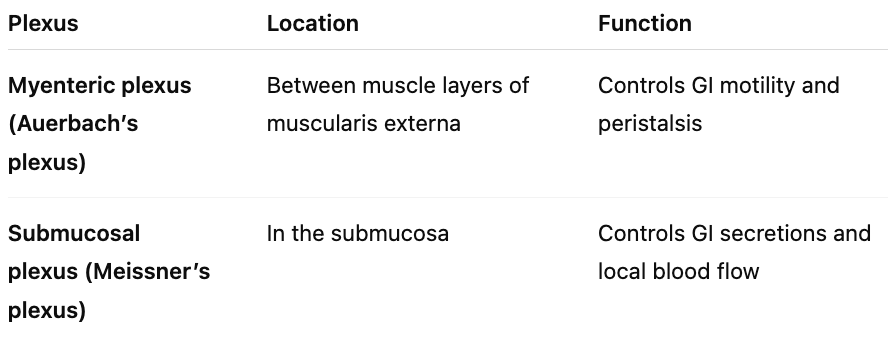
Myenteric plexus (Auerbach’s plexus) location
Between muscle layers of muscularis externa
Submucosal plexus (Meissner’s plexus)
In the submucosa
Myenteric = muscle/movement
Submucosal = secretion
Secretions and substances needed for digestion
with source and function
anatomy of the enterocyte (which border is which)
Apical border / brush border, Basolateral membrane, Tight junctions
Apical border / brush border
Faces the intestinal lumen/food; Contains microvilli and digestive enzymes for absorption
Basolateral membrane
Faces blood/interstitial fluid; Nutrients exit enterocyte through this side
Tight junctions
Between enterocytes; Regulate permeability between cells
brush border = enterocyte membrane on lumen side
Contains the glycocalyx and digestive enzymes
Differences between fat-soluble and water-soluble vitamins
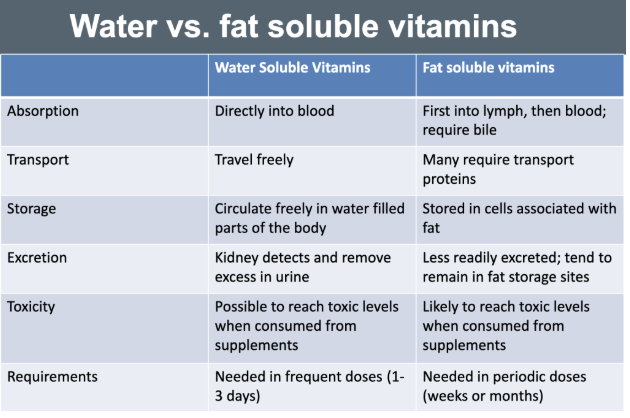
Differences between fat-soluble and water-soluble vitamins
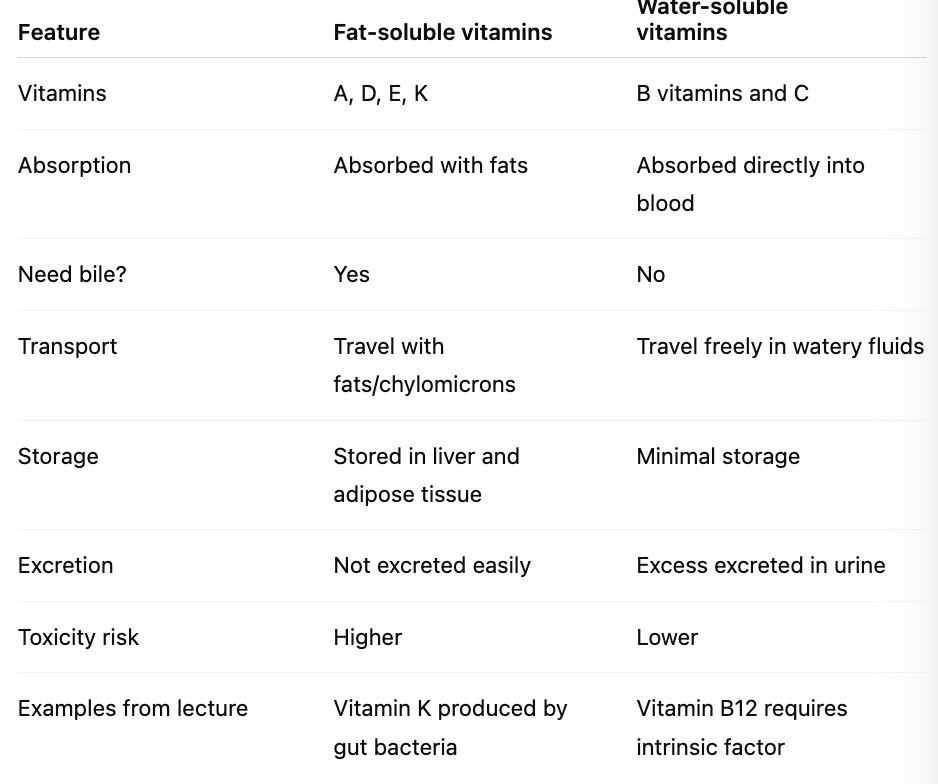
Fat-soluble vitamins depend on fat digestion and bile
Water-soluble vitamins dissolve in water and absorb more directly