Judicial Branch & Civil Liberties: Court Systems, Cases, and Rights
 Call Kai
 Learn
Learn Practice Test
 Spaced Repetition
 Match
Match Flashcards
 Knowt Play
1/37

There's no tags or description
Looks like no tags are added yet.
Name | Mastery | Learn | Test | Matching | Spaced | Call with Kai |
|---|
No analytics yet
Send a link to your students to track their progress
38 Terms
Judicial Branch
The branch of government responsible for interpreting laws.
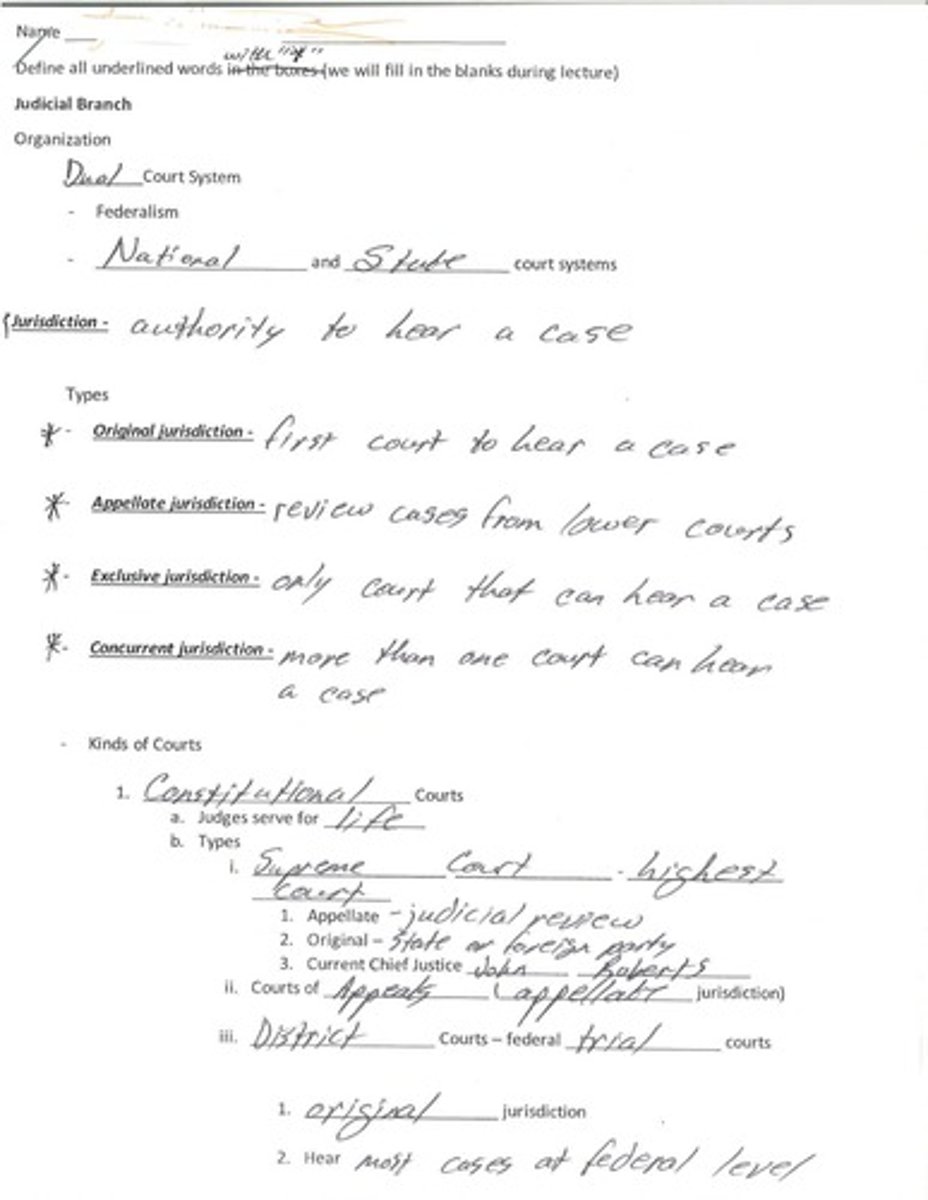
Dual Court System
The existence of both federal and state courts.
Federalism
A system of government where power is divided between a central authority and constituent units.
Jurisdiction
Authority to hear a case.
Original jurisdiction
The first court to hear a case.
Appellate jurisdiction
The authority to review cases from lower courts.
Exclusive jurisdiction
Only court that can hear a case.
Concurrent jurisdiction
More than one court can hear a case.
Supreme Court
The highest court in the United States.
Court of Appeals
Courts that review cases for appellate jurisdiction.
District Courts
Federal trial courts with original jurisdiction.
Writ of Certiorari
An order for a lower court to send a case up to a higher court.
Certificate
A lower court asks the Supreme Court to clarify a question.
Majority Opinion
The opinion of the court that reflects the majority's decision.
Concurring Opinion
An opinion that agrees with the majority but provides additional support.
Dissenting Opinion
The minority opinion that does not agree with the majority.
Judicial Restraint
Reluctance to declare legislative enactments unconstitutional unless obvious.
Judicial Activism
Judicial decisions influenced by the spirit of the times and needs of the nation.
Civil Rights
Protection against actions of government.
Civil Liberties
Government protecting people seeking constitutional guarantees.
Bill of Rights
The first 10 amendments to the Constitution.
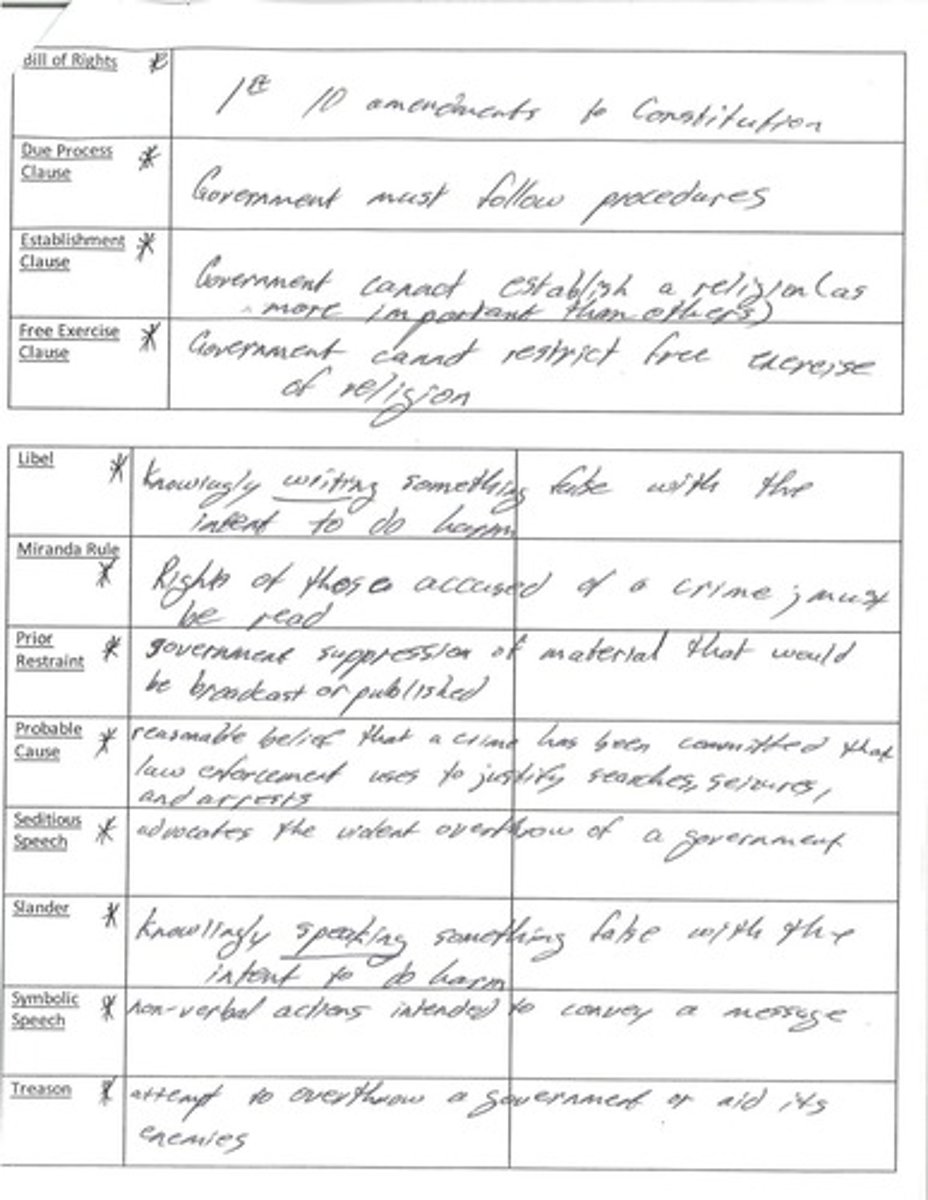
Due Process Clause
Government must follow procedures before depriving a person of life, liberty, or property.
Establishment Clause
Government cannot establish a religion.
Free Exercise Clause
Government cannot restrict free exercise of religion.
Libel
Knowingly writing something false with the intent to harm.
Miranda Rule
Rights of the accused must be read to them.
Probable Cause
Reasonable belief that a crime has been committed.
Seditious Speech
Speech advocating the violent overthrow of a government.
Slander
Knowingly speaking something false with the intent to harm.
Symbolic Speech
Non-verbal actions intended to convey a message.
Treason
Attempt to overthrow a government or aid its enemies.
Marbury v. Madison
Established judicial review.
McCulloch v. Maryland
Supreme Court sided with the national government regarding the constitutionality of a national bank.
Gibbons v. Ogden
Strengthened the Supremacy Clause and the Interstate Commerce Clause.
Brown v. Board of Education
Challenged separate but equal doctrine established in Plessy v. Ferguson.
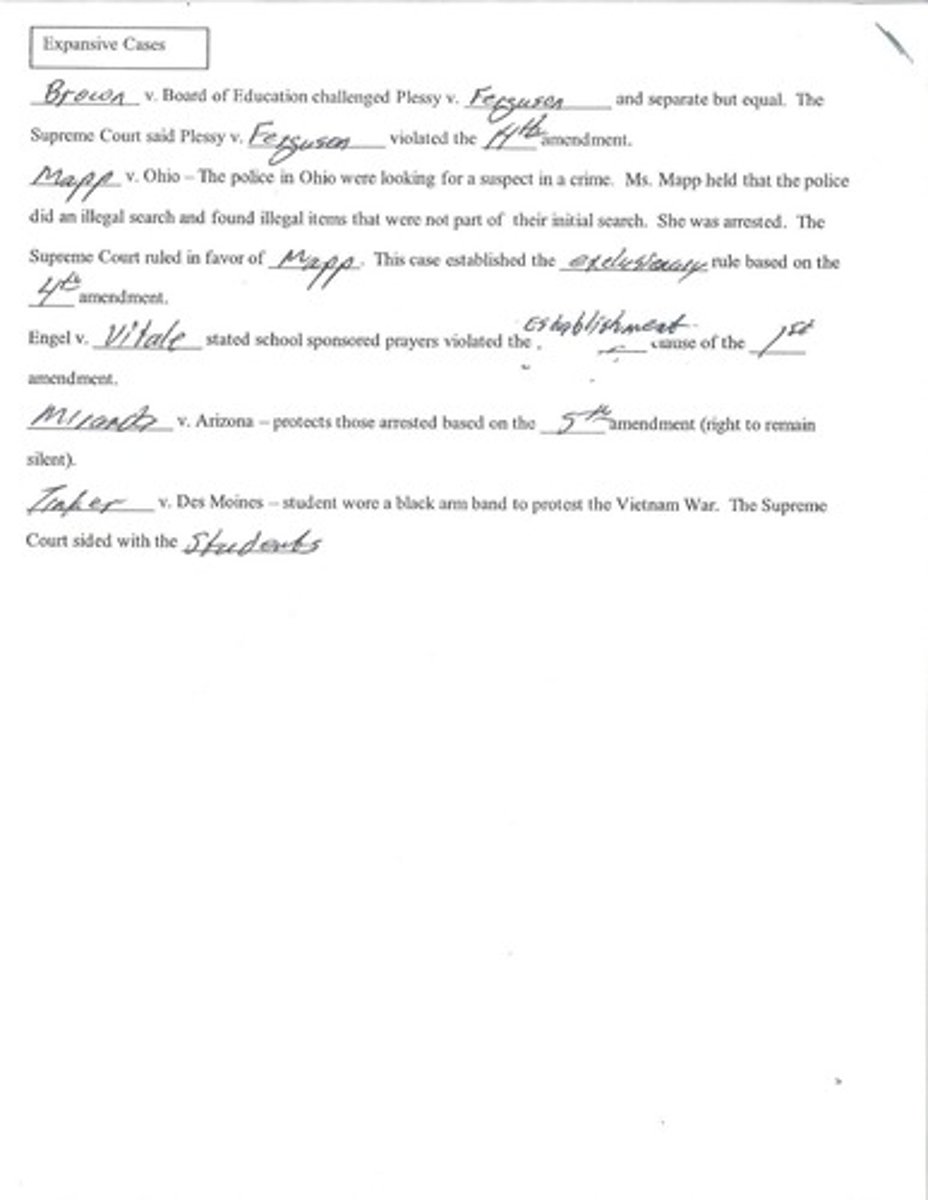
Mapp v. Ohio
Established the exclusionary rule based on the 4th amendment.
Engel v. Vitale
School-sponsored prayers violate the Establishment Clause.
Tinker v. Des Moines
Student speech is protected unless it is disruptive.