anatomy test 3
 Call Kai
 Learn
Learn Practice Test
 Spaced Repetition
 Match
Match Flashcards
 Knowt Play
1/235

There's no tags or description
Looks like no tags are added yet.
Name | Mastery | Learn | Test | Matching | Spaced | Call with Kai |
|---|
No analytics yet
Send a link to your students to track their progress
236 Terms
Neurology flashcards
define neurology
the study of normal functions and disorders of nervous system
whats the nervous system responsible for
all behaviors, memores, and movements
list 3 asic functions of nervous system
sense change
interpret change
react to change
what does the nervous system us to sense and react to stimuli
sensory receptors
effectors
how does reacting with effectors present
muscular contraction
glandular secretion
what are major structures of the nervous system
brain
cranial nerves
spinal cord
spinal nerves
ganglia
enteric plexus
sensory receptors
how many cranial nerves come from the base of the brain through the ___ of the skull
12;foramina
whats a nerve
a nerve is a bundle of hundreds or thousands of axons, each of
which courses along a defined path and serves a specific region of
the body.
the spinal cord connect to the ___ through the ____ of the skull and is encircled by the bones of the vertebral column
brain, foramen magnum
how many pairs of spinal nerves emerge from the spinal cord
31
true or false each spinal nerve serves a specific region of body
describe ganglia
groups of cell bodies of neurons located outside the brain and spinal cord
what does enteric plexuses do
helps regulates the digestive system
sensory receptors are part of neurons that ___
Sensory receptors are either parts of neurons or specialized cells that
monitor changes in the internal or external environment.
what’s another name for sensory neurons
afferent
what do association or interneurons do?
Serve the integrative function
– Analyze the sensory information, store some aspects, and make decisions
regarding appropriate behaviors
whats a name for motor neurons and what do they do
efferent
Serve the motor function
– Respond to stimuli by initiating action.
what does the central nervous system consist of
brain and spinal cord
What does the peripheral nervous system consist of
cranial and spinal nerves that contain both sensory and motor fibers
What does the peripheral nervous system do
connects CNS to muscles, glands and all sensory receptors
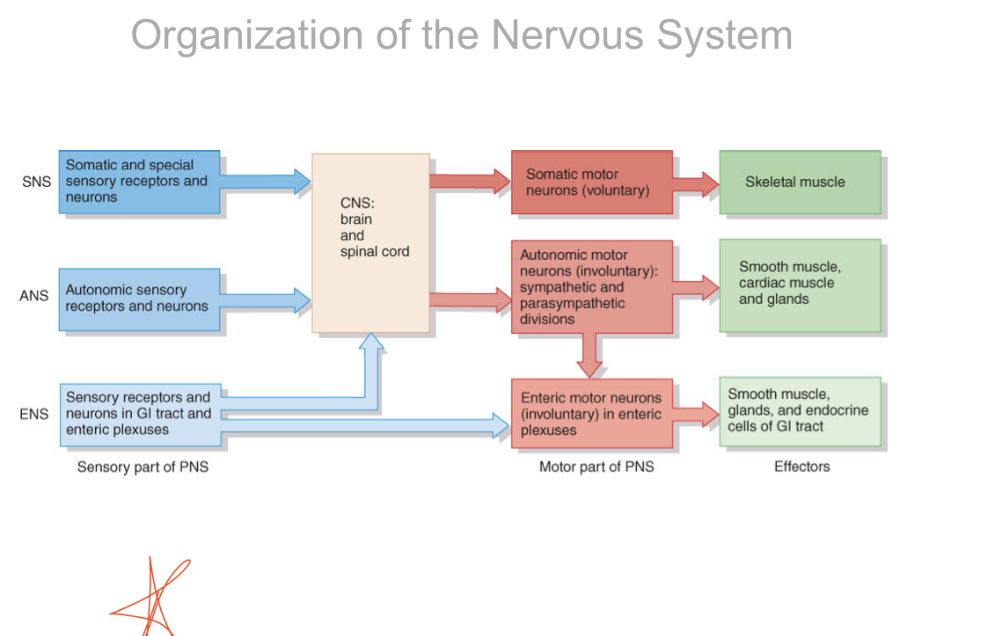
What are the sub divisions of the pns and are they voluntary or involuntary
somatic (voluntary)
Autonomic (involuntary)
Enteric
What does the somatic nervous system consist of and what parts of the body does it connect to the cns
Afferent (sensory) neurons from cutaneous and special sensory
receptors to the CNS
– Efferent (motor) neurons to skeletal muscle tissue
What parts of the body does the autonomic nervous system connect to the the cns
sensory neurons from visceral organs to CNS
– motor neurons to smooth and cardiac muscle and glands
What are 2 subdivisions of the autonomic ns and what do they do
sympathetic division; e.g., speeds up heart rate
• parasympathetic division; e.g., slows down heart rate
true or false there are neurons in the enteric nervous system that extend the length of te gi tract
true
true of false the neurons of the enteric plexus depend on the ANS and CNS to operate
No, they operate independently
what do the afferent and efferent neurons of the ens do
Sensory neurons of the ENS monitor chemical changes within the
GI tract and stretching of its walls
• Enteric motor neurons govern contraction of GI tract organs, and
activity of the GI tract endocrine cells.
what are chemoreceptors for
respond to chemicals
mechanoreceptors are for…
responding to mechanical stimuli
what are the two types of cells in the nervous system and describe them
Neurons: functional cells of the nervous system. Transmit information from one part of the
body to another.
2. Neuroglia: support cells.
which are smaller neurons or neuroglia and which is more abundant
neuroglia
What can happen because neuroglia divides so much
Gliomas: tumors that
result from rapid mitosis
of neuroglia
what is the reason when you have nerve damage theres little regeneration
neurons are post mitiotic and dont divide
whats the functional unit of the nervous system
neuron
do neurons have capacity to produce action potentials
yes
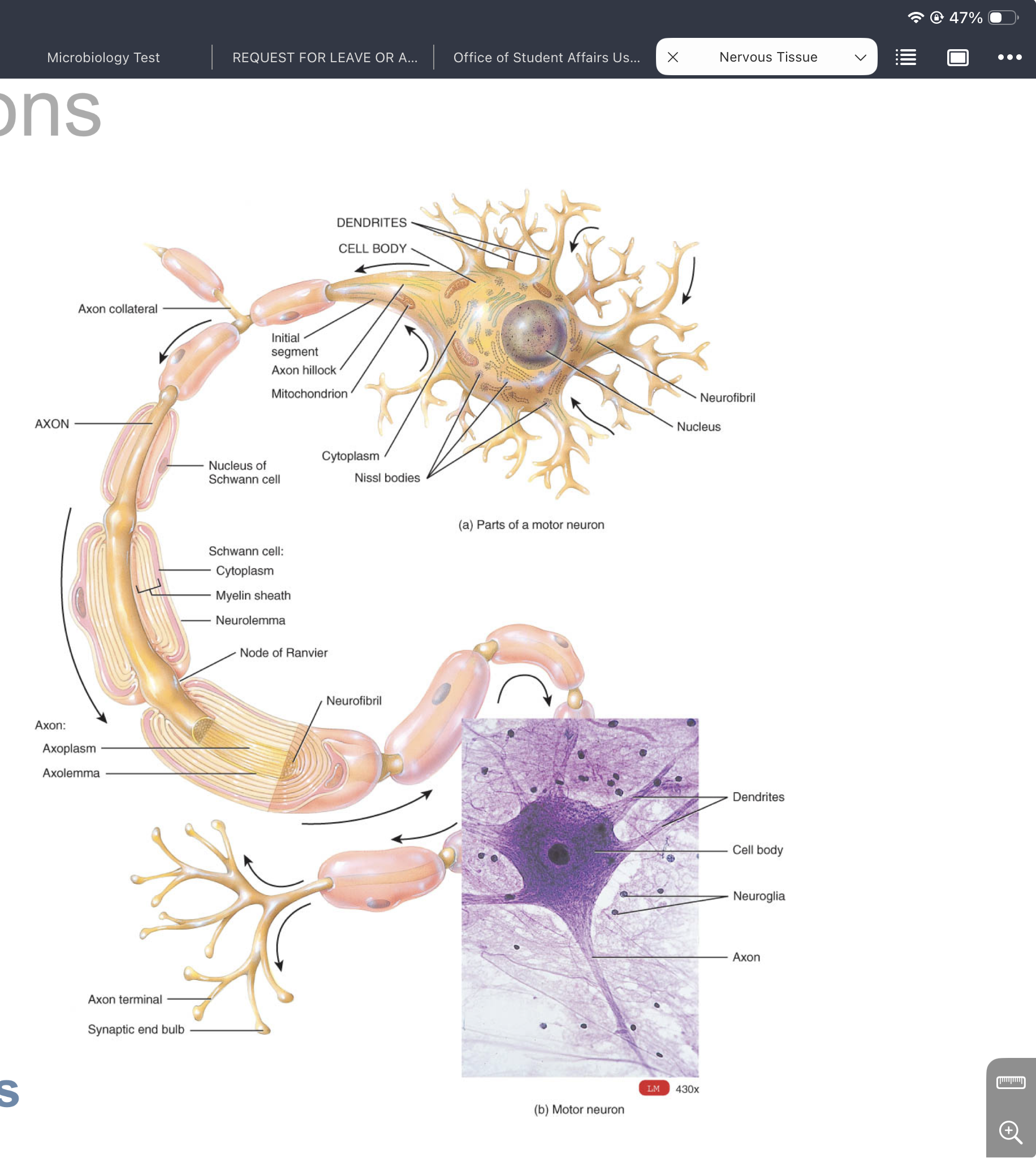
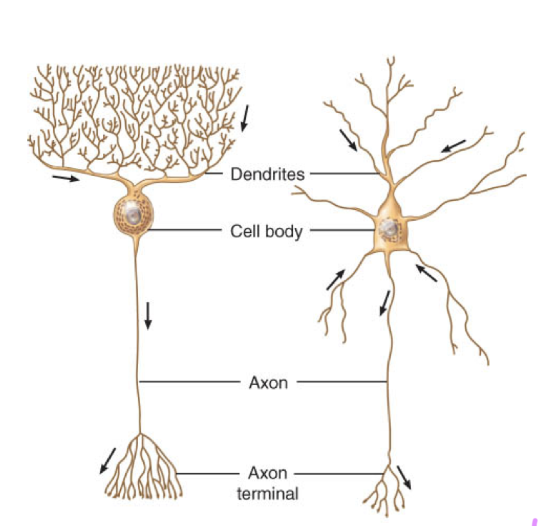
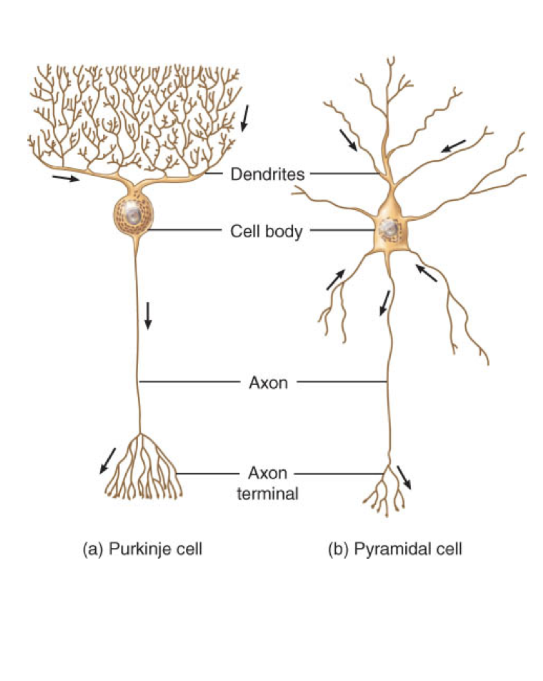
What are the parts of a neuron
Cell body
– single nucleus with prominent
nucleolus
– Nissl bodies (chromatophilic
substance): rough ER and free
ribosomes for protein synthesis
– neurofilaments give cell shape
and support
– microtubules move material
inside cell
• Cell processes: dendrites and axons
Dendrites conduct impulses ___ the cell body
toward
true or are axons or dendrites specialized for contact with other neurons
dendrites
which cell process is unmyelinated
dendrites
do axons conduct impulses towards or away from the body
away
true or false in axonal transport the cell body is location for most protein synthesis if so give an example
neurotransmitters and repair proteins
what are the axonal transport systems
slow and fast
true or false in slow axonal transport movement in one direction only- away from cell body
• 1-5 mm per day
true
What does fast axonal transport do and describe it
Fast
• moves organelles and materials along surface of microtubules
• 200-400 mm per day
• transports in either direction
• substances to be used/recycled in cell body
what are examples of fast axonal transport and disease and how does it work
Fast axonal transport: route by which toxins or
pathogens reach neuron cell bodies
– tetanus (Clostridium tetani bacteria): disrupts motor neurons
causing painful muscle spasms
– When bacteria enter the body through a laceration or puncture
injury, the wound is more serious if it is in the head or neck
because of shorter transit time
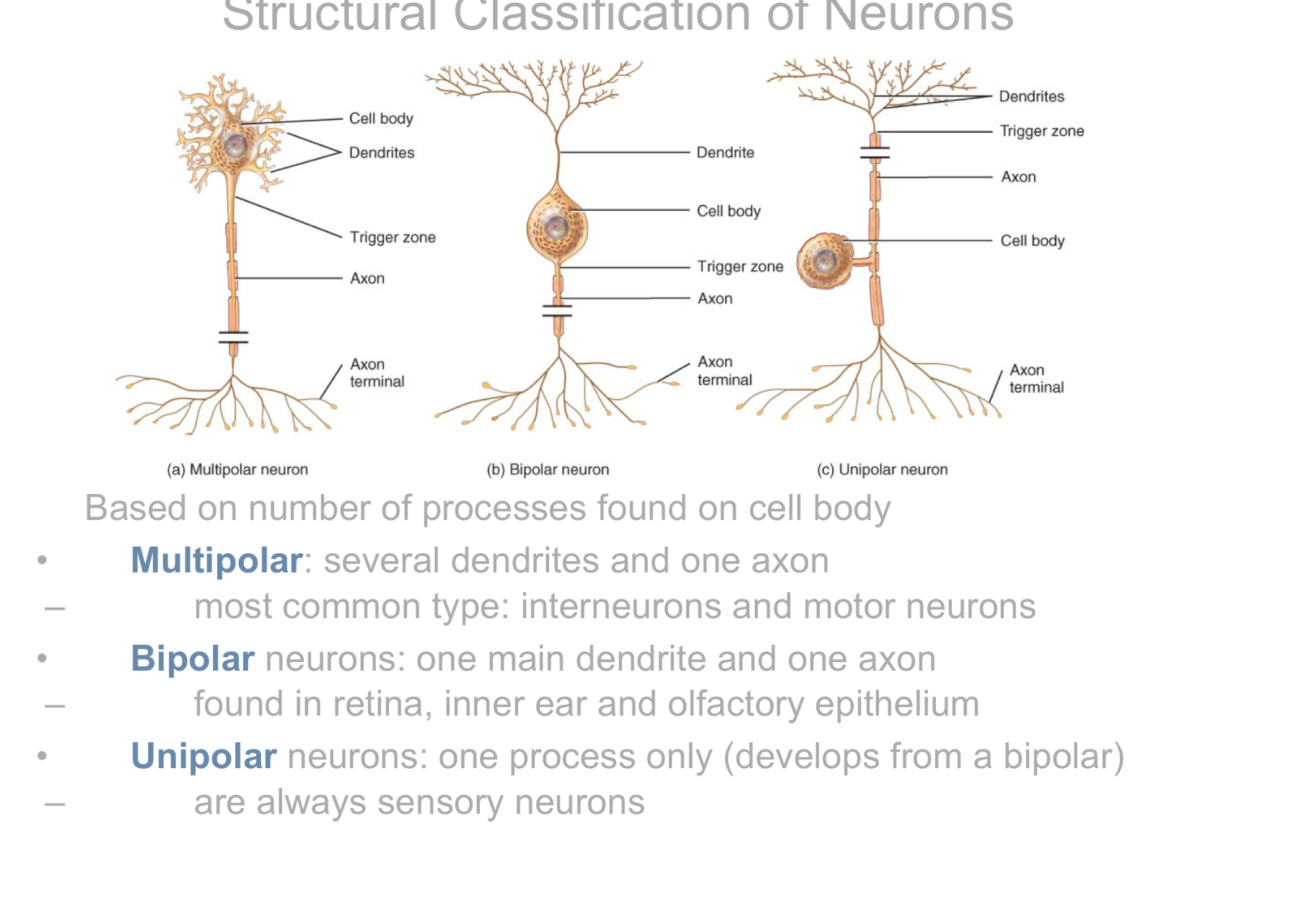
What are the structural classifications for neurons and describe them
Based on number of processes found on cell body
• Multipolar: several dendrites and one axon
– most common type: interneurons and motor neurons
• Bipolar neurons: one main dendrite and one axon
– found in retina, inner ear and olfactory epithelium
• Unipolar neurons: one process only (develops from a bipolar)
– are always sensory neurons
Define nerves
a bundle of hundreds or thousands of axons, each of
which courses along a defined path and serves a specific region of
the body
are dendrites myelinated or unmyelinated
unmyelinated, because they are specialized for contact with other nuerons
Blank ____ neurons carry impulses from sensory receptors to the central nervous system
Afferent
the autonomic nervous system controls ___ & ____ muscles and glands
smooth and cardiac
the myelin sheath in the cns is produced by _____
oligodendrocytes
the myelin sheath in the pns is produced by
Schwann cells
Purpose of myelin sheath
The myelin sheath is a fatty, insulating layer wrapped around nerve cell axons that functions primarily to speed up electrical impulse conduction and provide metabolic support. It enables rapid, efficient signaling (saltatory conduction) through gaps called nodes of Ranvier, crucial for healthy motor and sensory function.
are the functional unit of the nervous system
nuerons
the ___ is the part of a neuron that conducts impulses away from the cell body
Axon
The ___ is matter in the CNS consist primarily of myelinated axons (processes)
white
Describe the difference between the sympathetic and parasympathetic divisions of the nervous system
sympathetic speed up the heart rate and para sympathetic slows down the heart rate
the ____ matter in thr cns consist primarily of myelinated axons (processes
White
explain how fast and slow axonal transport differs
Fast transports in both directions and allows for the movement of organelles and materials along surface of microtubules (200-400mm)
Slow only allows for movement away from body in 1-5 mm per day
What is the functional significance of nodes of ranvier
Allows for high-speed/efficient signal transmission through "saltatory conduction," where action potentials "jump" from node to node.
what is the role of Na+/K+ Atp pump in maintaining resting membrane
The Na+/K+ATPase pump maintains the resting membrane potential (typically around \(-70mv) by actively transporting three sodium ions (Na+) out of the cell and two potassium ions (K+) in, using ATP.
what are the structural classifications of neurons and their make up and explain where theyre found
Multipolar- several dendrites and 1 axon, primarily found in cns, and most common type is interneurons and motor neurons.
Bipolar: one dendrite and one axon, found in retina, inner ear and olfactory epithelium
Unipolar: only one process and develops from Bipolar, always sensory neurons
3 types of ion channels and examples
Leakage channels: gates open and close constantly
allowing specific ions to diffuse through
– specific types we’ll consider: Na, K, and Ca
Gated channels open and close in response to a stimulus
– specific types we’ll consider: Na+, K+, and Ca2+ (voltage, ligand, mechanical)
Active Transport Channels
– Na+/K+ ATPase pump keep resting cell membrane
function of leakage channels, gated channels, and active transport channels
leakage: remain randomly open to allow ions (K+) and (Na+) to pass through continuously. They are crucial for maintaining the neuron's resting membrane potential, creating a negative charge inside the cell (roughly -70 mV).
gated: Control ion flow in response to specific triggers to allow for electrical signaling like action potentials.
Active Transport : Actively move ions (e.g., Na+, K+, Ca2+) against their concentration gradient, which is crucial for maintaining the resting potential that passive channels rely on.
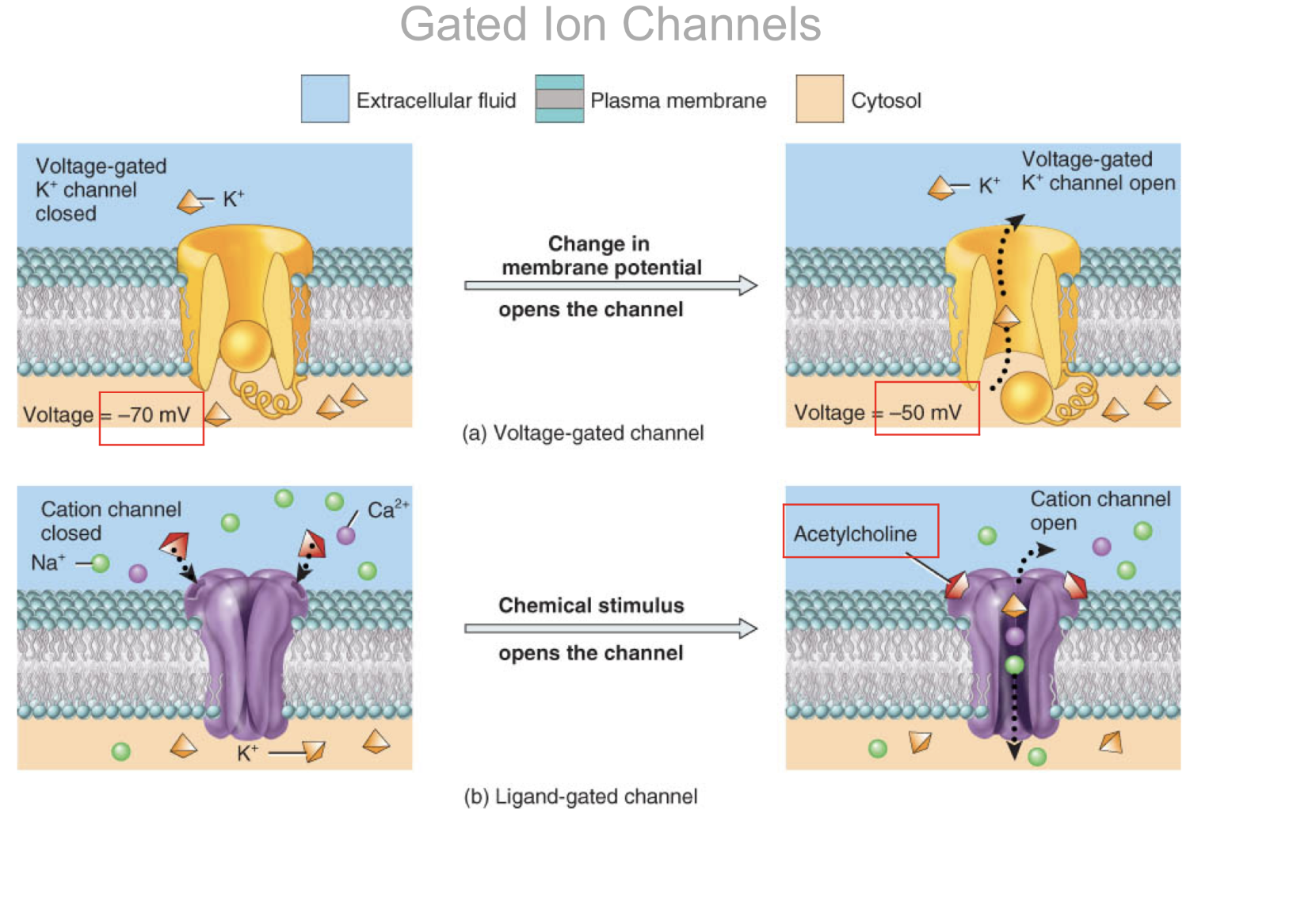
What are the 3 types of gated ion channels and whats their functions
3 types of gated ion channels:
Voltage-gated channels respond to a direct change in the membrane
potential. Fig. 12.11 a
• Types we’ll consider: Na+, K+, and Ca+2
Ligand-gated channels respond to a specific chemical stimulus. Fig. 12.11
b
• Type we’ll consider: Na+ channels responding to the neurotransmitter
acetylcholine
Mechanically gated ion channels respond to mechanical vibration or
pressure.
major structures of nervous system and their function
The nervous system is organized into the central nervous system (CNS—brain and spinal cord) for processing information and the peripheral nervous system (PNS—nerves and ganglia) for transmitting signals throughout the body. Key functions include sensory input (detecting changes), integration (processing), and motor response (acting on information).
3 basic function of nervous system
sense stimuli, interpret information, and respond
what is the role of myelination in the nervous system
protect and insulate axons
accelerate speed of signal transmission
draw a nerve cell
what are divisions of the nervous system
CNS & PNS
what are the sub divisions of the nervous system
Somatic, autonomic (parasympathetic and sympathetic), enteric
Where do sensory neurons transport information from and to
from the skin, muscles, joints, sensory organs, and viscera organs to the cns
what doe motor neurons do
send motor nerve impulses to muscles and glands
wat do interneurons do
connect sensory to motor neurons
Example of voltage gated channel
Na+, K+, Ca2+
Example of Ligand gated channel
Na+ channels responding to the neurotransmitter acetylcholine
What is a disease related to axonal transport
tetanus
How does tetanus work
disrupts motor neurons causing painful muscle spasms
What does the myelin sheath consist of and what does the neurilemma
Myelin sheath: multiple layers of Schwann cell plasma membrane
wrapped around an axon
• Neurilemma is cytoplasm and nucleus of the Schwann cell
myelinated axons are considered
white matter
when are myelin sheaths completely developed
after 1 year
What are some diseases where you see yelin degeneration
multiple sclerosis
diabetes mellitus
true or false when axons are severed they can regenerate
true
where do unmyelinated axons rest
invaginations of Schwann cells or
oligodendrocytes
true or false unmyelinated cells can be considered white matter
no gray matter
Oligodendrocytes myelinate the axons in what part of the nervous system
cns
You only see neurilemma in what part of the nervous system and why
in the pns bc it comes from schwann cells
Why is there little regrowth after injury in the cns
lack of a distinct tube and neurilemma
What do these all have in common, nerve cell bodies, dendrites, axon terminals,
bundles of unmyelinated axons and neuroglia
gray matter
How does gray matter look in the spinal cord
forms an H- shaped inner core surrounded by white matter
how does gray matter present in the brain
thin outer shell of gray matter covers the surface and
is also found in clusters called nuclei inside the CNS
In terms of the brain what is the nucleus
a mass of nerve cell bodies and dendrites inside the cns
What are the two types of electrical signals neurons use to communicate and describe each one
action potentials that can travel long distances
– graded potentials that are local membrane
changes only
true or false depolarization causes the cell to be less negative and the outside to be come more positive
true
true or false with action potential Voltage does not diminish as the action potential is propagated away from the site of stimulus
true
what is hyperpolarization
Voltage does not diminish as the action potential is propagated
away from the site of stimulus
true or false Graded potentials occur most often
in the axons and cell body of a
neuron.
False graded potentials occur most often in the dendrites and cell body of a neuron.
How do graded potentials arise
Source of stimuli
– mechanical stimulation of membranes with mechanical gated ion channels (pressure)
– chemical stimulation of membranes with ligand gated ion channels (neurotransmitter)
• Graded/postsynaptic/receptor or generator potential
– ions flow through ion channels and change membrane potential locally
– amount of change varies with strength of stimuli
• Flow of current (ions) is local changeonly
• If the graded potential is great enough, then voltage-gated ion channels open and an action