Intro to Neuro Ch. 6 Book
 Call Kai
 Learn
Learn Practice Test
 Spaced Repetition
 Match
Match Flashcards
 Knowt Play
1/98

There's no tags or description
Looks like no tags are added yet.
Name | Mastery | Learn | Test | Matching | Spaced | Call with Kai |
|---|
No analytics yet
Send a link to your students to track their progress
99 Terms
Sounds enter the ear as pressure waves which _____.
push and pull the eardrum, causing it to vibrate
If a sound is _____, a muscle pulls the stirrup away from the most sensitive parts.
too loud
Each of the 30,000 sensors picks a different part of the sound and sends it to _____.
the brain
The external ear consists of the part on the outside of the head called the _______ plus the _______, which leads to the eardrum.
pinna, ear canal
The middle ear consists of a series of miniscule bones—the malleus, incus and stapes—connecting the eardrum to the cochlea. The primary function of the middle ear is to _____ .
amplify sound.
The principal elements for converting sounds into neural activity are found on the basilar membrane. This membrane vibrates in response to sound, with the apex displaced maximally by _______ sound, and the base displaced maximally by _______ sound.
low-frequency, high-frequency
Ion channels on the stereocilia of auditory hair cells are activated by _____.
mechanical energy
What is the correct order for the pathway from the cochlea to the auditory cortex?
Cochlea, cochlear nucleus, superior olivary nucleus, inferior colliculus, medial geniculate nucleus, auditory cortex
Which statement is false?
Tonotopic organization occurs at the inferior colliculi, but not the cochlea.
Which of the following is a measure of sound intensity, perceived as loudness?
Decibel
True or False: The frequency of sounds is perceived as loudness
FALSE
__________ is the number of cycles per second in a sound wave, measured in hertz.
Frequency
Which of the following statements are true of the external ear? Select all that apply.
The external ear helps capture, focus, and filter sounds.
The shape of the external ear provides cues about the distance of the source of a sound.
The auditory canal is part of the external ear.
True or False: The external part of the ear is called the oval window.
FALSE
Which of the following statements is true of IHC afferents?
They convey to the brain the action potentials that provide the perception of sounds.
Which of the following is a reason why each successive location along the basilar membrane shows its strongest response to a different frequency of sound?
The basilar membrane is tapered.
Even a tiny bend of the stereocilia in the ear produces a large and rapid depolarization of the hair cells. Which of the following causes this depolarization?
The operation of a special type of large and nonselective ion channel found on stereocilia
The __________ of the middle ear concentrate and amplify vibrations from the air.
ossicles
The part of the inner ear that ultimately converts vibrations from sound into neural activity is the __________.
Cochlea
Identify the complementary theories that explain the ways in which the pitch of sounds is encoded. Select all that apply.
Place coding theory
Temporal coding theory
True or False: Temporal coding is most evident at lower frequencies, up to about 4,000 Hz.
True
Which of the following are binaural cues that are analyzed by the human auditory system to detect the location of a sound source? Select all that apply.
Interaural intensity differences
Interaural temporal differences
Identify the types of interaural temporal differences (ITDs).
Ongoing phase disparity
Onset disparity
By adulthood, the portion of primary auditory cortex where music is first processed, called __________, is more than twice as large in professional musicians as in nonmusicians.
Heschl’s gyrus
Which of the following is a disorder characterized by the inability to discern tunes accurately or to sing?
Amusia
Who among the following 40-year-olds is most likely to show enhanced speech perception?
Derek, who underwent classical music training from age six
__________ is defined as very-low-frequency sound, generally below the 20 Hz threshold for human hearing.
Infrasound
True or False: Intensity difference is defined as a perceived difference in loudness between the two ears, which the nervous system can use to localize a sound source.
True
Select the passage that discusses the functions of auditory cortex from an ecological perspective.
Mammalian species employ a huge range of frequencies in their vocalizations, from infrasound in elephants and whales to ultrasound in bats and porpoises and many other species. These sounds have been shaped by evolution to serve special purposes. For example, many species of bats analyze the reflected echoes of their ultrasonic vocalizations to navigate and hunt in the dark. At the other end of the spectrum, elephants emit ultra-low-frequency alarm calls that are so powerful that they travel partly through the ground and are detected seismically by other elephants and yet are so nuanced that the elephants can distinguish human-related threats from bee-related threats and can use their “rumbles” to identify potential mates.
Which of the following is a hearing impairment in which the ears fail to convert sound vibrations in air into waves of fluid in the cochlea?
Conduction deafness
In the context of restoring auditory stimulation in deafness, which of the following is true of cochlear implants?
These devices can detect sounds and selectively stimulate nerves in different regions of the cochlea.
Which of the following is true of cortical deafness?
It involves bilateral lesions of auditory cortex.
Which of the following are types of central deafness? Select all that apply.
Cortical deafness
Word deafness
True or False: Most cases of central deafness involve a simple loss of auditory sensitivity.
False
In the context of hearing loss, __________ involves selective trouble with speech sounds despite normal speech and normal hearing for nonverbal sounds, whereas __________ involves more-complete impairment, struggling to recognize all complex sounds, whether verbal or nonverbal.
word deafness; cortical deafness
Which of the following are true of sensorineural deafness? Select all that apply.
Sensorineural deafness is most often the result of permanent damage or destruction of hair cells.
Treatments for sensorineural deafness focus on the use of prostheses.
Sensorineural deafness can be caused by medical problems such as infections and adverse drug effects.
Sasha visits a doctor after experiencing hearing loss. The doctor finds that Sasha's ear is unable to convert sound waves in the air into waves of fluid within the cochlea. Which of the following treatment methods should the doctor best use to treat Sasha? Select all that apply.
Use of Teflon prosthetics to restore the transmission of sound vibrations to the cochlea
Use of hearing aids that employ electronic amplification
Surgical freeing up of the ossicles if they are fused together
A sensation of noises or ringing in the ears not caused by external sound is referred to as __________.
tinnitus
True or False: Anyone listening to something for more than 5 hours per week at 89 dB or louder is exceeding workplace limits for hearing safety.
True
Which of the following is the primary function of the vestibular system of the human body?
Giving the sense of balance
Identify the components of the human vestibular system. Select all that apply
Semicircular canals
The saccule
The utricle
Identify the technical terms for the different axes in which the human head can rotate. Select all that apply.
nodding up and down (technically known as pitch), shaking from side to side (yaw), and tilting left or right (roll).
True or False: A human being's sense of balance is primarily the product of the pressure exerted by the feet on the ground
False
The receptors of the vestibular system are __________. The cilia of these cells are embedded in a gelatinous mass inside an enlarged chamber called the __________.
hair cells; ampulla
Which of the following factors causes motion sickness?
Movements of the body that one cannot control
Ryan and Sana discuss various features of the vestibular system. Ryan says, “Hair cells of the vestibular system act as the receptors of the vestibular system.” Sana says, “Vestibular information is insignificant in directing the eyes and ears toward specific locations when our bodies are themselves in motion.” Which of the following statements is true about this scenario?
Ryan's statement is correct.
True or False: According to the sensory conflict theory, people feel bad when they receive contradictory sensory messages, especially a discrepancy between vestibular and visual information.
True
In the context of tastes, __________ is described as the full-bodied, thick, mouth-filling quality of some foods.
kokumi
True or False: The numerous little bumps on our tongues are taste buds.
False
Identify the kinds of papillae that occur in different locations on the tongue. Select all that apply.
Foliate papillae
Circumvallate papillae
Fungiform papillae
True or False: Each papilla houses only one taste bud
False: Taste buds, each consisting of a cluster of 50–150 taste receptor cells, are found buried within the walls of the papillae. A single papilla may house several such taste buds
True or False: Each taste cell is sensitive to all the five basic tastes.
False; Each taste cell is sensitive to just one of the five basic tastes.
Taste projections of the gustatory system ultimately extend to the __________.
somatosensory cortex
__________ are fine fibers that extend from taste receptor cells into a tiny pore, where they come into contact with substances that can be tasted, called __________.
Microvilli; tastants
The combination of T1R2 and T1R3, two members of the T1R family, makes a receptor that selectively detects _______ tastants
sweet
In contrast with many other receptor cells in the body, olfactory receptor cells _____.
are periodically renewed
Humans have approximately _______ different olfactory receptor genes in the genome, although only about half of them appear to be fully functional.
1000
What is the best description of olfactory receptor molecules?
G-protein linked receptors
True or False: Our ability to perceive a large number of different odors is what produces the complex array of flavors that we normally think of as tastes.
True
True or False: One glomerulus receives input exclusively from one specific class of odorant receptors.
True
Which of the following is the only sensory modality that synapses directly in the cortex rather than having to pass through the thalamus?
smell
True or False: Humans possess one of the most developed and functional vomeronasal organs.
False: The vomeronasal organ is either vestigial or absent in humans, and almost all of our V1R and V2R receptor genes have become nonfunctional “pseudogenes” over evolutionary time.
Olfactory information is conveyed to the brain via the axons of mitral cells, which extend from the glomeruli to various targets. Which of the following are among the targets? Select all that apply.
The prepyriform cortex
The hypothalamus
The amygdala
Alex and Taylor are siblings. As they walk by a bakery, they smell freshly baked bread. They are both reminded of a time in their childhood when their grandmother used to feed them bread for breakfast. Which of the following is the reason why the smell of bread made Alex and Taylor remember their childhood?
The same limbic structures that act as targets for olfactory inputs are also closely involved in memory and emotion.
Which of the following statements accurately indicates the differences between humans and dogs in terms of olfaction?
Dogs have 100–300 million olfactory receptor neurons, whereas humans have 6 million olfactory receptor neurons.
Olfactory receptor neurons are found in the ___________.
olfactory epithelium
Each olfactory neuron extends a fine, unmyelinated axon into the nearby olfactory bulb of the brain, where it terminates on one specific __________—a spherical clump of neurons—out of the thousands that exist in the olfactory bulb.
glomerulus
True or False: Within the 5–10 square centimeters of olfactory epithelium that we possess, about 6 million olfactory receptor neurons are found.
True
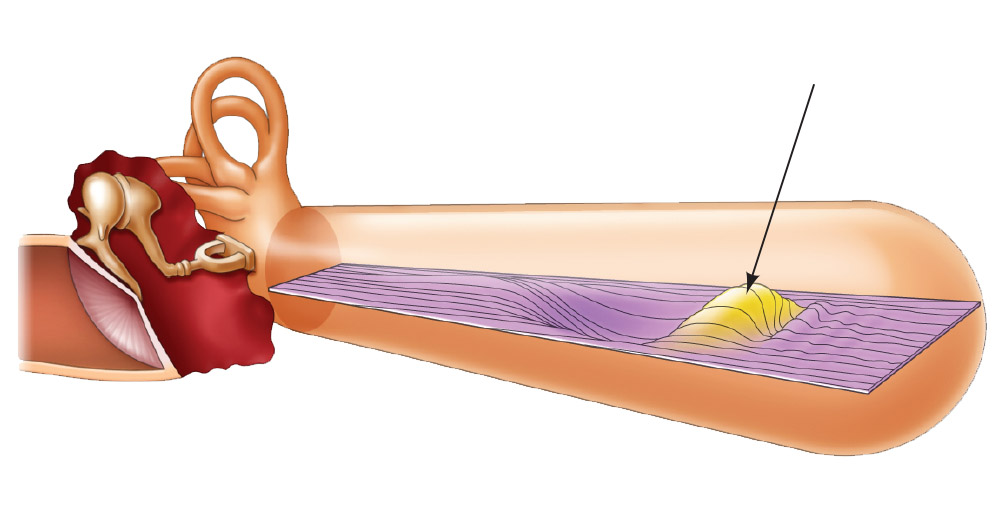
According to the image, the sound that is being produced is a ___ frequency sound, because the greatest displacement of the basilar membrane is at the ___
Low frequency, at the apex
What does it mean that sound is ‘transduced’ in the cochlea?
That this is where mechanical sound waves are converted to neural activity.
What is the name for the phenomenon that is produced when higher frequencies hit one ear before the other, preventing sound from reaching both ears with equal loudness?
Sound shadow
Which of the following statements about our hearing is/are true? Select all that apply.
Aging reduces our ability to distinguish between sounds that occur simultaneously.
A baby gets better at distinguishing sounds in the language(s) they hear.
Repeated exposure to a sound of the same frequency can change auditory cortical cell responsivity.
Damage to the eardrum that prevent it from vibrating in response to sound would cause what kind of deafness
Conduction deafness
When a person is born with a genetic abnormality that interferes with the function of their hair cells. would cause what kind of deafness
sensorineural deafness
When a patient has experienced a stroke that results in damage to their auditory cortex. would cause what kind of deafness
central deafness
While a hearing aid (which amplifies sound coming into the ear) can be used in cases of _______ deafness, a cochlear implant (which detects sound and directly stimulates the auditory nerve) can help to restore hearing after _______ deafness.
conduction; sensorineural
Receptor proteins can often be divided into families or subfamilies. In the image shown, these subfamilies of receptors are organized into distinct bands in the mouse olfactory epithelium. What does it mean when receptor proteins are part of a subfamily?
That the members of the family have similar structures and recognize chemically similar odorants.
True or false? Smell is the only sense that doesn’t pass through the thalamus for processing before projecting to the cortex
True
Important targets for the olfactory outputs include the hypothalamus, the amygdala, and the prepyriform cortex—components of what system in the brain that may explain the potency of odors in evoking nostalgic memories of childhood?
The limbic system.
Which of the following statements about the vomeronasal system are true? Select all that apply
It makes use of a class of chemicals called pheromones that can signal information between animals of the same species.
It is a secondary chemical detection system that is specified for detecting pheromones.
It is found in the majority of terrestrial vertebrates.
Which of the following are the two measures in terms of which a pure tone is physically described? Select all that apply.
Frequency; Amplitude
Select the passage that is most relevant to the inner ear.
The cochlea is a spiral of three parallel canals: the scala vestibuli, the scala media, and the scala tympani. The scala media contains the receptor system, called the organ of Corti, that converts vibration from sound into neural activity. It consists of three main structures: the auditory sensory cells, called hair cells, which bridge between the basilar membrane and the overlying tectorial membrane; an elaborate framework of supporting cells; and the auditory nerve terminals that transmit neural signals to and from the brain.
Bailey is listening to music using earphones when the volume accidentally gets turned up completely. Which of the following parts of the ear are crucial in protecting against such extremely loud noises that may otherwise be damaging to the ear?
The tensor tympani
The stapedius
True or False: While walking around town, Rita can detect whether a car that is honking is somewhere in front or is on an overpass above. This is because spectral cues arriving at the hills and valleys of the external ear provide the inferior colliculus of the brain with critical information about the elevation of a sound source.
True
Which of the following statements are true of the external ear? (Select all that apply.)
The external ear helps capture, focus, and filter sounds.
The shape of the external ear provides cues about the distance of the source of a sound.
The auditory canal is part of the external ear.
Nadia, a scientist, is studying how the human auditory system perceives a 300 Hz sound. Which of the following experimental outcomes is Nadia likely to observe?
The pitch of a sound is determined by the rate of firing of auditory neurons.
Santiago experiences the sound of a dog barking at a distance. However, the loudness perceived is different between the two ears. Identify the reasons why these differences occur. Select all that apply.
These differences occur because one ear is pointed more directly toward a sound source.
These differences occur because the head casts a sound shadow.
Alexa often listens to loud music and frequently attends rock concerts. After experiencing some hearing difficultly, Alexa visits a doctor. The doctor finds that broad swaths of hair cells in Alexa's ears have been destroyed. Which of the following should the doctor do to restore Alexa's hearing?
Place cochlear implants in her ears
A doctor diagnoses Martin with sensorineural deafness. Which of the following are likely to be causes of Martin's deafness? (Select all that apply.)
Overamplified music
Industrial noise
Nearby gunshots
A human being’s sense of balance is the product of the ________, relying on several small structures that adjoin the _______ and are known collectively as the ________.
inner ear; cochlea; vestibular system
Sheila and Juan are going out of town in a car. Sheila is driving the car, and Juan is sitting in the passenger seat. Which of the following statements is most likely to be true about this scenario in the context of the vestibular system of the human body?
Sheila is less likely to suffer from motion sickness than is Juan.
Based on the sensory conflict theory, who among the following is most likely to experience motion sickness?
Jonathan, who is sitting in the backseat of a moving car
“Vestibular information is crucial for planning body movements, maintaining balance against gravity, and smoothly directing sensory organs like the eyes and ears toward specific locations, even when an individual's body is itself in motion.” Which of the following is most likely to be inferred from this statement?
Outputs from the vestibular nuclei project in a complex manner to motor areas throughout the brain.
Which of the following is the sensory system that detects taste?
The gustatory system
Laura, a researcher, conducts a study on the ways in which taste cells of the human tongue sense one of the five basic tastes. Laura finds that certain taste cells are sensitive to two particular ions present in the substance that gives the taste. When these taste cells are depolarized, it is seen that these cells release neurotransmitters that stimulate afferent neurons that relay the information to the brain. Based on the information given in this scenario, which of the following basic tastes is being studied by Laura?
Salty
Syeda, a researcher, is studying about the gustatory system. Syeda focuses on a taste that often signals the presence of toxins and learns that members of the T2R family of receptor proteins appear to function as the receptors of this taste. Which of the following statements are true about this taste? Select all that apply.
The receptors for this taste are more like metabotropic receptors than ionotropic receptors.
The cells that sense this taste exhibit broadly tuned sensitivity to any substance that has this taste.
Which of the following statements are true of olfactory neurons? Select all that apply
The sense of smell starts with olfactory receptor neurons.
Humans have around 6 million olfactory receptor neurons in the olfactory epithelium.
Which of the following is a chemical signal that is released outside the body of an animal and affects other members of the same species?
A pheromone
Clara sprays an air freshener in a room and is immediately able to detect the fragrance. How is the information of the air freshener's fragrance conveyed to Clara's brain?
Via the axons of mitral cells