Assessing Fusional Vergence - Diagnosis and Management of Common Ocular Conditions Spring 2026
 Call Kai
 Learn
Learn Practice Test
 Spaced Repetition
 Match
Match Flashcards
 Knowt Play
1/51

There's no tags or description
Looks like no tags are added yet.
Name | Mastery | Learn | Test | Matching | Spaced | Call with Kai |
|---|
No analytics yet
Send a link to your students to track their progress
52 Terms
What are the tests that asseses fusional vergence?
NRA/PRA
Binocular accommodative facility
Prism changes the _____ demand of the target without changing the _______ demand
vergence; accommodative
BO prism (increases/decreases) the convergence demand of a target
increases
BI prism (increases/decreases) the convergence demand of a target
decreases
What are the 2 ways to assess vergence ranges?
-Bar prism
-Von Graefe -- using Risley prisms in the phoropter
What is a good target to perform fusional vergence ranges with?
20/30 target with lots of vertical contours for horizontal vergences
What should you record following fusional vergence range measurments?
Blur / Break / Recovery
What should you record if there is NO blur during fusional vergence ranges?
x / break / recovery
Why does blur occur during fusional vergence ranges?
occurs when accommodation changes (no longer closely matches accommodative demand)
Why would accommodation change during fusional vergence testing?
Patient can run out of fusional vergence and patients will NOT want to see double so they change their accommodation.
The blur finding is the limit of what?
the limit of fusional vergence
What are the 2 ways to answer the question, "Are the vergences measured accurate?"
-Do they meet normative data?
-Do they adequately compensate for the phoria?
What are Morgan's norms for distance BI fusional vergence ranges?
x / 7 / 4
What are Morgan's norms for distance BO fusional vergence ranges?
9 / 19 / 10
What are Morgan's norms for near BI fusional vergence ranges?
13 / 21 / 13
What are Morgan's norms for near BO fusional vergence ranges?
17 / 21 / 11
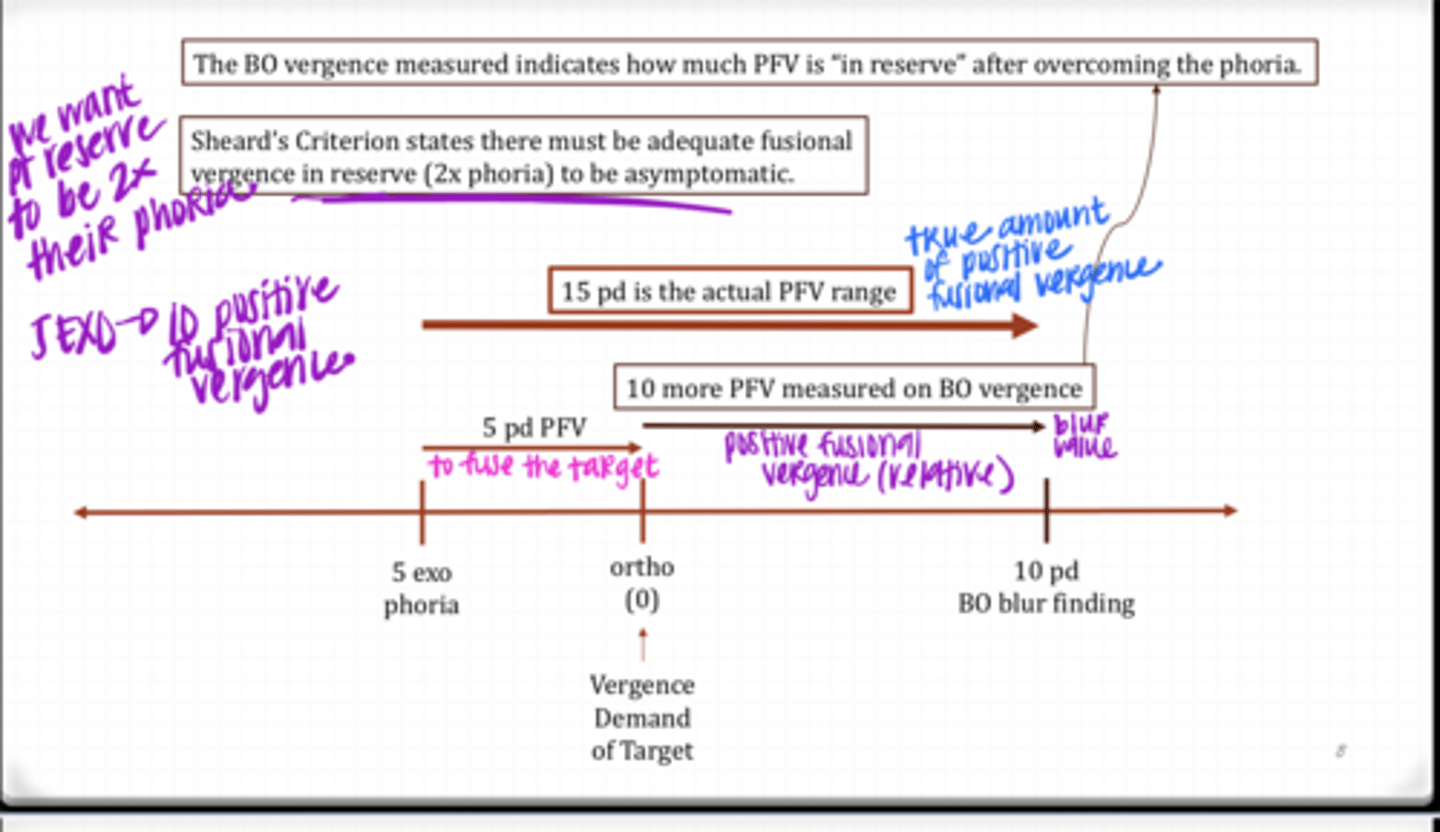
Clinically, what are we really measuring when assessing fusional vergence?
measuring the RELATIVE VERGENCE RANGE -- relative to the vergence demand of the target
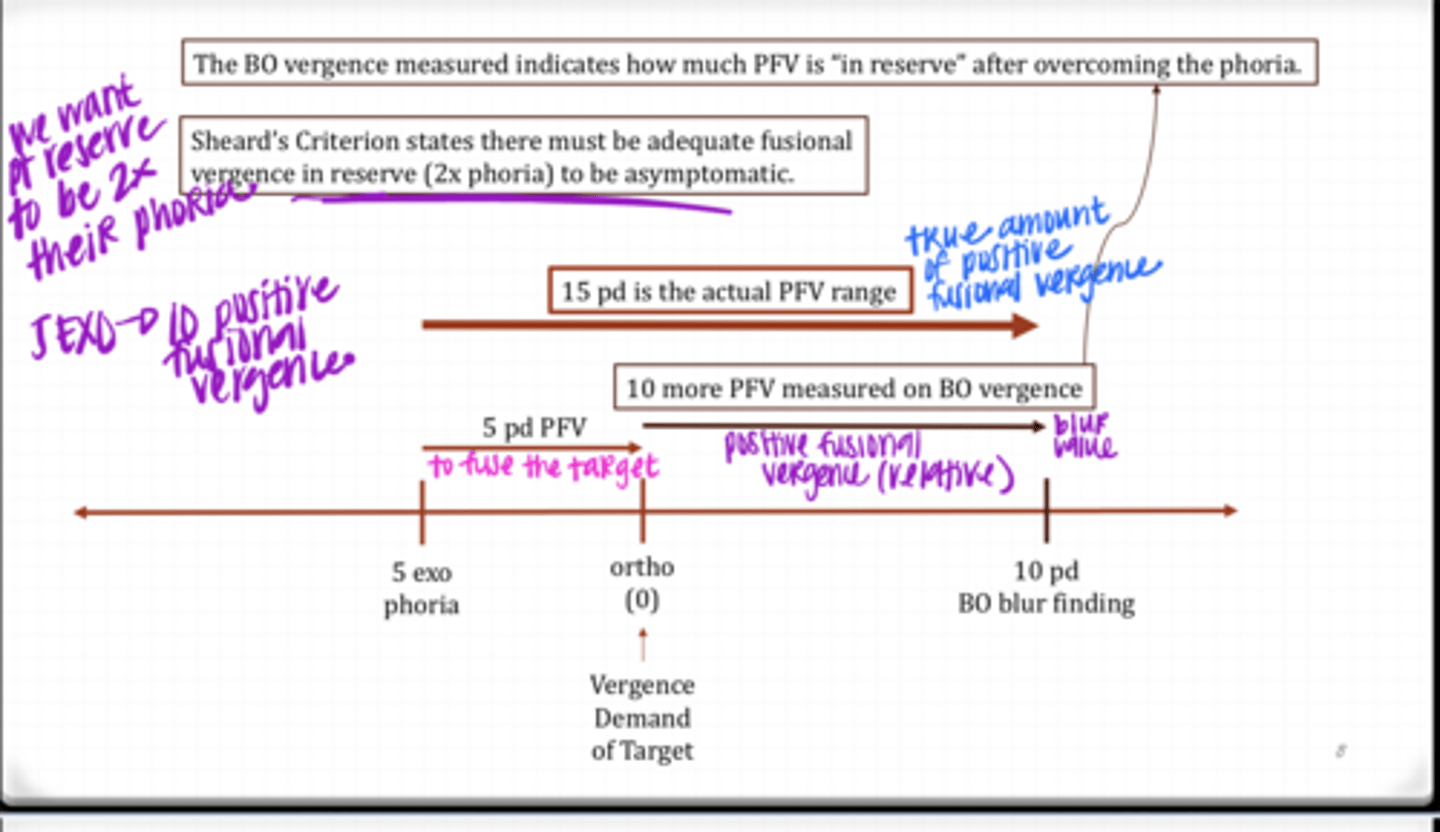
At the start of the fusional vergence testing, is the patient already using the required amount of fusional vergence to overcome any phoria that may be present?
Yes
Sheard's criterion states what?
That there must be adequate fusional vergence in reserve (2x the phoria) to be asymptomatic
What is the compensating vergence range for EXO deviations? Why?
BO vergence ranges are compensating -- PFV is required to overcome the phoria
What is the compensating vergence range for ESO deviations? Why?
BI vergence ranges are compensating -- NFV is required to overcome the phoria
25YO
Near VA (w/o correction): 20/20 OU
Near CT (w/o correction): 12 EXO
Near BO vergence (w/o correction): 8/ 14 / 10
With no lenses or prisms in place, when asked to look at 20/30 print at 40cm, what would you predict your patient to report the letter are?
Single and clear
Distance CT: 6 XP
Near CT: 14 XP
Distance BI: x / 7 / 4
Distance BO: 9 / 19 / 10
Near BI: 13 / 21 / 13
Near BO: 17 / 21 / 11
Does this patient meet Sheard's criterion at distance?
-6XP at distance
-Compensating = BO vergence ranges
-Distance BO: 9 / 19 / 10
-Patient does NOT meet Sheards
Distance CT: 6 XP
Near CT: 14 XP
Distance BI: x / 7 / 4
Distance BO: 9 / 19 / 10
Near BI: 13 / 21 / 13
Near BO: 17 / 21 / 11
Does this patient meet Sheard's criterion at near?
-14P at distance
-Compensating = BO vergence ranges
-Near BO: 17 / 21 / 11
-Patient does NOT meet Sheards
Distance CT: 6 XP
Near CT: 14 XP
Distance BI: x / 7 / 4
Distance BO: 9 / 19 / 10
Near BI: 13 / 21 / 13
Near BO: 17 / 21 / 11
What is the diagnosis for this patient?
convergence insufficiency
Distance CT: 6 XP
Near CT: 14 XP
Distance BI: x / 7 / 4
Distance BO: 9 / 19 / 10
Near BI: 13 / 21 / 13
Near BO: 17 / 21 / 11
What are the treatment options for this patient?
-vision therapy
-base in prism since EXO at all distances
What are the objectives in Phase 1 of vision therapy for patients with convergence insufficiency?
-Focus on convergence (& maybe a little accommodation)
-Develop awareness of therapy feedback: feeling of looking closely (KA, blur/clarity, diplopia, localization/float, SILO, suppression)
-Develop voluntary convergence
-Normalize PFV amplitudes (smooth)
What activities would be helpful in Phase 1 of vision therapy for patients with CI?
-Brock String with beads and then no beads
-Establish SILO then Vectogram BO
-VTS4 MCV BO
-Bernelloscope Convergence cards smooth
-Barrel Card towards end
What are the objectives in Phase 2 of vision therapy for patients with convergence insufficiency?
-focus on expanding divergence and convergence jumps
-normalize NFV amplitudes (smooth)
-normalize PFV facility (jumps)
-normalize NFV facility (jumps)
What activities would be helpful in Phase 2 of vision therapy for patients with CI?
-vectogram BO with prism/breaking vergence/changing fixation
-vectogram BI
-VTS4 MCV BI
-VTS4 jump ductions BO only
-aperture rule
-bernelloscope BO jumps
-binocular lens rock
-free fusion towards the end
What are the objectives in Phase 3 of vision therapy for patients with convergence insufficiency?
-Emphasis on changing from divergence to convergence and oculomotor with fusion
-Develop jumps between convergence and divergence
-Integrate vergence with changes in accommodation
-Integrate vergence with pursuits and saccades
What activities would be helpful in Phase 3 of vision therapy for patients with CI?
-Brock string with movement
-Duel Vectograms
-Tranaglyphs with R/G flippers
-VTS4 jump ductions BI & BO
-bernelloscope jump series
-free fusion jumps
-free fusion rotations
-VTS4 vergence with rotation
-BOP/BIM with any vergence activity
Distance CT: 4 XP
Near CT: 10 EP
Distance BI: x / 10 / 8
Distance BO: 10 / 20 / 12
Near BI: 6 / 12 / 10
Near BO: 18 / 25 / 20
Does this patient meet Sheard's criterion at distance?
-4XP at distance
-Compensating = BO vergence ranges
-Distance BO: 10 / 20 / 12
-Patient does meet Sheards
Distance CT: 4 XP
Near CT: 10 EP
Distance BI: x / 10 / 8
Distance BO: 10 / 20 / 12
Near BI: 6 / 12 / 10
Near BO: 18 / 25 / 20
Does this patient meet Sheard's criterion at near?
-10EP at distance
-Compensating = BI vergence ranges
-Near BI: x / 10 / 8
-Patient does NOT meet Sheards
Distance CT: 4 XP
Near CT: 10 EP
Distance BI: x / 10 / 8
Distance BO: 10 / 20 / 12
Near BI: 6 / 12 / 10
Near BO: 18 / 25 / 20
What is the diagnosis for this patient?
convergence excess
Distance CT: 4 XP
Near CT: 10 EP
Distance BI: x / 10 / 8
Distance BO: 10 / 20 / 12
Near BI: 6 / 12 / 10
Near BO: 18 / 25 / 20
What are the treatment options for this patient with convergence excess?
-ADD reading glasses (relax at near)
-base out prism at near
-vision therapy
What are the objectives in Phase 1 of vision therapy for patients with convergence excess?
-Focus on divergence (maybe a little accommodation)
--Develop awareness of therapy feedback: feeling of looking closely (KA, blur/clarity, diplopia, localization/float, SILO, suppression)
-Develop voluntary divergence (& convergence)
-Normalize NFV amplitudes (smooth)
What activities would be helpful in Phase 1 of vision therapy for patients with CE?
-Brock String with beads and then no beads. Emphasis on feeling of diverging
-Establish SILO then Vectogram BI
-VTS4 MCV BI
-Bernelloscope Divergence cards smooth
What are the objectives in Phase 2 of vision therapy for patients with convergence excess?
-focus on expanding divergence and convergence jumps
-normalize PFV amplitudes (smooth)
-normalize NFV facility (jumps)
-normalize PFV facility (jumps)
What activities would be helpful in Phase 2 of vision therapy for patients with CE?
-vectogram BI with prism/breaking vergence/changing fixation
-vectogram BO
-VTS4 MCV BO
-VTS4 jump ductions BI only
-aperture rule
-bernelloscope BI jumps
-binocular lens rock
-free fusion towards the end
What are the objectives in Phase 3 of vision therapy for patients with convergence excess?
-Emphasis on changing from divergence to convergence and oculomotor with fusion
-Develop jumps between convergence and divergence
-Integrate vergence with changes in accommodation
-Integrate vergence with pursuits and saccades
What activities would be helpful in Phase 3 of vision therapy for patients with CE?
-Duel Vectograms
-Tranaglyphs with R/G flippers
-VTS4 jump ductions BI & BO
-bernelloscope jump series
-free fusion jumps
-free fusion rotations
-VTS4 vergence with rotation
-BOP/BIM with any vergence activity
Distance CT: 8 XP
Near CT: 8 XP
Distance BI: x / 15 / 12
Distance BO: 15 / 25 / 20
Near BI: 12 / 20 / 15
Near BO: 18 / 25 / 20
Does this patient meet Sheard's criterion at distance?
-8XP at distance
-Compensating = BO vergence ranges
-Distance BO: 15 / 25 / 20
-Patient does NOT meet Sheards
Distance CT: 8 XP
Near CT: 8 XP
Distance BI: x / 15 / 12
Distance BO: 15 / 25 / 20
Near BI: 12 / 20 / 15
Near BO: 18 / 25 / 20
Does this patient meet Sheard's criterion at near?
-8XP at near
-Compensating = BO vergence ranges
-Near BO: 18 / 25 / 20
-Patient does meet Sheards
Distance CT: 8 XP
Near CT: 8 XP
Distance BI: x / 15 / 12
Distance BO: 15 / 25 / 20
Near BI: 12 / 20 / 15
Near BO: 18 / 25 / 20
What is the diagnosis for this patient?
basic exophoria
Distance CT: 8 XP
Near CT: 8 XP
Distance BI: x / 15 / 12
Distance BO: 15 / 25 / 20
Near BI: 12 / 20 / 15
Near BO: 18 / 25 / 20
What are the treatment options for this patient with basic exophoria?
-vision therapy
-base in prism at all distances
What are the objectives in Phase 1 of vision therapy for patients with basic exophoria?
-Focus on convergence (maybe a little accommodation)
-Develop awareness of therapy feedback: feeling of looking closely (KA, blur/clarity, diplopia, localization/float, SILO, suppression)
-Develop voluntary divergence (& convergence)
-Normalize PFV amplitudes (smooth)
What activities would be helpful in Phase 1 of vision therapy for patients with basic exophoria?
-Brock String with beads and then no beads
-Establish SILO then Vectogram BO
-VTS4 MCV BO
-Bernelloscope Convergence cards smooth
-Barrel Card towards end
What are the objectives in Phase 2 of vision therapy for patients with basic exophoria?
-focus on expanding divergence and convergence jumps
-normalize NFV amplitudes (smooth)
-normalize PFV facility (jumps)
-normalize NFV facility (jumps)
-normalize PFV at intermediate distances
What activities would be helpful in Phase 2 of vision therapy for patients with basic exophoria?
-vectogram BO with prism/breaking
vergence/changing fixation
-vectogram BI
-VTS4 MCV BI
-VTS4 jump ductions BO only
-aperture rule
-bernelloscope BO jumps
-binocular lens rock
-free fusion towards the end
-vectograms @ 1M then projected
-VTS MCV @ 5 ft
What are the objectives in Phase 3 of vision therapy for patients with basic exophoria?
-Emphasis on changing from divergence to convergence and oculomotor with fusion
-Develop jumps between convergence and divergence
-Integrate vergence with changes in accommodation
-Integrate vergence with pursuits and saccades
-Normalize PFV at distance
What activities would be helpful in Phase 3 of vision therapy for patients with basic exophoria?
-Brock string with movement
-Duel Vectograms
-Tranaglyphs with R/G flippers
-VTS4 jump ductions BI & BO
-bernelloscope jump series
-free fusion jumps
-free fusion rotations
-VTS4 vergence with rotation
-BOP/BIM with any vergence activity
-Projected vectograms/tranaglyphs
-VTS4 vergence @ 10ft
-Free fusion at distance