Tissues
 Call Kai
 Learn
Learn Practice Test
 Spaced Repetition
 Match
Match Flashcards
 Knowt Play
1/91

There's no tags or description
Looks like no tags are added yet.
Name | Mastery | Learn | Test | Matching | Spaced | Call with Kai |
|---|
No analytics yet
Send a link to your students to track their progress
92 Terms
Tissue
group of cells that have similar functions
4 types of tissues found in the body
epithelial, connective, nervous, muscle
some functions of connective tissue
Protection, Structure, Support, Binds/Transportation, hemopoiesis, energy storage, mineral storage, body temperature, homeostasis, carries oxygen, immune system, blood clotting
Connective tissues have a _____replication rate than epithelial but cells do ___
slower; replicate
which connective tissue is avascular
cartilage
cartilage tissue does not have a
nerve supply
Connective tissues that are vascular
blood, adipose, bone
most abundant tissue in the human body
connective tissue
Connective tissue consist of three basic units
Cells, ground substance, and fibers (together these make the matrix)
collagen fibers
compose of the protein collagen, they are very strong, resistant to stretching, but are little flexible, found in bone, ligaments, tendon, and cartilage
elastic fibers
compose of the protein, elastin, provide strength and flexibility, through its ability to stretch, found in skin, blood vessels, and lungs
Reticular fibers
Very thin, collagenous fibers that provide structural support around Adipose, nerves, and muscle fibers
hyaline cartilage
Ends of long bones, growth, plates, nose, rings within respiratory passages, costal cartilages
Fibrocartilage
Intervertebral disc, menisci, pubic synthesis
elastic cartilages
Ears, part of larynx
Fixed cells, and connective tissue (red blood cells)
Fibroblast and mast cells
Fibroblast
cells that produce fibers that go into the matrix
Mast cells
produce histamine associated with inflammation and allergies, also produce heparin which prevents blood from clotting
Type of wandering cell in connective tissue
macrophages
Macrophages
originate as leukocytes and our specialized to carry out phagocytosis (eat cells)
Ground Substance/Matrix
made up of mostly water and fluids when fibers come together with gel (Extracellular fluid)
Loose Connective Tissue
connective tissue is not as strong; few collagen and more elastic; in blood vessels; more cells, less fibers
Dense Connective Tissue
less cells; more fibers; ends of bones, tendons, ligaments
Tendons function
binds muscle to bone
blood function
transports nutrients
bone function
protection; hematopoiesis
cartilage fucntion
structure; articular cartilage (reduces friction; binds bones/organs
ligament function
binds bones
Adipose function
protection, stores energy, regulates body temperature
specific types of connective tissues
tendons, bones, blood, ligaments, cartilage, adipose
where do you find epithelial tissue
line cavities; covers surfaces
functions of epithelial tissue
protection, secretion, absorption, diffusion
epitheilal tissues have the____
fastest cell mitotic/replication rate
What tissue is mostly cells and very little extracellular fluid (matrix)
epithelial tissues
Epithelial tissues contain the most…
cell junctions
Epithelial tissues are classified as
avascular
What gives you hints about function of that specific tissue
cell shape and layering
what epithelial tissues is also referred to as
lining tissue
Basement membrane
epithelial tissues adheres to the connective tissue just beneath it by a membrane
Glands
composed of epithelial cells and therefore are considered in the epithelial tissue
how are the different types of epithelial tissues classified
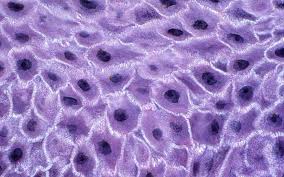
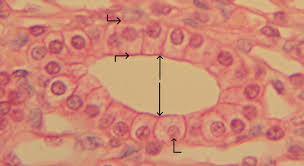
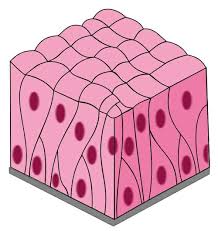
squamous, cuboidal, columnar
where are squamous epithelial tissues found
alvoli, blood vessels (allow things to enter easily; diffusion/osmosis)
where cuboidal epithelial tissues are found
glands (absorb/store)
where columnar epithelial tissues are found
digestive tract, trachea (absorb/store)
squamous
cubodial
columnar
Simple meaning
one layer
straified meaning
mutliple layers (protection)
where nerve tissue is found
Brain, spinal cord (C.N.S); all other nerves (P.N.S)
two types of nerve cells
neurons (sends nerve impulses); neuroglia (take care of neurons; don’t send nerve impulses)
Main parts of a neurons
cell body, dedrite, axon, myelin
cell body function
contains nucleus and other organelles (main)
dendrite function
receives electrical impulse; receives info from other neurons
axon function
relays the information to its next destination
myelin
covers parts of axon; increases speed of impulses and keeps nerve impulses inside
Functions of nerve tissue
create and sends nerve impulses throughout the body also to support nerve tissue itself
Neurons cell replication
Slow to no cell replication
neuroglia cell replication
Can replicate
Nerve tissue is considered
vascular
Nervous tissue has blank but more than connective tissue
Few Cell junctions
functions of muscle tissue
Main function is to produce force for motion. Secondary functions are thermogenesis, used to maintain posture, and helps control organ volume.
Nervous tissues have many _____ cells but fewer _____ with ____ matrix between
Neuroglia; neurons; little
Muscle tissues have ___ cells with ____ matrix between cells
Many; little
Muscle fiber
Same as muscle cell
Muscle atrophy
When muscle fibers decreased in size due to non-use or disease
Muscle hypertrophy
When muscle fibers increase in size due to strenuous in aerobic use (sprinting, weightlifting)
Voluntary muscles
When muscle fibers that are under our conscious control to contract
Involuntary muscle fibers
Muscle fibers that are not under our conscious control to contract
Thermogenesis
The production of heat has a result of muscle contraction and relaxation
Muscle fatigue
when a muscle fiber can no longer contract
muscle contraction
the shortening of a muscle fiber to produce force
What smooth muscle is also referred to as
Visceral
three types of muscle tissue
smooth, cardiac, skeletal
where smooth muscle tissue is found
digestive tract, blood vessels, lining hallow organs (iris; small instestines)
where cardiac muscle tissue is found
heart
cardiac muscle tissue characteristics
strigated; involuntary
where skeletal muscle tissues are found
attached by tendons
Voluntary or Involuntary: skeletal muscle tissue
voluntary
striations
alternating light and dark cross-marking on some types of muscle tissue
do all three muscle tissues have striations
smooth doesn’t
voluntary meaning
you make it happen after thinking
involuntary meaning
do not have to think to work
cell junction
points of contact between the plasma membranes of cells
tight junction
fluid tight cells
location of tight junction
stomach, small intestines, urinary bladder
anchoring junction
holds cells to other cells or other structures
where anchoring junctions are most common
common in tissues subjected to friction and stretching
location of anchoring junctions
outer layer of skin, muscles, gastrointestinal tract
Gap junction
permits electrical signals and chemical molecules to pass from cell to cell