Ras MAPK Signaling Molecule
 Call Kai
 Learn
Learn Practice Test
 Spaced Repetition
 Match
Match Flashcards
 Knowt Play
1/5

There's no tags or description
Looks like no tags are added yet.
Name | Mastery | Learn | Test | Matching | Spaced | Call with Kai |
|---|
No analytics yet
Send a link to your students to track their progress
6 Terms
Ras Structure and Activation
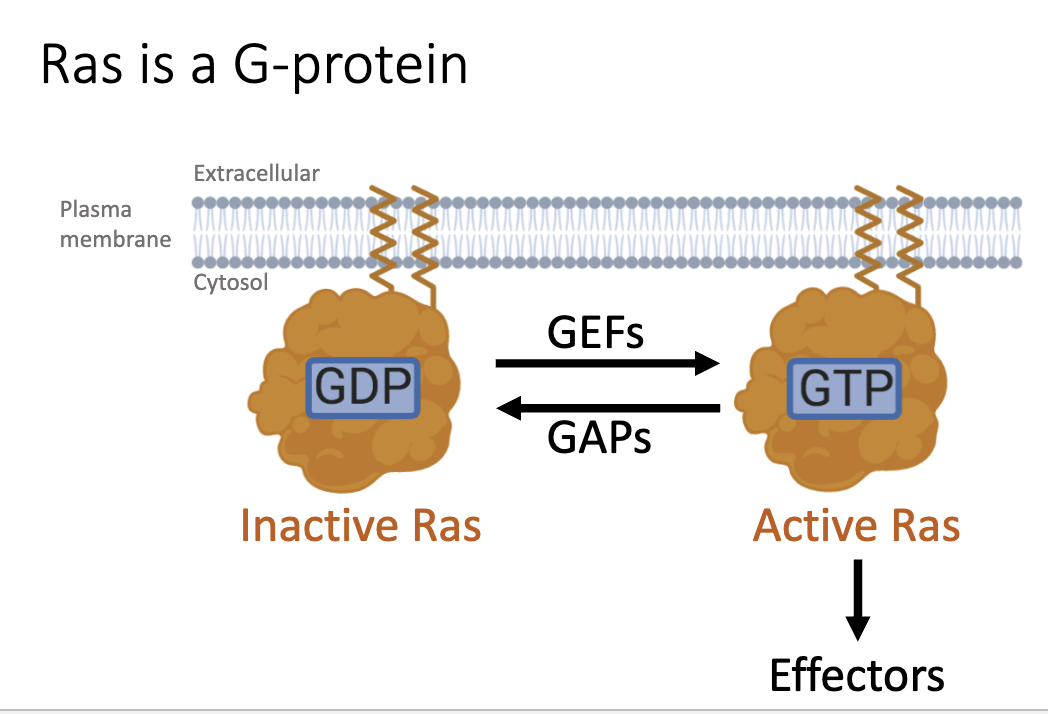
Ras is a small, GTPase or G-protein.
Ras is covalently modified with lipid groups, which promote association with phospholipid membranes.
Ras can be bound to GDP, which is the inactive form, or GTP, which is the active form.
The activity of Ras GEFs promote the active form of Ras, and the activity of Ras GAPs promote the inactive form of Ras.
The active form of Ras, can bind to and change the activity of target protein effectors.
MAP Kinases (MAPKs), how do they phosphorylate, how are they activated
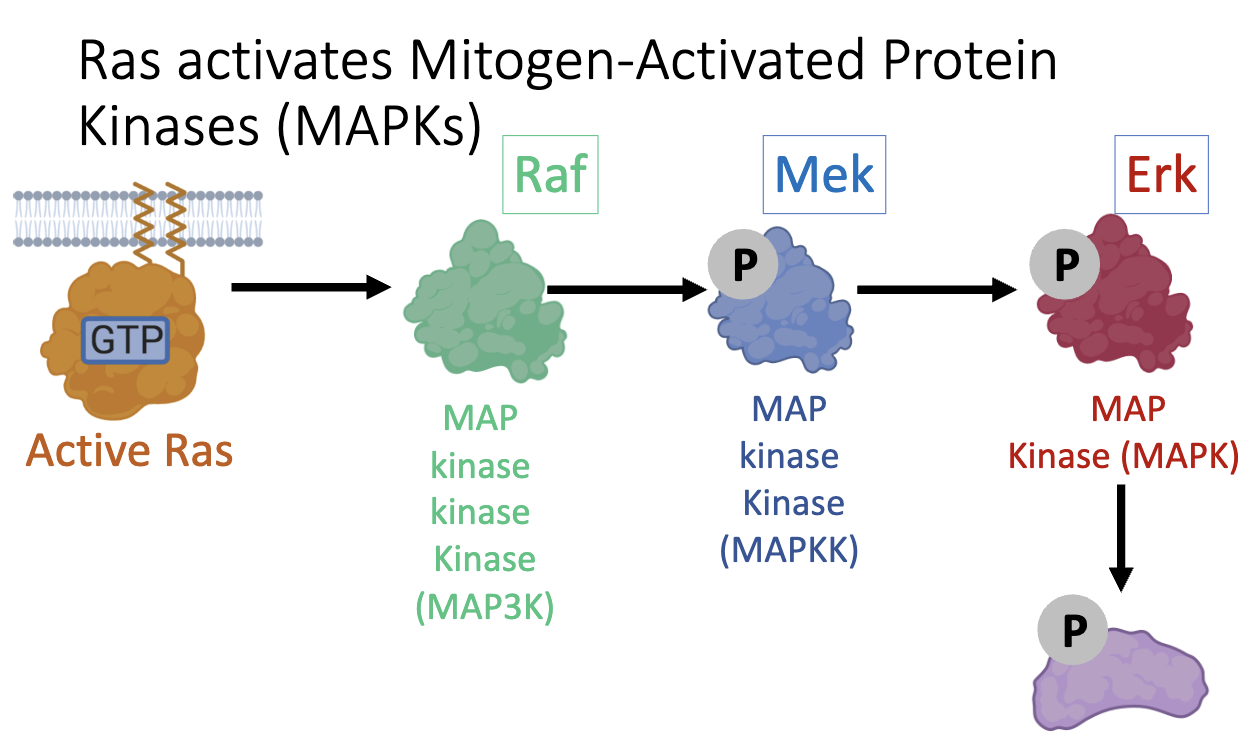
One of the targets of active Ras is a series of kinases called mitogen-activated protein kinases, or MAP kinases, or MAPKs for short.
The MAP kinases, which phosphorylate target proteins on serine and or threonine,
were named because they are activated by extracellular signals called mitogens that stimulate cells to divide.
MAP Kinase Cascade
Ras binds to and activates MAP kinase kinase kinase, or MAP3K for short (no phosphate thingy)
MAP3K phosphorylates MAP kinase kinase, or MAPKK for short.
Phosphorylation by MAP3K activates MAPKK, and MAPKK phosphorylates and activates MAP kinase, or MAPK for short.
MAPK can phosphorylate multiple target proteins which continue the signaling pathway.
Conservation and Naming
Ras and MAP kinases are highly conserved throughout evolution. There are different versions in different organisms and different versions expressed within a single cell type.
In mammalian systems, one specific group of MAP kinases are called Raf, Mek, and Erk
Ras
Ras activates