9. Fresh Food packaging & sustainability
 Call Kai
 Learn
Learn Practice Test
 Spaced Repetition
 Match
Match Flashcards
 Knowt Play
1/47

There's no tags or description
Looks like no tags are added yet.
Name | Mastery | Learn | Test | Matching | Spaced | Call with Kai |
|---|
No analytics yet
Send a link to your students to track their progress
48 Terms
Most applied protective packaging technologies in EU currently available
MAP (meat, fish, meals, cheese)
E-MAP (fruit, vegetables, soft cheeses)
Vacuum & Skin (meat, cheese, technical parts)
Hardly applied protective packaging technologies in EU
Active packaging
Oxygen scavengers
Flavour release
Tray sealer
Small-lab scale
1 pull vacuum
-0.85 atm: vegetables
-0.96 atm: meat
2 applies over-pressure gas mixture
+0.05 atm
3 seals and opens
Shelf life of fresh meat products (traditional vs MAP)
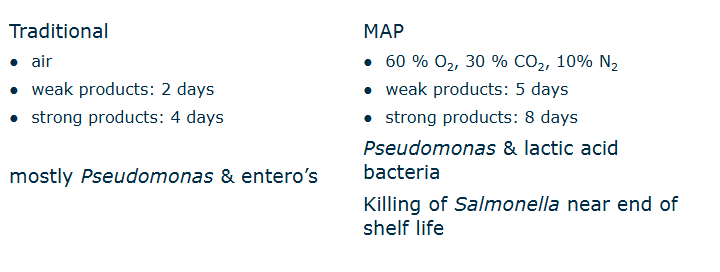
Traditional:
Air
Weak products: 2 days
Strong products: 4 days
Mostly Pseudomonas & entero’s
MAP:
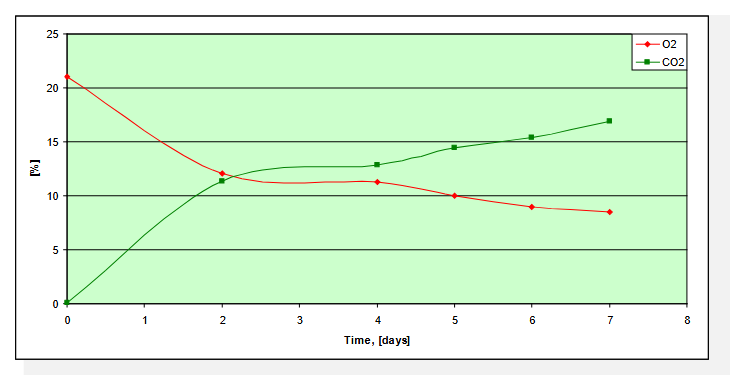
60% O2, 30% CO2, 10% N2
Weak products: 5 days
Strong products 8 days
Pseudomonas & lactic acid bacteria
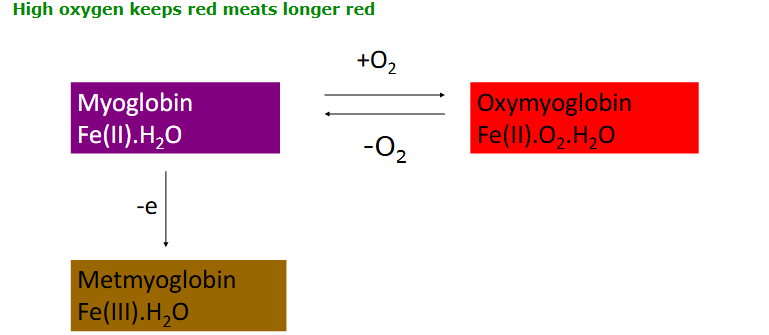
Meat colour & pigments
Packaging used on fresh meat
Seals with meat on flange (a protruding ridge, lip, or rim)
PET-PE trays + PE-PET top-film
PET-PE trays + PE-EVOH-PP top-film
Seals only with clean flanges
Real mono-PET trays + modified-PET-PET top-film
Modified PET to facilitate sealing
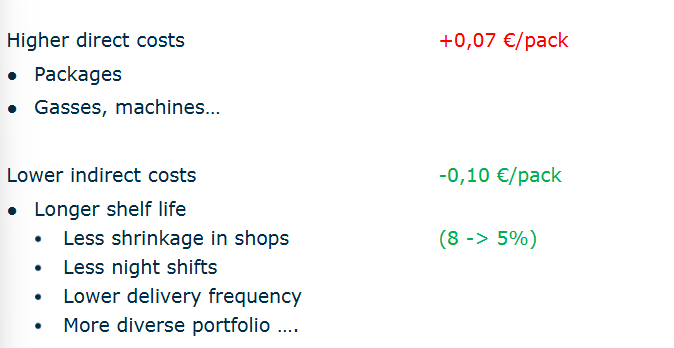
Costs of MAP
A one cent difference makes a big difference
But overall the change in packaging has been cheaper and more cost effective
If shelf life is longer you have less workers because less meat needs to be packaged.
MAP for fish - disadvantages
Very difficult
Has much more dynamic processes inside fish packages
Fat oxidation, amine formation, enzymatic decay, microbial respiration, permeation & CO2 absorption
Growth of microbes on fish is slowed down less by CO2 than those on meat
Keeping fish fresh in MAP is much more challenging
Fish MAP - advantages
Oxygen prevents pungent odour of fish
Legal limit for amin content 35 mg N/100g
Fish is much more temperature sensitive
Lean fish: 60% O2 - 40% CO2
Has less oxidation sensitive fats
The high oxygen in the lean fish is used to react with the dimetilamina and the trimetilamina to the corresponding amine oxides that do not smell
Oxygen is used as a mask to prevent pungent odor
Fat fish: 40% CO2 - 60% N2 (Fat in fish is really sensitive to oxidation, hence there is no oxygen)
Future of MAP for meat/fish
Prolong shelf-life
Reach distant markets (food needs to stay good during transport)
Source from PL, CZ, UKR (because it is cheaper)
Make packed fish more attractive by using MAP meals
Adding oxygen to these pre-packed meals makes post-pasteurized meals more attractive (specifically oxygen absorbers)
PPP: packaging + process + product
skin-packaging technology
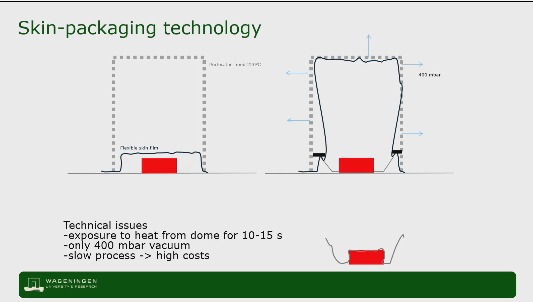
Combination MAP and marinades
MAP + oil
longest shelf life of 10 days
under abuse conditions (5 C)
The shelf-life depends on the acceptance limit for the colony forming units
These acceptance limits can be determined by supermarkets themselves
Vacuum packaging for meat
Doesn’t work with all meat types
Longer shelf life than MAP: 18-21 days
Better display options
Issue with acceptance of purple fresh meat
Marination to make it look good
Different machines, but very expensive machines and slow
Multiple layers so bad for the environment
From trays to flow packs for meat?
Plastic reduction
In 2020 several meat companies started with PP/EVOH/PP films
Weight reduction of 70-80%
Lower costs but new machines
Mediocre recyclability to MIX
The three P’s for extending the shelf life of fresh meat
P: protective packaging
P: initial load of the product
P: Process: temperature and hygiene
Amount of microbes on meat in different stages
Around 2000:
NL/EU initial TAC used to be: 104 CFU/g
Nowadays: Decontamination: carcass and parts
USA: chemistry (disinfectants): 102 CFU/g (not allowed in EU)
EU: new tech in coming decade (using steam) : 101-102 CFU/g
Alternatively nowadays: Hygienic redesign of the complete company
Eliminate cross contamination technology leads a contamination level of: 103 CFU/g
Ultrafast chilling of carcasses technology leads a contamination level of: 101 CFU/g
How to manage temperature in the chain
Slaughter and production:
To chill carcasses as quickly ans possible
Chilled cutting and boning rooms
Labor law or meat quality
Laborers cannot be in very cold temperatures at all times during their work so neither will the meat be
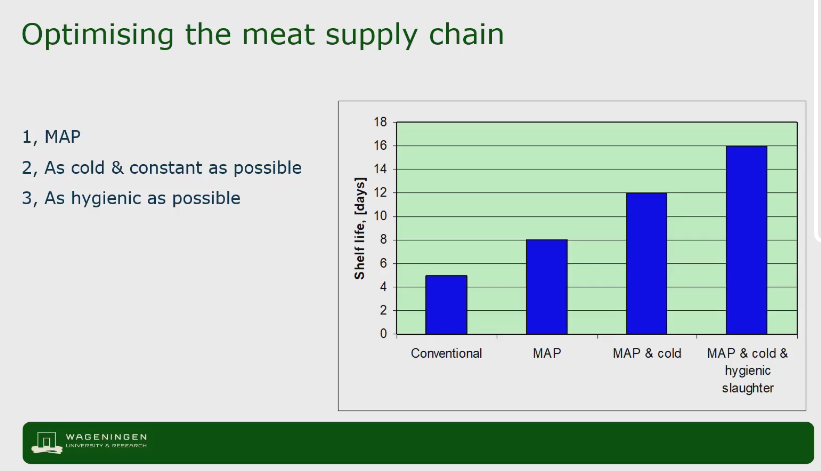
How has the meat supply chain been optimized in the last few years
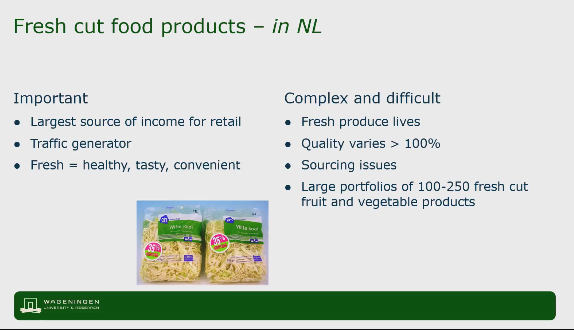
Fresh cut food products market in NL
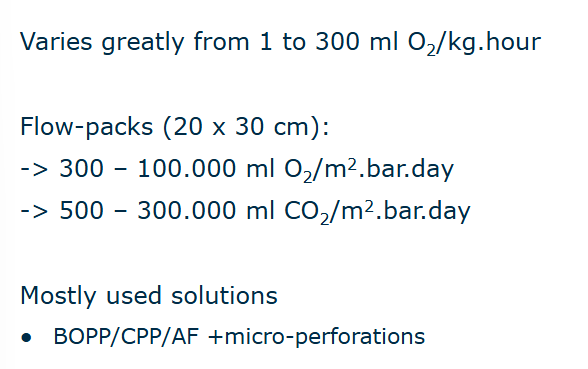
Respiration in fruits and vegetables
when you have mixed veggies, is really hard because they all transpire differnetly → solution= perforations
Effect of different RH%
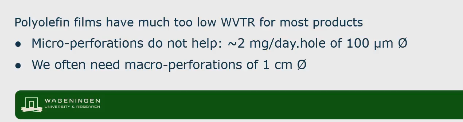
100% cucumbers → PE shrink film
Cucumbers need very high humidity (close to 100%) to prevent water loss.
85% bell-peppers, tomatoes → macro-perforated films
These vegetables still need humidity, but not as high as cucumbers.
Polyolefin films vegetables
Variation in quality of vegetables
Variations of >100% in:
Microbiological load
Respiration activity
Origin, harvest method, growing conditions, seed type
Simultaneously:
Control the initial quality and optimise packaging
What are the three main protective packaging technologies?
MHP: control of moisture loss (g/day)
Tomatoes, bell-pepper, cucumber, mushrooms
Barrier film - macro-perfoated films
EMAP: control of gas composition
Strawberries, spinach, brocolli, belgian endive
Laser perforated films
Anaerobic EMAP
Additionally protective against cutting discoloartion
Cut onions, egg plant, courgette, salads, fruits
Normal BOPP film with at most 1 micro perforation
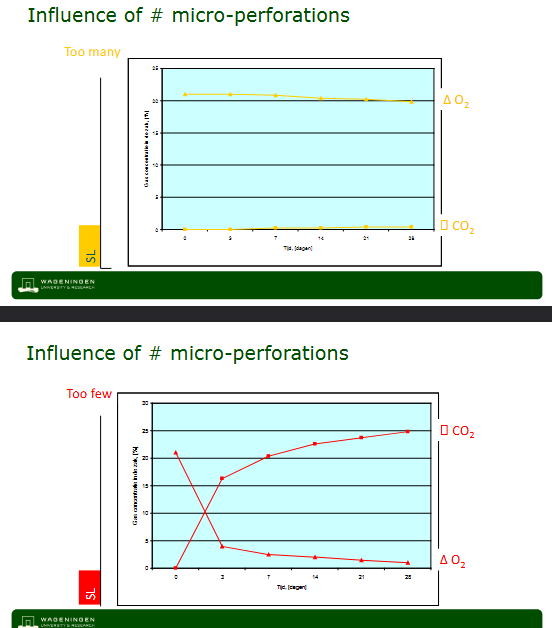
EMAP number of micro-perfoations
You don’t want too many or too little
too much CO2 = fermentation/rot
Too little CO2= red discoloration
History of sustainability
1707 - more trees cut down then there were trees they realized
1950/60s - computers calculated that at that rate we would consume more than we had giving a shock
1979 - Waste hierarchy was created supported re-use and recycle ideas
1987 - sustainable development idea
1994 - Planet, profit and people
2002 - cradle-2-cradle, idea that you could make a chair disassemble it and make it into a new chair.
2009 - Calculated limits to our growth, planetary boundary
2018 - donut economy
2022 - triple planetary crisis
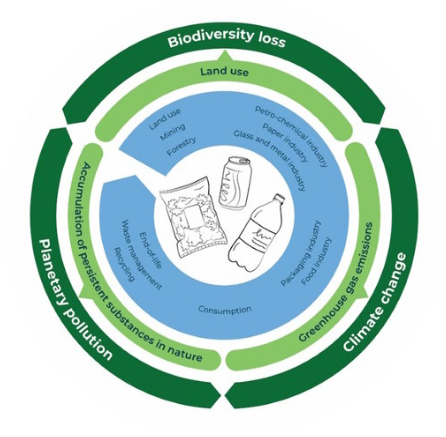
3 planetary crisis
The three planetary crisises are: biodiversity loss, climate change and planetary pollution and they also affect each other
our use of packages impacts all three crises simultaneously, often negatively sometimes postively
It is about finding the right balance
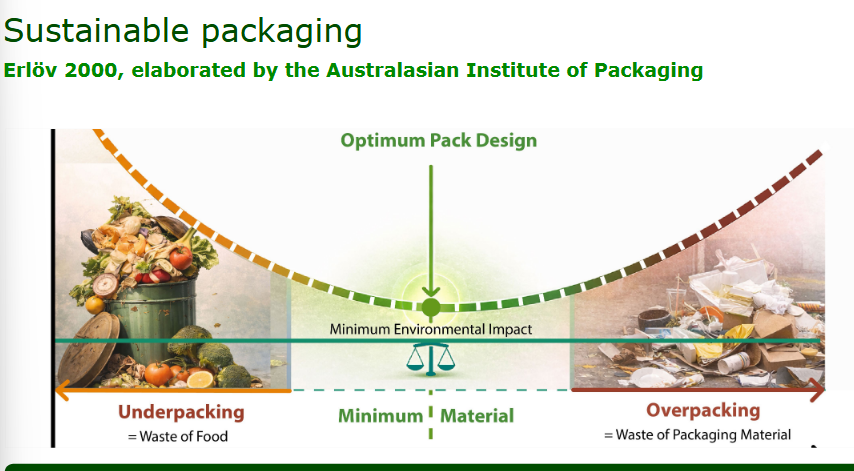
Sustainable packaging
early attempts to grasp the notion of sustainable packaging (2009-2011)
“packaging is not inherently sustainable, but it can help in making a product or a production method more sustainable."
Later this defintion of “Sustainble packaging coalition” became much more complicated
Packaging and sustainability between 2000-2018
Sustainable packaging was regarded as the most climate neutral one
LCA enabled Global Warming Potential (GWP) calculations which sparked policies.
The contribution of packaging is limited
Packaging and sustainability from 2015 on.
From 2015 on: Planetary pollution is noticed
Shifted in focus from climate change to circularity
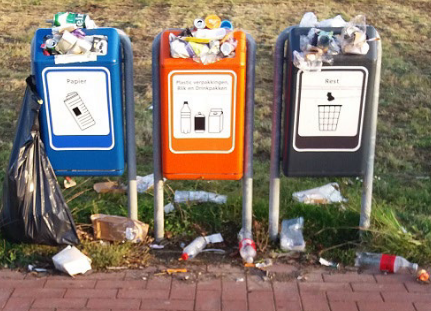
Why do we have planetary pollution?
Lack of waste management infrastructure in most of the world
Human littering behavior
Crooked laws in developed countries to register exported plastic waste as ‘recycled’
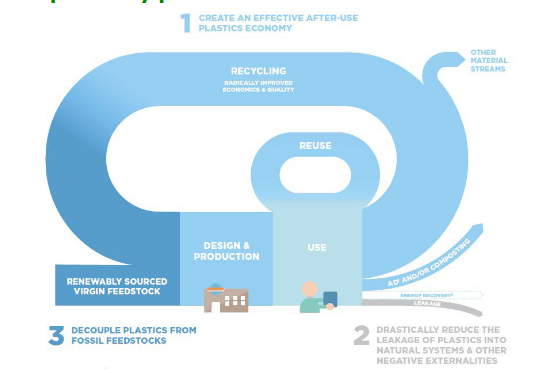
The new plastic economy
Idea by the Ellen McArthur Foundation in 2016
Circularity was perceived as a method to reduce planetary pollution
What is recyclability?
Everything can be recycled; it matters what you aim for:
Recyclability is by inherently depending on:
The targets
The infrastructure available
hence it is situational, temporal, context dependent
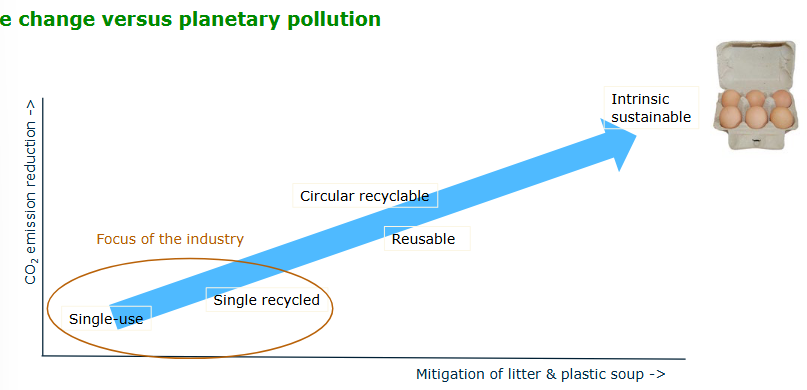
Open loop vs. Closed loop recyling
Recyclable (open loop): implies that the main material of the package can be retrieved and used again in a new application
Almost all current plastic packages can be open-loop recycled into park-benches, plastic lumber, etc.
Circular recyclable (closed loop): implies that the main material of the package can be retrieved and used again in the same or comparable application
PET bottle-to-bottle recycling
Intrinsic sustainable packaging
Can be infinitely recyclable
And if littered will dissolve in the rain
Perfect example = egg carton
Expansion of LCA
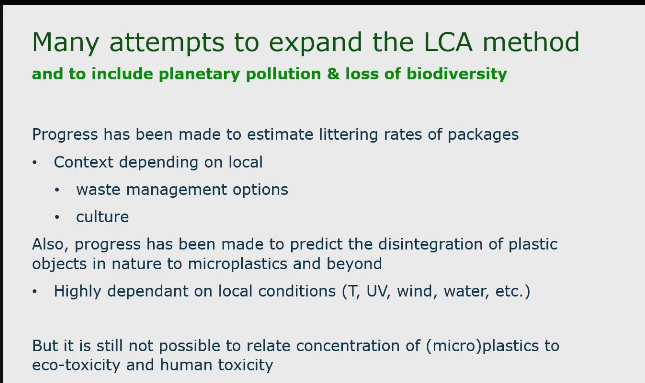
Lots of work to measure littering rates!
Depends on city and culture
Microplastic dispersion is really hard to predict as it varies depending on conditions
Effect on health unknown
Therefore hard to expand LCA
Footprints and handprints
We really need packaging though, because we are living in an urbanized society, and we need central production, and that means we need packaging.
We have to find better balance between the benefits of packaging, being able to live as we an and not harming the planet.
Footprints = burdens
Handprints = Benefits
Balance between footprints and handprints
New definition for a sustainable package
Offers maximal protection (minimal food loss)
Has minimal impact on the triple planetary crisis, which can be shown with:
An analysis of the impact on climate change (GWP-100) executed with recent food loss rates and local end-of-life fates elaborated with
An indicator for planetary pollution and,
An indicator for the loss of biodiversity
Balances the social and economic pros and cons for civilians and incumbents
What can we do today about sustainability?
Sustainability is complicated → improving one thing reduces quality of another there is no simple solution
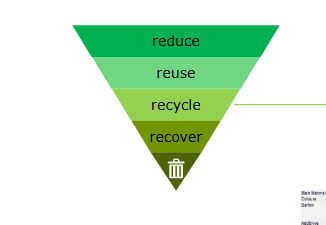
Examples of reduce
Suitable for larger fresh products: melons, cabbages, apples, bananas (DON’T NEED PACKAGING)
Issues with reducing:
Foods need to be labeled.
Shrivelling, bruising of foods
Unsuitable for:
Liquids
Small products such as berries that need to be contained
Examples of Reuse
Food-safety only allows: glass, stainless steel and PP
All companies with an existing reusable glass bottle system want to maintain it
Examples of replace
Using paper bags and carton trays instead of plastics
Issues:
Moisture sensitive
Non-recyclability of coated paper
Only clean paper bags are allowed in the paper waste
Limited applicable and suitable
Beware of regrettable replacements
Examples of recycle
Most FMCG companies strive for well-recyclable packages and if allowed, also the use of recycled content
nevertheless results in multiple dilemmas
Can biobased packages offer solutions? & name some examples
Current applications:
Beer cups
PLA does not splinter
Organic fresh produce
Avoid upsetting the heavy users of organic food
Cheapest campaign to promote a sustainable images
Other applications: difficult to get equal performance
Generate free publicity (because the packaging is different)
Difficult to fit in the current waste system (doesnt recycle)
Performance, profit, planet and people regarding bio-based packages
Performance: equal or less
Profit: always (a bit) more expensive
Planet:
Climate change: sometimes better
Planetary pollution: less persistent pollution
Biodiversity loss: sometimes better
People
Appealing to many consumers
Beware for inflation
What are the barriers to set-up a new reuse system?
DRS-high collection rates/retail commitment
Standardised pool bottles - minimal distances
Non-viscous beverages/products - easy cleaning
Consumer acceptance & long-during participation
Graph with perfect amoutn of perforations to match respiration rate