Chemistry & Matter 9
 Call Kai
 Learn
Learn Practice Test
 Spaced Repetition
 Match
Match Flashcards
 Knowt Play
1/75

There's no tags or description
Looks like no tags are added yet.
Name | Mastery | Learn | Test | Matching | Spaced | Call with Kai |
|---|
No analytics yet
Send a link to your students to track their progress
76 Terms
What is the history of atomic theory?
Democritus - 430 BC
Dalton - 1808
Thompson - 1897
Rutherford - 1911
Bohr - 1913
Chadwick - 1932
What did Democritus discover?
Matter is formed of small pieces that could not be cut into smaller parts called "atomos" meaning uncuttable
What did Dalton discover?
1. Atoms are tiny, invisible particles
2. Atoms of one element are all the same.
3. Atoms of different elements are alI different.
4. Compounds form by combining atoms.
What did Thompson discover?
Atoms are made mostly out of (+) charged materials (like dough in a bun). The (-) charged electrons are found inside the (+) dough
What did Rutherford discover?
Atoms have (+) particles in the center and are mostly empty space
(+) particles are called protons
The center of atoms is called the nucleus
What did Bohr discover?
Improved on Rutherford’s model- proposed that electrons move around the nucleus in specific layers/shells
What did Chadwick discover?
Worked with Rutherford to discover particles with no charger- called neutrons
neutrons also found in nucleus
What do electrons do?
orbit around the nucleus
Describe subatomic particles
Protons - positively charged particles found in the nucleus
Neutrons - neutral particles found in the nucleus
Electrons - negatively charged particles that orbit the nucleus
Which scientist discovered how to arrange elements properly?
Russian scientist, Dmitri Mendeleev
found out you could arrange elements based on chemical properties and atomic mass
What are Ions?
Ions are groups of atoms that carry a positive or negative charge
What is each row in the periodic table called?
Period
What is each column in the periodic table called?
Group
have similar chemical properties
What are the 3 main groups of elements the periodic table can be broke into?
Non-metals. Metals, and Metalloids
What are Metals?
lustrous (shiny)
malleable (can be hammered into sheets)
ductile (can be drawn into wires)
solids at room temperature
great conductors of electricity
What are non-metals?
can be in any state
not shiny
brittle (fragile)
poor conductors of electricity
What are metalloids?
have characteristics of both metal and non-metals
can conduct electricity but not always very well
What are alkali metals?
most reactive metals
have one electron in the outermost shell
require extra storage
What are alkaline earth metals (Group 2)?
react when exposed to air and water
What are halogens (Group 17)?
Most reactive non-metals
Naturally found in compounds
have an unpaired electron but instead of giving it
away, they gain another to form compounds
What are noble gases (Group 18)?
Chemically stable because they do not have any unpaired electrons (not reactive)
Highly unlikely to take part in a chemical change
What is an ionic compound?
A compound formed when a metal transfers electrons to a non-metal
creating oppositely charged ions that attract
What is a molecular compound?
a compound formed when two or more non-metals share electrons
creating covalent bonds
What is an ion?
An atom that has gained or lost electrons
giving atom a positive or negative charge
What is a valence electron?
An electron in the outermost shell of an atom
these electrons are involved in bonding
What is a cation?
A positively charged ion formed when a metal loses electrons
How does a metal become a cation?
It loses valence electrons
charge becomes positive
What is an anion?
A negatively charged ion formed when a non-metal gains electrons
How does a non-metal become an anion?
it gains electrons
charge becomes negative
What is the transfer of electrons in covalent bonds?
there is NO transfer of electrons in covalent bonds
non-metals SHARE electrons
What is the transfer of electrons in ionic bonding?
a metal gives electrons to a nonmetal
forming ions that attract
What is a full valence shell?
When the outer electron shell has its maximum number
making the atom stable
Why does gaining an electron make an atom negative?
electrons are negative, so adding one gives more negatives (electrons) than positives (protons)
atom becomes an anion
Why does losing an electron make an atom positive?
Losing a negative electron leaves more positive protons
atom becomes cation
Why do electron move between atoms?
Atoms want to become want to become stable by filling or emptying their outer shell
(octet rule)
What is the octet rule?
Atoms are most stable when they have 8 electrons in their outer (valence) shell
What are multivalent elements?
Metals that can form more than one possible ion charge
they can lose different numbers of electrons
What are polyatomic ions?
A group of atoms bonded together that have an overall charge
Are ionic compounds conductive? Why?
yes, when melted or dissolved, because ions are free to move (Ions have charges) allowing electricity to flow
What is covalent and ionic bond?
Covalent - bond when non-metals share electrons
forms molecules
Ionic - bond when metal transfers electrons to non-metal
opposite charges attract
What are diatomic molecules?
Elements that naturally exist as two atoms bonded together
Why do elements have specific charges?
They gain or lose electrons in the easiest way to get a full valence shell and become stable
What are common charges by group?
Group 1 (alkali): +1
Group 2 (alkai earth): +2
Group 17 (halogens): -1
Group 16 (chalcogens): -2
What are catalysts?
is a substance that speed up the rate or reaction
is present with reactants of a reaction, they are not consumed during a reaction
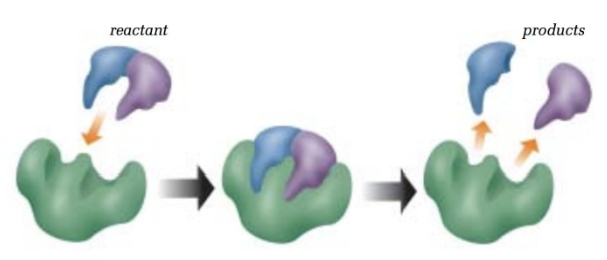
What is an enzyme?
Called a catalase
a protein that speed up reaction
found in many diff. types of animal and plant cells
the shape of an enzyme molecule helps break the reactant down
Types of changing rates of reaction
Temperature
reactant moves faster
Stirring
keeps reactant particles in motion
Crushing
greater surface area, more room available for reaction
Higher concentration (more solute)
more atoms of each reactant available to react
What are inhibitors?
chemical/substances or conditions that slow down chemical reactions
ex. hot or cold
What are 3 reactions involving oxygen?
Combustion
Corrosion
Cellular Respiration
What is combustion?
when oxygen reacts with a substance to form a new substance and give off energy (heat)
What is corrosion?
slow chemical change when oxygen reacts with a metal
ex. rusting
What is cellular respiration?
chemical reaction that takes place in the cells of your body
food (glucose) reacts with oxygen to produce energy
What are endothermic reactions?
chemical reactions that absorb energy/heat
corrosion
What are exothermic reactions?
chemical reactions that give off energy/heat
cellular respiration
combustion (fire)IB
How to prevent corrosion?
painting
galvanization
cathodic protection
What happens when chemical bonds are broken?
energy is added
endothermic
What happens when chemical bonds form?
energy is released
exothermic
What is Galvanization?
coating metal with a layer of zinc to protect it from corrosion (rusting)
zinc acts like a barrier and sacrifices itself for the corrosion
What is cathodic protection?
when a more reactive metal (like zinc) is attached to a metal so it will rust first
mostly underwater and underground
5 Factors affecting reaction rate?
Stirring
Temperature
Catalysts
Surface Area
Concentration
What are chemical properties?
reaction with acids
reaction with water
reaction to heat
ability to burn
behaviour in air
What are physical properties?
colour
lustre
boiling point
melting point
mallaebility
ductility
crystal shape
hardness
conductivity
density
What are Isotopes?
Atoms that are of the same element with the same number of protons but different number of neutrons
What two reactants are needed for corrosion?
Oxygen and water
Why do elements in the same group have similar chemical characteristics?
They have the same number of valence electrons
What are chemical changes ?
When a new substance forms
What are physical changes?
When a substance changes state
If temperature increases, what type of reaction is it?
Exothermic (heat is released)
If temperature decreases, what type of reaction is it?
Endothermic (heat is absorbed)
What does “most readily” mean?
Happens the fastest or easiest
How to know if compound conduct electricity?
must have ions
ions must be free to move (molten or dissolved in water)
solid ions don’t conduct
What is oxidation?
A chemical reaction where a substance loses electrons
What are indicators?
Substances that change colour to show a chemical property of a solution
What is a solution?
Particles fully dissolved, clear
How to tell if a substance is a good insulator?
Low melting/Boiling point
How to tell if substance is a good conductor?
High melting/boiling point
What is electronegativity?
the ability of an atom to attract shared electrons