MCDB 153 - Midterm 1
 Call Kai
 Learn
Learn Practice Test
 Spaced Repetition
 Match
Match Flashcards
 Knowt Play
1/311

There's no tags or description
Looks like no tags are added yet.
Name | Mastery | Learn | Test | Matching | Spaced | Call with Kai |
|---|
No analytics yet
Send a link to your students to track their progress
312 Terms
The nervous system:
1. _______ changes in the external and internal environment (light, touch, sound, pain, taste, muscle stretch, etc.)
2. _________ this information to other cells for processing and storage
3. _________ other cells on how to respond to the changes originally detected, if a response is appropriate
Detects, Transmits, Instructs
What are the two parts of the nervous system?
- Central Nervous System (CNS)
- Peripheral Nervous System (PNS)
The nervous system is (macroscopic/microscopic).
Macroscopic
What are the two principal kinds of cells in the nervous system?
Neurons and Glia cells
What are the 4 regions in a neuronal cell?
- Cell body or "soma"
- Dendrites
- Axon
- Synapse
Cell Body / Soma
The part of a neuronal cell that contains the nucleus and other parts of the cell needed to sustain its life (ribosomes, nucleus, mitonchondria, etc).
Dendrites
Branchlike parts of a neuron that are specialized to receive information from other cells.
Axon
A threadlike extension of a neuron that carries nerve impulses away from the cell body.
Synapse
The junction between the axon tip of the sending neuron and the dendrite or cell body of the receiving neuron.
In neurons, branching is rare along the ____.
Axon
Dorsal Root Ganglion (DRG)
Contains cell bodies of sensory neurons; one major incoming projection from the periphery (leg, arm, etc) and on major outgoing projection that exits the spinal chord (CNS).
Blood Brain Barrier
Blood vessels (capillaries) that selectively let certain substances enter the brain tissue and keep other substances out.
_____ cells provide a scaffold for some aspects of neural development.
Glial
Neural development is about (inter/intra)-cellular communication mediated by signal transduction pathways; these pathways often regulate gene expression or other intracellular events, which in turn promote downstream developmental events.
Inter
Signal Transduction
A series of molecular changes that converts a signal on a target cell's surface to a specific response inside the cell.
Why are there multiple elements involve in the process of signal transduction between the binding of the ligand to the extracellular signal molecule to the binding of the target protein?
Multiple elements are involved because the enzymes must activate multiple cascades.
What are the three classes of ligand-activated cell surface receptors?
1. Ion channel linked receptors
2. G-protein linked receptors
3. Enzyme linked receptors
Ion Channel Linked Receptors
Receptors that bind a ligand and open a channel through the membrane that allows specific ions to pass through.
G-Protein Linked Receptor
A signal receptor protein in the plasma membrane that responds to the binding signal molecule by activating a G protein.
Enzyme Linked Receptor
A transmembrane protein that displays catalytic activity in response to ligand binding.
Receptor Tyrosine Kinase (RTK)
A receptor protein that spans the plasma membrane, the cytoplasmic (intracellular) part of which can catalyze the transfer of a phosphate group from an ATP molecule to a tyrosine on another protein. They often respond to the binding of a signaling molecule by dimerizing and then phosphorylating a tyrosine on the cytoplasmic portion of the other receptor in the dimer.
Housekeeping Gene
A gene that is transcribed constitutively because its product is needed at all times and in all cells. (ex. genes that code for glycolysis)
Trans-Acting Factors
A regulatory protein that binds to a regulatory element in the DNA and exerts a trans effect.
What are the four types of intercellular signaling?
1. Contact-Dependent
2. Paracrine
3. Synaptic
4. Endocrine
Combinatorial Signaling
Inductive signaling with several signals that lead to different cell responses.
What are the three main experimental strategies used to study the development of the nervous system?
1. Using whole animals (rodents, chicks, flies, worms, etc)
2. Using cultured tissues from animals ("explants")
3. Using cultured cells from animals ("primary" and/or "transformed" cells)
True or False - Receptor Tyrosine Kinases only have a single transmembrane pass.
True
Primary cells
Cells which are directly isolated from organisms and are short lived.
Transformed cells
Cells that have become cancerous, proliferate without regard to cell cycle checkpoints, density-dependent inhibition, anchorage dependence and other regulatory mechanisms.
(Primary/Transformed) cells can live indefinitely.
Transformed
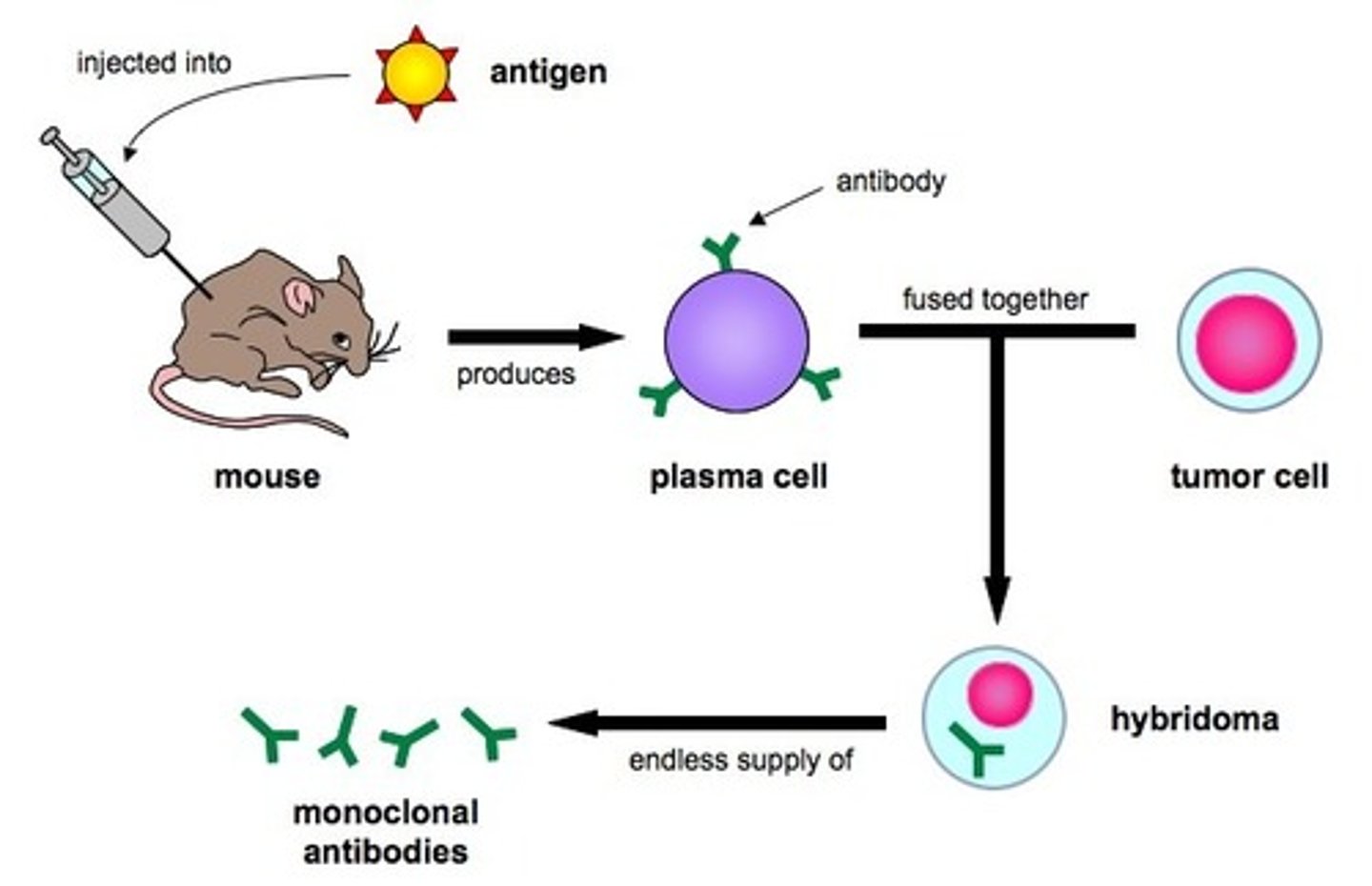
Polyclonal Antibodies
Antibodies produced by injecting animals with a specific antigen. A series of antibodies are produced responding to a variety of different sites on the antigen.
Monoclonal Antibodies
A collection of identical antibodies that interact with a single antigen site.
Antigens
Foreign substances that trigger the attack of antibodies in the immune response.
Variable Region of Antibody
The part of the antibody that combines with the antigen; this region of antibodies varies from one antibody to another, even within one class.
Constant Region of Antibody
The part of the antibody that has the receptors that bind to natural killer cells, macrophages, monocytes, and eosinophils. It is the same in all antibodies across organisms of the same species.
How many subunits are in an antibody?
Four
The quaternary structure of antibodies is held together via _________ bonds.
Disulfide
Hybridomas
Hybrid cell lines that make monoclonal antibodies of defined specificity. They are formed by fusing a specific antibody-producing B lymphocyte with a myeloma cell that grows in tissue culture and does not make any immunoglobulin chains of its own.
Affinity Purification
A method of separating biochemical mixtures based on a highly specific interaction such as that between antigen and antibody, enzyme and substrate, or receptor and ligand.
Immunofluorescence Microscopy
Uses antibodies fluorescently tagged to bind specifically to a corresponding antigen as a probe for identifying a particular molecule in cells, tissues, or tissues, or biological fluids.
GFP
Green flourescent protein, used to tag proteins in immunofluorescence microscopy.
Immunofluorescence microscopy works well for ________ proteins.
Membrane
The secondary antibody recognizes the (variable/constant) region of the primary antibody.
Constant
To localize an intracellular protein, you need to deal with the plasma membrane, which antibodies cannot get through normally. To do this, cells on a dish are treated simultaneously with two reagents. What are the two reagents used?
1. A non-ionic detergent (such as Triton X-100 or NP-40) to solubilize the membrane.
2. A "fixative" (such as paraformaldehyde) to cross-link all the proteins in place.
In immunofluorescence microscopy, what is the problem with using a fixative to "freeze" the cells?
The cells die, meaning that features of the cell can't directly be observed over the course of time.
True or False - If two proteins in a "fixed" cell co-localize, they must be interacting.
False - If two proteins co-localize in the cell (ex. tau and tubulin are both cytosolic), they may be interacting, but there could also be a 3rd protein involved instead.
When using immunofluorescence microscopy to determine the presence of different proteins in a cell, why is it important to make sure all of the antibodies (primary and secondary) come from different animals?
Antibodies from different species have different constant regions, ensuring that no off-target binding occurs.
A protein of interest in a living cell can be visualized using ___-fusion proteins.
GFP
True or False - Fusion proteins containing cDNA encoding protein of interest will be fused IN FRAME to cDNA of fluorescent molecule (GFP, etc)
True
Transfection
Insertion of recombinant DNA into animal cells.
When performing transfection (adding a gene for GOF) the gene of interest should be inserted (upstream/downstream) of the promoter.
Downstream
Gene Knockout
Genetic manipulation in which one or more of an organism's genes are prevented from being expressed.
Gene Knockdown
To decrease gene expression by breaking mRNA using RNAi.
CRISPR/Cas9
A unique technology derived from prokarytoes that enables geneticists and medical researchers to edit parts of the genome by removing, adding or altering sections of the DNA sequence.
CRISPR
The collection of DNA sequences that tells Cas9 exactly where to cut.
Cas9
RNA-guided DNA endonuclease enzyme associated with the CRISPR, produces single strand breaks in DNA.
When "deleting" a protein of interest, how do dominant negatives "poison" a multimeric complex?
Most proteins do not operate as monomers; multimers are more common. In these multimers, only one of the monomers has to be a mutant for the complex not to work, greatly reducing the function of the protein in an organism.
How does RNAi work?
-Double-stranded RNA gets chopped up by the enzyme Dicer
-The resulting RNA pieces are called microRNAs (miRNAs) or small interfering RNAs (siRNAs)—there are slight differences between these 2 types of RNAs, but we won't worry about that
-miRNAs/siRNAs form a complex with proteins—this complex is called RISC
-RISC pairs with the target mRNA (because the miRNA/siRNA is complementary to the target mRNA)
-The target mRNA can no longer be translated
-Thus the mRNA has been "interfered" with so that the gene that the mRNA came from will no longer be expressed (no protein produced)
Function Blocking Antibodies
An antibody that does not have a reaction when combined with an antigen, but prevents other antibodies from combining with that antigen.
In SDS-PAGE, the proteins being analyzed are (positively/negatively) charged.
Negatively
In SDS-PAGE, the little proteins run through the gel (faster/slower) than the large proteins.
Faster
Immunoblotting (Western blotting)
Run some proteins through an SDS-PAGE and then blot onto a membrane, probing with antibodies for the specific protein of interest. For example, when looking to detect the presence of tubulin, anti-tubulin should be used.
Coomassie Blue
A dye that stains proteins blue and allows them to be visualized.
In situ hybridization
A technique using nucleic acid hybridization with a labeled probe to detect the location of a specific mRNA in an intact organism.
True or False - Cells can tell the difference between a radioactive version of a particular molecule and a non-radioactive version of the same molecule, making it difficult to truly "detect" and "follow the radioactive ones.
False - Cells cannot tell the difference between a radioactive version of a particular molecule and a non-radioactive version of the same molecule, making it easy to "detect" and "follow" the radioactive ones.
In immunofluorescence, formaldehyde can be used to ______ a cell.
Fixate
During direct immunofluorescence, the fluorophore is on the _______ antibody. During indirect immunofluorescence, the fluorophore is on the ________ antibody.
Primary, Secondary
Immunofluorescence requires ________ permeabilization if the target is intracellular.
Membrane
(Immunofluorescence/Fluorescent Fusion Proteins) can be done in living cells in real-time.
Fluorescent Fusion Proteins
What are the two components of a fluorescent fusion protein?
1. Fluorescent Tag
2. Protein of Interest
What are fluorescent fusion proteins useful for?
Time analysis and seeing how proteins traffic
What are the steps to immunofluorescence (IF) ?
1. Make/buy antibody to protein of interest.
2. Fix (and permeabilize, if necessary) cells.
3. Stain sample with primary Ab against protein of interest.
4. (Indirect only) Stain sample with secondary Ab against primary Ab's constant region.
Epitope
Small, accessible portion of an antigen that can be recognized.
(Monoclonal/Polyclonal) antibodies are immortal.
Monoclonal
(Monoclonal/Polyclonal) antibodies are specific for multiple epitopes on the same protein.
Polyclonal
B cells
Cells which produce antibodies.
What is/are the advantage(s) to using a primary antibody in immunofluorescence as opposed to a secondary antibody?
Primary antibodies are faster.
What is/are the advantage(s) to using a secondary antibody in immunofluorescence as opposed to a primary antibody?
Secondary antibodies are cheaper and provide more signal amplification.
When would a monoclonal antibody be more useful than a polyclonal antibody?
If a lot of off-target binding is occurring.
When using fluorescent reporters, the cDNA fluorescent tag should be (upstream/downstream) of the cDNA gene of interest in the plasmid.
Downstream
When using SDS-PAGE or a Western Blot, are you able to get absolute or relative quantification of your protein of interest?
Relative Quanitification
Gain of function can be acquired biochemically by adding plasmids with the cDNA of interest downstream of a ____________ promter.
Constitutive
Gene knockout involves the (complete/incomplete) elimination of protein.
Complete
Gene knockdown involves the (complete/incomplete) elimination of protein.
Incomplete
Gene knockout cannot be used if a mutation is _________ ______.
Embryonic Lethal
Gene (knockout/knockdown) may be used to conditionally cause loss of function in otherwise embryonic lethal genes and/or to test necessity at a certain time.
Knockdown
Why is the cytoplasm of the fertilized egg not homogenous?
This allows cell specialization to occur as the cell divides.
How can two sister cells become different after division?
If the two sister cells have different neighbors, they will become different as a result of influences acting on them after their birth.
Inductive Signal
A short-range chemical cue that is passed to an embryonic cell from a neighboring cell or from the maternal environment and that "tells" the embryonic cell what to do next.
Inductive signals do not just occur in a binary decision - they can occur in _________.
Gradients
What are the 5 essential processes by which an embryo is constructed?
1. Cell Proliferation
2. Cell Specialization
3. Cell Interaction
4. Cell Movement
5. Cell Death
Cell Proliferation
The process of increasing cell numbers by mitotic division.
Cell Specialization
The process in which cells develop in different ways to perform different tasks; differentiation of the cell.
Cell Interaction
The coordination of the behavior of one cell with that of its neighbors; signaling between cells.
Cell Movement
The rearrangement of the cells to form structured tissues and organs.
Cell Death
Apoptosis; suicide of the cell.
Vertebrate embryos look (similar/different) in early development.
Similar
Von Baer's Law
The features that distinguish between different species tend to arise later in development.
Universal Mechanism of Animal Development
Different species often use similar molecules to:
- Define specialized cells
- Define differences between body regions
- Create the body's patterns
*Simply stated, to develop the organism!
Gray Crescent
A light-gray region of the cytoplasm of a fertilized egg cell located near the equator of the egg on the side opposite the sperm entry.