RC3 - Emotional perspective (keyterms, mp + scenario questions)
0.0(0)
Studied by 1 person Call Kai
 Learn
Learn Practice Test
 Spaced Repetition
 Match
Match Flashcards
 Knowt Play
Card Sorting
1/51

There's no tags or description
Looks like no tags are added yet.
Last updated 2:43 PM on 5/29/26
Name | Mastery | Learn | Test | Matching | Spaced | Call with Kai |
|---|
No analytics yet
Send a link to your students to track their progress
52 Terms
1
New cards
What is the affect heuristic?
A mental shortcut where people use their overall positive or negative feelings about an object as information when making risk judgments — with or without conscious thought (Slovic et al., 2002, 2004)
2
New cards
What is integral affect?
Feelings that are directly tied to the object or stimulus itself (e.g., fear of cancer when thinking about cancer screening)
3
New cards
What is incidental affect?
Mood states that are unrelated to the stimulus but get misattributed to it (e.g., feeling sad about the rain and carrying that negativity over to judgments about climate change)
4
New cards
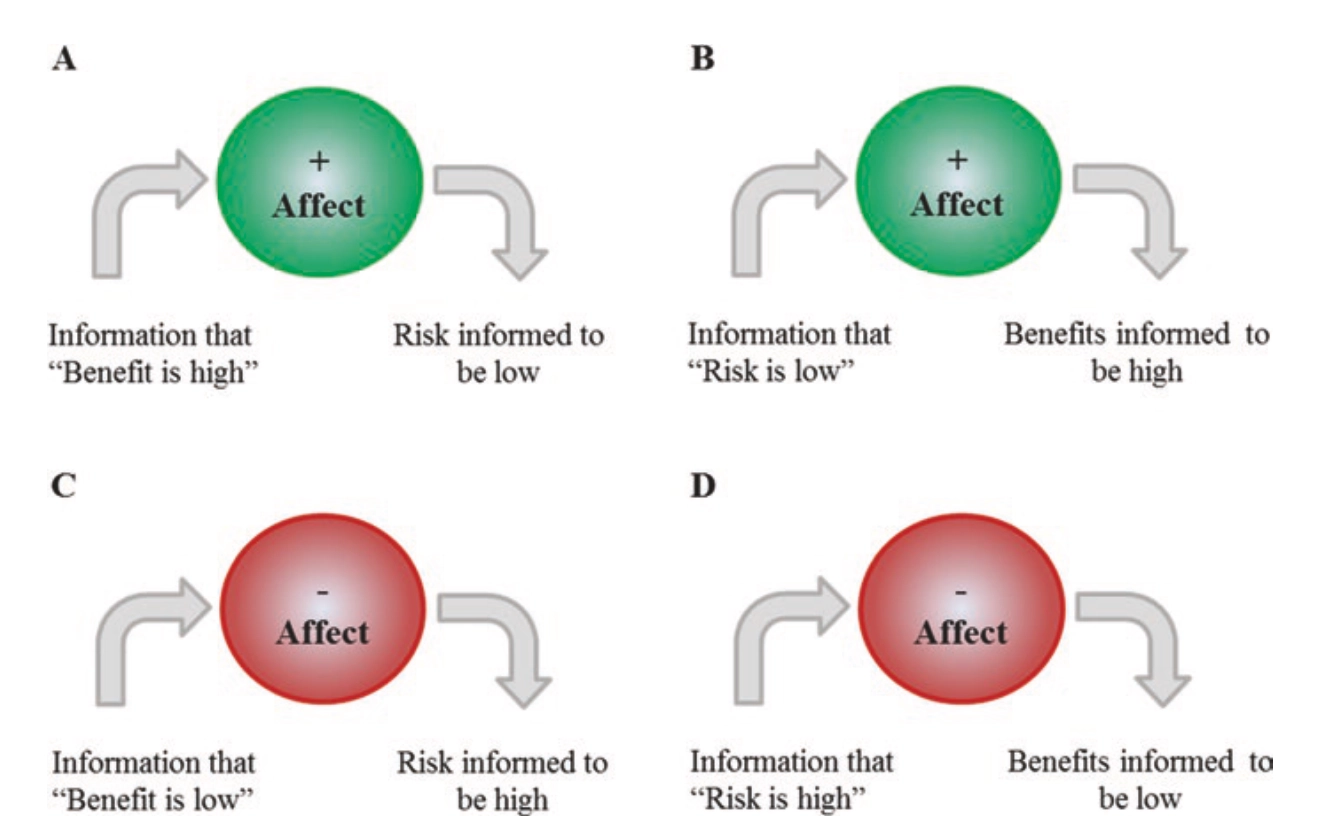
What is the inverse relationship between risk and benefit in the affect heuristic?
When people have positive affect toward something, they perceive its risks as low and its benefits as high; negative affect produces the opposite — high risk, low benefit — regardless of actual statistics (Alhakami & Slovic, 1994)
5
New cards
Give an example of the inverse risk-benefit relationship
Train rails evoke positive affect → perceived as low risk and high benefit. Nuclear energy evokes negative affect → perceived as high risk and low benefit
6
New cards
Under what conditions do people rely more on affective processes?
When there is time pressure (less opportunity to deliberate) and when the judgment is complex, unfamiliar, or unanticipated (e.g., judging ChatGPT risk vs. cancer risk)
7
New cards
What are the four functions of affect?
1. Affect as information (how do I feel about this?) 2. Affect as common currency (translating complex info into simple evaluations) 3. Affect as spotlight (directing attention to specific details) 4. Affect as motivator (triggering approach or avoidance behavior)
8
New cards
What is affect as information?
Using the feeling itself as data — "I feel uneasy about this surgery, so it must be dangerous." Risk communication can backfire when affect is negative (e.g., breast cancer screening)
9
New cards
What is affect as common currency?
Affect translates complex, incomparable risk information into a simple positive/negative evaluation that allows different risks to be compared intuitively
10
New cards
What is affect as spotlight?
Affect directs attention to specific information (e.g., numerical cues); what ends up in the spotlight disproportionately shapes risk perception and decisions (e.g., graphic images on cigarette packages)
11
New cards
What is affect as motivator?
Affect triggers approach or avoidance tendencies that drive behavior (e.g., negative affect motivating cancer screening or quitting smoking)
12
New cards
What did Evans et al. (2015) find about the functions of affect in smoking communication?
1. Graphics produced greater negative affect than text (affect as information) 2. Greater negative affect led to greater quit intentions (motivator) 3. Negative affect from graphics promoted more careful scrutiny of risk information, increasing risk perceptions and quit intentions (spotlight)
13
New cards
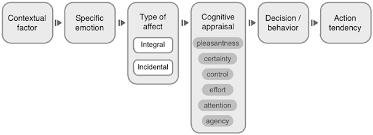
What is the Appraisal-Tendency Framework (ATF)?
A framework stating that specific discrete emotions influence risk judgments through their unique cognitive appraisal dimensions — not just their valence (positive/negative)
14
New cards
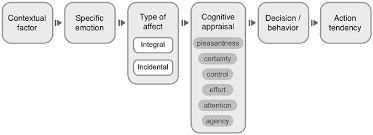
What are the six cognitive appraisal dimensions in the ATF?
1. Pleasantness 2. Certainty 3. Control 4. Anticipated effort 5. Attentional activity 6. Others' responsibility (agency)
15
New cards
What is the key insight of the ATF compared to the affect heuristic?
Emotions of the same valence (e.g., fear and anger are both negative) can have opposite effects on risk perception because their cognitive appraisal profiles differ
16
New cards
How do fear and anger differ on cognitive appraisal dimensions?
Both are low on pleasantness. Fear = low certainty, low individual control, high others' responsibility. Anger = high certainty, high individual control, high others' responsibility
17
New cards
How does fear affect risk perception?
Fear decreases certainty and individual control → leads to higher perceived risk and greater risk aversion
18
New cards
How does anger affect risk perception?
Anger increases feelings of certainty and control → leads to lower perceived risk and more risk-taking behavior
19
New cards
What is the link between ATF and Slovic's dread/unknown risk dimensions?
Unknown risks relate to the certainty dimension; dread risks relate to the individual control dimension — both core appraisal dimensions in ATF
20
New cards
What is the representativeness heuristic?
Judging the likelihood of an event based on how closely it resembles a mental prototype or stereotype, rather than on actual statistical probability (Tversky & Kahneman, 1974)
21
New cards
What biases does the representativeness heuristic produce?
Conjunction fallacy, base-rate neglect, insensitivity to sample size, and misconceptions of chance
22
New cards
What is the conjunction fallacy?
The error of judging a combination of two events as more probable than either event alone (e.g., thinking "feminist bank teller" is more likely than "bank teller")
23
New cards
How can the conjunction fallacy be reduced?
Frame the question as a frequency — ask people to imagine 100 people fitting the description, rather than judging probability directly
24
New cards
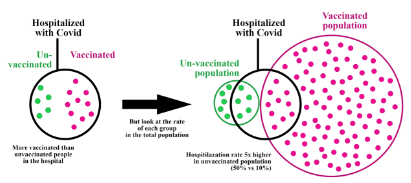
What is base rate neglect?
Ignoring the underlying statistical frequency of a category when making probability judgments — focusing on how representative someone/something seems instead (e.g., judging Jack is an engineer based on personality despite only 30% of the group being engineers)
25
New cards
What is the availability heuristic?
Judging the probability or frequency of an event based on how easily examples come to mind — not on actual statistics
26
New cards
Why does the availability heuristic distort risk perception?
Vivid, memorable, or media-covered events (e.g., terrorist attacks, plane crashes) are easily retrieved, making them feel more likely than statistically rare events
27
New cards
What is bounded rationality?
The concept that humans have limited cognitive capacity and time, making it impossible to process all available information — leading to the use of heuristics to simplify decisions
28
New cards
What is the heuristics and biases program?
A research tradition (Tversky & Kahneman) emphasizing that heuristics lead to systematic cognitive errors (biases) through attribute substitution — replacing hard questions with easier ones
29
New cards
What are the four heuristics identified in the heuristics and biases program?
1. Availability heuristic 2. Representativeness heuristic 3. Affect heuristic 4. Anchoring and adjustment heuristic
30
New cards
What is the anchoring and adjustment heuristic?
Estimates are strongly influenced by an initial reference point (anchor); people adjust insufficiently from it, and external anchors selectively activate consistent information in memory
31
New cards
What is ecological rationality?
The idea that heuristics are accurate and adaptive when they fit the structure of the environment — making them superior to complex algorithms in certain real-world conditions
32
New cards
What are fast and frugal heuristics?
Simple, efficient decision rules that require minimal information and lead to accurate decisions when matched to the right environment (adaptive toolbox approach)
33
New cards
What is the take-the-best heuristic?
A fast and frugal heuristic where decisions are made based on only the single most valid, discriminating cue (one-reason decision making)
34
New cards
What is the recognition heuristic?
Choosing the option you recognize over the one you don't — a simple heuristic that often leads to accurate decisions
35
New cards
What is the 1/N heuristic?
Distributing resources or investments equally across all options to spread risk — a simple but often effective strategy
36
New cards
What is the local warming effect?
People are more likely to believe in global warming on a day when local temperature is unusually high — a real-world example of the availability heuristic affecting climate risk perception
37
New cards
What is a nudge?
A subtle change to the choice environment that steers behavior in a predictable direction without forbidding options or changing financial incentives (e.g., default organ donation)
38
New cards
What is a boost?
An intervention that strengthens people's own decision-making capacity rather than steering their behavior externally — the alternative to nudging
39
New cards
What is risk as feelings vs. risk as analysis?
Risk as feelings = fast, intuitive, automatic emotional responses to danger. Risk as analysis = slow, deliberate, logical evaluation of probability and outcomes. When they conflict, affective centers often dominate
40
New cards
What is the key finding of the 'Risky Feelings' paper?
Patients' emotional responses to medical risk information are more influential than their cognitive knowledge. Effective communication must target the emotional gist patients attach to risks, not just statistical facts
41
New cards
What is hindsight bias in medical risk communication?
After learning the actual risk, patients feel it matches what they already expected — making prior self-estimates unreliable and distorting how new information is received
42
New cards
What is information evaluability?
The difficulty of judging whether a risk number is good or bad without a reference point — the emotional meaning of "6%" depends almost entirely on the comparison context provided
43
New cards
What are comparative risk statistics and why are they powerful?
Statistics that compare a personal risk to a reference group (e.g., population average); the same personal risk feels far more alarming when framed as above-average, directly increasing preventive behavior
44
New cards
What are evaluative labels?
Simple qualitative words (e.g., "positive," "low risk," "high") attached to medical results that shape emotional perception more strongly than the underlying numbers
45
New cards
What is an affect-rich outcome?
A potential consequence (e.g., getting a stoma) that triggers vivid, intense emotional reactions — causing patients to avoid treatments with such outcomes even when those treatments statistically reduce mortality
46
New cards
Why does cancer recurrence feel more frightening than a new cancer of equal statistical risk?
Recurrence carries a unique emotional weight — the return of a known threat feels more personal and certain than the possibility of an entirely new disease, even when the probabilities are identical
47
New cards
What is cultural cognition theory and what is its counterintuitive finding?
People align risk perceptions with their social group's values. Counterintuitively, individuals with the highest scientific literacy are the most polarized — they use their skills to filter information to fit their cultural worldview, driven by fear of social exclusion
48
New cards
What is objective numeracy and how does it affect risk processing?
The measurable ability to work with numbers and probabilities. Low-numeracy individuals are more influenced by superficial affective cues; high-numeracy individuals extract more precise affective meaning from actual probabilities
49
New cards
How does arousal affect long-term risk perception?
Higher physiological and mental arousal causes deeper processing and better memory encoding of risk information — keeping risk perception elevated even after the initial emotion fades
50
New cards
What is emotion regulation and why does it matter for risk decisions?
The conscious management of one's emotions (e.g., reappraising a situation positively); it plays an influential role in how people make decisions under uncertainty or adversity
51
New cards
What distinguishes the affect heuristic from the ATF?
The affect heuristic treats affect as a general positive/negative signal; the ATF goes further by showing that specific discrete emotions (fear vs. anger) with the same valence produce systematically different risk judgments due to their unique appraisal profiles
52
New cards
What cognitive question does each emotional theory answer?
Affect heuristic: what role do general feelings play in risk perception? ATF: how do specific discrete emotions shape risk judgments differently? Heuristics chapter: how do people simplify complex decisions under risk and uncertainty?