PURE OCR A LEVEL MATHS
 View linked note
 Call Kai
 Learn
Learn Practice Test
 Spaced Repetition
 Match
Match Flashcards
 Knowt Play
1/209

There's no tags or description
Looks like no tags are added yet.
Name | Mastery | Learn | Test | Matching | Spaced | Call with Kai |
|---|
No analytics yet
Send a link to your students to track their progress
210 Terms
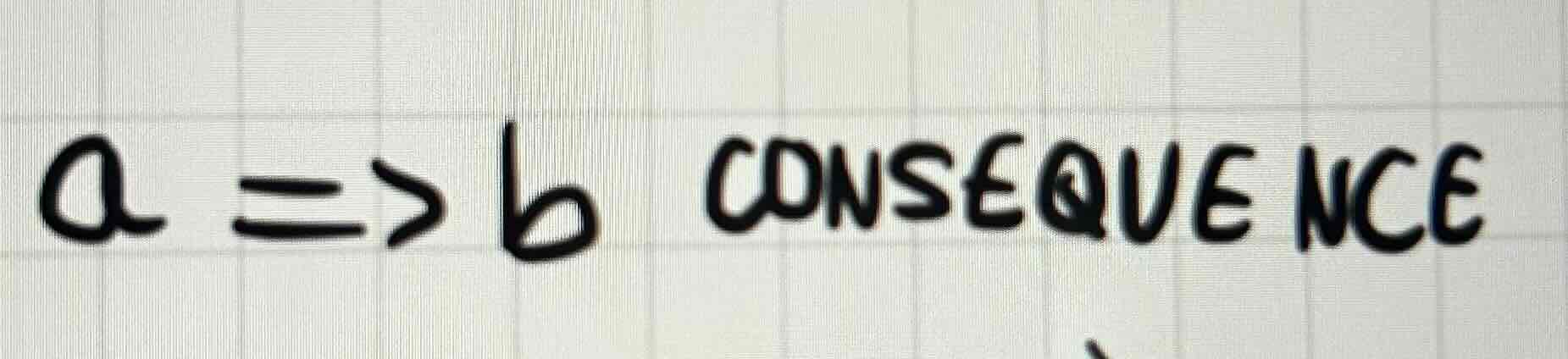
Proof:
this means
a implies b
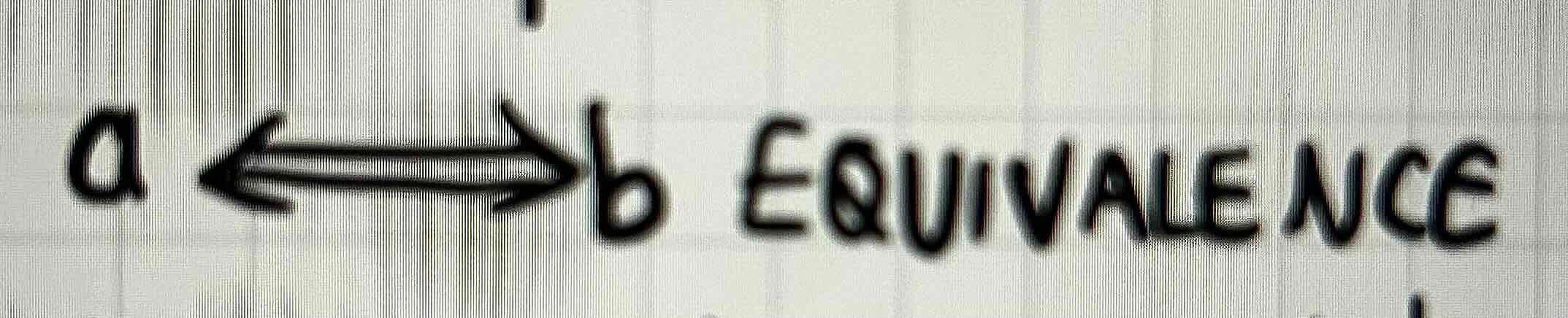
Proof:
This means
a is true if and only if b is true
Proof by exhaustion:
use when
There is a set number of scenarios small enough to consider
Proof by exhaustion:
Prove n is a prime number
n/2= a decimal so 2 is not a factor
3,5,7,11,… check the prime numbers until you reach a value close to the sqrt of n
I.e n=97 sqrt97 is roughly 10 so dont check a factor above 10
Conclude: as there are no factors <sqrtn, there are no factors > sqrtn
Proof by exhaustion:
No square number ends in ‘n’
If a number ends in a 1, number squares will end in a 1 as …1²=1
Check all single digits
2²=4 3²= 9 4²=6 5²=5 6²=6 7²=9 8²=4 9²= 1 0²=0
So none of these values end in n
Proof by exhaustion:
Every integer can be written as these general forms
n=3k
n=3k-1
n=3k-2
Proof be deduction:
Use when
Showing a conjecture must be true
Mostly using algebra
Proof by deduction:
Show k³-k is divisible by (for example) 6 for all integers n>1
k(k-1)(k+1)
Three consecutive integers will either be
Odd, even, odd
Even, odd, even
Therefore as it will always include an even, its must be divisible by 2
As it will always include a multiple of three, it must be divisible by 3
Therefore it is divisible by 6
Disprove:
Counter example is used when
You can think of a single example that disproves a statement, generally by inspection
Proof by contradiction:
Is used when
You can state the opposite statement
Prove it is false
And therefore show the original statement was true
Proof by contradiction:
Prove sqrt n is irrational
Assume sqrt n is rational so sqrt n= a/b where a,b are whole numbers in their simplest form, therefore a and b cannot be even
Square both sides
Multiply both sides by b²
Therefore a² is a multiple of n, hence a must be a multiple of n where a=nk
Substitute a=nk
Therefore b² is a multiple of n, hence a must be a multiple of n where b=nk
Therefore the assumption has been contradicted as if they are both of the multiple n, a/b is not in its simplest form
Proof by contradiction:
Prove 2^(3/2) is irrational
Assume 2³/2 is rational so 2³/2= a/b where a,b are integers in their simplest form
2=a³/b³ so a³ has a factor of 2 so a=2k
2b³=8k³ so b³ has a factor of 2 so b=2k
If both a and b have a factor of 2, a/b not in simplest form therefore a contradiction
Proof be contradiction:
There are infinitely many primes
Assume there is a finite list of primes where p is the product of all primes up to pn+1
If p is prime, p is not in the list
If p isn’t prime, p has a prime factor which must be a factor of 1
This is impossible as P is a whole number, so this is a contradiction
Proof by contradiction:
Contradictions to look out for
If a and b are integers, a+or-b must be an integer also
One side of the general equation is even, one side is odd, an odd number cant be equal to an even number
Straight lines:
midpoint between two points
(x1+x2/2, y1+y2/2)
Straight lines:
Distance between two points
sqrt ( (x1-x2)²+(y1-y2)² )
Straight lines:
Gradient of the line joining two points
(y1-y2)/(x1-x2)
Straight lines:
The equations of straight lines passing through two points
y=mx+c
y-y1=m(x-x1)
Straight lines:
If they are parallel..
The gradients will be the same
Straight lines:
If they are perpendicular…
m1 x m2= -1
Or the negative reciprocal
Straight lines:
Find the perpendicular bisector
Find the midpoint
Find the gradient
Find the perp gradient
Sub into the straight line equation
Straight lines:
The area of a trapezium
½ x h x (a+b)
Quadrilaterals:
Definition of a trapezium
One pair of parallel sides
Quadrilaterals:
The definition of a parallelogram
2 pairs of parallel sides
2 pairs of sides of the same length
Quadrilaterals:
Definition of a rhombus
All sides are the same length
Diagonals meet at 90’
Quadrilaterals:
Definition of a Kite
2 pairs of equal sides
Diagonals meet at 90’
Circles:
The equation of a circle
(x-a)² + (y-b)² = r²
Has centre (a,b) with radius r
Circles:
Determine if a line and a circle intersect
Substitute y or x and determine if the roots given are real, if so then it intersects
Alternatively can be proven with discriminant, if b²-4ac<0 then there are no real roots
Circles:
Find the points of intersection of two circles
find the centre and radius for both circles
Expand both equations and set to 0
Make the equations equal to each other and set equal to y
Substitute this into one of the original circle equations to find either x and y
Sub the value of x or y to find the other
Circle theorems:
The angles in a semi circle are
Right angles
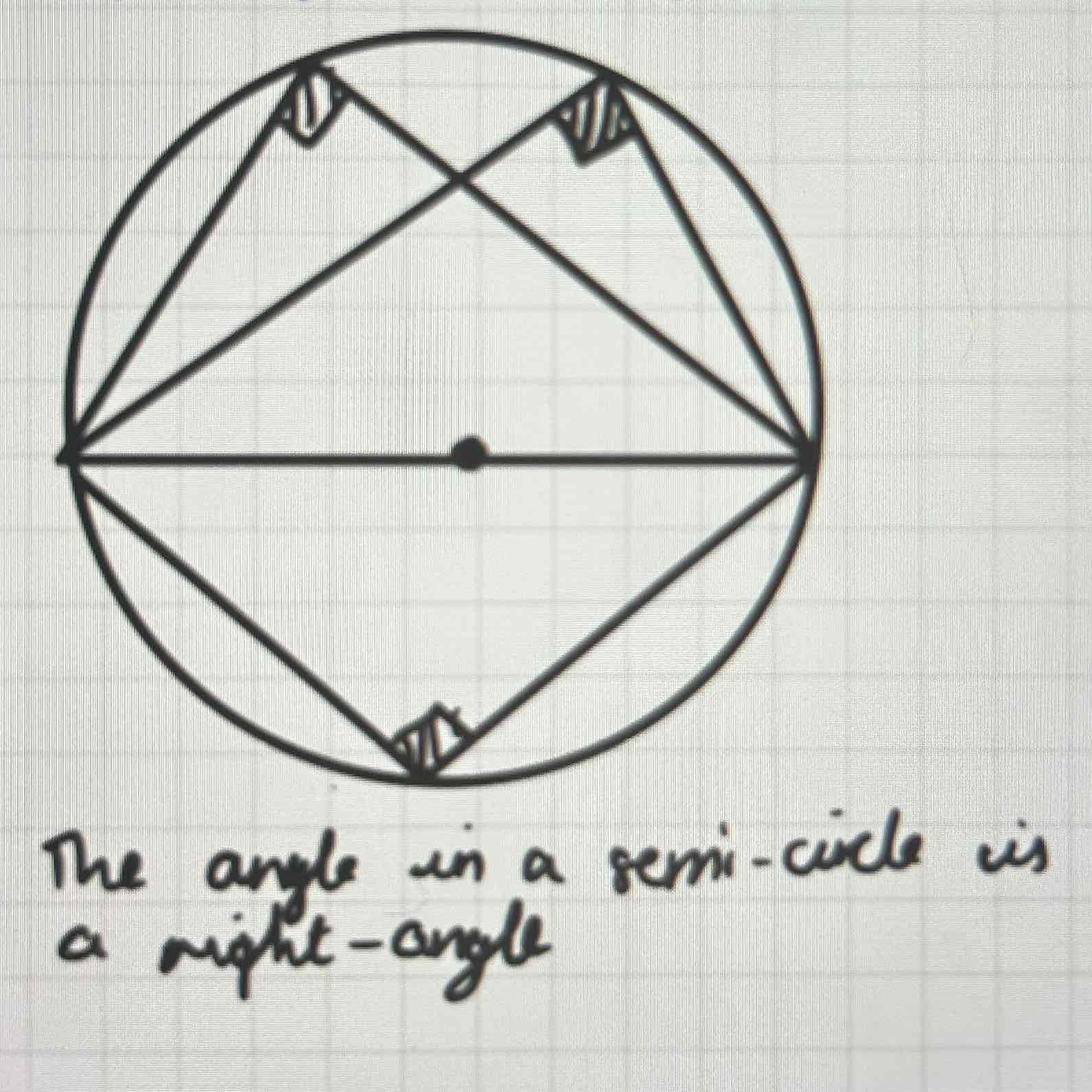
Circle theorems:
The use of the semi circle theorem to prove AC is a diameter with 3 points
Draw a diagram
Find the gradient of AB
Find the gradient of BC
show the gradients are perpendicular through m1 x m2= -1
Hence through the circle theorem AC is a diameter as AB and AC are perpendicular with A,B,C on the circumference
Circle theorems:
The perpendicular bisector of two points on the circumference..
Will always cross the centre
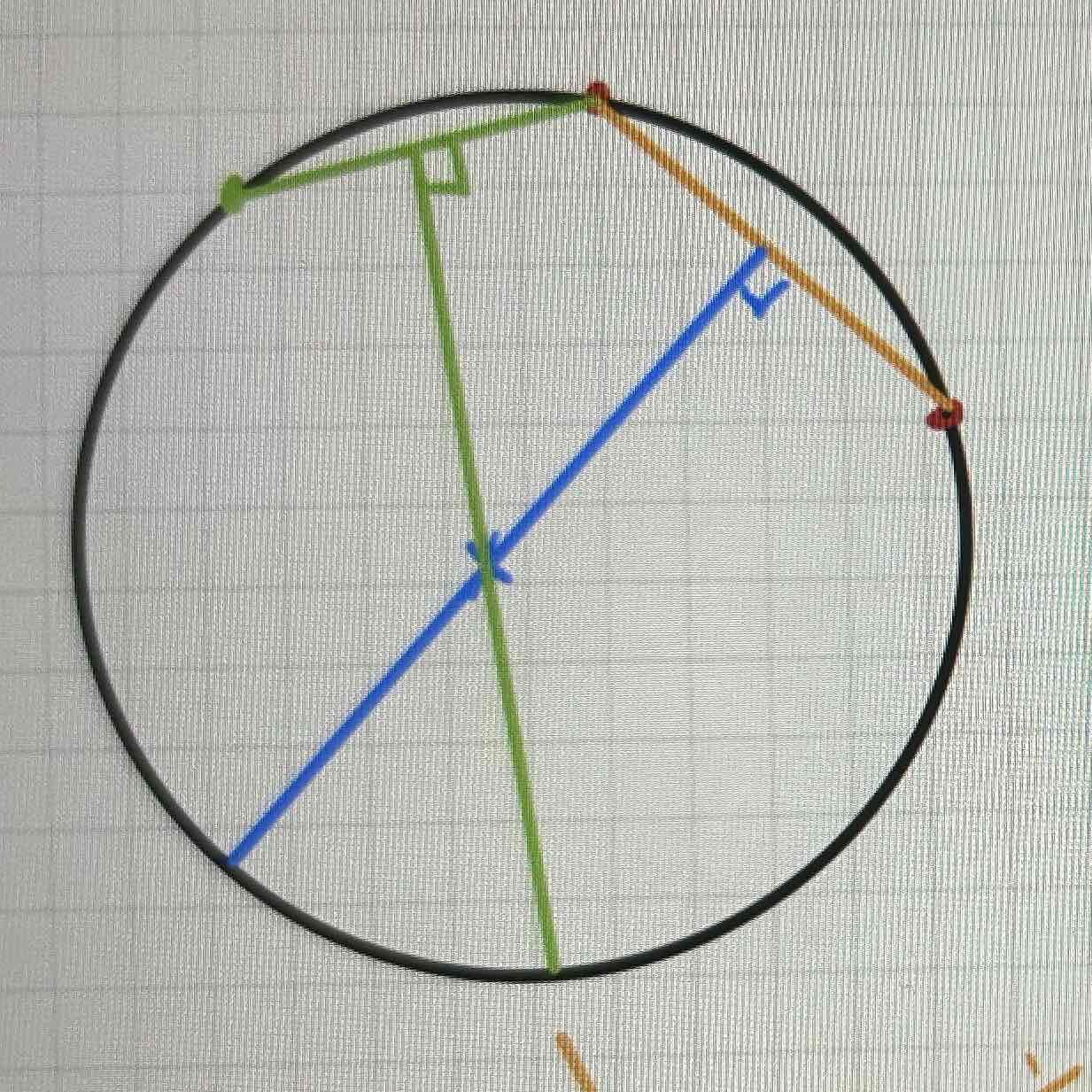
Circle theorems:
Finding the centre and radius of a circle with the perpendicular bisector theorem, given three points on the circumference
Find 2 perpendicular bisectors
Find the intersection of the two perp bisectors (the centre of the circle)
Find the radius by measuring the centre point to one point on the circumference
Circles:
The normal is..
The tangent is…
The line that passes through the circumference and the centre
The line that touches the edge of the circumference once
They are perp to each other
Circles:
Circles not touching..
distance between centres> r1+ r2
Circles:
Circle found floating in a circle..
distance between centres +r1<r2
Circles:
Co-centric circles when
They have a common centre but different radiuses
Circles:
The circle edges are touching
d=r1+r2
Circles:
The circles are overlapping (venn diagram)
d<r1+r2
Parametric equations:
Meaning of parametric equation
Multiple equations describe the curve
Parametric equations:
Define x, y and t
x= f(t)
y=g(t)
t is the parameter
Parametric equations:
Write cartesian as parametric
Let x=t
Substitute into the y=f(x) equation
Parametric equations:
Write parametric as cartesian
Find x+y= f(t) 1
Find x-y= f(t) 2
Perform an operation (add, subtract, multiply, divide) to remove t and gain a cartesian
Or set both equal to t and and set equal to each other
Parametric equations:
Draw the parametric equation given x=f(t) y=g(t)
Create a table and sub in values of t to find (x,y) coordinates

Parametric equations:
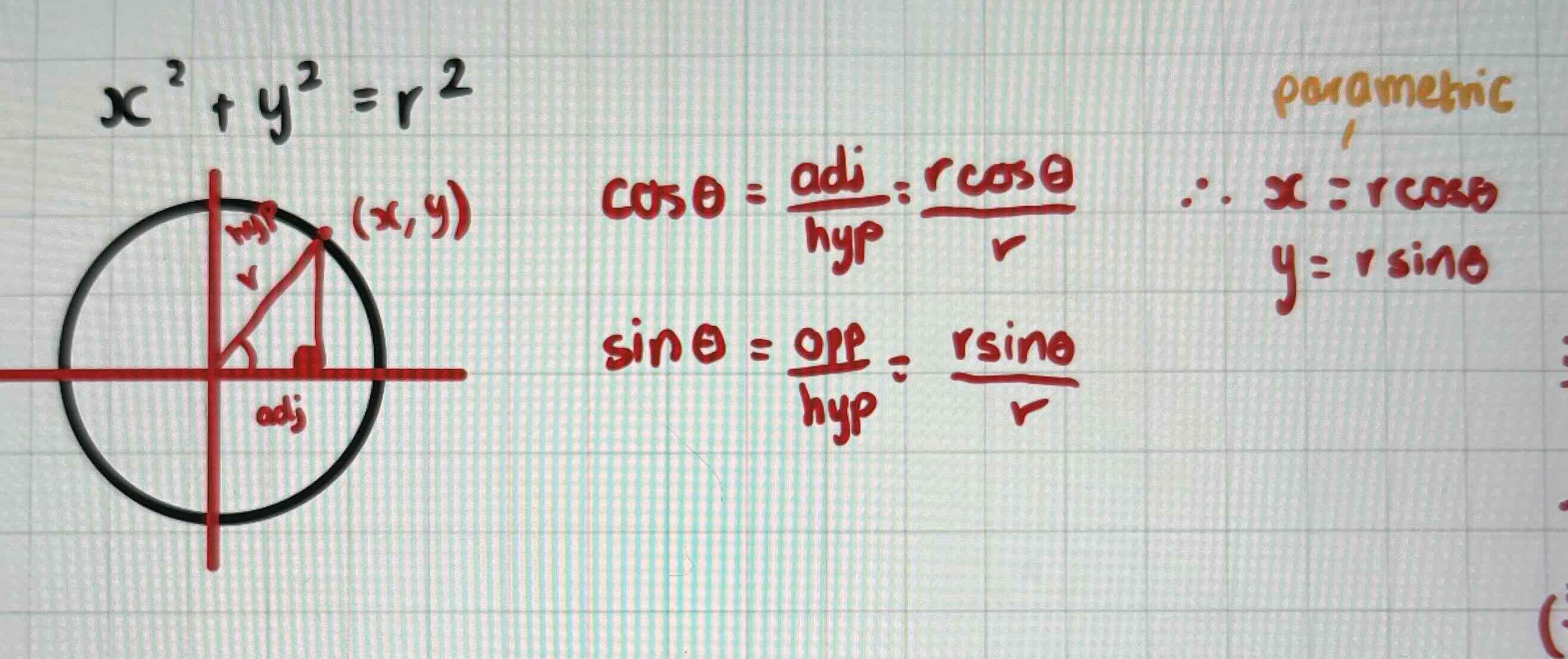
Define an circle parametrically
x=r costheta
y=r sintheta
Parametric equations:
Define an ellipse parametrically,
And then write it in cartesian form
x=a costheta
y=b sintheta
x/a=costheta y/b=sintheta
Cos²theta+ Sin²theta= 1 so
(x/a)² + (y/b)² = 1
Parametric equations applied:
When finding a length of time t, for which y or x is equated to something, use these equations
r=(u costheta t)i+ (u sintheta t - ½ gt²)j
where x=u costheta t
y=u sintheta t
Quadratics:
Completing the square
Get in the form a( x²+ b/ax+ c/a )
a( (x+half the x coefficient)² -(half the x coefficient)² - the constant )
The vertex is therefore at ( -(whats in the bracket), outside the bracket)
Quadratics:
Finding the line if symmetry of a quadratic curve
Complete the square of the line
The negative of the constant value inside the bracket is the line of symmetry
i.e (x-2)²+5 → x=2 is the line of symmetry
Quadratics:
What is the discriminant
b²-4ac
Quadratic
If b²-4ac<0
There are no real roots to the quadratic equation since in the quad formula you cant sqrt a negative number
Quadratics:
b²-4ac=0
There is one real repeated root
Quadratics:
b²-4ac>0
There are two distinct real roots
Inequalities:
Set notation
{ xER: inequality}
Inequalities
Interval notation rules
If x<a
xE (-infinity, a)
If a<=x<=b
xE [a,b]
If x<a or a<=x<=b
xE (-infinity, a) U [a,b]
Inequalities:
draw an inequality on a line
Full circle includes
Empty circle does not include
This is useful to see the overlap of inequalities on a number line
Polynomials:
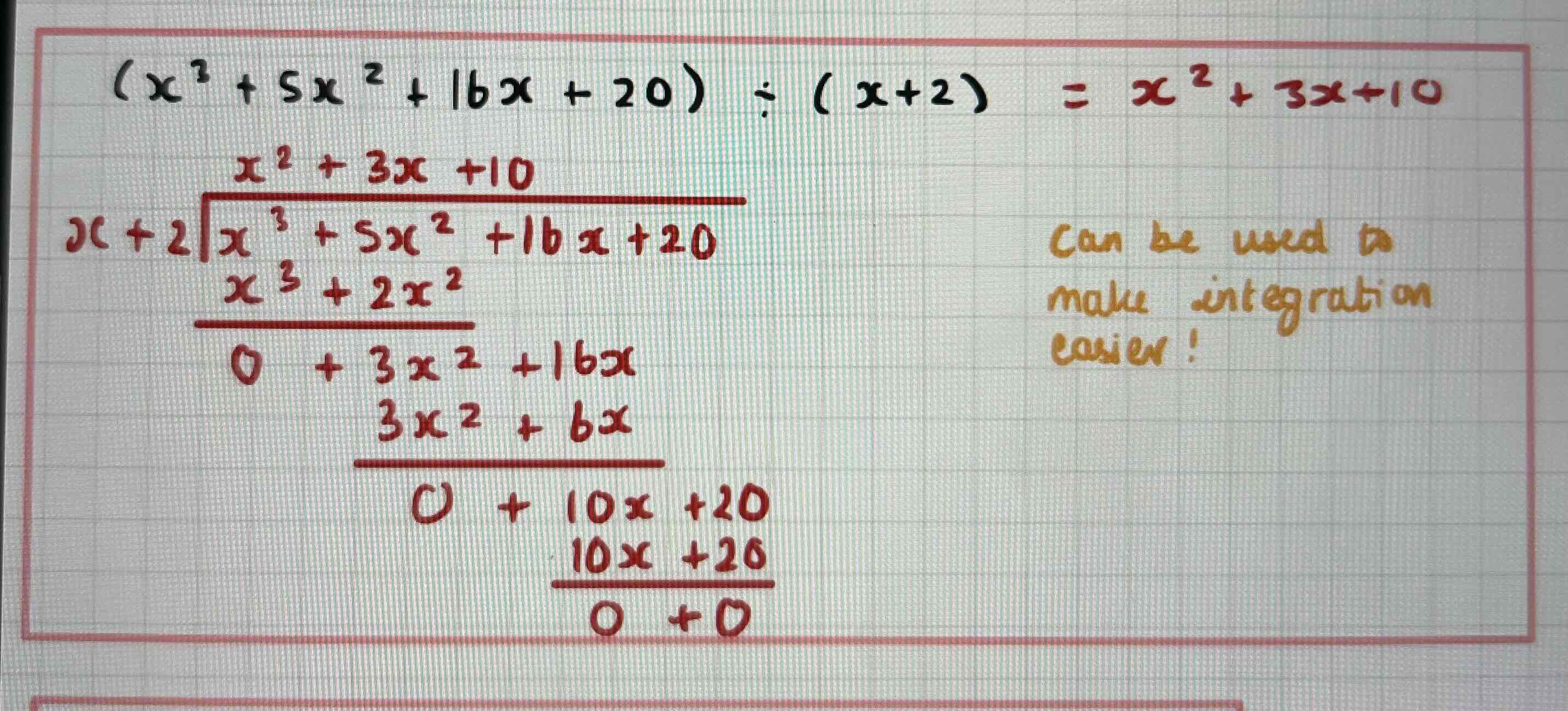
Bus stop division with quadratics
Polynomials:
Factor Theorem
If (x-a) is a factor of f(x) then f(a)=0
Polynomials:
remainder theorem
Function= linear x quotient + remainder
F(x)= (x-a)(q) + R
Graphs:
The modulus function is also known as
The absolute value of x
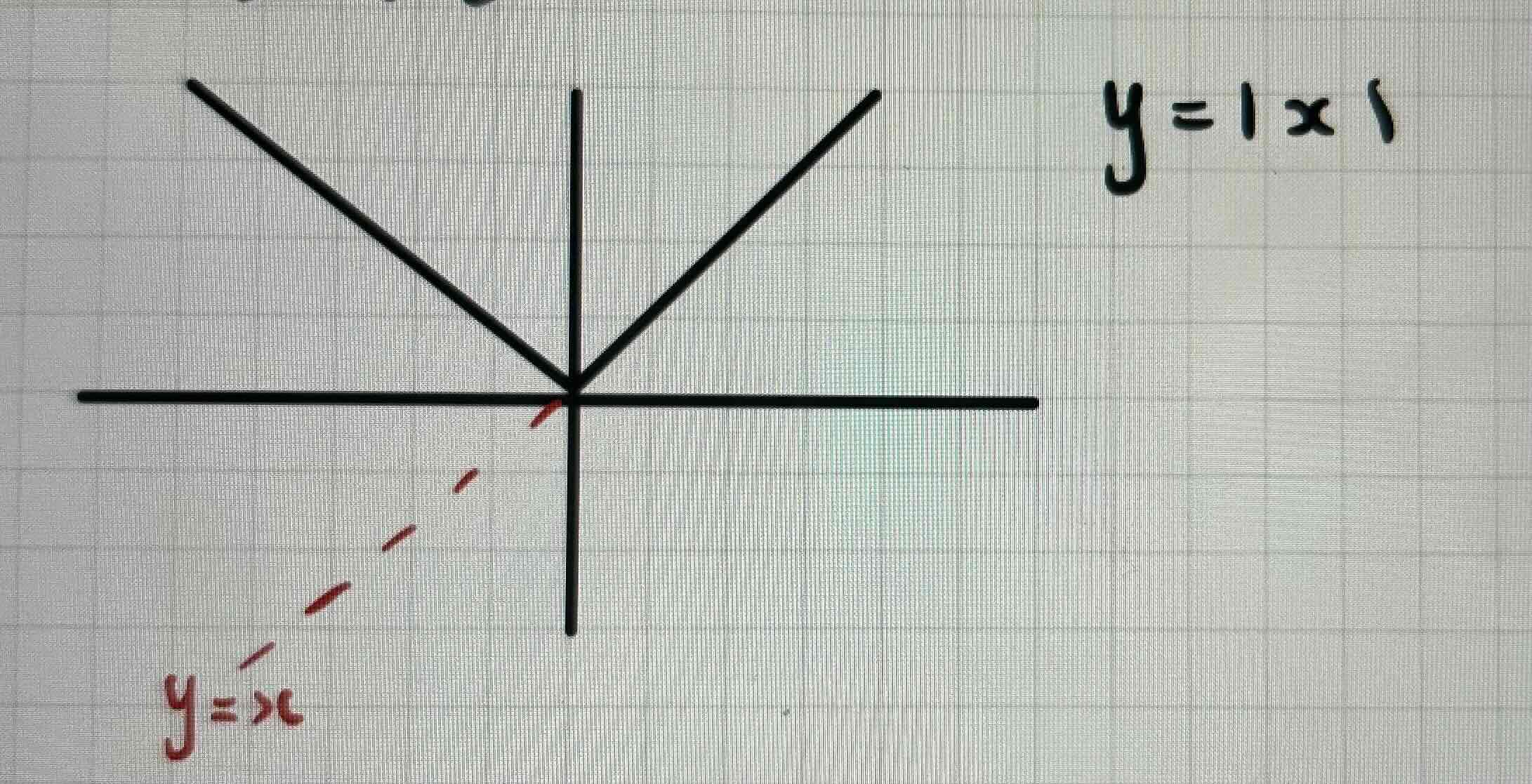
Graphs:
Sketching y=|x|
Modulus:
Find the vertex of y=a+b|x-c|
Think of completed square form
(The negative of whats in the modulus, whats outside the modulus)
So (c,a)
Modulus:
Find where the modulus equation crosses the axis
When x=0 to find one y value
Use symmetry if it crosses the axis again
Modulus:
Solving modulus equations with no y value
Get into the form a|x-b| to find the vertex
Set both sides to y and draw the lines
Notice the points of intersection
Solve the equation for the positive/negative gradient
Either ax-ab (positive) or -ax+ab (negative)
Modulus:
write a modulus as an inequality without the modulus
|x-a|<b
-b<x-a<b
Modulus:
Write an inequality as a modulus
‘a<x<b’ or ‘x<-a , x>b’
a+b/2
a-(a+b/2)<x-(a+b/2)<b-(a+b/2)
Find an operation that makes
|a-(a+b/2)|=|b-(a+b/2)|
|x-(a+b/2)|<|b-(a+b/2)|
Aka
2<x<10 2+10/2=6 -4<x-6<4 so |x-6|<4
Proportion:
y is directly proportional to x is written as
y=kx
Proportion:
y is inversely proportional to x is written as
y= k/x
Proportion:
Show two measurements are proportional
Use an equation involving the two measurements, i.e mass=density x volume
Sub your two measurements into the equation and get into the form y=kx or y=k/x depending on what you’re proving
Show that this proportional equation is true for all given measurements and conclude
Proportion:
When drawing proportional graphs what should you be wary of
If the units of measurement can be negative, i.e time cant be <0 so dont draw that part of the graph
Functions:
The range is
The scope of the y values
Functions:
The domain is
The scope of the x-axis
Functions:
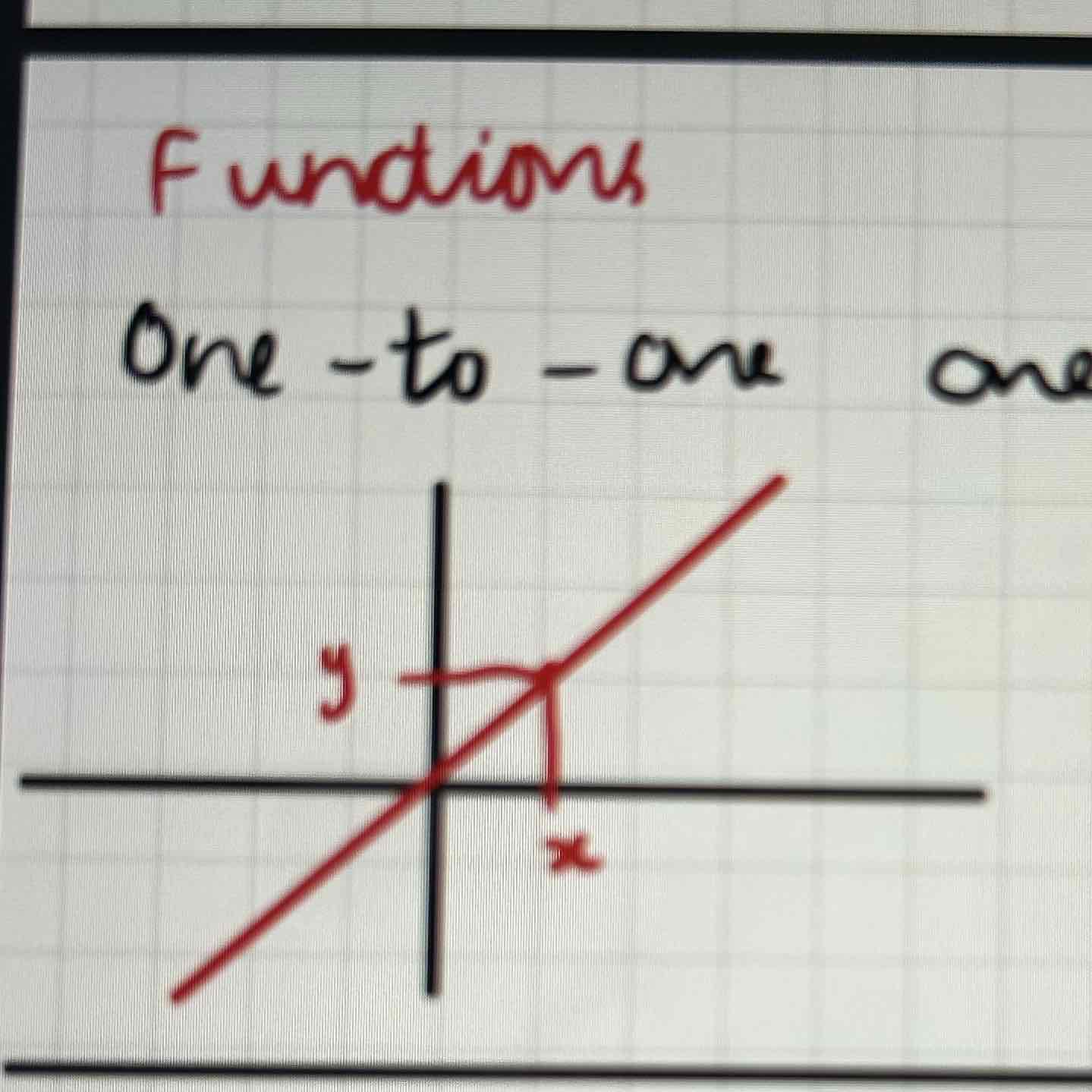
a one-to-one function
Has one x, for one value of y
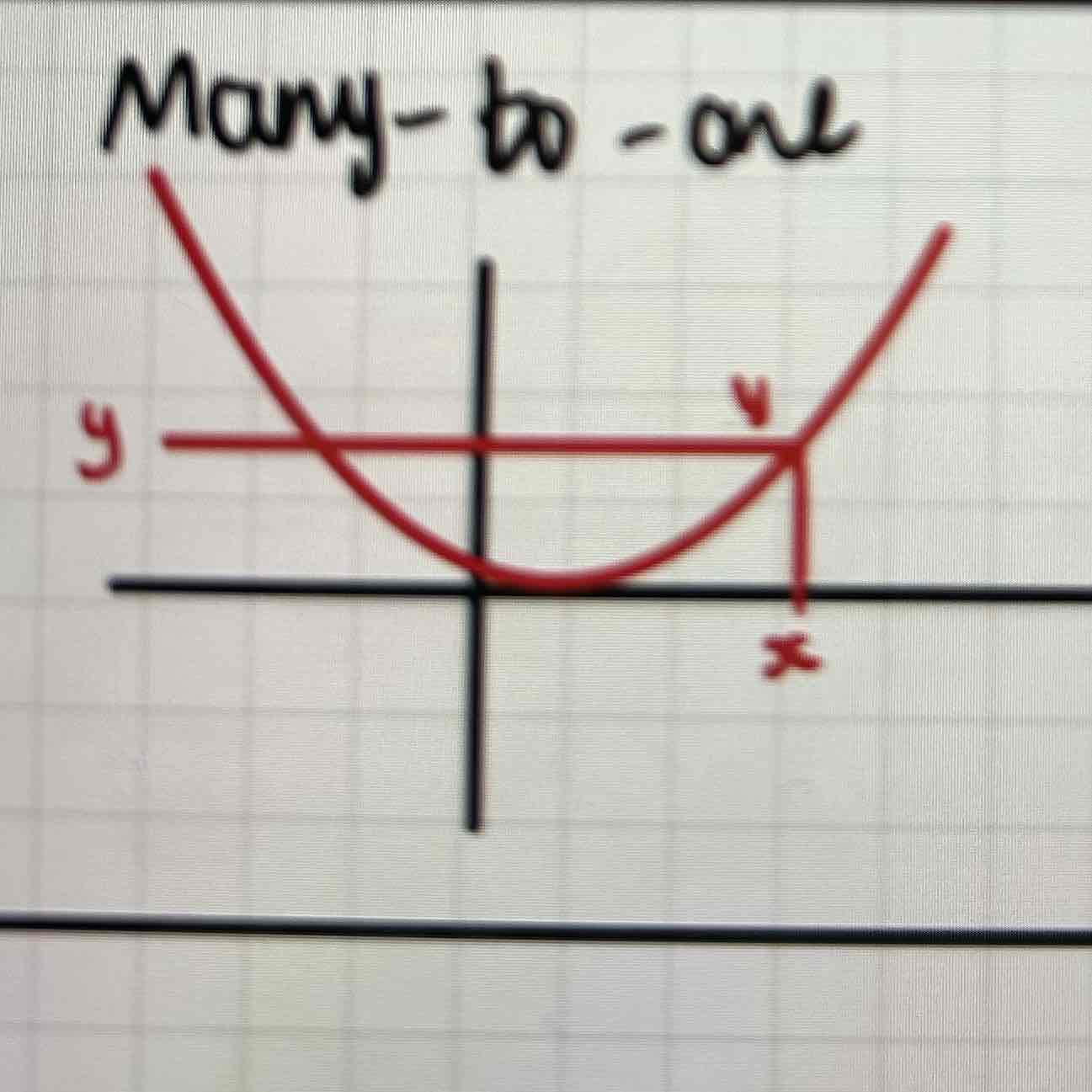
Functions:
a many-to-one function
one x, for many y values
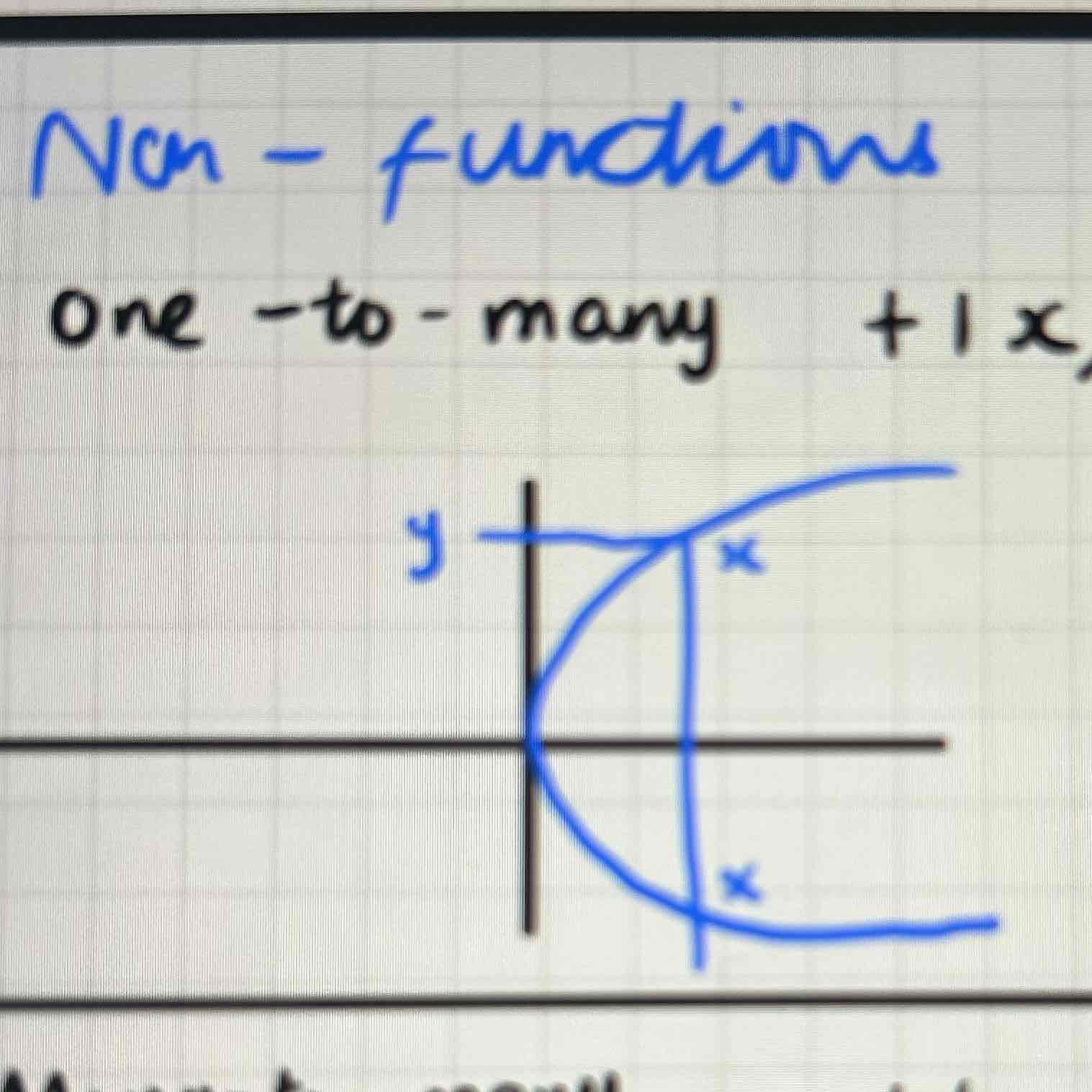
Functions:
A One-to-many non-function
Many values of x for multiple y values
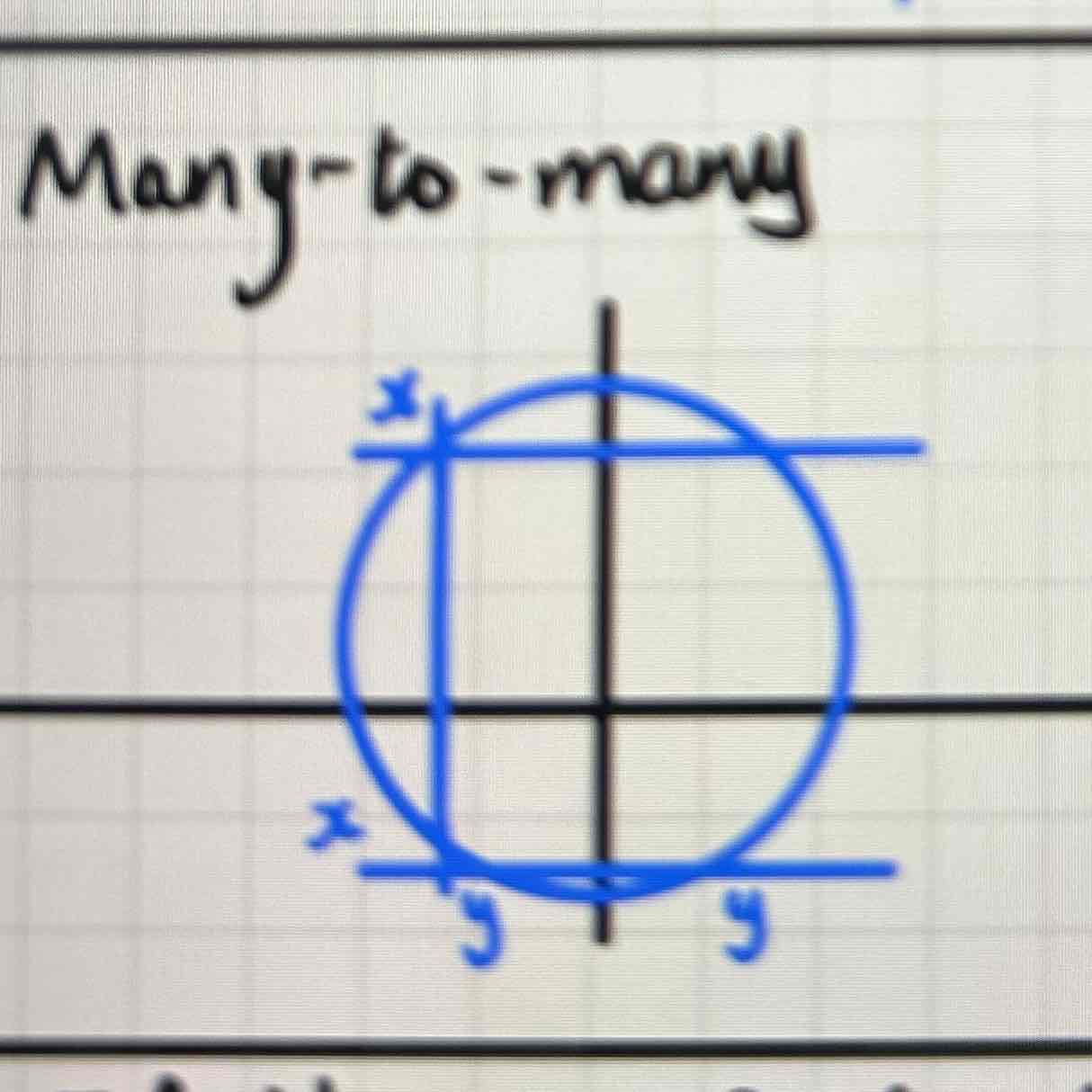
Functions:
A Many-to-many non-function
Multiple values of x for multiple values of y
Function:
What is a function
Giving in a value of x gives only one value of y
Only functions can have an inverse, so one-to-many and many-to-many graphs can have no inverse
Functions:
Definition of an even function
F(-x)= F(x)
This is because of a line of symmetry along the y-axis
Functions:
Definition of an odd function
F(-x)= -F(x)
The graph has rotational symmetry about the origin by 180’ (if u rotate part of the graph 180’, it will map onto itself)
Functions
f²(x) means
ff(x)
Functions:
Finding the domain of a composite function
Find the domain for all involved functions in the composite
The domain of the composite will be
-the domain of the composite function created
-and the domain of the first function (i.e for hgf(x), f(x) is the first function)
Functions:
Find and inverse function
Set f(x) to y
Swap x and y
Solve for y
Write y as f^-1 (x)
Functions:
What will the answer always be for
f(f^-1(x))
f^-1(f(x))
x
This shows e and ln are inverse functions
Functions:
Find the range and domain of the inverse function
The range is the domain of the original function
The domain is the range of the original function
Transformations:
f(x)+_a
A translation up or down by a
Transformations:
f(x+_a)
A translation right or left by -(a)
Transformations:
y=k(f(x))
A stretch parallel to the y-axis by s.f k
Transformations:
y=f(kx)
Stretch by s.f 1/k parallel to the x-axis
Transformations:
y=-f(x)
Reflection in the x-axis (y=0)
Transformations:
y=f(-x)
Reflection in the y-axis (x=0)
Transformations:
Find the equation of the graph after the transformation
y=f(x-a)+b
replace x with (x-a)
replace y with (y-b)
Transformations:
Find the equation of the graph after the transformation
y=(1/k x)
Replace x with (1/k x)
Transformations:
Find the equation of the graph after the transformation
y=k(f(x))
Replace y with 1/k y
Transformations:
Find the equation of the graph after the transformation
y=f(-x)
Replace x with -x
EVEN FUNCTION
Transformations:
Find the equation of the graph after the transformation
y=-f(x)
Replace y with -y
ODD FUNCTION
Transformations:
Rules for the order of graph transformations
If you do a transformation effecting y followed by a transformation effecting x the order does not matter
If you do a transformation effecting the same axis twice, order does matter
Use BIDMAS if both translations are outside when deciding the order to do them in
Use SAMDIB if both translations are inside the brackets when deciding the order
Partial Fractions:
Form for x/x²
A/(x..) + B/(x..)
Partial fractions:
Form for x/x(x+b)²
A/(x..) + B/(x+b) + C/(x+B)²
Partial fraction:
Form for x²/x²
A/(x…)+B(x..)+C
Partial fractions:
Form for x³/x² or x^4/x²
A/(x..)+B/(x..)+cx+D
A/(x..)+B/(x..)+cx²+Dx+E
..