Functions of political parties
 Call Kai
 Learn
Learn Practice Test
 Spaced Repetition
 Match
Match Flashcards
 Knowt Play
1/65

There's no tags or description
Looks like no tags are added yet.
Name | Mastery | Learn | Test | Matching | Spaced | Call with Kai |
|---|
No analytics yet
Send a link to your students to track their progress
66 Terms
6 functions of political parties
Recruitment of leaders
Representation
Participation and mobilisation
Organisation of gov’t
Policy formulation
Hidden
Importance of leaders
Possible govt ministers!
Difference of the role of the leader in the ruling vs the opposition party
Ruling party
Party leader is the PM and therefore controls the appointment of all ministers
Opposition party
Leader choses small frontbench who lead with them
Role of parties in shaping leaders
Internal party organisations and committees allow leaders to ‘cut their teeth’
This formal organisation gives opportunities for party members to be trained as leaders
Example of importance of party leadership - Labour in 2015-16
Ed Miliband resigned post-2015 GE defeat
Created a power vacuum
Party membership voted for Corbyn who is v far left compared to the MPs and Peers
Corbyn was the party leader from 2015-20 but MPs in Plmt refused to acknowledge him as their leader
Example of importance of party leadership - Conservatives in 2019
Lost faith in May post-Brexit failure
Johnson was the favourite among MPs and members of the party (who vote for the leader) which meant he was elected as party leader and therefore PM
Liberal Democrat system of election of a party leader
2019 and 2020 - to run for leader, candidates had to
Be an MP
Have the support of 10% of LD MPs (so 1 other MP)
Have the support of at least 200 party members across at least 20 local parties
Nominations close, candidates campaign and are elected by all party members (1 member 1 vote)
Use AV to ensure majority
2019, 2020 - leadership contests only between 2 candidates (Swinson and Davey, Davey and Moran)
Ed Davey - centrist ‘Orange Book’
Swinson, Moran - socially liberal, progressive
3 reasons political parties are effective in their role of recruiting and training political leaders
Almost all senior politicians in the UK are associated with a party
Parties control who is chosen to stand for election (and therefore who is elected)
This means parties then control all the members of elected bodies
Parties also train up future party leaders by giving political candidates experience of canvassing, debating and running constituency parties
They are trained in the values and processes of their party, allowing them to test and grow their political skills and work their way up in a democratic way
2 reasons political parties are ineffective in their role of recruiting and training political leaders
Parties choose charismatic and popular leaders as opposed to those who are most competent
Skills to win elections ≠ skills to run the country and make difficult decisions
Party membership elects leaders rather than MPs, who are democratically elected, while the party membership makes up 2% of the population with disproportionate power!
Leaders chosen by these few people have been
Crazy out of touch with the wider party like Corbyn
Rich and also out of touch like Johnson
Sections of society represented by different parties (+ time period)
Labour, early 20th century
W/C, trade union members
Conservatives, 19th century
Landed gentry, aristocracy
Representative function of parties in the present day
Most contemp parties in modern democracies claim to represent the national interest
Seek to ensure all groups have their interests and demands considered by govt
All parties do have a bias towards some sections of society due to their core values and ideology
Populism + recent examples
Reactionary, quickly emerging political mvmt and way of campaigning that appeals to people’s emotions and prejudices by telling them what they want to hear
Seeks to go back to popular ideas of the past, not looking for progressive change
Defined by what they are opposed to, often anti-govt/taxation/establishment
Finds support among groups who feel their concerns have been ignored by established groups
E.g. MAGA, ‘take our country back’ (UKIP)
Emergence of populist parties
Reform in the UK
Rise of issue parties
Represent a specific cause
Green parties
Women’s rights parties (especially recently across Europe
Parties are effective at representing the interests of the electorate - mandate
They act as a link between the govt and people by turning public opinion into policies
This gives the winning party the popular mandate to carry out its policies
Parties are effective at representing the interests of the electorate - universal suffrage
Parties emerged to represent the views of the new wider electorate
Labour stemmed from socialism and trade unions to represent the W/C
Conservatives - represent interests of M/C and private businesses
Parties are effective at representing the interests of the electorate - ‘catch-all’
Increasing wealth and move away from heavy industry has meant parties have distanced themselves from their traditional ideology and instead develop policies that appeal to the mass of the electorate
All major UK parties are now catch-all parties
Parties are ineffective at representing the interests of the electorate - catch-all parties
Labour has reduced its trade union links under Blair to attract uncommitted voters but have therefore stopped properly representing the interests of the W/C
Some say that pressure groups are instead more effective at articulating interests to policy makers
Educative function
Parties have an educative function all year round
Inform citizens about political issues and then outline their solutions
Esp for those that are not directly affected by the issues
Educate the public about how the political system works
Examples of political parties educating the population
Green party
Awareness of environmental issues
UKIP
Awareness of the role and position of the EU
Labour
Awareness of low pay, 0 hour contracts, funding of the bedroom tax
Partisan dealignment
Process by which individuals no longer long-term identify with a particular party
Mandate
Instruction or command that gives authority to a body to act in a certain way
Mandate confers legitimacy on a political actor
Catch-all party
Party that develops widely-appealing policies (contrast to ideological parties)
Current role of parties in participation and mobilisation
Less significant
Has been taken over by the internet, media, think tanks, pressure groups and social media
Parties do coherently present the electorate with clear choices
Parties are effective at fostering participation and mobilising people - reducing disillusionment
Parties provide opportunities for like-minded people to join together and shape party/govt policy
They also educate and mobilise the electorate during their daily activities
These both build up loyalty and identification among the electorate
Parties are ineffective at fostering participation and mobilising people - partisan dealignment
Voters have become more and more dealigned with parties and are now less likely to vote, and when they do vote are unpredictable
This has been seen in falling membership numbers - parties have been unable to moblise the public to participate in both wider and internal democracy
Parties are ineffective at fostering participation and mobilising people - changing ways of campaigning
Rather than grassroots party members and MPs campaigning, party leaders use the media and social media more and more to replace the role of party activists
Election campaigns are based on centralised messaging instead of personalised calls to action
Explanation - ruling party
Parties form govt as the UK has a system of party govt
Whichever party has a majorty in the HoC forms the govt and implements its manifesto
They organise the legislative programme and ensure it is carried out
Parties are held accountable for their actions in govt
Explanation - opposition parties
Parties scrutinise and criticise govt policy
They provide a govt in waiting
Parties are effective in their role of organising government - stability and coherence
They give the govt stability and coherence as the members are from a single party (usually)
Members of govt are therefore united by common sympathies, attachments and ideologies
Parties are ineffective in their role of organising government - unity
Party unity has declined massively post-1970s so govts are not ideologically aligned and therefore not stable or coherent
There are often clear internal splits even if a party is ideologically aligned
Brexit
This weakens their control of the HoC
1970 - Heath govt (C) HoC majority
31
1983 - Thatcher govt (C) HoC majority
144
1997 - Blair govt (L) HoC majority
178
2010 - Coalition govt (C/LD) HoC majority
80
2015 - Cameron govt (C) HoC majority
12
2017 - May govt (C) HoC majority
No majority
2019 - Johnson govt (C) HoC majority
80
Policy formulation of the ruling party and 6 groups involved
Policy formulation of ruling party = that of the govt (duh)
Includes
Political leaders - ministers
Civil servants
Advisory units and committees
Private advisors
(Backbench MPs)
(Peers)
Policy formation of the opposition
Very important as they’re trying to replace the govt of the day
Includes
Leader
Leadership of the group
General membership of the party through conferences and party committees on a local/regional/national level
Aggregation (= policy-formulating function) and those who undertake it
Process undertaken by political parties of converting policies, demands and ideas into practical policy programmes for govt
Includes
Identifying range of demands from party members, society and other groups
Converting demands into consistent and compatible actions
Involves
Removal of contradictions
Making compromises
Undertaken by
Party leadership as will be the ones to eventually put it into practice in govt
Policy formulation’s role in supporting democracy: accountability
Govts can be held responsible for their performance in govt using their manifesto promises
Policy formulation’s role in supporting democracy: choice
Clarity of choice: allows electorate a clear choice between potential govts by enabling the presentation of distinct policy options and ideologies
Breadth of choice: increasing numbers of parties post-WW2 gives more electoral choice
Green Party and policy formulation
Green Party operates a one-member-one-vote system on policies the party should adopt
There are divides amongst members about nuclear energy so many members hope this will encourage the party to be pro-nuclear energy even if the leadership isn’t
Breadth of choice - number of candidates put forward and number of seats won by 8 largest parties in 2019 election
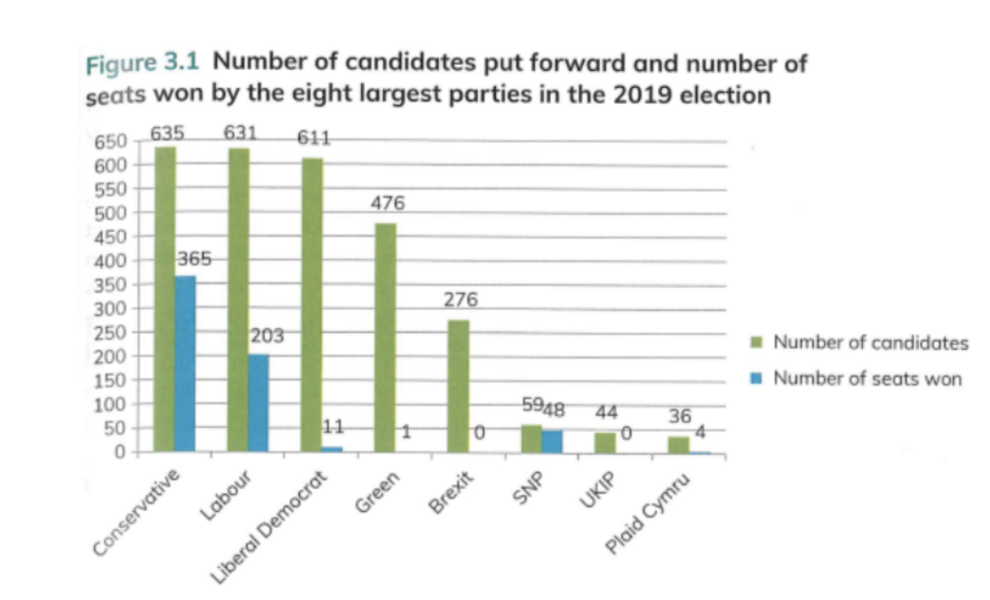
Number of C candidates put forward and number of seats won in 2019 election
635 candidates
365 seats
Number of L candidates put forward and number of seats won in 2019 election
631 candidates
203 seats
Number of LD candidates put forward and number of seats won in 2019 election
611 candidates
11 seats
Number of Green candidates put forward and number of seats won in 2019 election
476 candidates
1 seat
Number of Brexit Party candidates put forward and number of seats won in 2019 election
276 candidates
0 seats
Number of SNP candidates put forward and number of seats won in 2019 election
59 candidates
48 seats
Number of UKIP candidates put forward and number of seats won in 2019 election
44 candidates
0 seats
Number of PC candidates put forward and number of seats won in 2019 election
36 candidates
4 seats
Lack of efficacy of policy formulation: personalities over ideology
Parties have become less interested in long-term good for society and their ideological foundation
More interested in the technocratic choice of who will run the country better/which leader is more personable
They follow public opinion as opposed to shaping it
Lack of efficacy of policy formulation: lack of choice
C and L dominate seats in GEs, so there is no real choice for voters between potential govts
Lack of efficacy of policy formulation: apathy
Lack of clear ideology and voter choice leads to apathy and low turnout
% turnout and % of voters who percieved a large difference betwen parties - 2015
66% turnout
27% great difference
% turnout and % of voters who percieved a large difference betwen parties - 2010
65% turnout
23% great difference
% turnout and % of voters who percieved a large difference betwen parties - 2005
61% turnout
13% great difference
% turnout and % of voters who percieved a large difference betwen parties - 2001
59% turnout
17% great difference
% turnout and % of voters who percieved a large difference betwen parties - 1997
71% turnout
33% great difference
% turnout and % of voters who percieved a large difference betwen parties - 1992
78% turnout
56% great difference
% turnout and % of voters who percieved a large difference betwen parties - 1987
75% turnout
85% great difference
Explanation of hidden function
All main parties support the political system of Plmtary democracy
Therefore, they are part of the process that ensures the general population consents to the system
Parties that fundamentally challenge the nature of the poltical system
Seen as extremist
Are only marginal elements of the system
Events that would occur if parties fundamentally challenged the nature of the political system
Political conflict within society at large