BIOL2021: Chapter 19 - Cell Junctions and the Extracellular Matrix
 Call Kai
 Learn
Learn Practice Test
 Spaced Repetition
 Match
Match Flashcards
 Knowt Play
1/75

There's no tags or description
Looks like no tags are added yet.
Name | Mastery | Learn | Test | Matching | Spaced | Call with Kai |
|---|
No analytics yet
Send a link to your students to track their progress
76 Terms
What are the 2 basic strategies/mechanisms for holding cells together?
Cell Junctions (point where cells interact) and the Cytoskeleton
Extracellular Matrix (ECM)
What are the 2 major categories of animal tissues that use junctions and ECM?
Epithelial tissue
Connective tissue
What does epithelial tissue cover?
surfaces (body, cavities)
What does connective tissue do?
Supports, connects, or separates tissues
Mostly ECM with a few cells; handles stress, tension, compression
What are the 3 broad categories of cell junctions?
Cell-Cell contact
Cell-ECM contact
Some connect to actin/intermediate filaments
What do Tight junctions do?
Hold cells close together near the apical side
Seals gap between cells
Prevents diffusion of proteins and lipids from apical to basolateral surface
What are Gap junctions?
Channels that allow passage of small water soluble molecules
Where do anchoring junctions anchor to?
The cytoskeleton
What type of junction are Cell matrix junctions and desmosomes, and what do they connect to?
Anchoring junctions; Cell-Cell contact
Adherens junctions bind actin
Desmosomes bind intermediate filaments
What type of junction are Cell-matrix and hemidesmosomes, and what do they connect to?
Anchoring Junctions; Cell-ECM
Cell matrix binds actin
Hemidesmosomes bind intermediate filaments
What 3 components do anchoring junctions involve
Transmembrane adhesion proteins (cadherins for cell-cell, integrins for cell-ECM
Intracellular adaptor proteins
Cytoskeleton
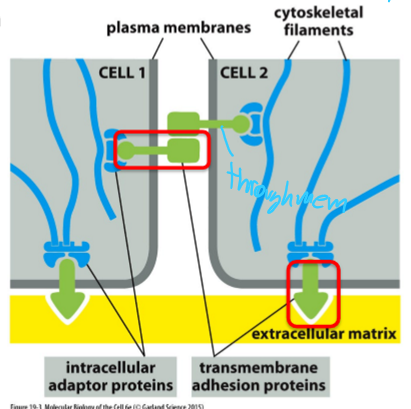
What are Cadherins?
The transmembrane link in cell-cell contacts
Diverse family
Found in almost all cell types
Resist external forces to prevent cells from being pulled apart
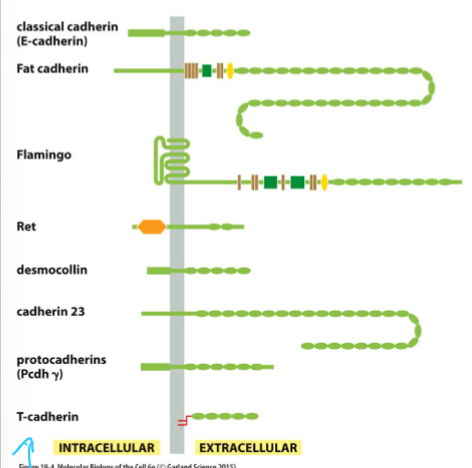
What do cadherins bind to?
Actin (adherens) or Intermediate filaments (desmosomes)
What do cadherins do?
Mediate Homophilic adhesion between cells
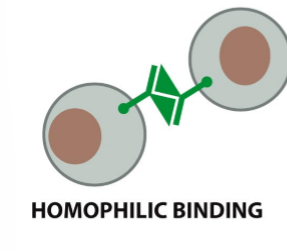
True/False; All cells have the same type of cadherin
False; Different cell types have different cadherins
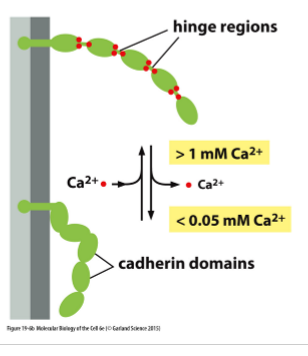
What does the extracellular region of a cadherin have?
Extracellular cadherin (EC) domain
What impact does Ca2+ binding to the EC domain of cadherin have?
Provides rigidity for homophilic binding
In adherens junctions, what happens to adaptor proteins linked to actin under tension?
They extend
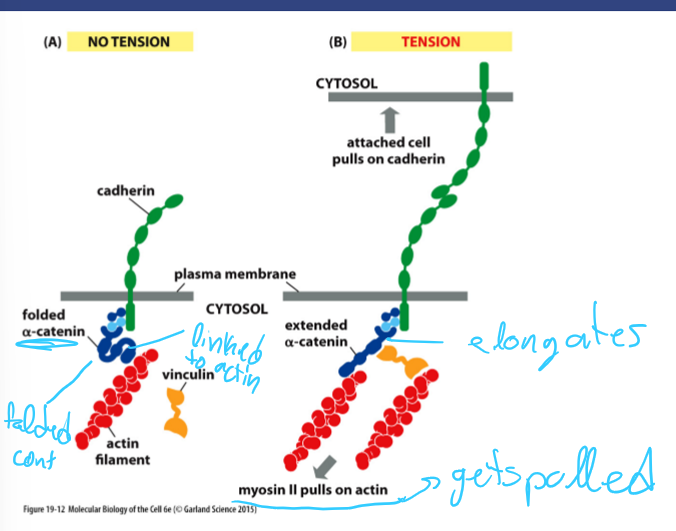
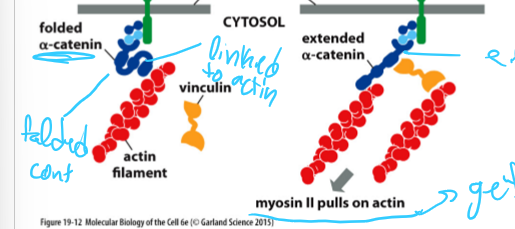
What does an α-catenin attach to?
Binds to actin and cadherin, as well as vinculin (which is binded to another actin filament)
What are desmosomes structurally similar to?
Adherens junctions
What is the function of Desmosomes in Epithelia cells?
To provide mechanical strength
What is the purpose of tight junctions?
Form a seal between cells
Restrict diffusion of membrane proteins and lipids
Restrict diffusion of extracellular molecules
What are claudins?
Transmembrane adhesion proteins found in tight junctions that form a seal
What do gap junctions do?
Couple cells electrically and metabolically
Allow synchronization in excitable tissue
Allow exchange of inorganic ion and small water soluble molecules
What are Connexins and Innexins and what organisms are they found in?
Gap junctions
Connexins; Vertebrates
Innexins; Invertebrates
What are Plasmodesmata?
Found in plant cells
Perform many of the same functions as gap junctions
Fused plasma membrane with smooth ER in between
Passes ions, small molecules
What is pectin and what does it do?
Polysaccharide
Attaches cell walls of adjacent cells
What do selectins do?
Mediate Transient Cell-Cell adhesions in the bloodstream
What are the 3 main types of cell-cell adhesion proteins
selectins
Integrins
Immunoglobulin (Ig) superfamily
What are selectins?
Cell-surface carbohydrate-binding proteins
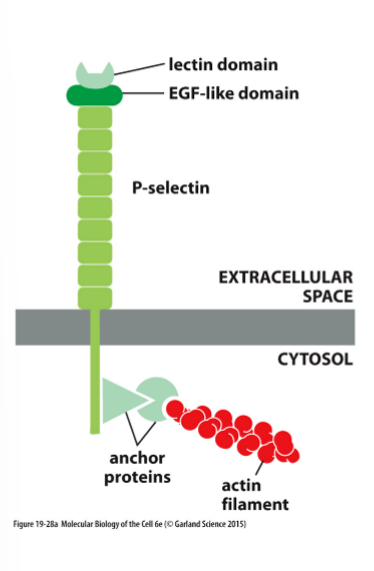
What is the general structure of a selectin?
Extracellular lectin domain (carbohydrate-binding)
EGF (epidermal growth factor)-like domain
Single transmembrane domain
intracellular domain; binds to anchoring proteins which bind to actin filaments
What are the 3 types of selectins found in the bloodstream?
L-selectins (lymphocytes)
P-selectins (platelets and endothelial cells)
E-selectins (endothelial cells)
What do L selectins do?
Interact weakly with oligosaccharides on endothelial cells
How do selectins mediate transient cell-cell adhesions in the bloodstream?
P- and E- selectins are expressed, which bind to oligosaccharides on lymphocytes
Integrins expressed on lymphocytes bind to endothelial Ig superfamily proteins, which strengthen lymphocyte binding
Selectins and integrins allow lymphocytes to migrate out of the blood
Cell-cell adhesion by selectins and integrins are heterophilic
What mediates Ca2+- independent cell-cell adhesion
Members of the Immunoglobulin (Ig) Superfamily
ICAM (intracellular cell adhesion molecule)
VCAM (vascular cell adhesion molecule)
NCAM (neural cell adhesion molecule)
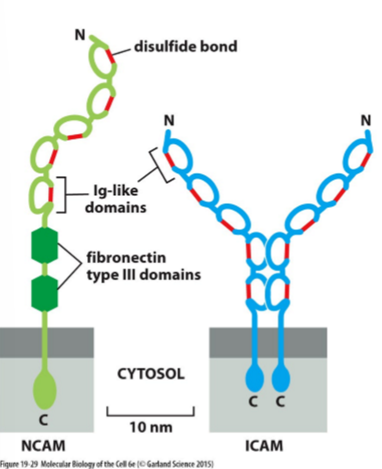
What is the general structure of endothelial Ig superfamily proteins?
Extracellular Ig-like domains
Transmembrane domain
Cytoplasmic C-terminal
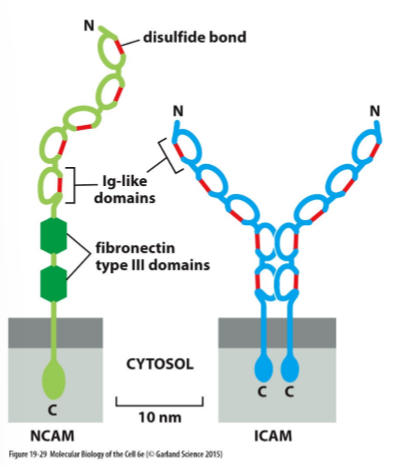
What type of binding do ICAM and VCAM mediate?
Heterophilic binding to integrins on lymphocytes
What is the extracellular matrix made and oriented by?
The cells within it; Proteins, polysaccharides, sometimes minerals
Hard or gel
What are the components of the ECM produced by?
Fibroblast
Osteoblasts; bone
Chondroblasts; Cartilage
What are the 3 main classes of molecules that the ECM s made from?
Glycosaminoglycan; large charged polysaccharides
Fibrous proteins; primality collagen family
Glycoproteins; non-collagen proteins with carbohydrate
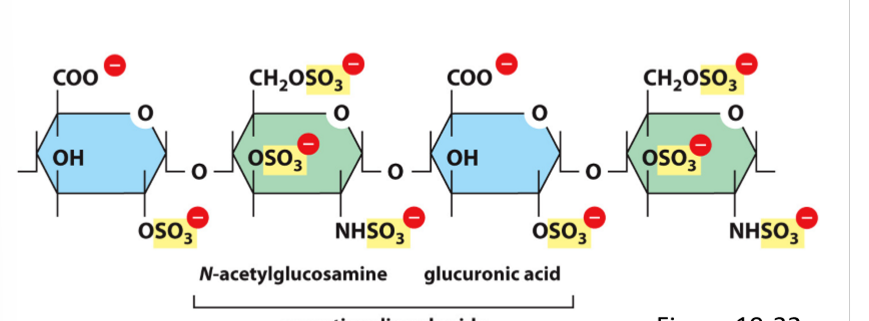
What are Glycosaminoglycan (GAG) chains?
Long unbranched polysaccharide chains of repeating disaccharide units
Strongly hydrophilic; attract cations which draw in water
Can link to protein to form proteoglycans
Occupy large amounts if space
Form hydrated Gels
What are the major proteins of the ECM?
Collagens
What are Collagens?
Major protein in connective tissue
Long, stiff, triple-stranded helical structure
Multiple strands = filament
42 collagen genes in humans; 25%of protein mass
What do secreted Fibril-Associated Collagens do?
Help organize collagen fibrils fibrils
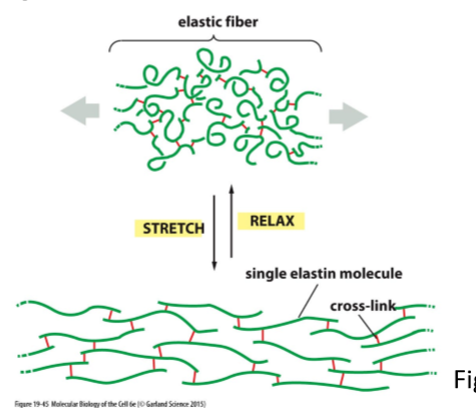
What do Elastin fibers do?
Give tissues resilience to recoil after stretching
Collagen fibers are interwoven with elastin fibers to prevent the tissue from tearing
What are Glycoproteins and what do they do?
Large scaffold proteins with some carbohydrates
Often have binding sites for other ECM proteins
Help organize the matrix and allow cells to attach to it
What is the Basal Lamina?
Specialized form of ECM
Thin, tough, and flexible sheet of ECM
Contains laminin, collagen, fibronectin etc
Has several functions
What are the functions of the basal lamina?
Structural role; connection between cell and connective tissue, surrounds some cells, separates cell types
Selective filter between extracellular compartments
Determine cell polarity
Organize plasma membrane proteins of adjacent cell
What is Laminin?
Glycoprotein
Composed of 3 large and long polypeptide chains (alpha, beta, and gamma) held together by disulfide bonds
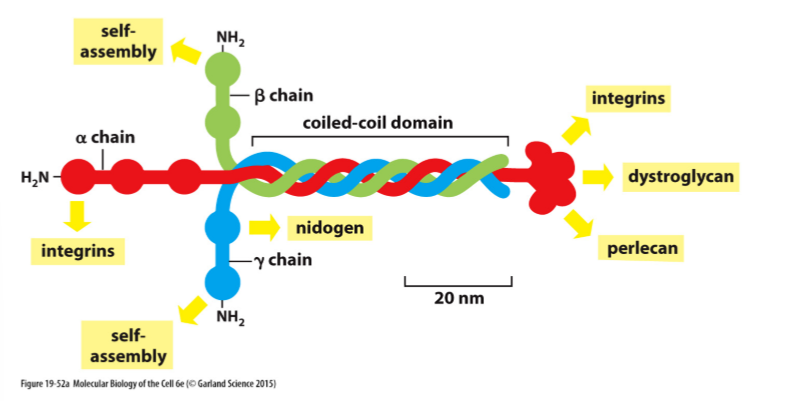
What is Epidermolysis Bullosa Caused by?
Genetic mutation of the LAMB3 (laminin) gene, preventing normal epidermal resistance to anchoring, making the skin fragile
What do matrix receptors do?
Bridge the cytoskeleton to ECM
What are integrins?
Transmembrane heterodimers that link the ECM to the cytoskeleton
Comprised of alpha and beta subunits (not covalently attached)
Bind actin or intermediate filaments on inside and laminin or fibronectin on outside
mediate signaling for cell behavior, including survival
Major matrix receptor
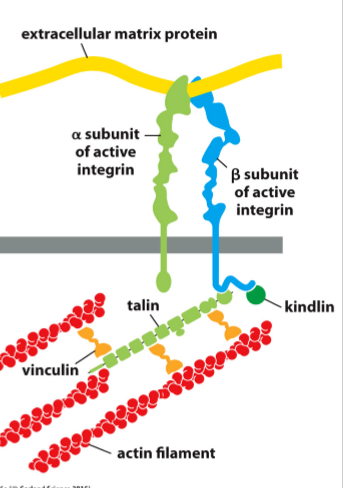
What do Type IV collagen, laminin, perlecan (glycoprotein) and nidogen (proteoglycan) form?
Cross-link network
What is laminin anchored to the cell by?
Binding to integrins
What does Laminin bind to?
Other laminins, collagen, nidogen, and perlecan
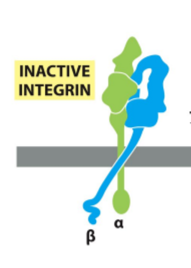
What happens when an integrin is in an inactive state?
Extracellular domain of integrin dimer is folded and cannot bind to matrix proteins
Cytoplasmic tails are hooked together and cannot bind adaptor proteins
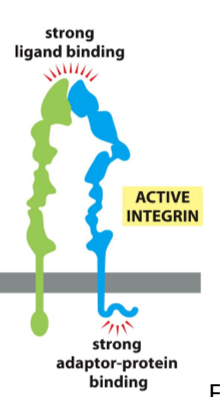
What form is an integrin in when it is active?
Extracellular domain is unfolded and extended
Cytoplasmic tails unhook to expose adaptor protein binding sites
What is an “Outside-In” activation of integrins?
ECM proteins switch integrins from inactive to active state
Leads to exposure of internal talin binding sites and subsequent actin filament binding
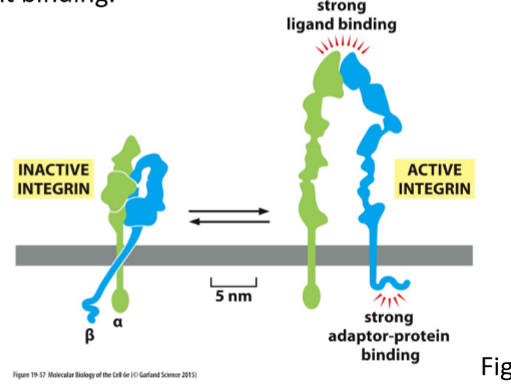
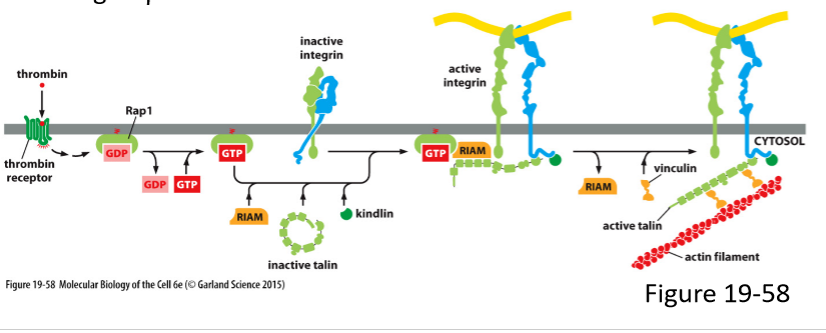
What is an “Inside-Out” activation of integrins?
Activation of GPCR leads to activation of small monomeric GTPase (Rap1)
Activated Rap1 small GTPase interacts with RIAM (RAP1-GTP interacting adaptor molecule)
RIAM recruits talin to the plasma membrane to allow it to bind to integrin beta subunit
Talin recruits vinculin, which allows integrin to associate with actin filaments
Talin binding also unfolds external domain of integrins to allow it to bind to matrix proteins
True/False; Plant cell wall is Thicker, stronger, and more rigid than the extracellular matrix.
True
What is the difference between the primary and secondary cell wall in plant cells?
Primary is thin and extensible, follows cell division until growth stops
Secondary is ridged and thicker, with addition of ligin (polymer)
What is the plant cell wall mostly made of?
Almost entirely of polymers; cellulose and ligin (no nitrogen), very little protein
What is the primary cell wall built from?
Cellulose microfibrils interwoven with a network of pectin polysaccharides
What is cellulose? What is it formed by?
Polysaccharide
Formed by cross-linked glycans
Glucose molecule is inverted with respect to neighboring glucose
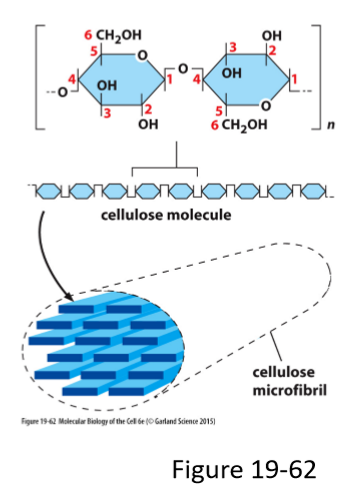
What is a cellulose microfibril?
Assembly of multiple cellulose molecules
Most abundant organic macromolecule on Earth
What allows cellulose to give cell wall tensile strength?
Hydrogen bonds between glucose molecules
Crystalline aggregates of cellulose chains (microfibrils)
What is the plant cell wall comprised of?
Orthogonal array of cellulose microfibrils
Cross-linking glycans
Pectin; polysaccharide
How are orthogonal arrays of cellulose microfibrils arranged?
In layers or lamellae
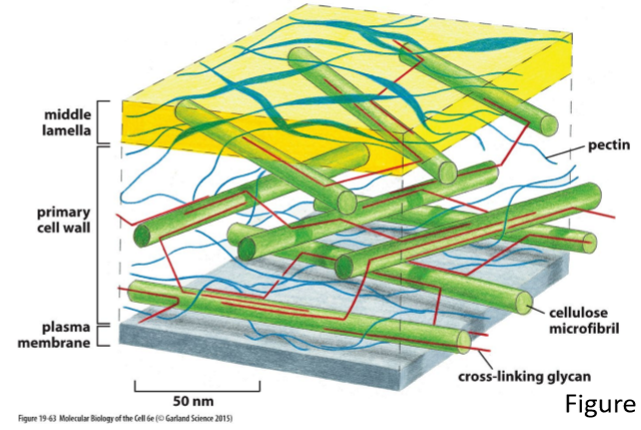
What are cross-linking glycans?
Heterogenous branched polysaccharides that bind tightly to cellulose microfibril
What charge does pectin have?
negative
Which lamella is pectin abundant in and why?
Middle lamella, helps to cement walls of adjacent cells
What part of the cell wall governs direction of cell expansion (growth)
The direction of cellulose microfibrils; aligned parallel to each other, and perpendicular to axis of cell elongation
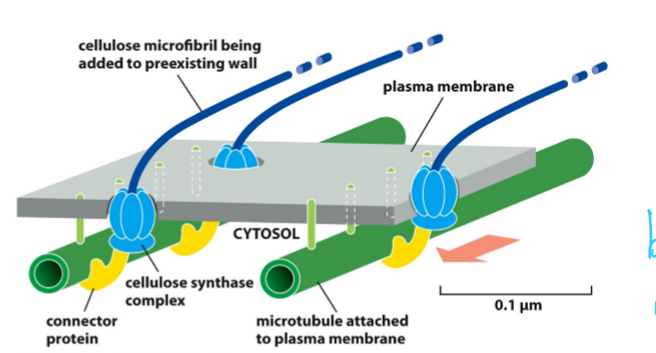
Where does cellulose microfibril synthesis occur?
At the plasma membrane
Where are ECM proteins synthesized?
In the ER and Golgi apparatus.
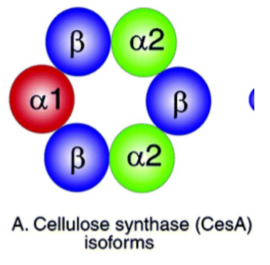
What is the cellulose synthase complex?
A hexagonal rosette subunit made of of 3 isoforms of cellulose synthase (CesA)
Assemble at the plasma membrane
Where are the distal and proximal end of cellulose microfibrils located?
Distil; Integrated into cell wall
Proximal; Pushes cellulose synthase complex along plasma membrane