Exam 1 Review - Ch. 1, 3, 4
 Call Kai
 Learn
Learn Practice Test
 Spaced Repetition
 Match
Match Flashcards
 Knowt Play
1/479

Earn XP
Description and Tags
BIOL 2301 - Margarita Bracamonte - HCCS
Name | Mastery | Learn | Test | Matching | Spaced | Call with Kai |
|---|
No analytics yet
Send a link to your students to track their progress
480 Terms
What is anatomy?
The study of internal and external body structures.
What are some basic components of the definition of anatomy?
The size, the shape, the color, the location, the tissue types etc.
What is physiology?
The study of how bodily structures function.
What are some components of the definition of physiology?
For movement, for absorption, for delivery of nutrients, etc.
How is anatomy and physiology connected?
The way something is structured could give insight on it’s function, one topic is learned through the other and vise versa.
How many levels of organization of the human body are there?
Seven.
What are the seven levels of organization from simplest to most complex?
Atoms
Molecules
Organelles/cells
Tissues
Organs
Organ systems
Organisms
What are the seven levels of organization from most complex to simplest?
Organisms
Organ systems
Organs
Tissues
Organelles/cell
Molecules
Atoms
What are atoms?
The first level of organization that is the smallest unit of matter.
What are the most common atoms in the human body?
Oxygen
Carbon
Hydrogen
Nitrogen
What percentages of each of the most common atoms in the human body?
Oxygen - 65%
Carbon - 18%
Hydrogen - 10%
Nitrogen - 3%
What is the atoms in the other 3% of the body?
A mixture of other metals and elements like iron, calcium, sodium, etc.
How do the atoms that make up the human body reach the body itself?
Through human consumption.
What are molecules?
The second level of organization that is made up of a combination of 2+ atoms.
What are the 5 most common molecules in the body?
Water
Carbohydrates
Proteins
Nucleaic acids (DNA and RNA)
Lipids
What are organelles?
Part of the third level or organisation that are microscopic structures with their own specific functions.
What do organelles form?
Cells.
What is a cell?
Part of the third level of organization that is the basic functional living unit of a living thing.
What are tissues?
The fifth level or organization that are groups of cells working together to perform a specific function.
What are the 4 main types of tissues in the body?
Epithelial
Connective
Muscle
Nervous
What is an organ?
The fifth level of organization that is a combination of 2+ different tissue types.
What is an example of an organ?
The heart, the lungs, the stomach, etc.
What is an organ system?
The sixth level of organization that is made up of a combination of 2+ organs that work together to perform the functions of an organ system.
What are examples of an organ system?
The digestive system is made up of the mouth, esophagus, stomach, intestines, and rectum/anus who’s goal is to digest food and break it down while absorbing all of it’s nutrients.
How many organ systems are in the human body?
11.
What is the Integumentary organ system responsible for?
Prevents pathogens likke bateria from entering the body while maintaining internal water and temperature levels.
What is the skeletal organ system responsible for?
Supports/protects the tissues and organs of the body, helps form blood cells, and stores and releases minerals.
What is the muscular organ system responsible for?
Moves body parts and creates heat that is used to help maintain internal bodily temperature.
What is the nervous organ system responsible for?
Detects and processes internal/external sensory information to then activate a bodily response.
What is the endocrine organ system responsible for?
Regulates body processes to maintain homeostasis by secreting hormones.
What is the cardiovascular organ system responsible for?
Distributes heat, hormones, nutrients, cells, waste, water, oxygen, etc. throughout the body.
What is the lymphatic organ system responsible for?
Defends against infections and disease and returns tissue fluid to blood.
What is the respiratory organ system responsible for?
Distributes oxygen to the body while removing carbon dioxide and produces sound for communication.
What is the digestive organ system responsible for?
Processes food into smaller molecules/ions that are absorbed by cells to store energy or food for when digestion needs to stop emergently.
What is the urinary organ system responsible for?
Removes wastes, excess substances, toxins, and excretes them while regulating water, blood ion concentrations, and pH.
What is the female reproductive organ system responsible for?
Producing oocyte (eggs) and sex hormones, create breast milk, and support developing embryo/fetus during pregnancy.
What is the male reproductive organ system responsible for?
Producing spem and sex hormones.
What is an organism?
The seventh and final level of organization that is composed of all 11 organ systems to maintain homeostasis.
What is homeostasis?
The body’s ability to maintain a stable internal condition within physiological ranges.
What is the physiological range of glucose in blood?
70-110mg/dL
What is the physiological range of internal body temperature?
36.7-37.8°C.
READ TEXTBOOK FOR LAST ONE
Why is homeostatic regulation imperative to survival?
Organ systems only funtion normally if within the physiological ranges, anything outside of them could be detremental to the system, therefore the person.
What are the two ways that the body regulates itself (feedback systems)?
Positve and negative feedback.
Of the two feedback systems that are used by the body to regulate itself, which is the main kind?
Negative feedback.
What are the three commponents of both feedback systems used by the body to regualte itself?
A sensor/receptor
A control center
An effector
What is a sensor/receptor in a feedback system?
It is a cell/tissue/organ/etc. that is specialized to notice the specific part or the body that needs regulation/to be in homeostasis.
What does a sensor/receptor in a feedback system do?
Moniters a physiological condition and sends input to the control center - whether regulation is needed or in homeostasis.
What is the control center in a feedback system?
A cell/tissue/organ/etc. that sets the physiological range to maintain a condition.
What does the control center do in a feedback system?
Evaluates inputs recieved from the sensor/receptor and sends output or instructions to effectors.
What is an effector in a feedback system?
A cell/tissue/organ/etc. that produces a response that returns a changed condition back to homeostasis.
What does the effector do in a feedback system?
Receieves output/instructions from the control center to then follow - regualates.
What is negative feedback?
Mechanism that returns a physiolofical change back to homeostasis - acts to reverse a change.
What is an example of negative feedback?
Body temperature lowers due to enviornment and the body signals the msucles to generate heat and higher the temperature back to homeostasus in physiological range.
Draw out cycle for negative feedback for increased blood sugar level:
INSERT DIAGRAM
Draw out cycle for negative feedback for decreased blood sugar level:
INSERT DIAGRAM
Why is there a physiological range rather than a fixed value?
If there was a fixed value than the body would use an extremely large amount of energy to be at that exact value consistently that would affect all sorts of intakes.
What is positive feedback?
A mechanism that increases/exaggerates a deviation from the normal limits after an initial stimulation where homeostasis is not the ultimate goal.
When do positive feedback mechanisms normally occur?
In dangerous or stressful situations that must be fixed quickly.
What are examples of positive feedback?
Blood clots forming to stop a bleed, childbirth, fevers to help heal, etc.
What is positive feedback during childbirth?
Cervical receptors signal to the nervous system that oxytocin is needed in excess to help contract muscles for birthing, cycle repeats many times slowly increasing the amount of oxytocin sent to the muscles which is why contractions become more close together as labor progreses.
What is the standard body reference position called?
Anatomical position.
What are characteristics of the anatomical position?
Person is standing straight up, facing forward with arms/hands to the side of body, feet are facing forward, flat on the floor about shoulder width apart, and palms are facing forward.
What is the movement that describes the moving of wrist to make palms face forward?
Supination.
What two names can a body laying down described as?
Prone or supine.
What is a prone body?
A body laying face down.
What is a supine body?
A body laying on it’s back.
What are anatomical directional terms used to describe?
Body structure positionings or potentially locate wounds.
In anatomical positioning, what direction is superior?
Above/up.
In anatomical positioning, what direction is inferior?
Below/down.
In anatomical positioning, what direction is ventral/anterior?
Front side of body.
In anatomical positioning, what direction is dosal/anterior?
Back side of body.
In anatomical positioning, what direction is medial?
In anatomical positioning, what direction is lateral?
In anatomical positioning, what direction is cranial/cephalic?
In anatomical positioning, what direction is caudal?
In anatomical positioning, what direction is proximal?
In anatomical positioning, what direction is distal?
In anatomical positioning, what direction is superficial?
In anatomical positioning, what direction is deep?
What is a plane?
An imaginary flat surface that passes through the body dividing it in order to see the inside.
What are the main 3 anatomical planes?
Transverse
Frontal/coronal
Saggital/horizontal
What two locations of the body does a transverse plane divide?
Superior and inferior.
What two locations of the body does a frontal/coronal plane divide?
Anterior and posterior.
What two locations of the body does a saggital/horizontal plane divide?
Left and right - not always in the perfect middle.
What are the two main anterior cavities of the trunk of the body?
Thoracic\
Abdominopelvic
What muscle sheet divides the thoracic to the abdominopelvic cavities?
Diaphram.
What lines body cavities and the organs in them?
Serous membranes.
What is a serous membrane?
A thin membrande that secretes a water-like fluid called serous fluid.
What main organs are found in the thoracic cavity?
Lungs
Heart
Trachea
Major blood vessels to and from the heart
Thymus gland
Esophagus
What is the central region of the throacic cavity called?
Mediastinum.
What organs of the thoracic cavity are found in the mediastinum?
Trachea
Heart
Major blood vessels to and from heart
Esophagus
Tymus gland
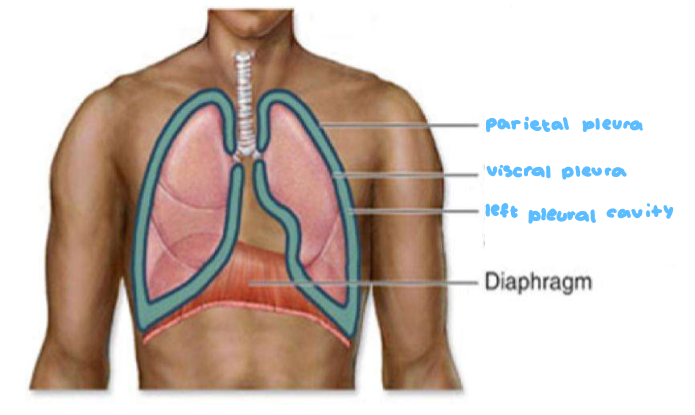
What are the two smaller cavities in the thoracic cavity called?
Pleura (two, left and right)
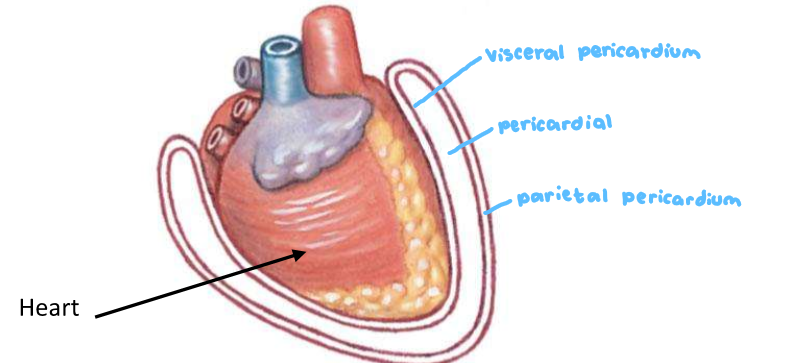
Paricardium
What organ is found in the two pleura cavities?
The left one holds the left lung and the right one holds the right lung.
What are the two serous membranes in the pleural cavities? What do they line?
Parietal → lines the wall of the cavity
Viseral → lines the lungs in the cavity
What organ does the paricardial cavity hold?
The heart.
What are the two serous membranes in the paracardial cavity? What do they line?
Parietal paracardium → lines the wall of the cavity
Visceral paracardium → lines the heart itself
What are the two divisions of the abdominopelvic cavity? What are their relative locations?
The abdominal cavity located superior to the pelvic cavity.
What are the two serous membranes of the abdominopelvic cavity? What do they line?
Parietal peritonium → the wall of the cavity
Visceral peritonium → all of the organs in the cavity
What organs are in the abdominal cavity?
Some but not all include the kidneys, stomach, large and small intestines, liver, gallbladder, etc.