Microbiology Exam 1 Chapters 1,2,3,5,6
 Call Kai
 Learn
Learn Practice Test
 Spaced Repetition
 Match
Match Flashcards
 Knowt Play
1/138

There's no tags or description
Looks like no tags are added yet.
Name | Mastery | Learn | Test | Matching | Spaced | Call with Kai |
|---|
No analytics yet
Send a link to your students to track their progress
139 Terms
Noncellular microbes
Viruses, prions, viroids
Microbial cell microbes
Bacteria, archaea, yeasts, fungi, protozoa
Eukaryotes
Include fungi, protozoa, and algae
Have a true nucleus
DNA in linear chromosomes
Organelles are compartmentalized
Prokaryotes
Include bacteria and archaea
DNA is found in a free-floating centralized region
DNA in circular chromosomes
Organelles are free-floating in cell cytoplasm
One of the most common tools used to classify species homology, which also means similarity
Comparing its genome, or DNA content (how much the DNA of organisms match).
Taxonomic Hierarchy
Kingdom, Phylum, Class, Order, Family, Genus, Species
Robert Hooke
First to create a working microscope. First to observes distinct units of living material, which he called “cells.” Was never able to view true single-celled organisms using his microscope.
Antonie Van Leeuwenhoek
First to observe a single celled microbe. Improved microscope.
Lazzaro Spallanzini
First to perform a study to disprove spontaneous generation.
Louis Pasteur
”Pasteurization” further disproved spontaneous generation by proving that thermal (heat) processing deactivated and killed microbes in substances.
Florence Nightingale
Discovered infectious disease was the largest contributor to death during the Crimean War, especially during the warmer climate months; early epidemiology work.
John Snow
”The father of epidemiology”; disease tracking in London during cholera outbreaks led to the
development of modern-day field of epidemiology.
Robert Koch
Performed the first demonstration that showed bacteria caused disease.
Edward Jenner
Developed the first vaccine.
Alexander Fleming
First to discover the action of antibiotics.
Sergei Winogradsky
One of the first scientists to study microbes in natural environmental habitats, and discovered a deeper understanding of microbe diversity.
Rosalind Franklin
Discovered the structure of DNA.
James Watson and Francis Crick
Used Franklin’s X-ray diffraction experiments to assemble a representative model of the structure of DNA to understand DNA was made up of 2 complement chains bounded together.
Koch’s Postulates for determining infectious agents
1. The microorganism must be found in diseased, but not healthy individuals.
2. The microorganism must be cultured from the diseased individual.
3. Inoculation of a healthy individual with the cultured microorganism must recapitulate the disease.
4. The microorganism must be re-isolated from the inoculated, diseased individual and matched to the original microorganism.
Theory of endosymbiosis
It proposes that certain organelles—specifically mitochondria and chloroplasts—were once free-living bacteria that were engulfed by larger host cells and eventually became permanent, integrated parts of them.
Signs of disease
Things that can be observed by a person examining a patient (ex. coughing, sneezing, runny nose, fever, sweating, rash).
Symptoms of disease
Things that can be felt only by the patient (ex. soreness, headaches, tightness, tiredness, malaise).
Germ theory of disease
Specific diseases are caused by specific kinds of microbes.
Epidemiology
The science that evaluates the occurrence, determinants, distribution, and control of health and disease in a defined human population
Virulence factors
Various genes that certain species of organisms contain that aid an organism in pathogenesis.
Mutualism
When two organisms both benefit from the shared relationship.
Parasitism
When one organism benefits from the shared relationship, and the other organism is harmed.
Commensalism
When one organism benefits from the shared relationship, and the other is not harmed, but doesn’t derive a benefit either.
Pathogenicity
Measure of infectivity (how easily an organism causes disease in its host) and virulence (how severe the disease is).
Lethal Dose (LD50) and Infectious Dose (ID50) both have a(n) ____________________________________ relationship with virulence and infectivity respectively.
Inverse
Two reasons an organism might be classified as an occasional pathogen
1. Organism might be location dependent – might be harmless in one region of the body, but can be pathogenic if it enters a different region.
2. Different strains of species may contain virulence factors that aid them in pathogenic behaviors.
Three main categories of virulence factors
Colonize the host
Evade host defenses
Damage the host
The five stages of infectious disease
1. Incubation phase – microbe/pathogen infects person, no symptoms or signs
2. Prodromal Phase – nonspecific symptoms and sign (“feeling the ick”)
3. Illness Phase – active infection, showing the major signs and symptoms relating to that pathogen,
immune system at highest activity
4. Decline Phase – signs and symptoms begin to subside, immune system clearing pathogen
5. Convalescence – fully recovered, no longer exhibiting any signs or symptoms
Horizontal transmission
The transfer of disease from one person or animal to another.
Vertical transmission
The direct transfer of disease from parent to offspring.
Vector
An organism, like a mosquito, capable of spreading illness from an infected person to a new person who does not have the disease itself.
Reservoir
An animal, organism, or environment that normally harbors the pathogen.
Carrier
A person or other organism who has the disease but not the symptoms and is capable of passing it on to another person.
6 main portals of access pathogens potentially can utilize to make a human sick
1. Entry via the eye
2. Fecal-oral route (eaten/ingested)
3. Respiratory route
4. Entry through the skin
5. Parenteral route (injected into the bloodstream ex. insect vector or contaminated needle)
6. Urogenital route (direct contact with genital mucosa or sexual transmission)
Endemic
A disease in which it is always present in a population at a low rate.
Epidemic
A disease in which the number is cases increases in a population very quickly.
Pandemic
A disease in which the spread of the disease has gone global.
Healthcare-Associated Infection (or nosocomial infection)
An infection that is acquired in a hospital or other health care facility, in which that patient didn’t have that particular disease prior to entering the facility, nor was it the reason they came to the facility in the first place.
Some host risk factors that go into determining a person’s susceptibility to getting disease
Age, hygiene, diet, nutrition, exercise/activity level, immunocompromisation, occupation, pre-existing
conditions, etc.
Phase-Contrast Microscopy
Light-dark pattern of specimen light refraction, leading to better understanding of 3-D resolution and true cell shape.
Transmission Electron Microscopy (TEM)
Electrons pass through a fixed, stained cross-section of a specimen in order to get high resolution of specific cell organelles.
Light Microscopy
Specimens are stained to appear dark against a light background, and typically resolution is not very detailed.
Scanning Electron Microscopy (SEM)
Electrons are scattered across a stained surface of a specimen, providing high resolution of detail and shows very good 3-D approximation.
Fluorescence Microscopy
Specimens appear dark, except for the cell parts that have been fluorescently dyed.

Name the cell shape
Coccus (cocci)

Name the cell shape
Bacillus (bacilli)

Name the cell shape
Vibrio
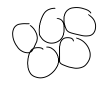
Draw the cellular morphology and arrangement.
Streptobacillus

Draw the cellular morphology and arrangement.
Staphylococcus
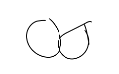
Draw the cellular morphology and arrangement.
Diplococcus
A spiral shaped bacteria is named either a __________________________ or a _________________________ depending on the particular organism’s characteristics.
Spirilla or a Spirochetes
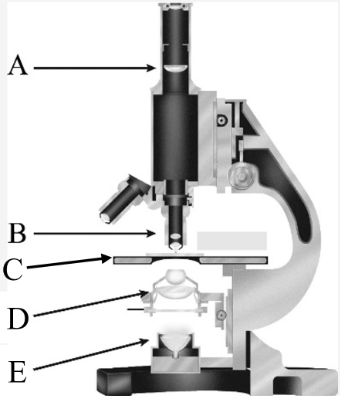
Label the microscope.
A: Eye Piece / Fixed eye piece lens
B: Objective lens
C: Stage
D: Condenser
E: Light source
Heat fixation
The process of using heat to kill and adhere/stabilize bacterial cell sample to a slide.
A standard Brightfield Compound Light Microscope typically has a fixed, or set, lens magnification in the eyepiece at _____________________ power, and a set of revolving lenses called ____________________________________ that have different magnifications powers.
10x power, objective lenses
A Gram positive cell will stain ___________________________ color when a gram stain procedure is performed.
A Gram positive cell has a _____________________________ layer of peptidoglycan and ___________________________ an outer membrane.
purple, thick, lacks
A Gram negative cell will stain ___________________________ color when a gram stain procedure is performed.
A Gram negative cell has a ____________________________ layer of peptidoglycan and ____________________________ an outer membrane.
pink (sometimes reddish), thin, contains
If something, like a staining procedure or a particular type of growth medium for bacteria, has a “Differential” function, what does that mean?
It means there will be a color distinction between different groups of organisms, usually based on a physical characteristic difference or in terms of ability to perform different biochemical functions.
For example, a Gram stain groups bacteria into two groups based on the differences in structure for their
cell wall.
Crystal Violet
Function of the reagent | What would the color of the cells be after each step of the procedure? | |
Gram Positive | Gram Negative | |
Primary Stain – stains all cells the same color, regardless of cell wall structure | Purple | Purple |
Gram’s Iodine
Function of the reagent | What would the color of the cells be after each step of the procedure? | |
Gram Positive | Gram Negative | |
Mordant – binds to the primary stain and intensifies the color of the primary stain. Forms a water insoluble compound with the primary stain | Purple | Purple |
Ethyl Alcohol
Function of the reagent | What would the color of the cells be after each step of the procedure? | |
Gram Positive | Gram Negative | |
Decolorizer – removes color from the Gram negative cells, however, it traps the color in the Gram positive cells by dehydrating the multiple layers of peptidoglycan | Purple | Colorless |
Safranin
Function of the reagent | What would the color of the cells be after each step of the procedure? | |
Gram Positive | Gram Negative | |
Counterstain – imparts color back into the Gram negative cells to allow for a color distinction between the two cell types | Purple | Pink |
Which reagent in the Gram Stain procedure is considered the “Differential Step”?
Ethyl Alcohol (decolorizer)
Brownian Motion (“false motility”)
Bacterial cell movement due to the bombardment of water molecules, and the cell is NOT actually moving itself.
True motility is when cells use a structures called ___________________________ to physically move themselves, and this has an _________________________ cost for the cells to use this structure.
flagella or cilia, energy
Peptidoglycan is a polymer molecule made up of the two monomer sugar molecules called?
N-Acetylglucosamine (NAG) and N-Acetylmuramic Acid (NAM)
These peptidoglycan polymers then form concentric rings with one another, and stack up on top of each other to form the multiple layers of the cell wall. These layers are held together via _____________________________ which come off the _____________________________________ of the n-acetyl muramic acid (NAM) molecules of the polymer.
peptide cross bridges which come off the peptide side chains
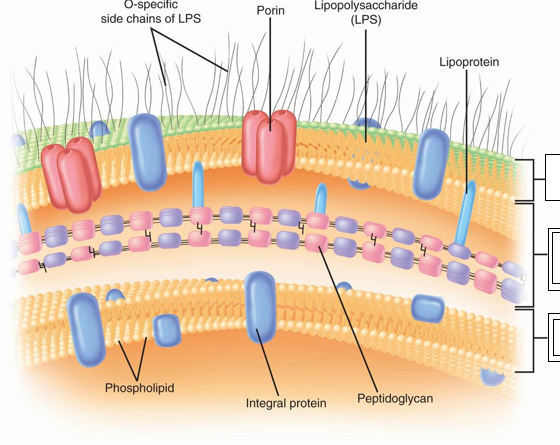
First section?
Outer membrane (gram negative specific)
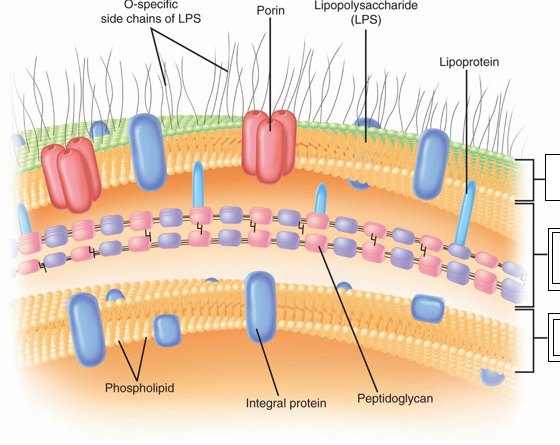
Second section?
Cell wall and periplasmic spaces
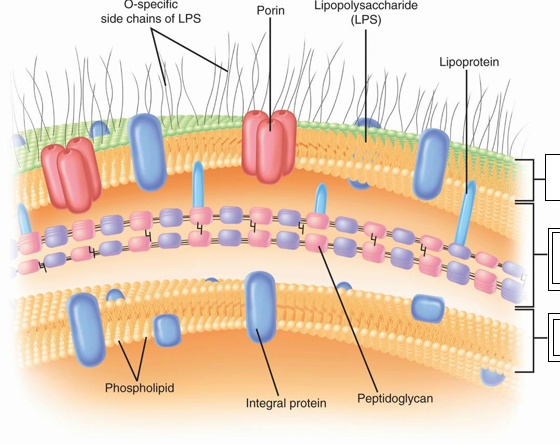
Third section?
Plasma membrane
DNA in a bacterial cell is not contained in an enclosed structure, but it is organized in a region centrally located in the cell in a region known as the _______________________________________. The circular chromosome of the cell connects back at a central point called the _______________________________________________.
nucleoid, origin of replication
Prokaryotic ribosomes consist of two subunits: the ____________________ and the ________________, which gives the prokaryotic ribosome a total size of ____________________.
30S, 50S, 70S
Bacterial cells make more of themselves in a process called _________________________________________, and in which the bacterial cell makes an identical copy of its DNA in a process called __________________________________, and the cell eventually splits into two equal, genetically identical cells.
binary fission, replication
Normal bacterial cellular life is referred to as _______________________________ cells or growth, but if environmental conditions get too harsh, some cells can trigger a different cellular process to occur, which would allow the bacterial cell to form a(n) ________________________________________, which allows for dormancy and protection from the harsh conditions.
vegetative, endospore
Most bacteria have sensor proteins that detect and sense chemicals in the environment, which either repel them away, or encourage them towards a certain chemical in a process called _______________________________________.
Chemotaxis
The Eukaryotic Cell (be able to label this stuff)
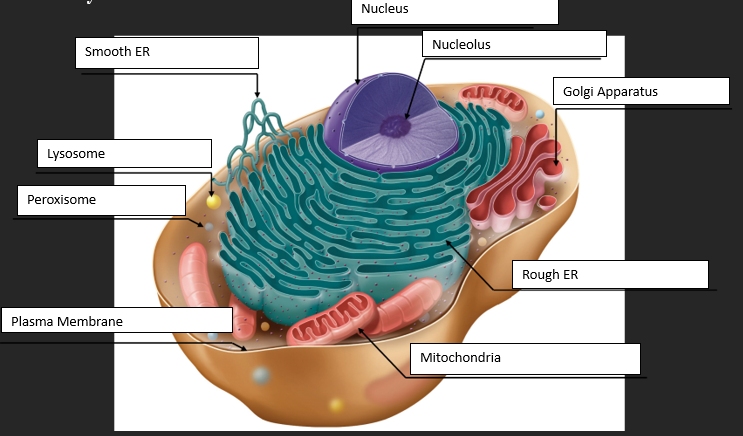
The Endomembrane System
1. Outer membrane of the double membraned nucleus
2. Endoplasmic Reticulum
· Smooth ER – no ribosomes; makes lipids, phospholipids, sterols, etc.
· Rough ER – has ribosomes; protein synthesis
3. Lysosome - membrane enclosed organelle that contains enzymes capable of biological material degradation.
4. Peroxisomes - contain enzymes involved in a variety of metabolic reactions
5. Golgi apparatus – directs and organizes where molecules in the cell should go.
Smooth ER
No ribosomes; makes lipids, phospholipids, sterols, etc.
Rough ER
Has ribosomes; protein synthesis.
Lysosome
Membrane enclosed organelle that contains enzymes capable of biological material degradation.
Peroxisomes
Contain enzymes involved in a variety of metabolic reactions.
Golgi Apparatus
Directs and organizes where molecules in the cell should go.
In what specific structure of a eukaryotic cell are ribosomes assembled?
Nucleolus
True or False: Peptidoglycan is unique to bacteria only, and is not found in any other type of organism.
True
When we are staining bacterial cell walls, we would want to use a _______ stain in order for it to bind to the _______ charge of the cell wall, due to the opposite charges attracting to one another.
basic, negative
After performing a serial dilution and spread plating the dilution factors, we are then looking for a statistically valid plate to use in our enumeration calculation. A statistically valid plate is defined as having between _____ and _____ colonies.
30-300
A fastidious organism would be best grown on a(n) _____________ growth medium.
enriched
Osmosis is the movement of _________ through a semi-permeable membrane, and the water is going to move from a _____________ concentration to a __________ concentration.
water ; high ; low
When a bacterial cell is placed into a hypertonic solution relative to the bacterial cell, _______ is going to move ____________ the cell, resulting in plasmolysis.
water ; out of
Why are bacteria more likely to die when they are left to grow at a temperature way above their maximum growth temperature, than compared to when they are left at a temperature below their minimal growth temperature?
The high heat causes permanent denaturation of proteins and enzymes.
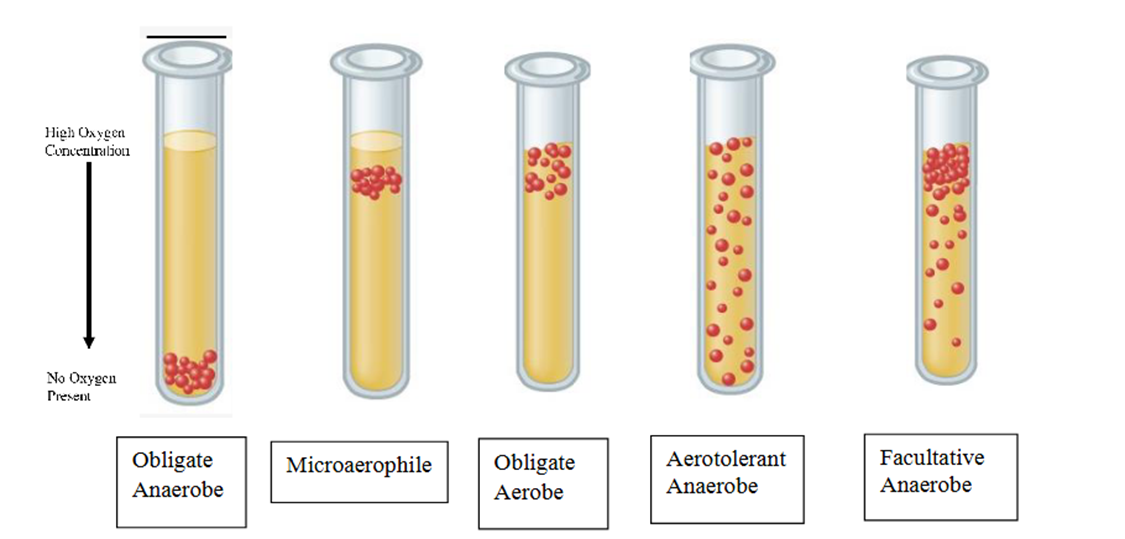
Aerotolerant Anaerobe
Does not utilize oxygen at all for any metabolic process, relies exclusively on fermentation to obtain energy, but is also not killed by reactive oxygen molecules.
Obligate Aerobe
Requires oxygen to be present in order to survive.
Obligate Anaerobe
Requires the absence of oxygen in order to survive – O2 is toxic to these organisms.
Facultative Anaerobe
Grows the fastest and most abundant with oxygen present, however, has other energy deriving pathways that does not use oxygen, and so it can still grow with little to no oxygen present.
Microaerophile
Requires oxygen to be present, but not at atmospheric levels. Too much oxygen is toxic to them, but they cannot survive in anoxic conditions either.
Draw what a microbe would look like for each oxygen classification in Fluid Thioglycollate medium.