Vygotky's theory of cognitive development : Cognitive and Development
 Call Kai
 Learn
Learn Practice Test
 Spaced Repetition
 Match
Match Flashcards
 Knowt Play
1/26

There's no tags or description
Looks like no tags are added yet.
Name | Mastery | Learn | Test | Matching | Spaced | Call with Kai |
|---|
No analytics yet
Send a link to your students to track their progress
27 Terms
What was Vygotsky's theory based on
The importance of social context and culture in child development. And that cognitive maturation is driven by biological maturation to some extend BUT a child's interactions with others is the most important factor
What did Vygotsky believe we were born with
Four elementary functions, Attention, sensation, perception and memory
What did he say would develop these
Our social and cultural enviroment allows these to develop into higher cognitive abilities. This happens through MKO’s, language, and ZPD
What is an MKO
a more knowledgable other that helps a child to learn, this can be a teacher or even a more knowledgable peer
What does an MKO do
They help the person learn how to problem solve by gradually moving responsability to them.
What did vygotsky say was the role of language
he believed culture is transmitted from experts to child through a three stage process
What is the first step in language development
Shared dialougue between adult and child
What is the 2nd step in language development
Child starts developing mental representation skills abd begin to communicate with themselves (egocentric speech)
What is the 3rd step in language development
leads to development of inner speech or thought
What did Vygotsky say would also happen during this
Reasoning abilities would develop through the initial language shared with adullt. this means that the enviroment we are surrounded by will effect our own inner dialougue
Why is there cultrual differences in development
Because children pick up their mental 'tools' through their physical and social environment
What is the ZPD
Zone of Proximal Development. The difference between what a child can do on their own and what the child can do with help, and what is out of reach
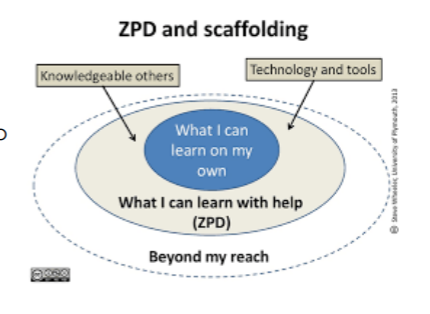
How does a child cross the ZPD
Through the help of a MKO who can teach and develop the childs skill, Vygotsky believed higher cognitive abilities could only come from the help of more advanced others
Who created the idea of scaffolding
Bruner and his colleagues
What is scaffolding?
Adjusting the support offered during a teaching session to fit the child's current level of performance, otherwise they may lose interest if they have already mastered the skill or do not understand
How many stages of scaffolding are there
5
What is the first (lowest ability) stage
Recruitment which includes engaging childs attention in a task
What is the 2nd stage
Reduction of degrees of freedom, focussing the child and where to start with solving it
What is the 3rd stage
Direction maintenance, encouragement of the child so they continue
What is the 4th stage
Marking critical features, highlighting the most important parts of the task
What is the 5th stage
Demonstration, showing the child how to peform the task
What is a strength of Vyogtsky's theory
supporting research that shows there is a gap in what children can achieve on their own and what they can do with the help from others
What is this supporting research
Roazzi and Bryan found that when asking 4-5 yr olds how many sweets in the jar, the children in the condition on their own failed to give a good estimate whereas those working with an older child that helped them through prompts all gave a close estimate.
What does Vygotsky's theory help explain
The cultural differences in development
Research that backs the cultural differences in development
Gredler, found that in papau new guinea children would learn how to count using body parts, he found that this made it very difficult for children to subtract and add numbers, limiting their cognitive development
How has Vygotsky's theory been applied
It has been applied to education , scaffolding is still being used today succesfully and enhancing childrens cognitive development
What is a issue of Vygotsky's theory
Piajet's theory offers a different explanation which weakens Vygotsky's ever so slightly