Unit 9 - Qualitative Research
 Call Kai
 Learn
Learn Practice Test
 Spaced Repetition
 Match
Match Flashcards
 Knowt Play
1/49

Earn XP
Description and Tags
Name | Mastery | Learn | Test | Matching | Spaced | Call with Kai |
|---|
No analytics yet
Send a link to your students to track their progress
50 Terms
Qualitative research questions EXAMPLES
Not a true experiment, not a quasi-experiment, not a correlational design.. Because this is a ________________
How do homeless people in London experience their lives?
What social and environmental barriers do parents and children see to healthy eating, physical activity and child obesity prevention programs?
How do cohabitating same-sex couples think about and manage their finances?
How is male and female sexuality represented in women’s magazines?
How is prejudice like racism ‘done’ in and through language?
Quantitative - Numbers used as data
Seeks to identify relationships between variables– with the aim of generalizing the findings to a wider population
Data is shallow but broad (not a lot of detail from each participant, but many participants take part)
Aims to reduce diversity to an average response
Tends to be deductive (theory-testing)
Qualitative - words/images used as data
Analyzing words themselves without limiting what people say/local meaning want to know how people frame an experience
More focused on a small population
Narrow but rich descriptions– get lots of data from a few participants
Look for patterns and individual differences, and similar experiences.
Usually generates a theory by seeing patterns in several instances (theory-generating)
Methods of data collection
Where do you get your words?
Interviews: important data collection method for qualitative, particular experience or opinions on a given concept
Focus Groups: like a group interview but to discuss with each other as well
Surveys: more often are quantitative, but open-ended questions
Researcher-directed diaries (a diary a researcher looks at)
Obtaining pre-existing textual data
Newspapers: the way Canadian print news talks about infertility
Magazines
Textbooks: the way psyc101 textbooks talk about science from 1950-2026
Advertisements
Websites
Blogs
Political speeches: is the way Obama talked about war different from Biden
Instagram comments
Any other “fragments of culture” (Braun & Clark, 2013)
Read 9a. notes for more compairisons
Qualitative vs. Quantitative have diff. goals and ways of going about things
Quantitative Research Aim
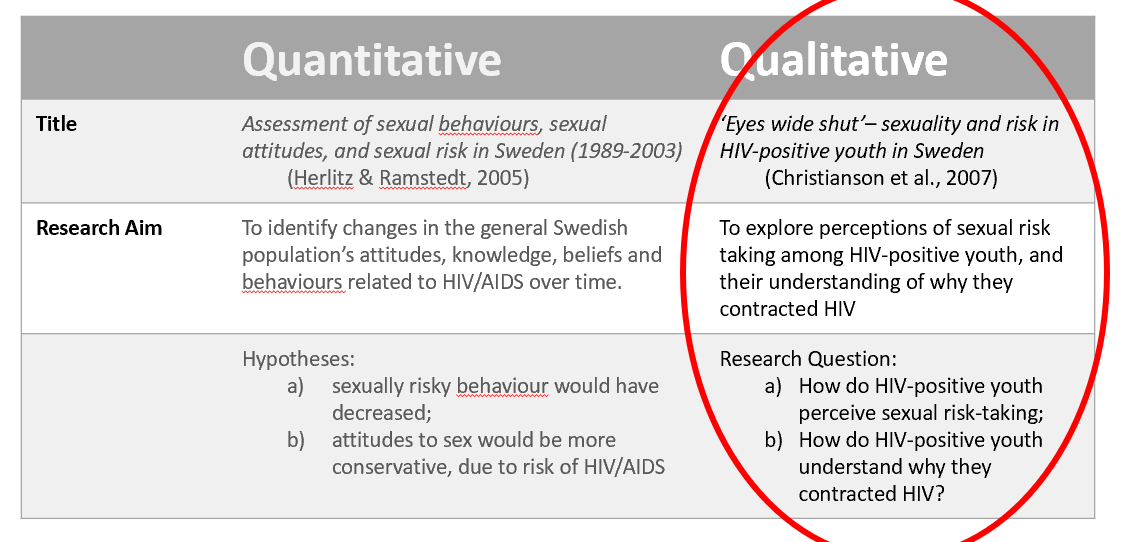
Assessment of sexual behaviours, sexual attitudes, and sexual risk in Sweden (1989-2003) (Herlitz & Ramstedt, 2005)
__________________: To identify changes in the general Swedish population’s attitudes, knowledge, beliefs and behaviours related to HIV/AIDS over time.
Quantitative Hypotheses
Assessment of sexual behaviours, sexual attitudes, and sexual risk in Sweden (1989-2003) (Herlitz & Ramstedt, 2005)
__________________: most quantitative research has these
A) sexually risky behaviour would have decreased;
B) attitudes to sex would be more conservative, due to risk of HIV/AIDS
Quantitative Sample
Assessment of sexual behaviours, sexual attitudes, and sexual risk in Sweden (1989-2003) (Herlitz & Ramstedt, 2005)
__________________:Random sample, stratified for age, generated from the general population in 1989, 1994, 1997 and 2003 (n = 4000 each year) (random and big)
Quantitative Method of Data Collection
Assessment of sexual behaviours, sexual attitudes, and sexual risk in Sweden (1989-2003) (Herlitz & Ramstedt, 2005)
__________________: Survey–Quantitative questionnaire (closed-response options), consisting of 85-90 items, delivered my mail.
Quantitative Method of Data Analysis
Assessment of sexual behaviours, sexual attitudes, and sexual risk in Sweden (1989-2003) (Herlitz & Ramstedt, 2005)
__________________:Statistical. Multiple logistic regression, a statistic method that determines the relative influence of multiple variables on a particular outcome
Quantitative Key Results
Assessment of sexual behaviours, sexual attitudes, and sexual risk in Sweden (1989-2003) (Herlitz & Ramstedt, 2005)
__________________: Neither hypothesis supported. Significant increase in casual sex without condoms and with multiple partners between 1989 and 2003; attitudes to ‘sex’ outside relationships was more permissive in 2003 than in 1989
Quantitative Conclusions
Assessment of sexual behaviours, sexual attitudes, and sexual risk in Sweden (1989-2003) (Herlitz & Ramstedt, 2005)
__________________:Need for continuous, extensive sexuality education to help reduce sexual risk which can be controlled by behaviour (e.g. condom use)
Quantitative Research Pros/Cons
This type of research can show: Changes in sexual attitudes and practices (at a population level), factors that might predict outcomes (ex. Attitudes)
This type of research cannot show: Why these changes occurred, The meanings of different experiences
Our evaluation: Useful for mapping large population-level patterns in behaviour, Can inform interventions
Qualitative Research Aim
‘Eyes wide shut’– sexuality and risk in HIV-positive youth in Sweden (Christianson et al., 2007)
__________________:To explore perceptions of sexual risk taking among HIV-positive youth, and their understanding of why they contracted HIV
Qualitative Research Question
‘Eyes wide shut’– sexuality and risk in HIV-positive youth in Sweden (Christianson et al., 2007)
__________________:we are not theory testing, no hypotheses
A) How do HIV-positive youth perceive sexual risk-taking;
B) How do HIV-positive youth understand why they contracted HIV?
Qualitative Sample
‘Eyes wide shut’– sexuality and risk in HIV-positive youth in Sweden (Christianson et al., 2007)
__________________:Purposive sample (picked on purpose bc of characteristic about them) of 10 HIV-positive Swedish residents (five female; five male; seven born in Sweden; three born abroad) aged between 17 and 24. Participants were recruited through three HIV clinics/organizations (small and not random)
Qualitative Method of Data Collection
‘Eyes wide shut’– sexuality and risk in HIV-positive youth in Sweden (Christianson et al., 2007)
__________________:In-depth semi-structured interviews (specific questions, but flexibility); tape recorded, transcribed verbatim
Qualitative Method of Data Analysis
‘Eyes wide shut’– sexuality and risk in HIV-positive youth in Sweden (Christianson et al., 2007)
__________________:Grounded theory. Multiple stages of coding and recoding the data into core categories and sub- categories
Qualitative Key Results
‘Eyes wide shut’– sexuality and risk in HIV-positive youth in Sweden (Christianson et al., 2007)
__________________:Identified two main clusters of factors that limited individuals’ possibilities for choice in sexual interactions:
A) ‘sociocultural blinds’ referred to factors which make safer sex a hard topic to broach, like the idea that being in love protects you from sexual risk
B) ‘from consensual to forced sex’ referred to factors within consensual encounters, like pleasure and trust, and coercion which resulted in risky sex
Qualitative Conclusions
‘Eyes wide shut’– sexuality and risk in HIV-positive youth in Sweden (Christianson et al., 2007)
__________________:Sexual experience and practices are context-bound. Power and gender affect most experiences. Contrary to the idea that informs health promotion, of a rational agent who makes informed choices about their behaviour, these accounts show that one’s ability to choose can be compromised by various factors outside the individual’s control
Qualitative Research Pros/Cons
This type of research can show: Can offer insights into the lived complexity of individuals, Can help understand how and why young people are at risk for HIV
This type of research cannot show: General patterns across the population, Cause and effect
Our evaluation: Useful for gaining a deep understanding of what a topic really is like for people in their lives, Can inform interventions
meaning
Qualitative research is about ______________ not numbers.
You cannot answer qualitative research with numbers
single answer
Qualitative research does not provide a _______________.
Acknowledge there is more than one way of making meaning from the data
More than one “story” could be told about any given data set
Qualitative research is subjective– there is more than one story to be told

context as important
Qualitative research treats ____________________________. It wants to consider all extraneous factors– focus on individual differences instead of averaging them out. Develop a holistic understanding of subjective experiences. (were there different factors for gay/lesbian youth?)
Whereas quantitative want to control all extraneous factors to isolate the impact of IV on DV– average individual differences
Example: Swedish “risky” sex studiesexperiential or critical
Qualitative research can be ________________________.
Experiential
_________________ -validates views, perspectives, and experiences
Driven by a desire to know people’s own perspectives
Participants’ interpretations are prioritized, accepted and focused on and are more important than the researchers
To “get inside the person’s head”
E.g. How do homeless people in London experience their lives? (Radley, Hodgetts, & Cullen)
Critical
_________________ -takes an interrogative stance toward the meaning or experiences expressed in the data
Language is understood as the main mode in which the reality of our world is created, interrogate the way its used to frame ideas and concepts
Doesn’t take data at face value
Researcher’s interpretations take precedent
Focus on how language is used “out there” in the world
E.g. How is male and female sexuality represented in women’s magazines? (Farvid & Braun, 2006)
Transcription
________________ - the process of turning audio or video recordings into written text
Many different ways of doing it, it is up to the researcher to choose
Depends on how much detail is needed for the analysis
Depends on the methodology being used and the analytic methods (surface level analysis of themes probably just requires words spoken, conversational analysis would need the intonation and pauses)
Transcription EXAMPLE
Takes a long time— gets all the specfic details
Sylvia: She was born in [small town] so she was one of the last babies that was actually born at the hospital there. Um, so the local doctors, the local nurses um, so when she was born, nobody said anything to me about um, what they thought. But they got us um, sent off to [city] for tests…
Sarah: Um, so you said that initially, nobody said anything about what they thought, right? And so, I assume by ‘nobody’ you were referring to— was it a doctor who delivered—
Sylvia: —doctors, nurses—
Sarah: — doctors, nurses. Um, in hindsight do you think that they all knew and just weren’t telling you? You’re nodding, yeah?
![<p>Takes a long time— gets all the specfic details</p><p><span><u>Sylvia:</u><em> She was born in [small town] so she was one of the last babies that was actually born at the hospital there. Um, so the local doctors, the local nurses um, so when she was born, nobody said anything to me about um, what they thought. But they got us um, sent off to [city] for tests…</em></span></p><p><span><u>Sarah:</u><em> Um, so you said that initially, nobody said anything about what they thought, right? And so, I assume by ‘nobody’ you were referring to— was it a doctor who delivered—</em></span></p><p><span><u>Sylvia:</u><em> —doctors, nurses—</em></span></p><p><span><u>Sarah:</u><em> — doctors, nurses. Um, in hindsight do you think that they all knew and just weren’t telling you? You’re nodding, yeah?</em></span></p>](https://knowt-user-attachments.s3.amazonaws.com/e11a1fb6-8754-4695-8aa3-65e2f75ff1d2.png)
Coding
__________________ - process of identifying aspects of the data that relate to your research question— get the most important/relevant data
Depending on the research question, there could be LOTS of diff. ones
A smaller amount of text to represent a larger amount of data. The first step of many qualitative analysis
Coding EXAMPLE
Data extract:
it's too much like hard work I mean how much paper have you got to sign to change a flippin’ name no I I mean no I no we we have thought about it ((inaudible)) half heartedly and thought no no I jus- I can’t be bothered, it’s too much like hard work. (Kate F07a)
Codes: 1) Talked about with partner; 2) Too much hassle to change name
Qualitative methods of analysis
Thematic Analysis
Interpretive Phenomenological Analysis
Grounded Theory
Narrative Analysis
Discourse Analysis
Thematic analysis
Qualitative methods of analysis
_______________ - Identified patterns of meaning across a dataset in relation to a research question
Interpretive phenomenological analysis
Qualitative methods of analysis
________________ - Focuses on how people make sense of their lived experience
Grounded theory
Qualitative methods of analysis
____________________ - Focuses on building theory from data; emphasis on understanding social processes
Narrative analysis
Qualitative methods of analysis
____________________ - Exploration of human experience as it’s represented in narratives
Discourse analysis
Qualitative methods of analysis
________________ - Concerned with patterns in language use connected to the social production of reality; concerned with how accounts are constructed in particular ways
Interrogating Qualitative Research
________________ - Applying quantitative criteria like validity and reliability to qualitative research is illegitimate; like “Catholic questions directed to a Methodist audience”
Different researchers have provided different methods for evaluating quality
Trustworthiness (Guba & Lincoln, 1985)
Trustworthiness (CTDC)
Framework for interrogating qualitative research
(___________)
Credibility
Transferability
Dependability
Confirmability
Credibility (CTDC)
CTDC
_________________ - Confidence in the ‘truth’ of the findings—is this interpretation a plausible interpretation of the original data?
Member-checking
Triangulation
Negative case analysis
Peer debriefing
Transferability (CTDC)
CTDC
__________________ - Showing how the findings could have applicability in other contexts (the extent to which the findings specific to them apply to others)
Ex. receiving your child’s down syndrome diagnosis requires info of Canada’s free healthcare, socioeconomic status, sociopolitical climate of down syndrome in Canada
Thick description
Dependability (CTDC)
CTDC
___________________ - Showing that the findings are consistent and could be repeated— grounded in data and excerpts/stories support the claim
Inquiry audit
Confirmability (CDTC)
CDTC
___________________ - The extent to which the respondents shape the findings of a study and not researcher bias, motivation, or interest.
Inquiry Audit
Triangulation (comparing with other studies, a sign to look back at stuff)
Reflexivity
Inquiry audit
Dependability
________________ - Researcher not involved in research process examines process and product of study– how coding was done, interviews, etc.
Have them see if conclusions are supported by the process and supported by the data to find out accuracy and whether data supports conclusion
Reflexivity
Confirmability
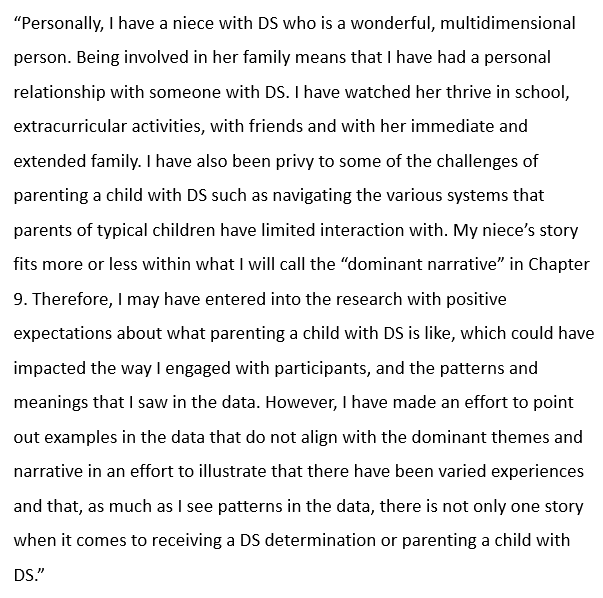
_______________ - explaining how you are situated to the research and how it could have affected your results. Researcher turns focus to themselves taking responsibility for the context, how you conducted, etc.
Member checking
Credibility
____________________ - Returning data to participants if they agree and it accurately reflects their experiences
Triangulation
Credibility + confirmability
_______________ - Comparing results to other similar studies’ findings – the truth is somewhere in that triangle
Negative case analysis
Credibility
____________________ - Discuss cases that are different from the dominant pattern and see how their experiences are different from the dominant. Shows the researcher is careful
Ex: Parents of children with down syndrome initially thought it as a horrible event, but eventually began to see it as positive – both the minority saw it as negative
Peer debriefing
Credibility
_______________ - Discuss methods and findings with other researchers (neutral) to determine if the conclusion is reasonable and plausible