Chapter 10 Genetics Study Guide: Key Concepts and Practice Questions
 Call Kai
 Learn
Learn Practice Test
 Spaced Repetition
 Match
Match Flashcards
 Knowt Play
1/34

There's no tags or description
Looks like no tags are added yet.
Name | Mastery | Learn | Test | Matching | Spaced | Call with Kai |
|---|
No analytics yet
Send a link to your students to track their progress
35 Terms
Meiosis
A type of cell division that reduces the chromosome number by half, resulting in four haploid cells, typically used in the formation of gametes.
Fertilization
The process where male and female gametes combine to form a zygote, restoring the diploid number of chromosomes.
Homozygous Dominant
An organism with two identical dominant alleles for a specific trait (e.g., AA).
Heterozygous
An organism with two different alleles for a specific trait (e.g., Aa).
Homozygous Recessive
An organism with two identical recessive alleles for a specific trait (e.g., aa).
Haploid
A cell that contains one complete set of chromosomes, typical of gametes (n).
Diploid
A cell that contains two complete sets of chromosomes, one from each parent (2n).
Crossing Over
The exchange of genetic material between homologous chromosomes during meiosis, leading to genetic variation.
Independent Assortment
The principle that alleles for different traits are distributed to gametes independently of one another.
Phenotype
The observable physical or biochemical characteristics of an organism, determined by its genotype.
Genotype
The genetic constitution of an organism, representing the alleles it possesses.
Dominant
An allele that expresses its trait even in the presence of a recessive allele.
Recessive
An allele that only expresses its trait when two copies are present (homozygous).
Probability
The likelihood of a particular genetic outcome occurring, often expressed as a fraction or percentage.
Alleles
Different forms of a gene that can exist at a specific locus on a chromosome.
Genes
Segments of DNA that code for proteins and determine specific traits.
Gamete
A reproductive cell (sperm or egg) that carries half the genetic information of an organism.
How many chromosomes in a human body cell?
A human body cell contains 46 chromosomes (23 pairs).
How many chromosomes in a human gamete?
A human gamete contains 23 chromosomes (haploid).
What is the diploid cell number for a human?
The diploid cell number for a human is 46.
What is the haploid cell number for a human?
The haploid cell number for a human is 23.
How many alleles for a single trait are found in a single sperm/egg cell?
There is one allele for a single trait in a sperm or egg cell.
What is the end product of meiosis for males?
The end product of meiosis for males is four viable sperm cells.
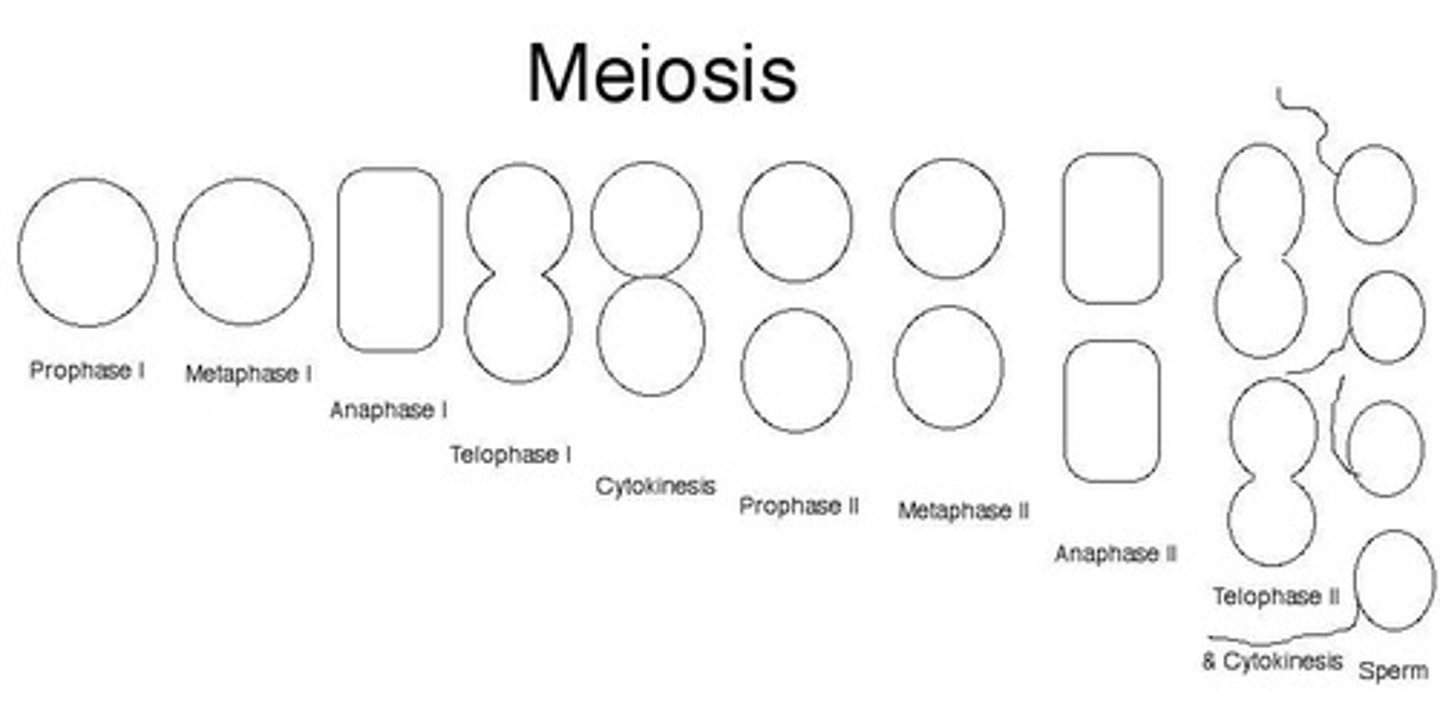
What is the end product of meiosis for females?
The end product of meiosis for females is one viable egg cell and three polar bodies.
What are the chances that a baby will be born male? Female? Why?
The chances are approximately 50% for male and 50% for female, due to the equal probability of X and Y sperm fertilizing the egg.
Explain how crossing over works and when it occurs.
Crossing over occurs during Prophase I of meiosis when homologous chromosomes exchange segments, increasing genetic diversity.
The fruit fly has four chromosome pairs, AaBbCcDd. How many possible combinations of chromosomes can be produced by fertilization?
There are 16 possible combinations of chromosomes (2^4) that can be produced by fertilization.
A diploid cell is heterozygous AaBb. When meiosis occurs what is the total number of possible combinations of gametes that can be made from those traits?
There are 4 possible combinations of gametes (AB, Ab, aB, ab) from the heterozygous AaBb cell.
If a red flower is crossed with a red flower, resulting in 125 red flowers and 31 white flowers what was the genotype of the parents?
The genotype of the parents was likely heterozygous (Rr) for red flowers.
What are the possible gametes that can be produced from the following pair of homologous chromosomes GgNn?
The possible gametes are GN, Gn, gN, and gn.
If two heterozygous parents are crossed for a single trait, what percentage of their offspring are expected to be heterozygous?
25% of their offspring are expected to be heterozygous.
When an individual who is homozygous recessive for a trait is crossed with someone who is heterozygous for the trait how many different genotypes and phenotypes will the offspring show?
The offspring will show 2 different genotypes and 2 different phenotypes.
What is the phenotype of both parents in the cross Ll x Ll?
Both parents have the phenotype of long tails.
What is the phenotype of the offspring in box 1?
The phenotype of the offspring in box 1 is long tail.
What is the genotype of the offspring in box 3?
The genotype of the offspring in box 3 is Ll.