L2- Genetic, molecular and cellular basis of cancer intro

0.0(0)
Studied by 0 people
call kaiCall Kai
learnLearn
examPractice Test
spaced repetitionSpaced Repetition
heart puzzleMatch
flashcardsFlashcards
GameKnowt Play
Card Sorting

1/28

encourage image

There's no tags or description

Looks like no tags are added yet.

Last updated 3:49 PM on 4/11/26
Name
Mastery
Learn
Test
Matching
Spaced
Call with Kai

No analytics yet

Send a link to your students to track their progress

29 Terms

1
New cards

what are the main facts and stats about cancer

  • More than 350,000 new cases registered annually.

  • Breast, lung, bowel and prostate cancer account for over 50% of cases

  • One in two lifetime risk of diagnosis.

  • One in four will die from cancer

  • Disease risk rises significantly with age: ~65% occur in people over 65.

  • 200 types- heterogenous

2
New cards

what is cancer

  • A heterogeneous group of diseases in which single cells acquire the ability to proliferate abnormally, resulting in an accumulation of progeny

  • Cancers are those tumours that have acquired the ability to invade through surrounding normal tissues

  • The most advanced form of this invasive process is metastasis, a state in which cancer cells escape from their original location, travel through the blood or lymphatic systems and take up residence at distant sites”

3
New cards

give some examples of classifications of cancers

Carcinomas- from epithelial tissues 

Sarcoma- from soft tissue 

Haematological- lymph blood (leukaemia and lymphoma) 
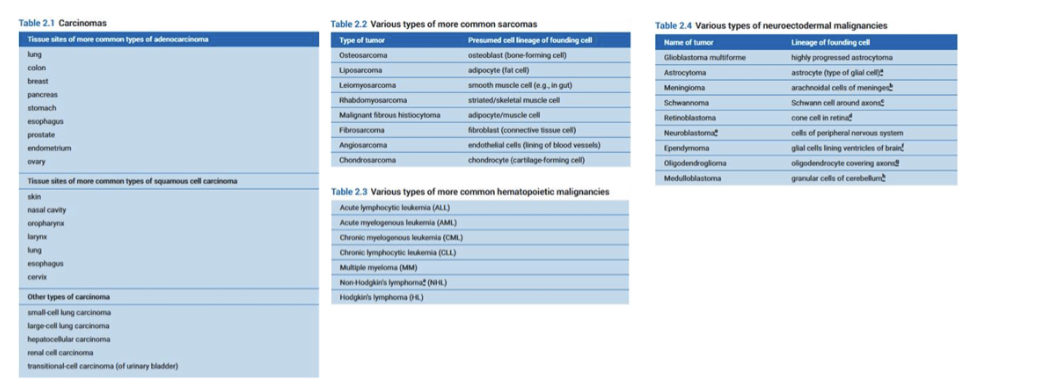
<p><span style="background-color: inherit; line-height: 22px; color: windowtext;"><span>Carcinomas- from epithelial tissues</span></span><span style="line-height: 22px; color: windowtext;"><span>&nbsp;</span></span></p><p class="Paragraph SCXO64660081 BCX0" style="text-align: left;"><span style="background-color: inherit; line-height: 22px; color: windowtext;"><span>Sarcoma- from soft tissue</span></span><span style="line-height: 22px; color: windowtext;"><span>&nbsp;</span></span></p><p class="Paragraph SCXO64660081 BCX0" style="text-align: left;"><span style="background-color: inherit; line-height: 22px; color: windowtext;"><span>Haematological- lymph blood (leukaemia and lymphoma)</span></span><span style="line-height: 22px; color: windowtext;"><span>&nbsp;</span></span></p>
4
New cards

what are the different types of tumour

benign- localised, non invasive

malignant- capable of invasion and metastasis

5
New cards

how does a benign tumour become malignant

Spectrum of tissue states and how cancerous they are  


Hyperplasia- more cells than normally would be  

Mild dysplasia- more cells and start to lose their organisation, shape and size 

Cancer- invasive, leave and go to other body sites  
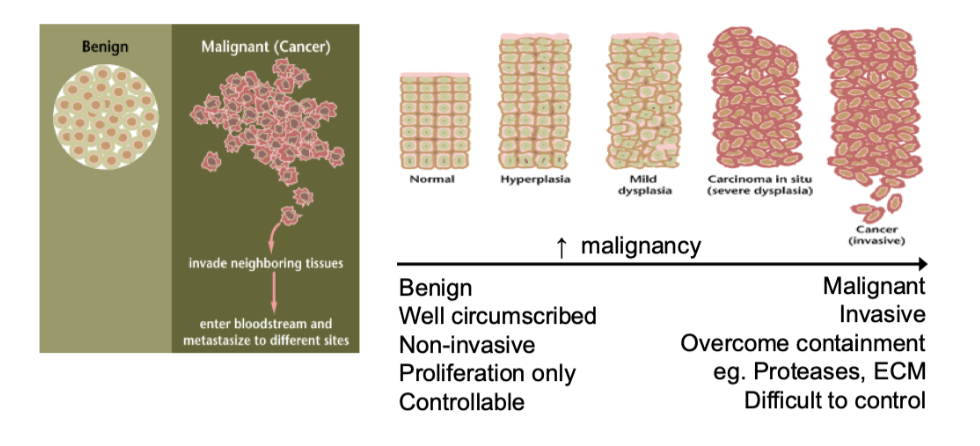
<p><span style="background-color: inherit; line-height: 22px; color: windowtext;"><span>Spectrum of tissue states and how cancerous they are&nbsp;</span></span><span style="line-height: 22px; color: windowtext;"><span>&nbsp;</span></span></p><p class="Paragraph SCXO184749153 BCX0" style="text-align: left;"><span style="line-height: 22px; color: windowtext;"><span>&nbsp;</span></span></p><p class="Paragraph SCXO184749153 BCX0" style="text-align: left;"><span style="background-color: inherit; line-height: 22px; color: windowtext;"><span>Hyperplasia- more cells than normally would be&nbsp;</span></span><span style="line-height: 22px; color: windowtext;"><span>&nbsp;</span></span></p><p class="Paragraph SCXO184749153 BCX0" style="text-align: left;"><span style="background-color: inherit; line-height: 22px; color: windowtext;"><span>Mild dysplasia- more cells and start to lose their organisation, shape and size</span></span><span style="line-height: 22px; color: windowtext;"><span>&nbsp;</span></span></p><p class="Paragraph SCXO184749153 BCX0" style="text-align: left;"><span style="background-color: inherit; line-height: 22px; color: windowtext;"><span>Cancer- invasive, leave and go to other body sites&nbsp;</span></span><span style="line-height: 22px; color: windowtext;"><span>&nbsp;</span></span></p>
6
New cards

what is angiogenesis

Describes the way a cancer can recruit its own blood supply 


Cancer cells reach a point they become self limiting  

  • So form own blood supply 

  • Secreted signalling molecules to make blood vessel to move up to the cancer  

  • Cancer cells closer to nutrients, easier to get rid of waste products- continue to grow  
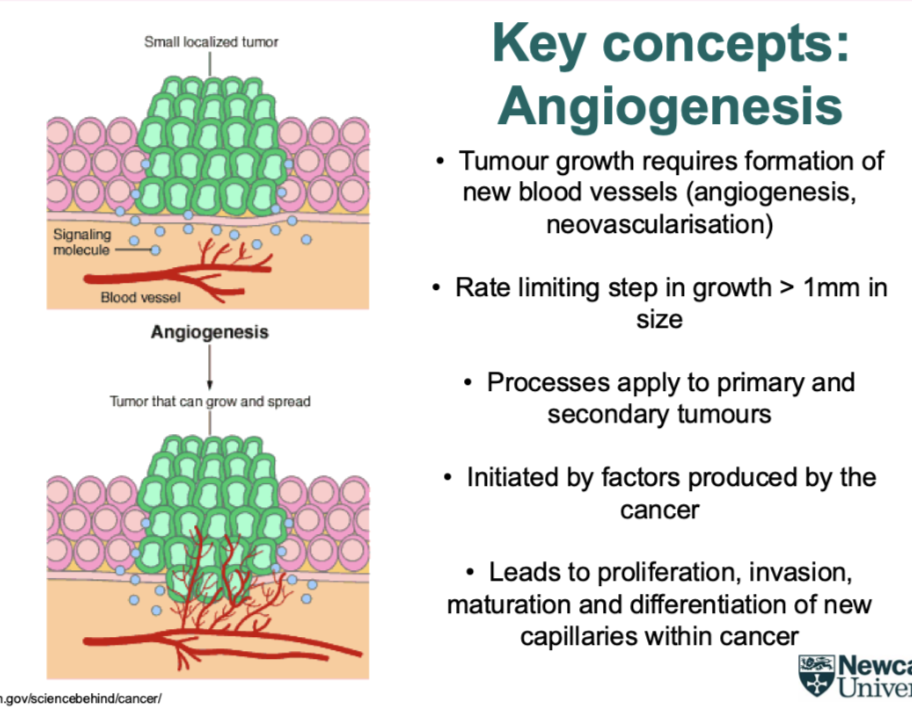
<p><span style="background-color: inherit; line-height: 22px; color: windowtext;"><span>Describes the way a cancer can recruit its own blood supply</span></span><span style="line-height: 22px; color: windowtext;"><span>&nbsp;</span></span></p><p class="Paragraph SCXO214413784 BCX0" style="text-align: left;"><span style="line-height: 22px; color: windowtext;"><span>&nbsp;</span></span></p><p class="Paragraph SCXO214413784 BCX0" style="text-align: left;"><span style="background-color: inherit; line-height: 22px; color: windowtext;"><span>Cancer cells reach a point they become self limiting&nbsp;</span></span><span style="line-height: 22px; color: windowtext;"><span>&nbsp;</span></span></p><ul><li><p class="Paragraph SCXO214413784 BCX0" style="text-align: left;"><span style="background-color: inherit; line-height: 22px; color: windowtext;"><span>So form own blood supply</span></span><span style="line-height: 22px; color: windowtext;"><span>&nbsp;</span></span></p></li><li><p class="Paragraph SCXO214413784 BCX0" style="text-align: left;"><span style="background-color: inherit; line-height: 22px; color: windowtext;"><span>Secreted signalling molecules to make blood vessel to move up to the cancer&nbsp;</span></span><span style="line-height: 22px; color: windowtext;"><span>&nbsp;</span></span></p></li><li><p class="Paragraph SCXO214413784 BCX0" style="text-align: left;"><span style="background-color: inherit; line-height: 22px; color: windowtext;"><span>Cancer cells closer to nutrients, easier to get rid of waste products- continue to grow&nbsp;</span></span><span style="line-height: 22px; color: windowtext;"><span>&nbsp;</span></span></p></li></ul><p></p>
7
New cards

what is metastasis

  • tumor cells can escape from primary site and re establish ar a distant secondary location(s)

  • by blood vessels, lymphatic system and body cavities

  • primary cause of death in cancer patients

Dependent on the individual cancer where the metastasis ends up 

  • But some commonly go to certain places e.g. initial melanoma tumour often travel to the brain  

Harder to treat after metastasis 
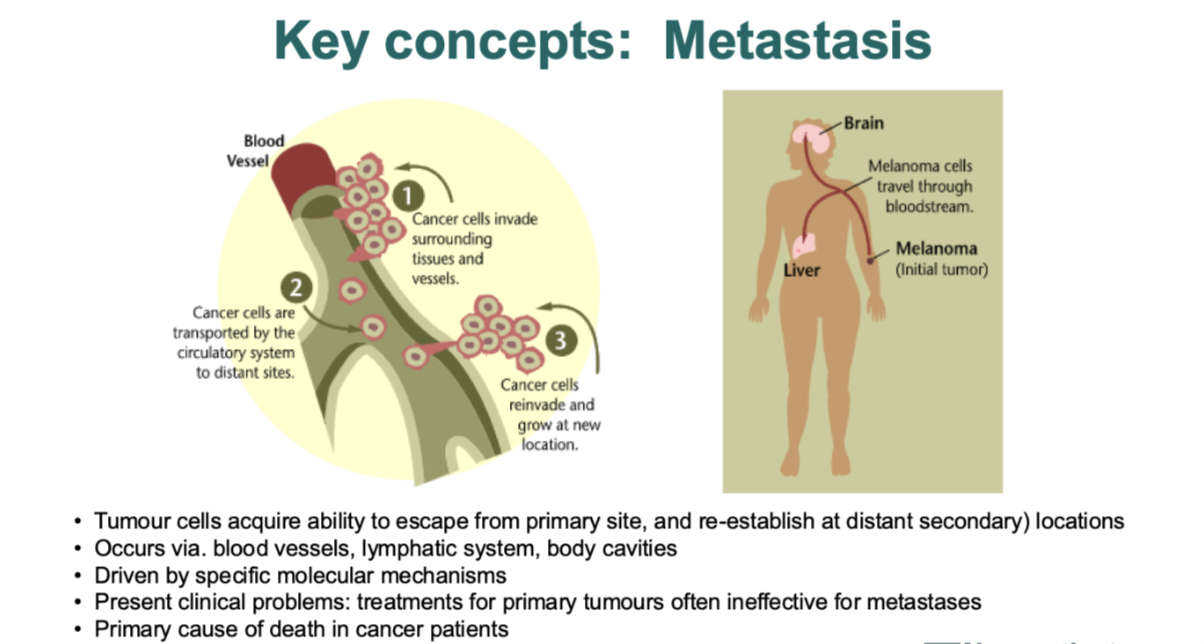
<ul><li><p>tumor cells can escape from primary site and re establish ar a distant secondary location(s)</p></li><li><p>by blood vessels, lymphatic system and body cavities </p></li><li><p>primary cause of death in cancer patients </p></li></ul><p><span style="background-color: inherit; line-height: 22px; color: windowtext;"><span>Dependent on the individual cancer where the metastasis ends up</span></span><span style="line-height: 22px; color: windowtext;"><span>&nbsp;</span></span></p><ul><li><p class="Paragraph SCXO85088935 BCX0" style="text-align: left;"><span style="background-color: inherit; line-height: 22px; color: windowtext;"><span>But some commonly go to certain places e.g. initial melanoma tumour often travel to the brain&nbsp;</span></span><span style="line-height: 22px; color: windowtext;"><span>&nbsp;</span></span></p></li></ul><p class="Paragraph SCXO85088935 BCX0" style="text-align: left;"><span style="background-color: inherit; line-height: 22px; color: windowtext;"><span>Harder to treat after metastasis</span></span><span style="line-height: 22px; color: windowtext;"><span>&nbsp;</span></span></p>
8
New cards

what is the mutational theory of cancer

Mutation:

A stably inherited change in the genetic material

Cancer can result from:

• Germ-line mutations- Passed down from parents to progeny 

• Somatic mutations- Happen in the population as we go through life in individual cells  

9
New cards

what is the evidence for the genetic basis of cancer

  • Evidence of mutations in cancer genomes- found to change the behaviour of cells

  • Susceptibility to some cancers inherited in families (approximately 5% of all cancers)

  • Mutations found in sporadic cancers and subsequently found to be transforming

  • Chromosomal changes are common in cancers

  • Some cancers associated with particular chromosomal abnormalities

  • Agents that damage DNA are thought to increase the susceptibility to cancer development

  • Some diseases are thought to arise from defects in DNA repair mechanisms that result in an elevated cancer risk

  • Infection with certain viruses associated with development of specific cancer

10
New cards

what are some cancer risk actors and carcinogens

Heredity- may be inherited predisposition to cancer 

Environment we are exposed to 

  • Chemical- smoking diet occupation 

  • Viral 

  • Radiation 

Add up to make our cancer risk  

Biggest factor is carcinogens in tobacco smoke  
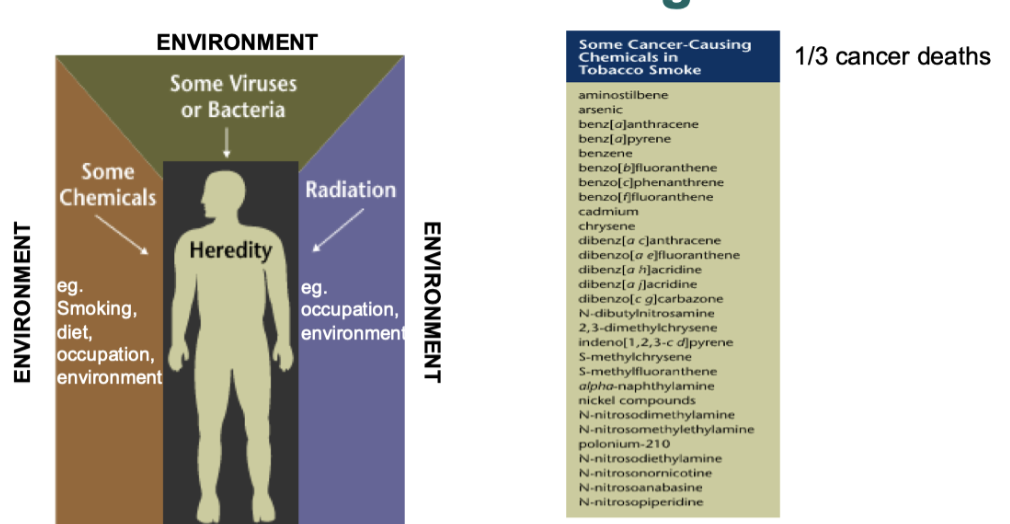
<p><span style="background-color: inherit; line-height: 22px; color: windowtext;"><span>Heredity- may be inherited predisposition to cancer</span></span><span style="line-height: 22px; color: windowtext;"><span>&nbsp;</span></span></p><p class="Paragraph SCXO178457977 BCX0" style="text-align: left;"><span style="background-color: inherit; line-height: 22px; color: windowtext;"><span>Environment we are exposed to</span></span><span style="line-height: 22px; color: windowtext;"><span>&nbsp;</span></span></p><ul><li><p class="Paragraph SCXO178457977 BCX0" style="text-align: left;"><span style="background-color: inherit; line-height: 22px; color: windowtext;"><span>Chemical- smoking diet occupation</span></span><span style="line-height: 22px; color: windowtext;"><span>&nbsp;</span></span></p></li><li><p class="Paragraph SCXO178457977 BCX0" style="text-align: left;"><span style="background-color: inherit; line-height: 22px; color: windowtext;"><span>Viral</span></span><span style="line-height: 22px; color: windowtext;"><span>&nbsp;</span></span></p></li><li><p class="Paragraph SCXO178457977 BCX0" style="text-align: left;"><span style="background-color: inherit; line-height: 22px; color: windowtext;"><span>Radiation</span></span><span style="line-height: 22px; color: windowtext;"><span>&nbsp;</span></span></p></li></ul><p class="Paragraph SCXO178457977 BCX0" style="text-align: left;"><span style="background-color: inherit; line-height: 22px; color: windowtext;"><span>Add up to make our cancer risk&nbsp;</span></span><span style="line-height: 22px; color: windowtext;"><span>&nbsp;</span></span></p><p class="Paragraph SCXO178457977 BCX0" style="text-align: left;"><span style="background-color: inherit; line-height: 22px; color: windowtext;"><span>Biggest factor is carcinogens in tobacco smoke&nbsp;</span></span><span style="line-height: 22px; color: windowtext;"><span>&nbsp;</span></span></p>
11
New cards

what are the types of mutations found in cancers

  • Chromosome number changes

  • Chromosome translocations

  • Amplifications

• Interstitial gains and losses (10’s – 1,000,000’s bps)

• Small deletions, insertions and single base pair mutations

• Epigenetic mechanisms – promoter hypermethylation

• Exogenous sequences

• e.g. viruses in cervical cancer (HPV), Burkitt’s lymphoma (EBV), Hepatocellular carcinomas (hepatitis virus) and Kaposi’s sarcoma (HIV virus)- viral DNA inserted into the genome

12
New cards

why is cancer such a rare event at the cellular level

  • DNA repair mechanisms

  • Apoptotic (cell death) mechanisms

  • Mutations in many genes do not affect cell growth

  • Most DNA does not code for protein

  • Rapidly dividing cells (eg intestinal epithelium and skin) are lost from the body so it does not matter if they contain mutations (unless they occur in a stem cell population)

  • Many cells do not divide all the time- they differentiate and lose their potential to divide (e.g. muscle cells)

No single mutation can circumvent these defences

13
New cards

what makes cancer a multi step disease

  • Multiple successive errors/cell (~6-7) are required to circumvent this protection and give rise to abnormal growth and a malignant cancer.

  • Chances of this are rare.

However, two general mechanisms allow this progression to happen

14
New cards

what is clonal evolution

accumulation and selection of multiple mutations in cancer

First mutation in one cell that makes changes to the cell causing more clones of that cell- much bigger target for second mutation to come along  

  • The process repeats  

  • Thought it has to happen at least 5-6 times 

Some mutations can make the cell more prone to acquire more mutations- so make cells accumulate more quickly and more likely to mutate  
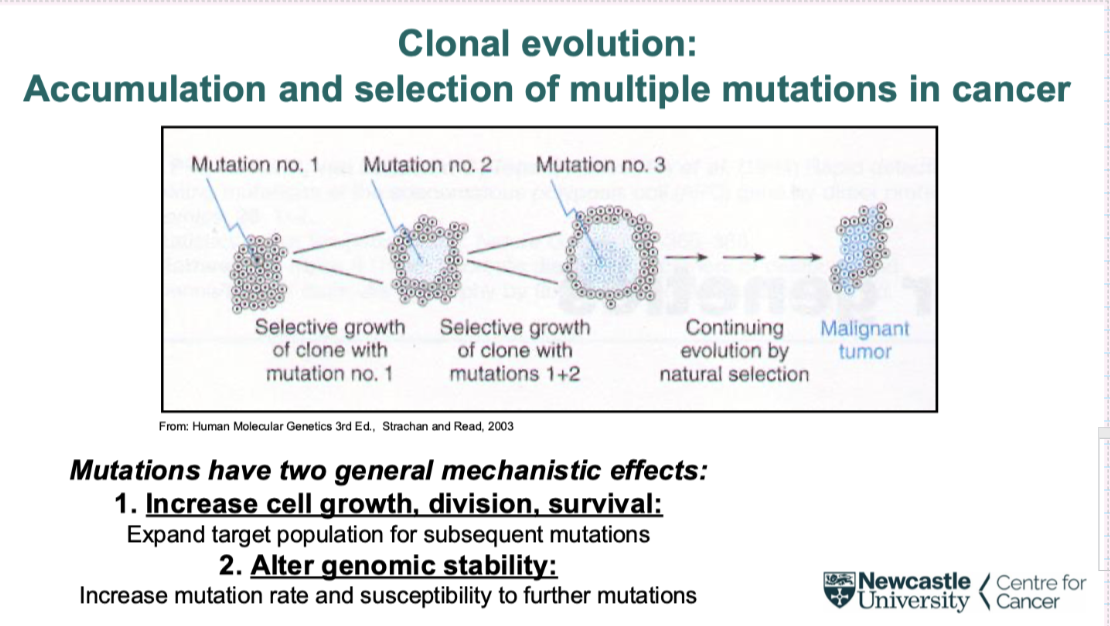
<p>accumulation and selection of multiple mutations in cancer </p><p><span style="background-color: inherit; line-height: 22px; color: windowtext;"><span>First mutation in one cell that makes changes to the cell causing more clones of that cell- much bigger target for second mutation to come along&nbsp;</span></span><span style="line-height: 22px; color: windowtext;"><span>&nbsp;</span></span></p><ul><li><p class="Paragraph SCXO251563307 BCX0" style="text-align: left;"><span style="background-color: inherit; line-height: 22px; color: windowtext;"><span>The process repeats&nbsp;</span></span><span style="line-height: 22px; color: windowtext;"><span>&nbsp;</span></span></p></li><li><p class="Paragraph SCXO251563307 BCX0" style="text-align: left;"><span style="background-color: inherit; line-height: 22px; color: windowtext;"><span>Thought it has to happen at least 5-6 times</span></span><span style="line-height: 22px; color: windowtext;"><span>&nbsp;</span></span></p></li></ul><p><span style="background-color: inherit; line-height: 22px; color: windowtext;"><span>Some mutations can make the cell more prone to acquire more mutations- so make cells accumulate more quickly and more likely to mutate&nbsp;</span></span><span style="line-height: 22px; color: windowtext;"><span>&nbsp;</span></span></p>
15
New cards

what are the 2 general mechanistic effects of mutations

1. Increase cell growth, division, survival:

Expand target population for subsequent mutations

2. Alter genomic stability:

Increase mutation rate and susceptibility to further mutations

16
New cards

what types of genes are targets of mutations in cancer

two general categories

  1. oncogenes

  2. tumor suppressor genes

17
New cards

what are oncogenes

normal cellular version- proto-oncogenes

  • Normal activity promotes proliferation, growth, invasion etc.

  • Gain-of-function mutations in cancer (1 allele):

  • Excessive or inappropriate activity

  • Dominant- only need mutation in one allele, transforming

  • can be switched on or off- constantly on in cancer cells

18
New cards

how are oncogenes responsible for growth control

See different oncogenes mutated at different parts of their signalling pathway 

Some oncogenes that can drive the cell cycle directly, or feed into it  
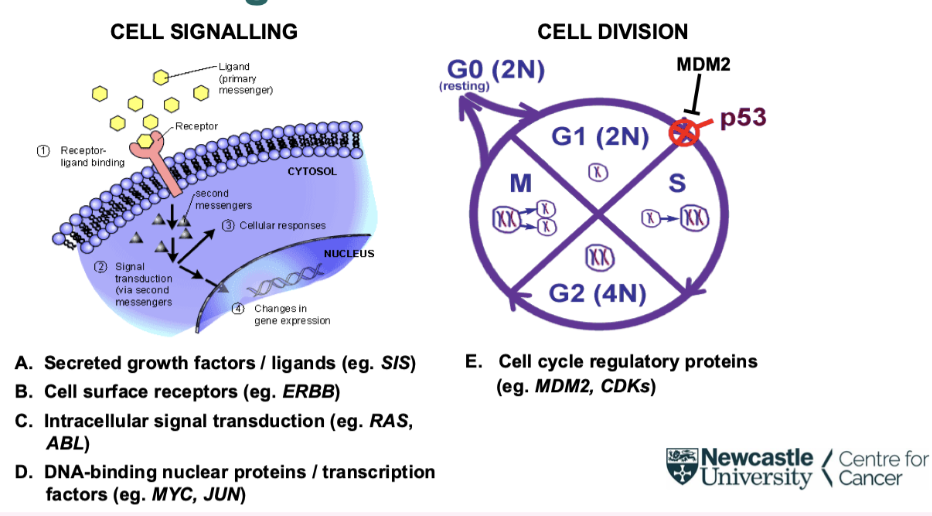
<p></p><p><span style="background-color: inherit; line-height: 22px; color: windowtext;"><span>See different oncogenes mutated at different parts of their signalling pathway</span></span><span style="line-height: 22px; color: windowtext;"><span>&nbsp;</span></span></p><p class="Paragraph SCXO179242833 BCX0" style="text-align: left;"><span style="background-color: inherit; line-height: 22px; color: windowtext;"><span>Some oncogenes that can drive the cell cycle directly, or feed into it&nbsp;</span></span><span style="line-height: 22px; color: windowtext;"><span>&nbsp;</span></span></p>
19
New cards

how are proto oncogenes activated

activation involves inappropriate fixed gain of function- activated in one of two ways  

  1. Quantitative – increase in production of unaltered product

  • Actual protein doesn’t change- just more of it there 

2, Qualitative – production of modified or novel product

  • Mutation that changes the product- e.g. does job more efficiently  

20
New cards

what are the 3 different mechanisms of oncogene activation

  1. Point mutation- single aa change that typically changes activity  

  2. Amplification- more quantitative change  

  3. Translocation/rearrangement-  

  • Genes that come together on gene fusion to make new gene product e.g. BCRA-ABL 

  • Bring genes into different regulatory areas e.g. Burkitt's lymphoma- oncogene put into really active area of genome  
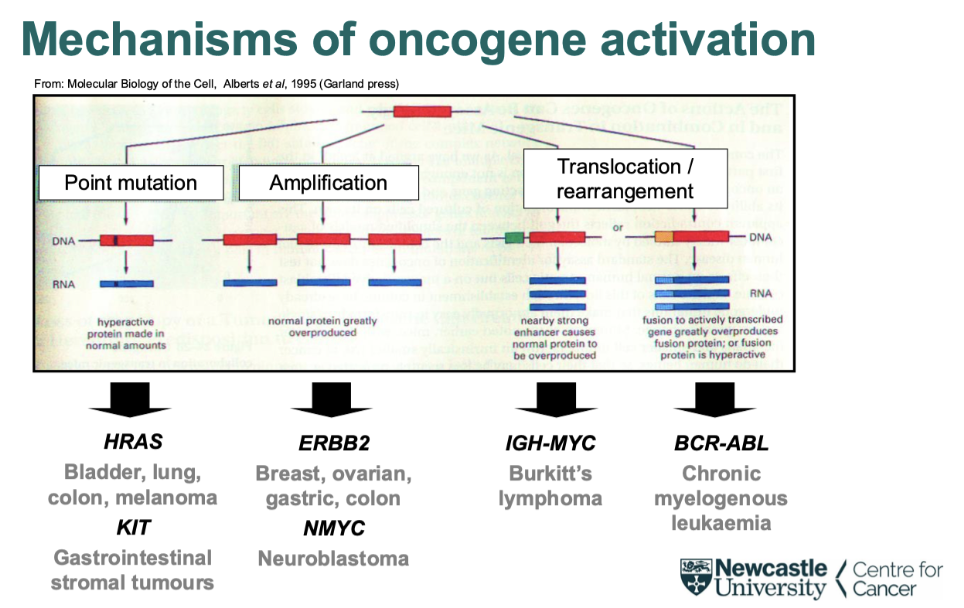
<ol><li><p class="Paragraph SCXO76683863 BCX0" style="text-align: left;"><span style="background-color: inherit; line-height: 22px; color: windowtext;"><span>Point mutation- single aa change that typically changes activity&nbsp;</span></span><span style="line-height: 22px; color: windowtext;"><span>&nbsp;</span></span></p></li><li><p class="Paragraph SCXO76683863 BCX0" style="text-align: left;"><span style="background-color: inherit; line-height: 22px; color: windowtext;"><span>Amplification- more quantitative change&nbsp;</span></span><span style="line-height: 22px; color: windowtext;"><span>&nbsp;</span></span></p></li><li><p class="Paragraph SCXO76683863 BCX0" style="text-align: left;"><span style="background-color: inherit; line-height: 22px; color: windowtext;"><span>Translocation/rearrangement-&nbsp;</span></span><span style="line-height: 22px; color: windowtext;"><span>&nbsp;</span></span></p></li></ol><ul><li><p class="Paragraph SCXO76683863 BCX0" style="text-align: left;"><span style="background-color: inherit; line-height: 22px; color: windowtext;"><span>Genes that come together on gene fusion to make new gene product e.g. BCRA-ABL</span></span><span style="line-height: 22px; color: windowtext;"><span>&nbsp;</span></span></p></li><li><p class="Paragraph SCXO76683863 BCX0" style="text-align: left;"><span style="background-color: inherit; line-height: 22px; color: windowtext;"><span>Bring genes into different regulatory areas e.g. Burkitt's lymphoma- oncogene put into really active area of genome&nbsp;</span></span><span style="line-height: 22px; color: windowtext;"><span>&nbsp;</span></span></p></li></ul><p></p>
21
New cards

what is the normal role of tumour suppressor genes

inhibit events leading to cancer

(eg. negative regulation of cell cycle, pro-apoptotic, genomic stability and repair)

  • Loss of function mutations (affecting 2 alleles) required for inactivation and cancer development

  • 2 copies of gene that both play suppressor role, if lose one still have another, need to lose both copies for them to be inactive  

22
New cards

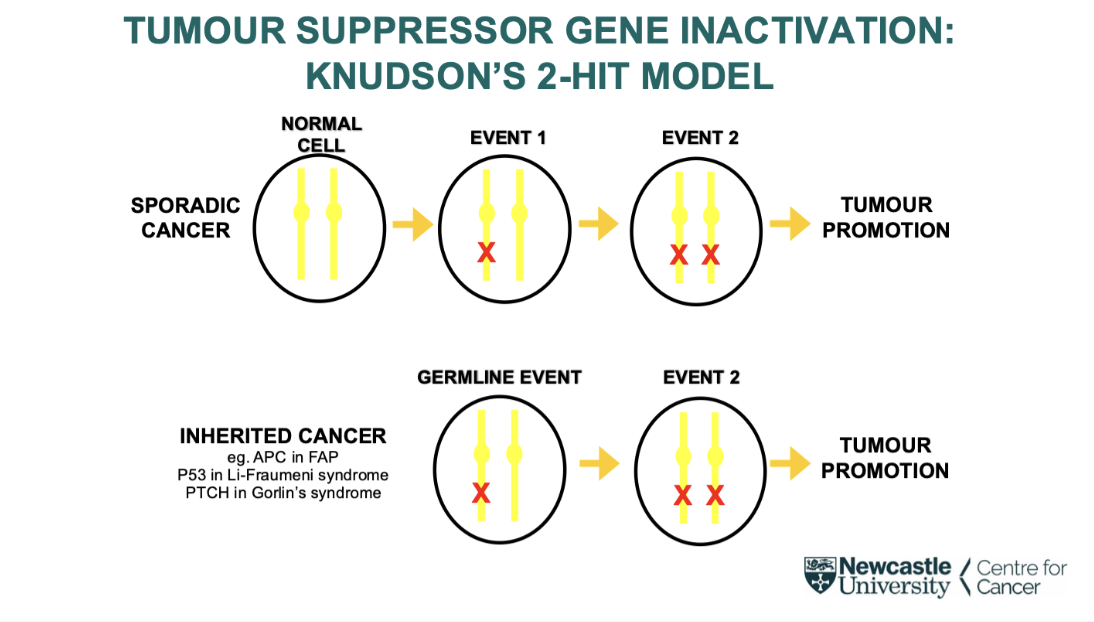
what is Knudson’s 2 hit model for tumour suppressor gene inactivation

  • Tumour suppressor can be one of the mutations out of the 6-7 needed, but they need two hits to knock each allele out  

  • Sporadic cases take longer and occur much later in life as have two already instead of one   

  • Most inherited cancer caused by inherited inactive tumour suppressor gene 

    • Only need a second mutation 

    • Happen earlier in life 

    • Can Happen in multiple tissues 

<ul><li><p><span style="background-color: inherit; line-height: 22px; color: windowtext;"><span>Tumour suppressor can be one of the mutations out of the 6-7 needed, but they need two hits to knock each allele out&nbsp;</span></span><span style="line-height: 22px; color: windowtext;"><span>&nbsp;</span></span></p></li></ul><ul><li><p><span style="background-color: inherit; line-height: 22px; color: windowtext;"><span>Sporadic cases take longer and occur much later in life as have two already instead of one&nbsp;&nbsp;</span></span><span style="line-height: 22px; color: windowtext;"><span>&nbsp;</span></span></p></li><li><p><span style="background-color: inherit; line-height: 22px; color: windowtext;"><span>Most inherited cancer caused by inherited inactive tumour suppressor gene</span></span><span style="line-height: 22px; color: windowtext;"><span>&nbsp;</span></span></p><ul><li><p class="Paragraph SCXO213709780 BCX0" style="text-align: left;"><span style="background-color: inherit; line-height: 22px; color: windowtext;"><span>Only need a second mutation</span></span><span style="line-height: 22px; color: windowtext;"><span>&nbsp;</span></span></p></li><li><p class="Paragraph SCXO213709780 BCX0" style="text-align: left;"><span style="background-color: inherit; line-height: 22px; color: windowtext;"><span>Happen earlier in life</span></span><span style="line-height: 22px; color: windowtext;"><span>&nbsp;</span></span></p></li><li><p class="Paragraph SCXO213709780 BCX0" style="text-align: left;"><span style="background-color: inherit; line-height: 22px; color: windowtext;"><span>Can Happen in multiple tissues</span></span><span style="line-height: 22px; color: windowtext;"><span>&nbsp;</span></span></p></li></ul></li></ul><p></p>
23
New cards

what types of mutation affect tumor suppressor genes

Mutations detected in TS genes are typically consistent with gene inactivation

  1. Deletions- Single bases to entire gene or surrounding region

  2. Truncating (insertions / deletions / nonsense (point)) eg. frameshifts, introduction of premature stop codon

  3. Missense (point)- Point mutation usually causes a change in shape instead of affecting activity directly  

Affect critical protein regions or protein structure

Can be dominant negative (eg. P53)

Compare vs. point activating mutations in oncogenes

24
New cards

what are the possible mechanisms of tumour suppressor gene inactivation

Crossover events- causing 2 faulty copies not 1 

Viruses produce viral proteins that bind to tumour suppressor genes and knock them out- not genetic  
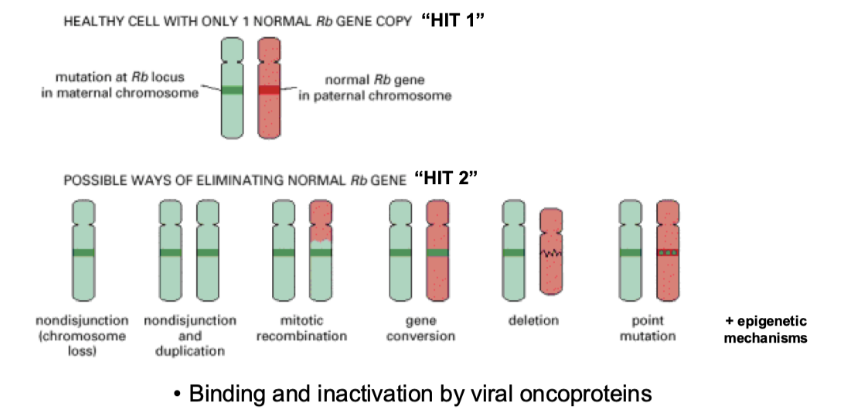
<p><span style="background-color: inherit; line-height: 22px; color: windowtext;"><span>Crossover events- causing 2 faulty copies not 1</span></span><span style="line-height: 22px; color: windowtext;"><span>&nbsp;</span></span></p><p><span style="background-color: inherit; line-height: 22px; color: windowtext;"><span>Viruses produce viral proteins that bind to tumour suppressor genes and knock them out- not genetic&nbsp;</span></span><span style="line-height: 22px; color: windowtext;"><span>&nbsp;</span></span></p>
25
New cards

what are the 2 functions of tumour suppressors

  1. gatekeepers

  2. caretakers

some can act as both

26
New cards

how do some TS act as gatekeepers

Stop proliferation- growth related tumour suppressors 

  • Transcriptional regulators of the cell cycle (RB1)

  • Cyclin dependent kinase inhibitors (eg. INK4a)

  • Cell adhesion regulators (E cadherin)

  • Angiogenesis regulators (VHL

27
New cards

how do some TS act as caretakers

Genes that look after state of genome and DNA stability and repair  

  • Transcriptional regulation and DNA repair (BRCA1 and 2)

  • Mismatch DNA repair (MSH2, MLH1, PMS1, MSH6)

28
New cards

how do some TS act as both gatekeepers and caretakers

Transcriptional regulators of cell cycle arrest or apoptosis (P53)

29
New cards

what is the multi step model of colorectal carcinoma development

Large range of stages of colorectal carcinoma 

5-7 that can be readily biopsied 

  • Each stage- different type of mutation involved 

  • Eg TS mutation early 

  • P53 later  

Shows you do ned multiple genes to be mutation in a given cancer 
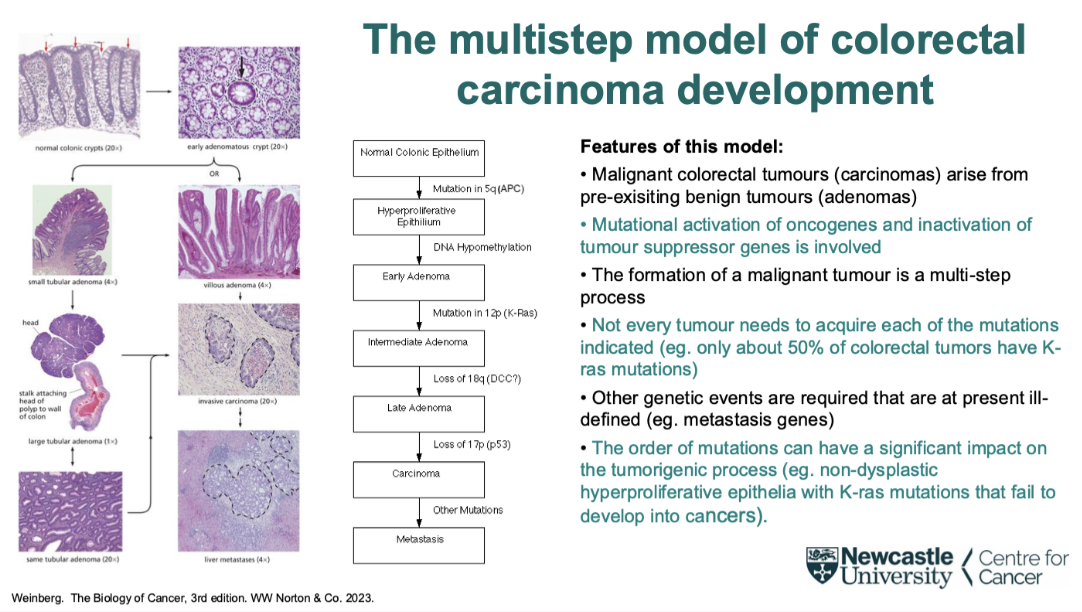
<p><span style="background-color: inherit; line-height: 22px; color: windowtext;"><span>Large range of stages of colorectal carcinoma</span></span><span style="line-height: 22px; color: windowtext;"><span>&nbsp;</span></span></p><p class="Paragraph SCXO147207450 BCX0" style="text-align: left;"><span style="background-color: inherit; line-height: 22px; color: windowtext;"><span>5-7 that can be readily biopsied</span></span><span style="line-height: 22px; color: windowtext;"><span>&nbsp;</span></span></p><ul><li><p class="Paragraph SCXO147207450 BCX0" style="text-align: left;"><span style="background-color: inherit; line-height: 22px; color: windowtext;"><span>Each stage- different type of mutation involved</span></span><span style="line-height: 22px; color: windowtext;"><span>&nbsp;</span></span></p></li><li><p class="Paragraph SCXO147207450 BCX0" style="text-align: left;"><span style="background-color: inherit; line-height: 22px; color: windowtext;"><span>Eg TS mutation early</span></span><span style="line-height: 22px; color: windowtext;"><span>&nbsp;</span></span></p></li><li><p class="Paragraph SCXO147207450 BCX0" style="text-align: left;"><span style="background-color: inherit; line-height: 22px; color: windowtext;"><span>P53 later&nbsp;</span></span><span style="line-height: 22px; color: windowtext;"><span>&nbsp;</span></span></p></li></ul><p class="Paragraph SCXO147207450 BCX0" style="text-align: left;"></p><p class="Paragraph SCXO147207450 BCX0" style="text-align: left;"><span style="background-color: inherit; line-height: 22px; color: windowtext;"><span>Shows you do ned multiple genes to be mutation in a given cancer</span></span><span style="line-height: 22px; color: windowtext;"><span>&nbsp;</span></span></p>