EGS6626 Fundamentals of Engineering Project Management Exam 4
 Call Kai
 Learn
Learn Practice Test
 Spaced Repetition
 Match
Match Flashcards
 Knowt Play
1/187

There's no tags or description
Looks like no tags are added yet.
Name | Mastery | Learn | Test | Matching | Spaced | Call with Kai |
|---|
No analytics yet
Send a link to your students to track their progress
188 Terms
What does getting the "when" defined mean for a project?
Defining the project schedule
What tool do you use to define the project schedule?
The Gantt Chart
What is featured in Gantt Charts?
- Activity
- Apply schedule logic from network
- Input duration
What are the advantages of the Gantt Chart?
- Easy to understand
- Effective communication tool
- Identify resource requests
What are the disadvantages of the Gantt chart?
- Out of control when there are too many activities
- Don't clearly show predecessor logic and relationships
- Don't show impacts of delaying an activity
What is schedule logic?
How tasks fit together
What are examples of kinds of schedule logic?
- Finish to Start (most common)
- Start to Start
- Finish to Finish
- Start to Finish
What is the Finish to Start schedule logic?
A relationship in which the start of a successor activity depends on the completion of its predecessor activity
What is the Start to Start schedule logic?
A relationship between activities in which the start of a successor activity depends on the start of its predecessor
What is the Finish to Finish schedule logic?
A relationship in which the finish of a successor activity depends on the finish of its predecessor activity
What is the Start to Finish schedule logic?
A relationship between activities in which a successor activity cannot complete until its predecessor activity starts
What is auditing the schedule?
Determining whether your Gantt Chart is done
How can you determine if your Gantt Chart is realistic?
- The whole is equal to the sum of its parts
- Assumptions are clearly stated
- Can you and your team deliver on time?
- Did you consider other projects like this one?
- Did you allow contingency?
What comes after the draft schedule is done?
Get project resources and money aligned with the schedule
What does getting the "how much" defined mean for a project?
Project resources and money should be aligned with the schedule
What is labor level of effort (LOE)?
Number of person days/weeks/hours to complete the activity
What are some examples of costs for other needed resources?
Travel, supplies, subcontractors, etc.
What tool do you use to get project resources and money aligned with the schedule?
A Resource Loaded Gantt Chart
What are some ways to add the costs (cost or resource loading) to each task?
- Even distribution (most common)
- Front loaded
- Back loaded
- S-curve
What are direct costs?
Project and labor expenses
What are examples of labor costs?
Staff salaries and fringe benefits
What is a typical calculation for fringe benefit costs?
Actual hourly salary plus 44% for fringe benefit costs
$1/hour of salary cost = $1.44/hour total cost with fringe benefits
Employee salary of $50,000 USD annually would cost $34.62/hour in direct labor or $72,000/year
What are some examples of direct costs?
- Labor costs including staff salaries and fringe benefits
- Subcontractors
- Travel
- Office expenses specific to the project
- Other non-labor expenses directly related to the project
What is another term for indirect costs?
Overhead costs
What are indirect costs?
Costs that are not directly related to the project but support operation
What are examples of indirect costs?
- Utilities (heat, light, air conditioning)
- Rent
- Telephones, computers, and other general office expenses
- Insurance
- Advertising
- Anything else to support business operation that is not project-specific
How do you determine costs for labor-based business?
Determined as percent of raw labor salaries
For indirect rate of 120%, $1.20 added to $1 of salary
What is the pool concept in overhead calculations?
Overhead costs accumulate in a pool or cloud, yearly assessment of overhead costs generates a new rate distributed across all projects or products. Costs include legal, utilities, business development, rent, insurance, and other required operations
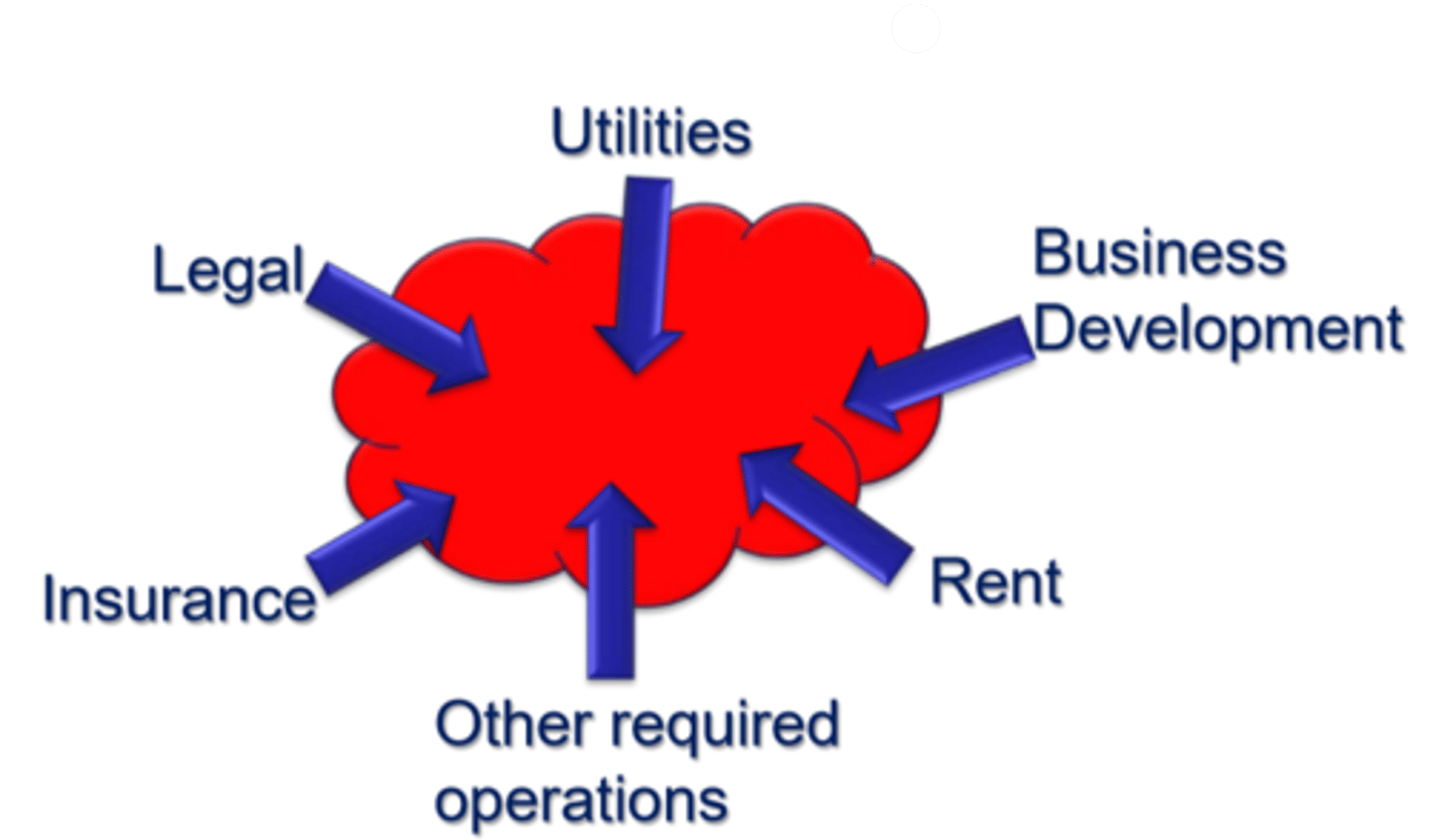
What are direct and indirect costs based off of?
Salaries
For a unit salary at $1.00/hr, add fringe benefits at $0.44/hr and indirect burden at $1.20/hour
Total cost of a staff person for every $1 of their salary is $2.64
For a $50,000/year employee, the actual cost (direct and indirect) is $50,000 x $2.64 or $132,000/year
What must companies do?
Recover all overhead (although indirects may be determined differently)
What terms are important for profit-based companies?
Price (or revenue), gross margin, net margin, labor multiplier, and cost vs. price
What is price for engineering project?
Total client revenue
What gets subtracted from total client revenue (price)?
Raw labor costs, fringe costs, and direct expense costs
What is included in the gross margin?
Indirect cost and net margin
What is the gross margin?
Total client revenue (price) - total direct costs = gross margin
What is total net margin?
Profit
Total client revenue - (total direct + indirect costs) = net margin (profit)
What are the margin metrics for a cup of coffee?
Price is $2.35
Direct costs $0.87
Overhead costs $1.28
Gross margin $1.48
Net margin (profit) $0.20
What are some budgeting tools companies or organizations use?
- Spreadsheets
- Resource-loaded Gantt tools
- Web applications
What are some advantages and issues with spreadsheets?
- Version control
- Undetected cells with bad formulas
What are some advantages and issues with resource-loaded Gantt tools?
- Reasonable approach but not a great estimating tool
- Setup and operation by professionals
What are some advantages and issues with web applications?
- Good tool with all the correct rates and factors
- You only have to worry about your estimates and nothing else
- Use it if possible!
Why are budgeting tools important?
At any given time, you can forecast the resource needs; by task or groups of task, can see money, staff, and timing
What is crashing the schedule?
Doing the schedule better, faster, and cheaper
What comes after the first pass of the schedule?
- Doing it better, faster, and cheaper
- Analyze the schedule
- Perform a cost analysis
- Engage your team and your senior staff
What are some considerations for crashing the schedule?
- Shorten the schedule by adding more resources
- Key is optimization of compression for the least cost
- Careful analysis required
- Useful any time schedule compression is needed
What is the final planning step?
- Planning is complete
- Ready to deliver
- What is your playbook for the team?
- Implement a project execution plan
What are some clarifications of the project execution plan?
- Also called a PxP or PEP
- Little new information is required
- Handy reference tool
What are the benefits of a PxP?
- Defines roles and expectations
- Promotes consistency, continuity, efficiency, and teamwork
- Fosters effective and efficient communications
- Supports and facilitates endorsement
- Assists in change management
- Improves client service and stakeholder satisfaction
- An up-to-date PxP prevents problems and saves time and money
What are some important things to think about before starting a PxP?
- Key PxP components
- Level of detail
- Company confidential information
- Communicate the PxP to the team
What is the information conveyed in the work breakdown structure of the PxP?
How will the work be divided up?
What should the project execution plan do?
- Be scalable
- Re-charter new team members
What is the information conveyed in the project resources and organization section of the PxP?
- Who's assigned and who's doing what?
- What resources do we have to work with?
What is the information conveyed in the project schedule of the PxP?
When is the work done?
What is the information conveyed in the project budget of the PxP?
How much will the work cost?
What is the information conveyed in the project scope and deliverables section of the PxP?
- What is the scope of work?
- What are the deliverables?
What is the information conveyed in the project instructions section of the PxP?
How will the work be accomplished?
What is the information conveyed in the critical success factors section of the PxP?
What are the drivers for the project?
What is the information conveyed in the client service plan of the PxP?
How will the client be satisfied?
What is the information conveyed in the contract management plan of the PxP?
How will work be procured and managed?
What is the information conveyed in the subcontractor management plan of the PxP?
How will the subcontractor be managed?
What is the information conveyed in the document management plan of the PxP?
Where and how long will documents be stored?
What is the information conveyed in the quality management plan of the PxP?
How will quality be ensured? What are the preventative and corrective actions?
What is the information conveyed in the communications plan of the PxP?
How will project communication be managed?
What is the information conveyed in the health and safety plan of the PxP?
How will health and safety be ensured?
What is the information conveyed in the risk management plan of the PxP?
How will risks be managed?
What is the information conveyed in the change management plan of the PxP?
How will change be managed?
What is the information conveyed in the closeout plan of the PxP?
How will the project be closed?
What is some introductory information included in the PxP?
- Purpose
- Project overview
- Critical success factors
What are essential components specific to a design project PxP?
- Design specific project instructions (template)
- Design specific quality management plan (template)
- Design basis report
- Constructability and operability review guidelines
- Risk management plan
- Communication plan, design disciplines
- Procurement and subcontractor management
- Legal and regulatory requirements summary
What are some examples of sections that could be included in the project background?
- Objectives
- Description
- Location
- Key issues and critical success factors
What are some examples of sections that could be included in the project information?
- Scope
- Schedule
- WBS and task budget
- Reference documents
- Client-provided data
What are some examples of sections that could be included in the project organization?
- Project team organization
- Client team organization
- Stakeholders/other consultants/outside agencies
- Roles and responsibilities
- Communications directory
- Project communications
What are some examples of sections that could be included in the project delivery?
- Project chartering and endorsement
- Requirements for deliverables
- Risk management plan
- Quality assurance/quality control
- Change management
- Health and safety
- Project closeout
What are some examples of sections that could be included in the project administration?
- Project statusing and controls
- Invoicing and progress reports
- Labor and expenses
- Document management
- Project files
- Conflict resolution
What are some examples of PxP appendices?
- Contract scopes of work
- Detailed project schedule
- Change management form
- Change management log
- Checklist for project closeout
- List of project file binder tabs
What are best practices for the PxP?
- Develop it with your team
- Make it dynamic
- Use feedback from team
- Templates are just tools, not absolutes
- Tell the project story
- Review on a routine basis
- Keep it simple and accessible
What are project controls?
Proactive methods to ensure you are meeting project constraints
What questions do project controls answer?
- Where are we now?
- Where are we going?
What should you do before the project controls?
- Develop a project execution plan (PxP)
- Secure endorsement
- Communicate the plan
- Must lead the team
What should you do with project controls?
- Execute the plan
- Monitor and control execution
- Manage change
- Report performance
- Update the plan
Why are project controls important?
- Projects over budget at only 15% complete usually overrun at completion
- Actual completion costs rarely improve by more than 10%
- Need to take action early and "stop the bleeding"
What do you look at with measuring project status?
- What do you measure?
- When do you measure?
- How do you measure?
What are some common internal metrics for defining project success?
- Financial performance
- Process adherence and operational performance
- Project team and customer satisfaction
What are examples of measures of project performance?
- Compliance with the contract
- Health and safety performance
- Delivered quality against targets
- Satisfactory risk management
- Baseline progress
- Taking appropriate preventative and corrective actions
What are KPIs?
- Key performance indicators
- Choose ones that are accurate indicators of performance towards objectives
What are SMART metrics?
- Specific: targeted to the objective
- Measurable: data are accurate and complete
- Actionable: good vs bad, so action is clear
- Relevant: measure things that are important
- Timely: you can get the data without delay
What are financial KPI components?
- Technical completion of scope
- Measurement of performance against budgets
- Measurement of performance against schedule
When do you monitor/measure?
- Pick a point in time to measure
- Align and compare to project plan (baseline, risk register)
How do you pick a point in time to measure?
- Design and consulting projects at least monthly
- Construction and similar projects at major milestones
How do you align and compare measurements to your project plan?
- Progress (actual work performed)
- Costs actually incurred to complete the project
- Risks that materialized or passed and impacts
What are rubber baselines?
Changing the baseline without change control
What might clients do with measurements?
Omit their milestones
What are contractor constraints with measuring?
- Front loading
- Inserting tight third party constraints to excuse contractor schedule slips
What is cost management?
In project status, it's how you measure
What cost management questions do you need answered as you deliver your project?
- What work was scheduled to have been completed?
- What was the cost estimate for the work scheduled?
- What work has been accomplished?
- What was the estimated cost for the work completed?
- What costs have been incurred?
- What are the variances from the planned budgets?
What is the estimate at completion (EAC)?
EAC = PJTD Costs + ETC
What is forecast variance at completion?
Forecast variance at completion = Cost Budget - (PJTD Direct + Future Costs)
What is estimate to complete (ETC)?
Future costs
What is estimate at completion (EAC)?
EAC = PJTD Direct + Future Costs
What is % Complete?
%C = PJTD Cost/EAC Cost