EX. 16 | Protein Catabolism, Part 2

0.0(0)
Studied by 0 people
call kaiCall Kai
learnLearn
examPractice Test
spaced repetitionSpaced Repetition
heart puzzleMatch
flashcardsFlashcards
GameKnowt Play
Card Sorting

1/4

encourage image

There's no tags or description

Looks like no tags are added yet.

Last updated 4:57 PM on 4/30/26
Name
Mastery
Learn
Test
Matching
Spaced
Call with Kai

No analytics yet

Send a link to your students to track their progress

5 Terms

1
New cards

Key Terms

Deamination — Removal of an amino group → converts into ammonia and carbon dioxide

Decarboxylation — Removal of carbon dioxide from an amino acid → converts into amine + carbon dioxide

Phenylalanine deaminase — Enzyme that deaminates phenylalanine

Hydrogen sulfide (H2S) — Produced by bacteria with desulfhydrase enzymes acting on sulfur-containing amino acids

Indole Test — Detects bacteria that can deaminate tryptophan to produce indole

MIO — Tests for motility, indole production, and ornithine decarboxylase activity

2
New cards

3 Main Tests

Phenylalanine Deamination

Hydrogen Sulfide (H2S) Production

MIO

3
New cards

Phenylalanine Deamination

Purpose

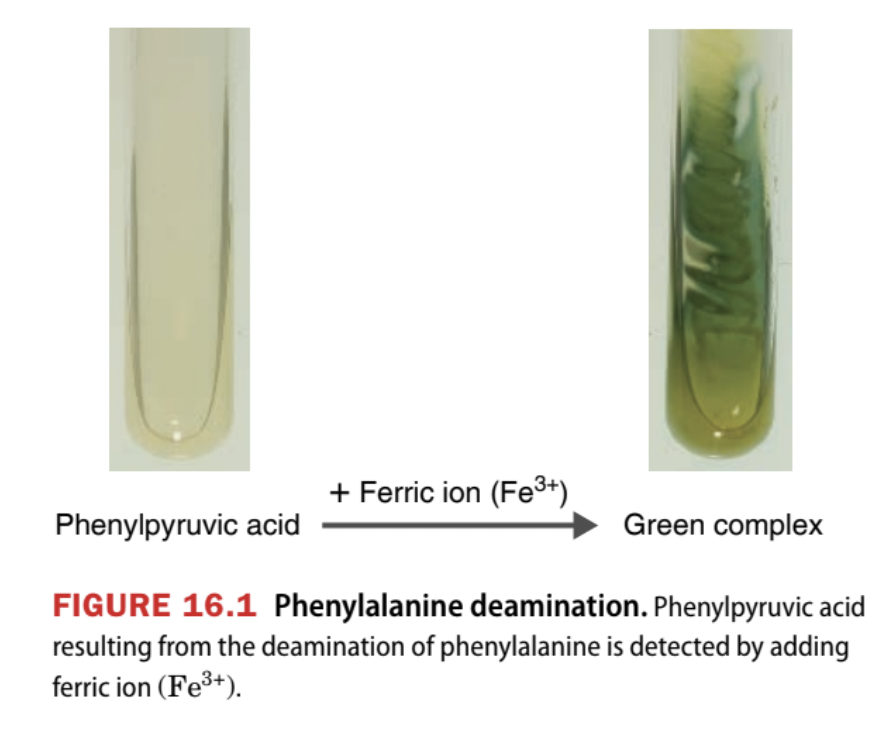
  • Determines whether bacteria have the enzyme phenylalanine deaminase, which removes the amino group from the amino acid phenylalanine, converting it into phenylpyruvic acid

Medium used

  • Phenylalanine slant

Results

  • Positive result: The bacteria have the enzyme and can break down phenylalanine into phenylpyruvic acid + ammonia

    • When ferric acid is added → reacts with phenylpyruvic acid → forms a dark green color

  • Negative result: No enzyme present in the bacteria, and no color change (remains original color = yellow or brown)
<p><span style="color: yellow;">Purpose</span></p><ul><li><p>Determines whether bacteria have the enzyme <strong>phenylalanine deaminase</strong>, which removes the amino group from the amino acid <strong>phenylalanine</strong>, converting it into phenylpyruvic acid<br><br></p></li></ul><p><span style="color: yellow;">Medium used</span></p><ul><li><p>Phenylalanine slant<br><br></p></li></ul><p><span style="color: yellow;">Results</span></p><ul><li><p><u>Positive result</u>: The bacteria have the enzyme and can break down phenylalanine into phenylpyruvic acid + ammonia</p><ul><li><p>When <strong>ferric acid</strong> is added → reacts with phenylpyruvic acid → forms a <strong>dark green </strong>color</p></li></ul></li></ul><p></p><ul><li><p><u>Negative result</u>: No enzyme present in the bacteria, and no color change (remains original color = yellow or brown)</p></li></ul><p></p>
4
New cards

Hydrogen Sulfide Production (H2S)

Purpose

  • Determines whether bacteria have the enzyme desulfhydrase, which allows them to break down sulfur-containing amino acids and release hydrogen sulfide gas as a byproduct

Medium used

  • Peptone iron deep

Results

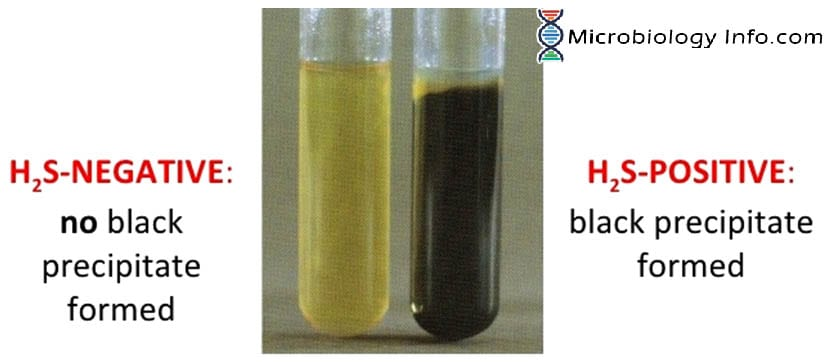
  • Positive result: The bacteria have the enzyme desulfhydrase and can break down the sulfur amino acids and release hydrogen sulfide gas

    • Hydrogen sulfide reacts with the ferrous sulfate in the medium → forms a black precipitate (FeS)

    • Black at the bottom (butt) of the tube

  • Negative result: No enzyme present in the bacteria, and no blackening in the tube
<p><span style="color: yellow;">Purpose</span></p><ul><li><p>Determines whether bacteria have the enzyme <strong>desulfhydrase,</strong> which allows them to break down sulfur-containing amino acids and release hydrogen sulfide gas as a byproduct<br><br></p></li></ul><p><span style="color: yellow;">Medium used</span></p><ul><li><p>Peptone iron deep<br><br></p></li></ul><p><span style="color: yellow;">Results</span></p><ul><li><p><u>Positive result</u>: The bacteria have the enzyme <strong>desulfhydrase</strong> and can break down the sulfur amino acids and release hydrogen sulfide gas</p><ul><li><p>Hydrogen sulfide reacts with the <strong>ferrous sulfate</strong> in the medium → forms a black precipitate (FeS)</p></li><li><p>Black at the bottom (butt) of the tube<br><br></p></li></ul></li></ul><ul><li><p><u>Negative result</u>: No enzyme present in the bacteria, and no blackening in the tube</p></li></ul><p></p>
5
New cards

MIO Test

Purpose

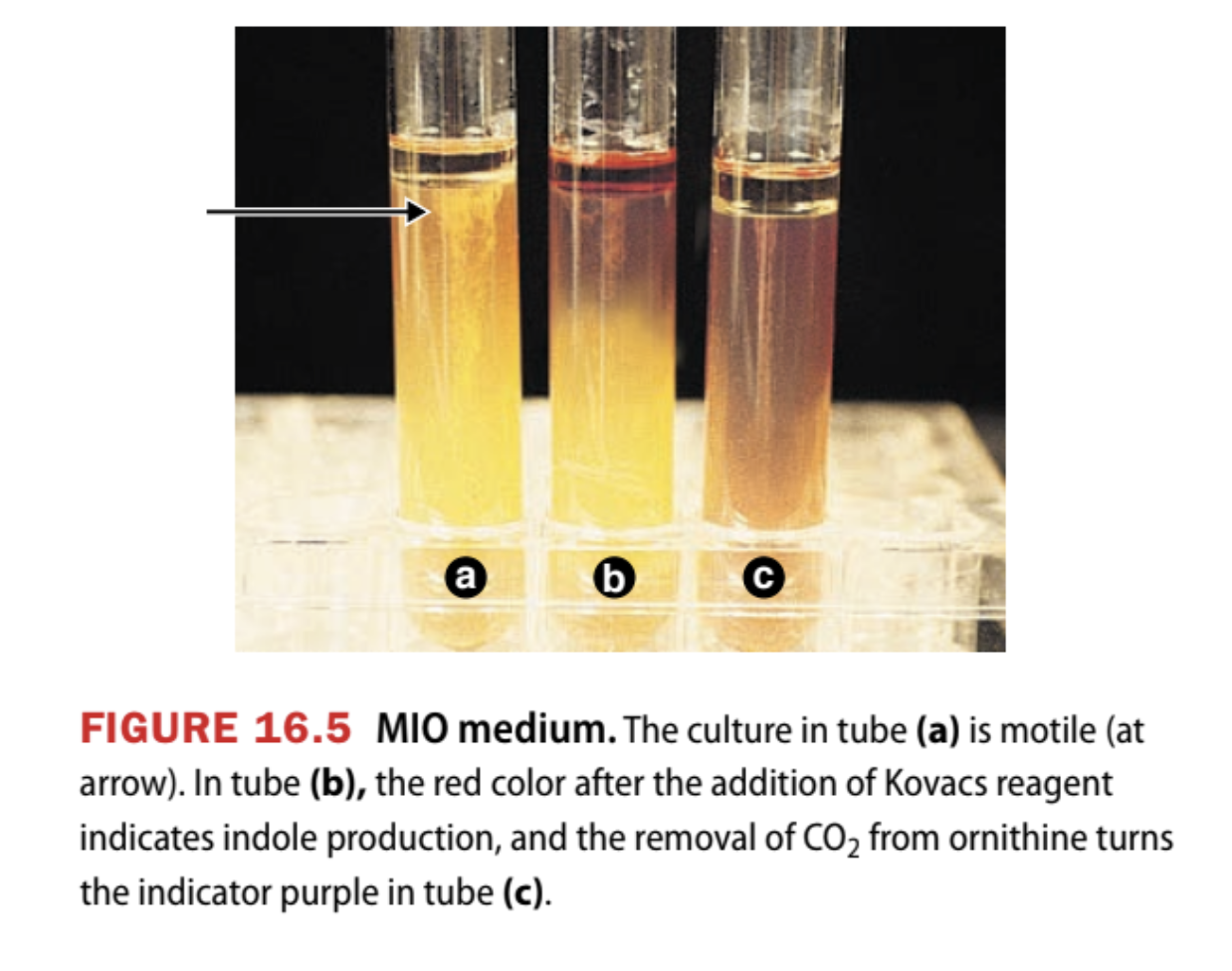
  • Detects 3 different characteristics: motility, indole, and ornithine decarboxylase

Motility

  • Determines whether the bacteria can move on their own

    • Positive result: Growth spreads outwards, away from the stab line

    • Negative result: Growth stays only along the stab line

Indole

  • Determines whether bacteria have tryptophanase, which breaks down the amino acid tryptophan into indole

    • Positive result: Cherry red ring after adding Kovacs reagent

    • Negative result: No red color

Ornithine Decarboxylase

  • Determines whether bacteria have ornithine decarboxylase, which removes carbon dioxide from the amino acid ornithine → produces putrescine

    • Positive result: Medium turns purple

    • Negative result: Medium stays yellow

<p><span style="color: yellow;">Purpose</span></p><ul><li><p>Detects 3 different characteristics: motility, indole, and ornithine decarboxylase<br><br></p></li></ul><p><span style="color: yellow;">Motility</span></p><ul><li><p>Determines whether the bacteria can move on their own</p><ul><li><p><u>Positive result</u>: Growth spreads outwards, away from the stab line</p></li><li><p><u>Negative result</u>: Growth stays only along the stab line<br><br></p></li></ul></li></ul><p><span style="color: yellow;">Indole</span></p><ul><li><p>Determines whether bacteria have <strong>tryptophanase</strong>, which breaks down the amino acid <strong>tryptophan</strong> into indole</p><ul><li><p><u>Positive result</u>: Cherry red ring after adding Kovacs reagent</p></li><li><p><u>Negative result</u>: No red color<br><br></p></li></ul></li></ul><p><span style="color: yellow;">Ornithine Decarboxylase</span></p><ul><li><p>Determines whether bacteria have ornithine decarboxylase, which removes carbon dioxide from the amino acid <strong>ornithine</strong> → produces putrescine</p><ul><li><p><u>Positive result</u>: Medium turns purple</p></li><li><p><u>Negative result</u>: Medium stays yellow</p></li></ul></li></ul><p></p>