BIOLOGY 11 - Meiosis and Chromosomal Errors
 Call Kai
 Learn
Learn Practice Test
 Spaced Repetition
 Match
Match Flashcards
 Knowt Play
1/29

Earn XP
Description and Tags
2ND SEM FINAL TERM
Name | Mastery | Learn | Test | Matching | Spaced | Call with Kai |
|---|
No analytics yet
Send a link to your students to track their progress
30 Terms
Meiosis
Type of cellular division that occur to produce sex cells in the reproductive organs (ovaries and testes).
Reduction division
The process where in it divides the number of chromosomes into halves in the formation of gametes
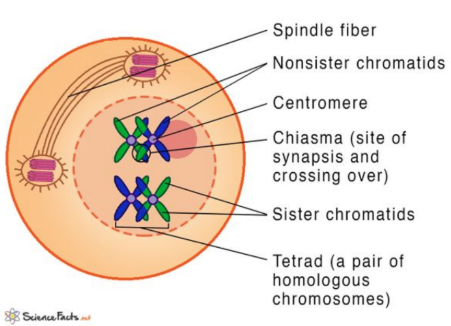
Prophase 1
- Chromosomes condense and become visible.
- Homologous chromosomes pair up (synapsis).
- Tetrads form (4 chromatids). - Crossing over happens (DNA is exchanged), site Chiasma.
- Nuclear membrane breaks down.
- Spindle fibers begin to form.
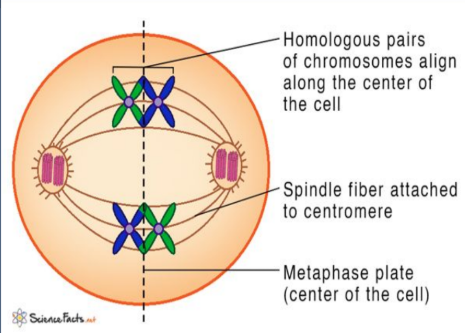
Metaphase 1
- Homologous chromosome pairs line up at the center (equator).
- Each pair is called a tetrad. - Spindle fibers attach to each chromosome.
- Orientation is random (independent assortment).
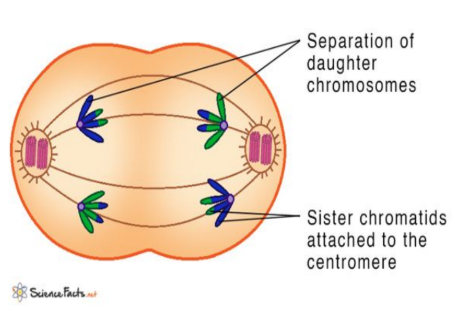
Anaphase 1
- Homologous chromosomes separate.
- Each chromosome moves to opposite poles.
- Sister chromatids stay together.
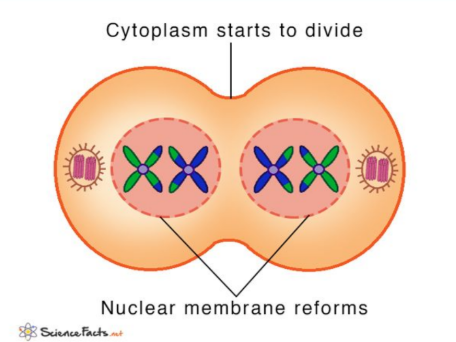
Telophase 1
- Chromosomes reach opposite poles.
- Nuclear membranes may reform.
- Cell divides (cytokinesis). - Two haploid cells are formed.
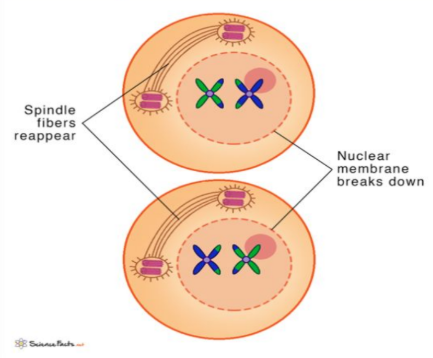
Prophase 2
- Chromosomes condense again.
- Nuclear membrane breaks down.
- Spindle fibers form.
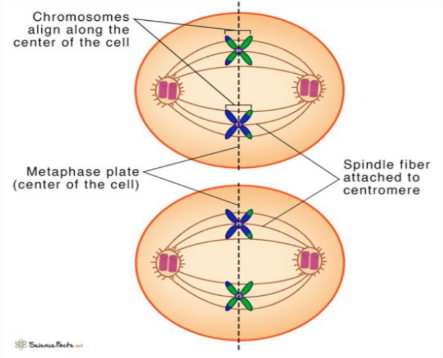
Metaphase 2
- Chromosomes line up at the cell center.
- Spindle fibers attach to sister chromatids.
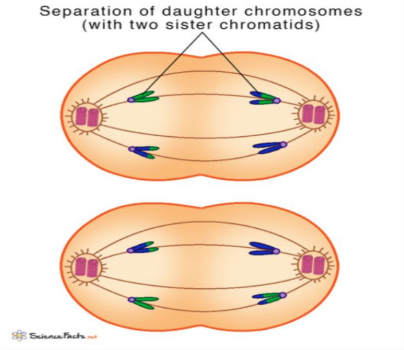
Anaphase 2
- Centromere divides and sister chromatids are pulled to the opposite poles.
- Chromatids move to opposite poles.
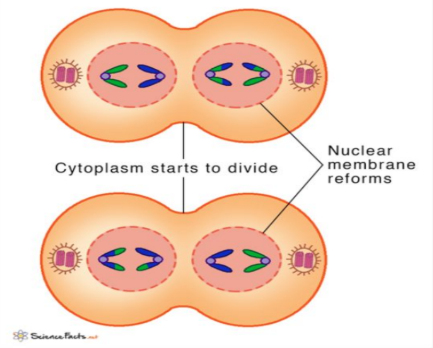
Telophase 2
- Chromatids reach poles.
- Nuclear membranes reform.
- Cells divide (cytokinesis).
- Four haploid cells are formed.
Gametogenesis
The process involving the production of gametes.
Spermatogenesis
the process by which sperm cells are produced.
Oogenesis
the process of gamete formation in females.
Independent Assortment
It is the random distribution of homologous chromosomes during meiosis.
Random Fertilization
is the chance fusion of any sperm with any egg during fertilization
Trisomy
a nondisjunction where the cells have 3 copies of a chromosome
Monosomy
a nondisjunction where the cells have only 1 copy of a chromosome
Nondisjunction
chromosomes don’t separate properly during meiosis as problems with the meiotic spindle causes errors in the daughter cells
Deletion
Duplication
Inversion
Translocation
4 types of breakage of chromosomes
Down syndrome
it is a syndrome caused by Trisomy 21 or also known as 3 copies of chromosome 21
Chromosome 21
it is the smallest human chromosome
Klinefelter’s syndrome
XXY where in they have male sex organs but are sterile, feminine characteristics, tall, and have normal intelligence
Trisomy X
XXX produces healthy females which makes Barr bodies
Jacob’s syndrome
XYY where there is an extra Y chromosome making them slightly taller than average, more active, normal intelligence, slight learning disabilities, delayed emotional maturity, and normal asexual development
Turner syndrome
(XO) it is monosomy X and has a varied degree of effects such as webbed neck, short stature, and sterile
Barr bodies
it is when all but one X chromosome is inactivated
Deletion
It is a change in chromosome structure where in there is the loss of a chromosomal segment
Duplication
It is a change in chromosome structure where in there is a segment being repeated
Inversion
It is a change in chromosome structure where it reverses a segment
Translocation
It is a change in chromosome structure where in a segment moves from one chromosome to another