Honors US History, Unit 1 Reconstruction
 Call Kai
 Learn
Learn Practice Test
 Spaced Repetition
 Match
Match Flashcards
 Knowt Play
1/31

There's no tags or description
Looks like no tags are added yet.
Name | Mastery | Learn | Test | Matching | Spaced | Call with Kai |
|---|
No analytics yet
Send a link to your students to track their progress
32 Terms
Fourteenth Amendment ratified, 1868
Constitutional amendment that extended civil rights to freedmen and prohibited states from taking away such rights without due process.
Radical Republicans
Political party that favored harsh punishment of Southern states after civil war
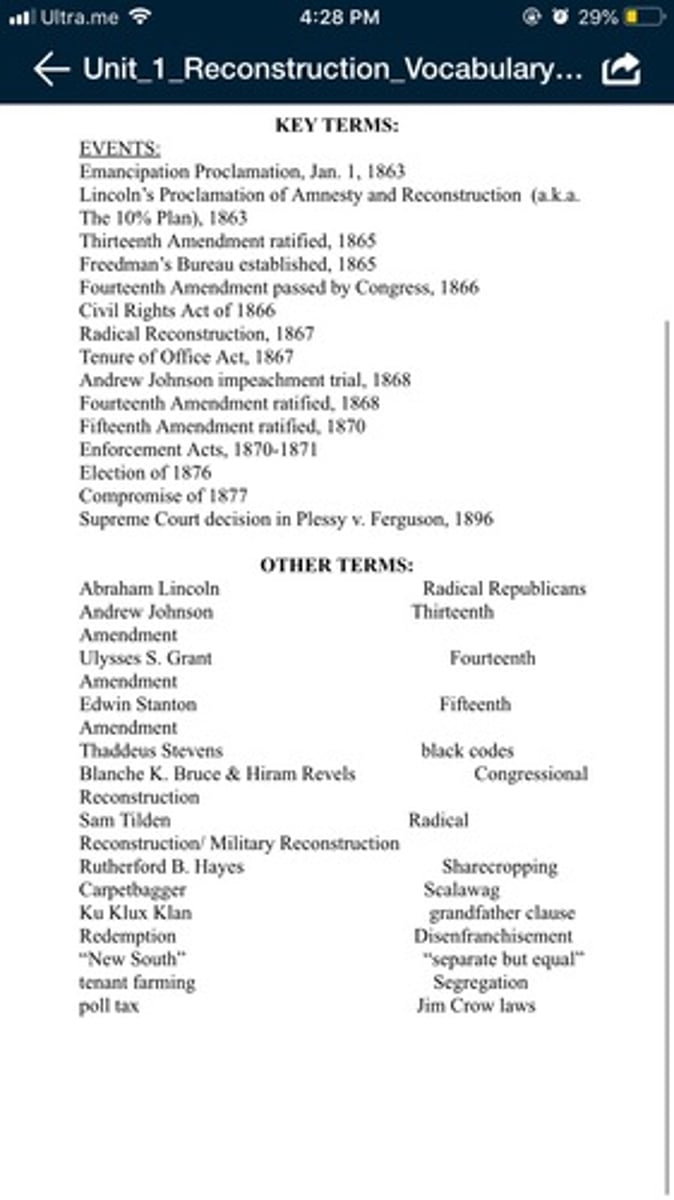
Thirteenth Amendment
1865 - Freed all slaves, abolished slavery.
Fifteenth Amendment
The constitutional amendment adopted in 1870 to extend suffrage to African Americans.
Radical Reconstruction
Reconstruction strategy that was based on severely punishing South for causing war
Civil Rights Act of 1866
law that established federal guarantees of civil rights for all citizens
Andrew Johnson impeachment trial, 1868
attempted impeachment against President Johnson in 1868; power struggle between him and Congress- President removed cabinet officer w/o Senate approval and he interfered w/ congressional reconstruction; crippled his presidency
Plessy v. Ferguson
a 1896 Supreme Court decision which legalized state ordered segregation so long as the facilities for blacks and whites were equal
Abraham Lincoln
16th president of the United States; helped preserve the United States by leading the defeat of the secessionist Confederacy; an outspoken opponent of the expansion of slavery.
Ulysses S. Grant
an American general and the eighteenth President of the United States (1869-1877). He achieved international fame as the leading Union general in the American Civil War.
Thaddeus Stevens
A Radical Republican who believed in harsh punishments for the South. Leader of the Radical Republicans in Congress.
Reconstruction
the period after the Civil War in the United States when the southern states were reorganized and reintegrated into the Union
Carpetbaggers
A northerner who went to the South immediately after the Civil War; especially one who tried to gain political advantage or other advantages from the disorganized situation in southern states
Klu Klux Klan
White supremacist group that terrorized African Americans
Tenant Farming
A system in which farm workers supply their own tools and rent farmland for cash
Fourteenth Amendment
A constitutional amendment giving full rights of citizenship to all people born or naturalized in the United States, except for American Indians.
black codes
Southern laws designed to restrict the rights of the newly freed black slaves
Sharecropping
A system used on southern farms after the Civil War in which farmers worked land owned by someone else in return for a small portion of the crops.
segregation
Separation of people based on racial, ethnic, or other differences
Emancipation Proclamation, Jan. 1, 1863
executive order given by Abraham Lincoln; it freed all of the slaves in the Confederacy
Thirteenth Amendment Ratified 1865
Constitutional amendment prohibiting all forms of slavery and involuntary servitude (except as a punishment for a convicted crime). Former Confederate States were required to ratify the amendment prior to gaining reentry into the Union.
Freedman's Bureau established, 1865
initiated by U.S. President Abraham Lincoln and was intended to last for one year after the end of the Civil War. The Freedmen's Bureau was an important agency of early Reconstruction, assisting freedmen in the South.
Fourteenth Amendment passed by Congress, 1866
granted citizenship to any person born or naturalized in the US; this amendment protects citizens from abuses by state governments, and ensures due process and equal protection of the law. It overrode the Dred Scott decision, and also reduced the representation in congress of any southern state that deprived African Americans of vote.
Radical Reconstruction, 1867
Reconstruction strategy that was based on severely punishing South for causing war
15th amendment ratified, 1870
Prohibited states from denying citizens the franchise on account of race. It disappointed feminists who wanted the Amendment to include guarantees for women's suffrage.
The Compromise of 1877 resulted in
the withdrawal of federal troops from the South
Andrew Johnson
17th President of the United States, A Southerner form Tennessee, as V.P. when Lincoln was killed, he became president. He opposed radical Republicans who passed Reconstruction Acts over his veto. The first U.S. president to be impeached, he survived the Senate removal by only one vote. He was a very weak president.
Scalawags
Southern whites who supported Republican policy through reconstruction
Grandfather Clause
A clause in registration laws allowing people who do not meet registration requirements to vote if they or their ancestors had voted before 1867.
"separate but equal" rule
doctrine that public accommodations could be segregated by race but still be considered equal
Jim Crow Laws
Laws designed to enforce segregation of blacks from whites
Still learning (19)