BIOPSY 215 - FInal Exam (NEW MATERIAL)
 Call Kai
 Learn
Learn Practice Test
 Spaced Repetition
 Match
Match Flashcards
 Knowt Play
1/86

There's no tags or description
Looks like no tags are added yet.
Name | Mastery | Learn | Test | Matching | Spaced | Call with Kai |
|---|
No analytics yet
Send a link to your students to track their progress
87 Terms
learning
process of aquiring new knowledge
memory
expression of the knowledge you’ve learned
change in behavior based on experience
difference between learning and memory
learning is acquiring knowledge; memory is storing and expressing it
classical conditioning
forming associations between stimuli that changes reponse to one of the stimuli
associated with Ivan Pavlov
a bell paired with food caused dogs to salivate to the bell alone
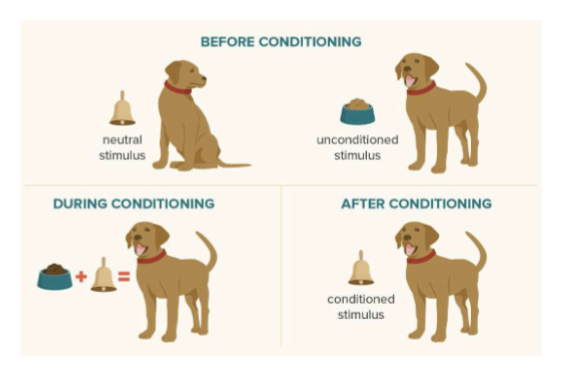
key parts of classical conditioning
unconditioned stimulus (US): naturally causes a response
unconditioned response (UR): natural response to the US
conditioned stimulus (CS): learned stimulus
conditioned response (CR): learned response to CS
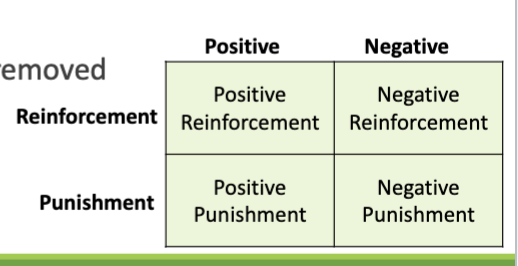
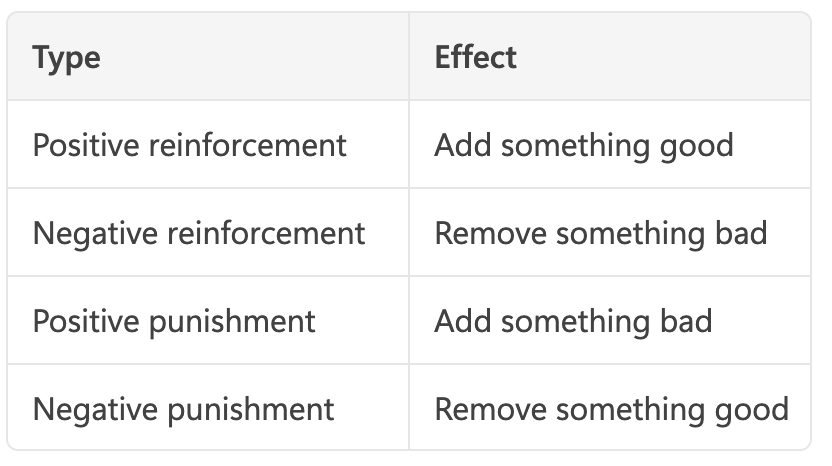
types of operant conditioning
reinforcement: increase probability of future responses
punishment: decreases probability of future responses
positive: something is given/added
negative: something is taken away/removed
flow of information through memory
sensory memory
short-term memory (STM) / working memory
long-term memory (LTM)
what biological changes are associated with short term vs. long term
short-term/working memory:
based on synaptic transmission
temporary changes in neural activity
long-term memory:
involved gene expression and protein synthesis
long-lasting synaptic changes
short term memory
brief storage of information
working memory
actively manipulates while holding it in mind
example: digit span test (used for both STM and WM)
capacity
memory systems have limited capacity, especially short-term memory
chunking
grouping information into meaningful units to increase capacity of STM and WM
primary effect
better recall of items at the beginning of a list
recency effect
better recall of items at the end of a list
types of long term memory
explicit (declarative) memory
episodic: personal experiences and events
semantic: facts and general knowledge
implicit (non-declarative) memory
procedural: skills, habits
priming
associative learning
non-associative learning
hippocampus
declarative memories (especially episodic)
patient H.M. evidence:
removal of hippocampus caused: severe anterograde and retrograde amnesia
intact abilities: working memory, language and intelligence, implicit memory
trisynaptic circuit
entorhinal cortex
perforant path
mossy fibers
schaffer collaterals
exit hippocampus
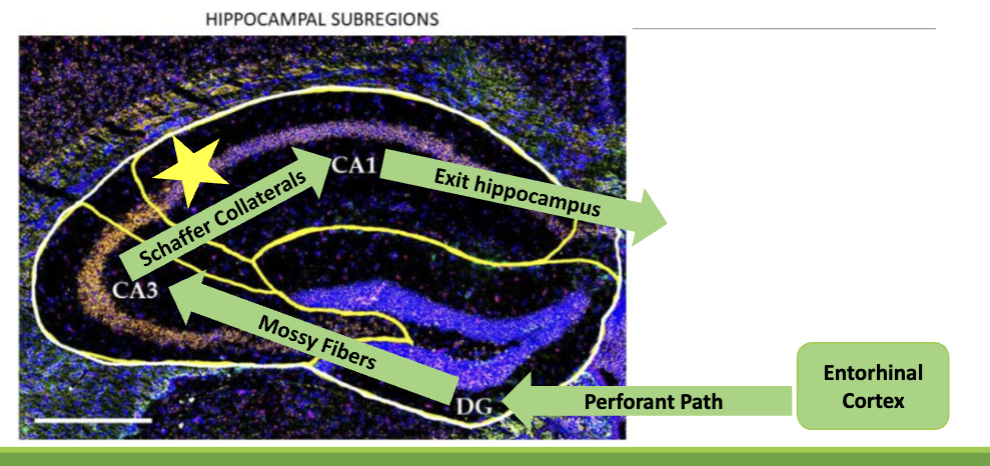
spatial memory
hippocampus is involved in spatial navigation
london taxi driver study
posterior hippocampus increase
anterior hippocampus decrease
shows plasticity from navigation experience
place cell
neurons that fire when an animal is in a specific location, creating spatial maps
prefrontal cortex (PFC) & Memory
heavily involved in working memory
two pathways
direct pathway: posterior parietal cortex —> PFC
indirect pathway: posterior parietal cortex —> thalamus & basal ganglia —> PFC
striatum role in memory
made up of caudate, putamen, and nucleus accumbens
important for habit-forming, motor learning, associative learning
linked to dopamine
NAc is important for reward learning
increased striatum activity during habitual behaviors; implicit memory
types of memory for other brain areas - amygala, anterior cingulate cortex
amygdala - fear learning
anterior cingulate cortex - reward learning
steps of long-term potentiation (LTP)
glutamate release presynaptically
glutamate binds AMPA receptors
EPSP occurs
Mg2+ block removed from NMDA receptor
Ca2+ enters the postsynaptic cell
Ca2+ activates PKC and CaMKII
presynaptic effects of LTP
increase in neurotransmitter release
responding to retrograde transmitters
postsynaptic effects of LTP
phosphorylation of AMPA receptors
new AMPA receptors added to membrane
increase in GluR1-containing AMPA receptors
growth of dendritic spines
what is LTD
weakening of synaptic connections
occurs following prolonged low level of synaptic stimulation
mechanism
removal/endocytosis of AMPA receptors
dephosphorylation of AMPA receptors
korsakoff’s syndrome - biological cause
symptoms:
similar to PFC damage
confabulation - fill in gaps of memories by guessing
cause:
thiamine (vitamine B1) deficiency
loss of neurons, especially in dorsomedial thalamus
alzheimer’s disease - biological cause
one of the most common causes of memory loss
symptoms:
memory problems (especially declarative memory); may fluctuate
confusion
depression
cause:
amyloid-β protein
tau protein
genetics
APOE gene - APOE4 associated with higher risk
brain atrophy
what does morris water maze test?
the morris water maze tests spatial learning and spatial memory, which are hippocampus-dependent
animals must learn the location of a hidden platform using external visual cues
key measures:
latency
path proximity
time spent in the target zone
poorer performance = worse spatial learned/memory
used because hippocampal neurogenesis is strongly linked to spatial navigation
what is TMZ and how does it affect the brain
TMZ (temozolomide) is a chemotherapeutic drug
used to suppress adult hippocampal neurogenesis
TMZ works by:
preventing cell division
reducing the birth of new neurons in the dentate gyrus of hippocampus
what is BrdU/what does it allow you to test
BrdU is a compound that gets incorporated into DNA during cell division
it labels newly generated cells
in this study, BrdU was used to
measure the amount of neurogenesis
confirm that TMZ successfully reduced new neuron formation
BrdU-positive cells = evidence of recent neurogenesis
general findings: depleting neurogenesis affected learning in which age group
significant impairment in juvenile animals
middle-aged: little to no effect
adults: moderate effects
james-lange theory
physiological response comes first, and the emotion is the interpretation of that response
example: I am afraid because my heart is racing
cannoon-bard theory
physiological arousal + emotional experience occur simultaneously
example: I fear and my heart races at the same time
schachter-singer theory
emotion results from:
physiological arousal
cognitive appraisal (interpreting the situation/context)
example: heart racing + dangerous context = fear
this theory explicitly includes cognition
basic emotion theory (BET)
core concepts
limited set of innate emotions
different brain regions/circuits are responsible for different emotions
strong background in evolutionary approach
basic emotions of basic emotion theory (BET)
happiness, sadness, fear, anger, disgust, surprise
think of inside out
theory of constructed emotion (TCE)
emotions are NOT innate
constructed in real time by the brain using:
affect
context
past experiences and memories
no emotion has a single dedicated brain area
what emotion is the amygdala associated with?
associated with fear and anxiety
amygdala connections (theres four)
amygdala —> hypothalamus: autonomic fear responses
amygdala —> PFC: approach and avoidance behaviors
amygdala —> pons: startle reflex
BNST —> amygdala: generalized emotional arousal
how does behavior change with damage to the amygdala?
no modification of startle reflex
difficulty interpreting emotional stimuli
difficulty with fear learning/show “fearlessness”
key symptoms/diagnostic of generalized anxiety disorder (GAD)
excessive worry for at least 6 months
difficulty controlling the worry
associated with symptoms like:
restlessness
fatigue
difficulty concentrating
muscle tension
sleep disturbance
irritability
causes significant distress or impairment
key symptoms/diagnostic of panic disorder
recurrent, unexpected panic attacks
at least one attack followed by:
persistent concern about future attacks
maladaptive behavior change
key symptoms/diagnostic of specific phobia
intense fear or anxiety about a specific object or situation
immediate anxiety response
actively avoided or endured with distress
fear is out of proportion
lasts for at least 6 months
key symptoms/diagnostic of post traumatic stress disorder (PTSD)
exposure to traumatic event
4 symptom categories
intrusion/re-experiencing
avoidance
negative mood/cognition
hyperarousal/hyperreactvity
symptoms last at least 1 month
key symptoms/diagnostic of obsessive-compulsive disorder (OCD)
obsessions: intrusive thoughts, urges, images
compulsions: repetitive behaviors or mental acts
performed to reduce distress
time-consuming or impairing
general neurobiological correlates of anxiety and related disorders
sympathetic nervous system dysregulation
altered HPA axis function
neurotransmitter changes:
GABA - decrease
norepinephrine - decrease OR increase
animal research models of anxiety - open field test
more time in center —> less anxiety
animal research models of anxiety - elevated plus maze
more time in open arms —> less anxiety
animal research models of anxiety - light-dark box
more time in light area —> less anxiety
treatments of anxiety - benzodiazepines
positive allosteric modulator of GABAa receptor
has potential for dependence, withdrawal symptoms; better for SHORT-TERM treatment
treatments of anxiety - SSRI
selective serotonin reuptake inhibitors
block serotonin transporters
kratom - does it increase or decrease anxiety? what 3 neurotransmitter systems is it working through?
generally decreases anxiety (anxiolytic-like effects)
acts on three neurotransmitter systems:
opioidergic system
GABAergic system
dopaminergic system
kratom - what is the rationale of using agonists and antagonists for certain receptor systems to test the mechanisms for a drug where mechanisms are unknown?
researchers use agonists and antagonists to see whether blocking or mimicking specific receptors eliminate the drug’s effect, revealing which systems are involved
core categories of symptoms (4 DSM-5 subcategories)
impaired control
using more than intended
difficulty cutting down or stopping
craving
social problems
problems at work, school, or home
continued use despite social/interpersonal issues
risky use
using in physically dangerous situations
continued use despite harm
physical dependence
tolerance
withdrawal
general substance use disorder mechanisms - what changes occur? (mesolimbic pathway, NAc, dopamine, cravings)
drugs increase dopamine in the VTA —> NAc
NAc is responds less to reward but responds more to drug rewarded-associated cues over time
causes craving and compulsive cues
cycle of substance use disorder - 3 stages
binge/intoxication
negative affect/withdrawal
preoccupation/anticipation (craving)
synaptic mechanisms of action for drug classes - stimulants
increase dopamine signaling:
cocaine - blocks dopamine, serotonin, norepinephrine transporters
amphetamine - reverse DA transporter (shifts DA from vesicles to cytosol)
nicotine - nicotinic acetylcholine receptor agonist
synaptic mechanisms of action for drug classes - opioids
opioid receptors agonists:
mu - pain relief, euphoria
delta - pain relief, reduce anxiety
kappa - pain relief, feeling of dysphoria
synaptic mechanisms of action for drug classes - alcohol
positive allosteric modulator of GABA receptors
antagonist at NMDA receptors
synaptic mechanisms of action for drug classes - cannabinoids
cannabinoid receptor agonists
suppress GABA and glutamate through retrograde signaling and inhibition of vesicle release
synaptic mechanisms of action for drug classes - hallucinogens
serotonin receptor agonists (LSD, psilocybin, MDMA, ketamine)
FDA-approved treatments for SUD treatments - alcohol
disulfiram/antabuse - affects alcohol metabolism
acamprosate - partial agonist at NMDA receptors
naltrexone - opioid receptor antagonist
FDA-approved treatments for SUD treatments - opioid
methadone/buprenorphine - opioid receptor agonists
naltrexone - opioid receptor antagonist
major depressive disorder
5 or more symptoms for at least 2 weeks
must include depressed mood or anhedonia
bipolar disorder - difference between bipolar I and bipolar II
bipolar I - manic & depressive episodes
bipolar II - hypomanic & depressive episodes
general mechanism of action for lithium
mood stabilizer that INHIBITS inositol monophosphatase, DECREASE second-messenger signaling, INCREASE GABA, and DECREASE dopamine and glutamate
4 main categories of pharmaceutical treatments for depression & their mechanisms of action
tricyclics - block serotonin, norepinephrine, and dopamine transporters
SSRIs - block serotonin transporters
SNRIs - block serotonin and norepinephrine transporters
MAOIs - inhibit monoamine oxidase
all lead to the monoamine hypothesis
what is the monoamine hypothesis of depression?
depression results from low monoamine neurotransmitters
limited scientific support
treatment methods for treatment-resistant depression - electroconvulsive therapy (ECT)
induces controlled seizures under anesthesia, producing rapid antidepressant effects by increasing neuroplasticity and BDNF
treatment methods for treatment-resistant depression - transcranial magneitc stimulation (TMS)
noninvasive treatment that uses magnetic pulses to stimulate cortical brain regions and alter mood-related neural circuits
treatment methods for treatment-resistant depression - ketamine & esketamine
NMDA receptor antagonist that rapidly increase synaptic plasticity and BDNF, leading to fast antidepressant effects
treatment methods for treatment-resistant depression - psilocybin
serotonin receptor agonist that disrupts rigid thought patterns and promotes lasting changes in brain connectivity and plasticity
how do treatments for treatment-resistant depression generally work?
they modulate neural activity and enhance neuroplasticity and BDNF rather than acting slowly through monoamine neurotransmitter alone
what role might neuroplasticity and BDNF play in depression?
BDNF enhances LTP
treatments that increase BDNF and plasticity provide faster symptom relief
schizophrenia - diagnostic criteria
at least 2 or more symptoms for at least 1 month
delusions
hallucinations
disorganized speech/behavior
negative symptoms (alogia, avolition, flat affect)
schizophrenia - positive vs negative symptoms
positive: delusions, hallucinations, disorganized behavior
negative: flat affect, avolition, alogia
schizophrenia - neurodevelopmental hypothesis
prenatal and/or neonatal brain abnormalities combined with genetic and environmental risk factors contribute to later schizophrenia
genetic contribution
heritable with no single cause
DISC1 is implicated in neuronal migration, differentiation, learning, and dendritic spines
environmental risk factors
urban living
prenatal stress or illness
pregnancy/birth complications
season of birth effects increase risk
schizophrenia - dopamine hypothesis
schizophrenia results from excess activity in certain brain areas
schizophrenia - glutamate hypothesis
deicient or dysregulated glutamate activity causes schizophrenia
antipsychotics
block dopamine receptors; based on the dopamine hypothesis that excess dopamine contributes to schizophrenia
second-generation antipsychotics
strongly block serotonin receptors & increase glutamate signaling
align with the glutamate hypothesis of schizophrenia
autism spectrum disorder - diagnostic criteria
persistent deficits in social communication/interaction
restricted, repetitive behaviors, interests, hyper- or hypo-reactivity
autism spectrum disorder - core social deficits
social-emotional reciprocity
nonverbal communication
developing/understanding relationships
autism spectrum disorder - restricted and repetitive behaviors
stereotyped movements or speech
inflexible routines
highly restricted interests
abnormal sensory reactivity (hyper- or hypo-)
autism spectrum disorder - neurodevelopmental changes associated
altered somatosensory processing
reduced GABA signaling
local & global hypoconnectivity
inefficient synaptic pruning