Topic 3 - Electrolysis
 Call Kai
 Learn
Learn Practice Test
 Spaced Repetition
 Match
Match Flashcards
 Knowt Play
1/199

Earn XP
Description and Tags
Name | Mastery | Learn | Test | Matching | Spaced | Call with Kai |
|---|
No analytics yet
Send a link to your students to track their progress
200 Terms
When added to water, which ions do acids produce?
Hydrogen.
Which ions make aqueous solutions acidic?
Hydorgen.
When added to water, which ions do alkalis produce?
Hydroxide.
Which ions make aqueous solutions alkaline?
Hydroxide.
Are hydrogen ions positive or negative?
Positive.
Are hydroxide ions positive or negative?
Negative.
The pH scale uses the numbers ____ to determine the acidity or alkalinity of a substance.
0 - 14.
Which numbers on the pH scale are acidic?
0-6.
Which numbers on the pH scale are neutral?
7.
Which numbers on the pH scale are alkaline?
8-14.
Which pH is the most acidic?
pH 1.
Which pH is the most alkaline?
pH 14.
What can be used to measure pH?
Universal indicator and pH probe.
Name a piece of equipment that could be used to measure the pH of a substance more accurately than the universal indicate a paper.
pH meter or probe.
Name 4 indicators that can be used to determine the acidity or alkalinity of a substance.
Universal Indicator.
Methyl Orange.
Litmus Paper.
Phenolphthalein.
Which colour is methyl orange in acids?
Red.
Which colour is methyl orange in alkalis?
Yellow.
Which colour is methyl orange in neutral solutions?
Yellow/orange.
Give the colour of methyl orange in acids and alkalis.
Red in acids and yellow in alkalis.
Which colour is litmus paper in acids?
Red.
Which colour is litmus paper in alkalis?
Blue.
Which colour is litmus paper in neutral solutions?
Blue.
Give the colour of litmus paper in acids and alkalis.
Red in acids and blue in alkalis.
Which colour is phenolphthalein in acids?
Colourless.
Which colour is phenolphthalein in alkalis?
Pink.
Which colour is phenolphthalein in neutral solutions?
Colourless.
Give the colour of phenolpthalein in acids and alkalis.
Colourless in acids and pink in alkalis.
Describe how to use a universal indicator to test the pH of a substance.
Add a few drops of universal indicator solution to the substance.
Check the colour against a colour chart to determine the pH value.
Suggest a problem with using universal indicator to test for the pH of a solution.
The colour of the solution is matched to pH colour chart so may be subjective and doesn’t provide an exact pH value.
Why is universal indicator not used to measure pH during titrations?
It does not give a sharp colour change which is required to identify the end-point.
Why would litmus paper not be a suitable indicator in an experiment?
Litmus paper only shows if the solution is acidic / alkaline, not how acidic or alkaline it is.
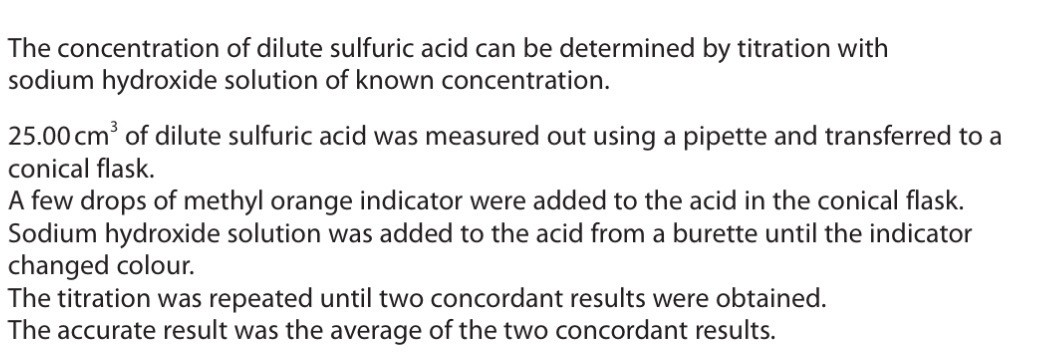
Describe the colour change seen at the end points of this titration.
Red to yellow.
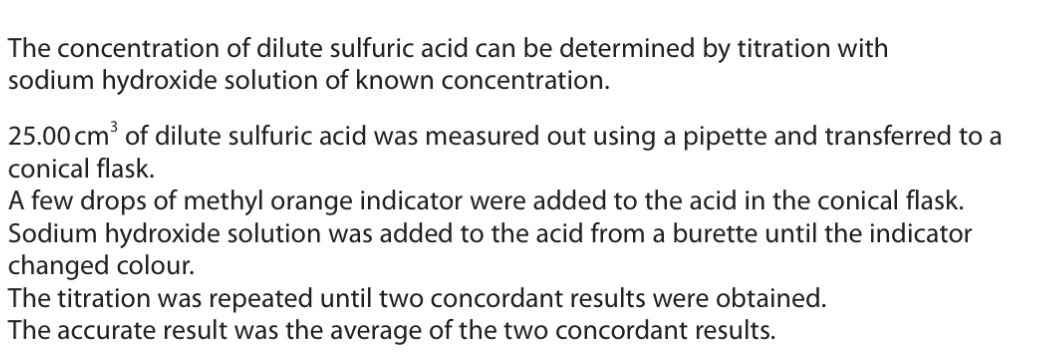
Explain two detail details that could be added to this method to ensure an accurate result is obtained.
Use a white tile to make it easier to see exactly when the colour change of indicator takes place.
Wash inside burette/pipette with appropriate solution before titration to ensure they are not contaminated.
Acid X has a pH of 1. What can be said about the concentration of hydrogen ions in acid X?
High concentration of hydrogen ions, making it a strong acid.
Alkali X has a pH of 8.5. What can be said about the concentration of hydroxide ions in alkali X?
Low concentration of hydroxide ions, making it a weak alkali.
The higher the concentration of hydrogen ions in a solution, the ____ the pH.
Lower.
The higher the concentration of hydorxide ions in a solution, the ____ the pH.
Higher.
What is the difference between strong and weak acids?
Strong acids ionise/dissociate completely in aqueous solutions whereas weak acids only partially ionise/dissociate in aqueous solutions.
Weak acids have fewer hydrogen ions/lower concentration of hydrogen ions than strong acids.
An acid completely dissociates in water. How can this acid be described?
Strong acid.
An acid only partially dissociates in water. How can this acid be described?
Weak acid.
Will a strong or weak acid of equal concentrations have more hydrogen ions in a solution?
Strong.
Strong acids have a pH between ___.
0-3.
Weak acids have a pH between ___.
4-6.
What does the ⇌ symbol indicate in the dissociation of an acid?
The acid is weak because it only partially dissociates.
Give examples of strong acids.
Hydrochloric acid, nitric acid, sulphuric acid.
Give examples of weak acids.
Ethanoic acid, citric acid, carbonic acid.
Do strong or weak acids have reversible reactions?
Weak acids.
What is the difference between a dilute and concentrated solution?
Dilute solution contains a small amount of solute in a given volume of solution whereas a concentrated solution contains a large amount of solute in a given volume of solution.
What is a concentrated solution?
Contains a large amount of solute in a given volume of solution.
What is a dilute solution?
Contains a small amount of solute in a given volume of solution
What is the difference between a dilute and concentrated acid?
Dilute acids contain a small amount of acid in a given volume of solution whereas concentrated acids contain a large amount of acid in a given volume of solution
If p H decreases by one unit, what happens to the concentration hydrogen ions?
Increases by a factor of ten.
If p H increases by one unit, what happens to the concentration hydrogen ions?
Decreases by a factor of ten.
How many times greater is the concentration of hydrogen ions in a solution of pH 4 and pH 6?
100 times.
If a hydrogen ion concentration in a solution of pH 5 increases by a factor 1000, what is the new pH?
pH 2.
What is the pH of distilled water?
pH 7.
What is a base?
A substance that can neutralise an acid to form a salt and water.
What type of base is an alkali?
Soluble base.
What is a name for soluble bases?
Alkalis.
Alkalis are insoluble bases. True or false?
False.
Alkalis are soluble bases. True or false?
True.
Are metal oxide soluble or insoluble bases?
Insoluble.
What are the common forms of bases?
Oxides, hydroxides or carbonates of metals.
Which substances can act as bases in acid base reactions?
Metal oxides, hydroxides and carbonates.
Why are metal oxides normally bases rather than alkalis?
Metal oxides are normally insoluble whereas alkalis are soluble.
Do all metals react with dilute acids?
No only those above hydrogen in the reactivity series.
Only metals above ____ in the reactivity series react with dilute acids.
Hydrogen.
State the reaction that occurs between a base and acid.
Base + Acid → Salt + Water.
What are the products when an acid reacts with a base?
Salt + Water.
State the reaction that occurs between a metal and acid.
Metal + Acid → Salt + Hydrogen.
What are the products when an acid reacts with a metal?
Salt + Hydrogen.
State the reaction that occurs between a metal carbonate and acid.
Metal Carbonate + Acid → Salt + Water + Carbon Dioxide.
What are the products when an acid reacts with a metal cabonate?
Salt + Water + Carbon Dioxide.
Effervescence is released when acid reacts with what? Why?
Acid reacts with metal carbonate because it forms carbon dioxide.
Why is effervescence produced when an acid reacts with metal carbonate?
They produce carbon dioxide when they react.
State the reaction that occurs between a metal oxide and acid.
Metal Oxide + Acid → Salt + Water.
What are the products when an acid reacts with a metal oxide?
Salt + Water.
State the reaction that occurs between a metal hydroxide and acid.
Metal Hydroxide + Acid → Salt + Water.
What are the products when an acid reacts with a metal oxide?
Salt + Water.
What is a neutralisation reaction?
A reaction that occurs when an acid reacts with a base to form salt and water.
What is the ionic equation for a neutralisation reaction?
H⁺(aq) + OH⁻(aq) → H2O(l).
Which salt does hydrochloric acid form?
Chloride.
Which salt does sulfuric acid form?
Sulfate.
Which salt does nitric acid form?
Nitrate.
Which products are formed when sodium hydroxide reacts with hydrochloric acid?
Sodium chloride + Water.
Which salt is formed when magnesium reacts with sulfuric acid?
Magnesium sulfate.
Which salt is formed when zinc oxide reacts with nitric acid?
Zinc nitrate.
Which salt is formed when calcium carbonate reacts with hydorchloric acid?
Calcium chloride.
Write the word equation for when sodium carbonate and sulfuric acid react.
sodium carbonate + sulfuric acid ⟶ sodium sulfate + water + carbon dioxide
What happens when ammonia reacts with water?
Hydroxide ions form.
Are aqueous ammonia and ammonium the same thing?
Yes.
Aqueous ammonia is the same as ____.
Ammonium.
What is the chemical test for hydrogen?
Hold a lit burning splint at the open end of a test tube containing a gas. If hydrogen is present, it burns with a squeaky pop released.
In a test from hydrogen, what happens if hydrogen is present?
A squeaky pop is released.
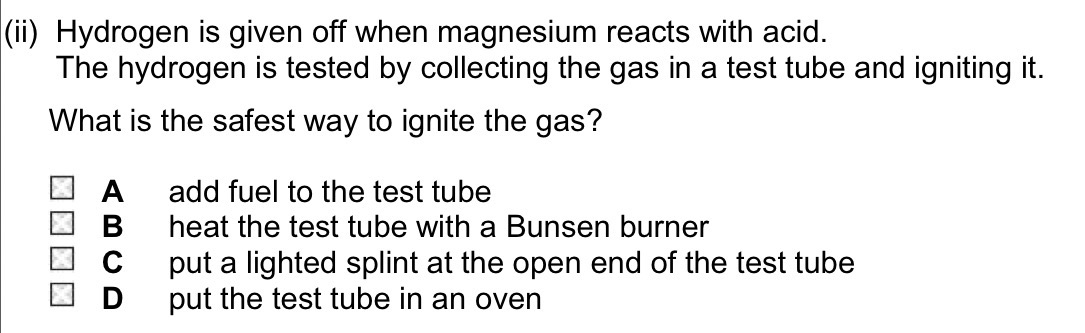
Pick A, B, C and D.
C.
What is the chemical name for limewater?
Calcium hydroxide.
What is a solution of sodium hydroxide called?
Limewater.
What is the test for carbon dioxide?
Bubble carbon dioxide through an aqueous solution of calcium hydroxide (limewater). If carbon dioxide is present, lime water turns to cloudy/milky.
In a test for carbon dioxide, what happens if carbon dioxide is present?
Lime water turns to cloudy/milky.
Why is it difficult to identify hydrogen and carbon dioxide gas?
They’re colourless and odourless.