Sensation & Perception Ap Psych
 Multiple Choice & FRQ
 Call Kai
1/63

Earn XP
Description and Tags
64 Terms
Synesthesia
where stimulating one sense automatically triggers an experience in another sense. (tasting color)
Transduction
The transformation of stimulus energy to electrochemical energy of neural impulses (except smell)
Perception
The mental process of interpreting sensory signals
Bottom-Up Processing
Involves starting with an incoming stimulus and working upwards until a representation of the object is formed in our minds

Top-Down Processing
Form our perceptions starting with a larger object, concept, or idea before working our way toward more detailed information
PROSOPAGNOSIA
FACE BLINDNESS
PEOPLE EXPERIENCE FUNCTIONAL SENSATION BUT INCOMPLETE PERCEPTION
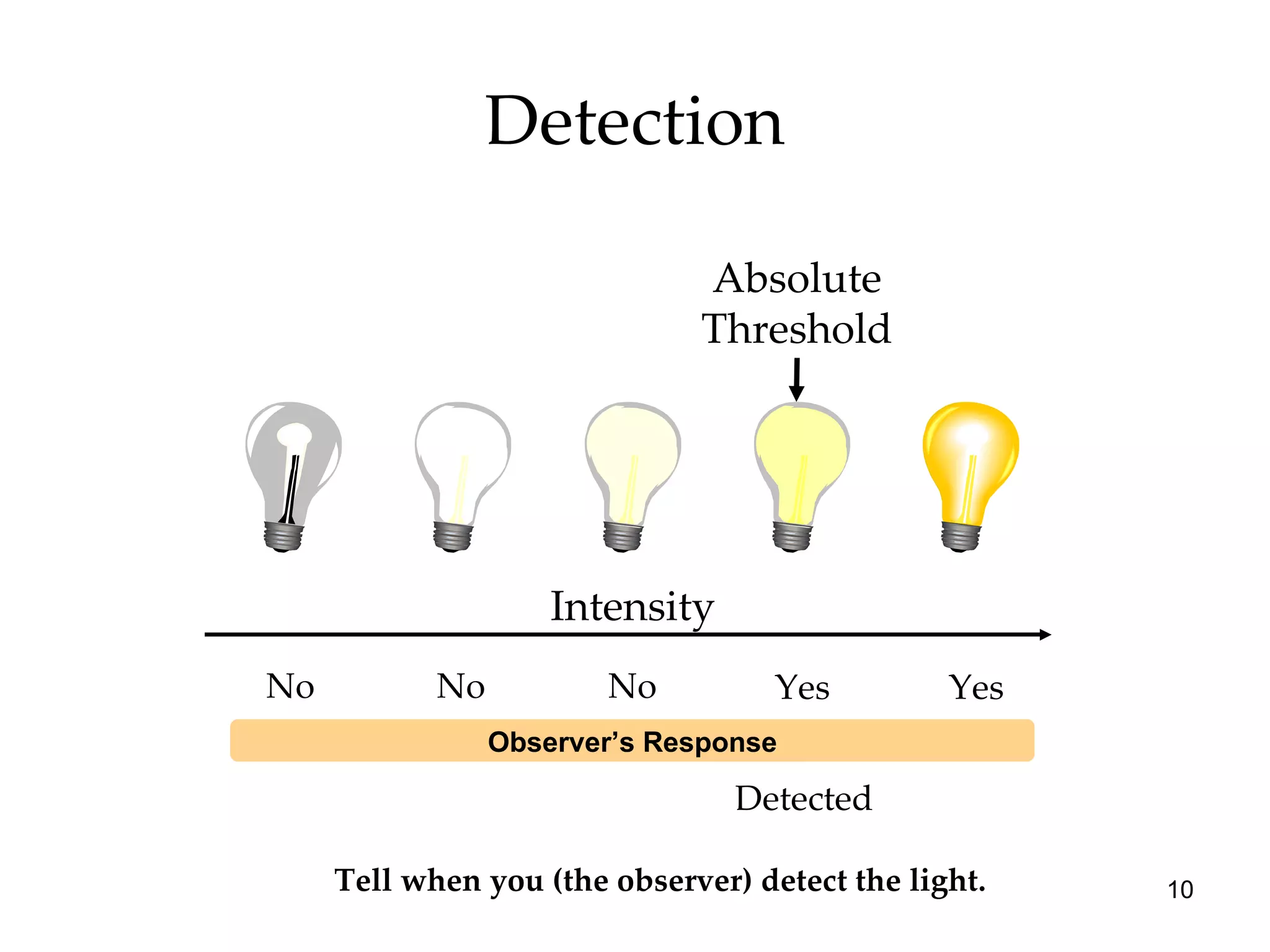
Absolute Threshold
Minimum stimulation needed to detect a particular stimulus 50% of the time.(Point something becomes noticeable)
Signal Detection Theory
theory predicting how and when we detect the presence of a faint (weak) stimulus (signal) amid background stimulation (noise)

SDT Matrix
The observer decides whether she hears the tone or not, based on the signal being present or not. This translates into four outcomes.
COCKTAIL PARTY EFFECT
is the brain's ability to focus on a single speaker or conversation while filtering out a wide range of competing background noise
Subliminal Sensation
When stimuli are below one’s absolute threshold for conscious awareness (EX: Backwards Music)
Difference Threshold “Just Noticeable Difference (JND)
The amount something must be changed in order for a difference to be noticeable, or detectable at least half the time
Weber’s Law
The principle that, to be perceived as different, two stimuli must differ by a constant minimum percentage (rather than a constant amount)
Sensory Adaptation
Reduction in sensitivity to a stimulus after constant exposure to it
Selective Attention
We center our attention on certain important elements of our environment while other things blend into the background or pass us by completely unnoticed
Inattentional Blindness
When our focus is directed at one stimulus (relevant to us), leaving us blind to other stimuli

Change Blindness
The tendency people have to miss changes in their immediate visual environment
Transduction
In sensation, the transformation of stimulus energy into neural impulses
Phototransduction
Conversion of light energy into neural impulses that the brain can understand

Cornea
Transparent tissue where light enters the eye.

Iris
Muscle that expands and contracts to change the size of the opening (pupil) for light.

Lens
Focuses and adjusts the light rays on the retina.

Retina
Contains sensory receptors (rods and cones) that process visual information and sends it to the brain.
Optic Nerve
Carries neural impulses from the eye to the brain.
Blind Spot
Point where the optic nerve leaves the eye because there are no receptor cells located there.
Fovea
Central point in the retina around which the eye’s cones cluster
Rods
They allow us to see in black and white
Cones
Provide color vision
Bipolar & Ganglion Cells
Bipolar cells receive messages from photoreceptors and transmit them to ganglion cells, which are for the optic nerve.
Vision Pathway
Can I pee like really fast before going out to vote
Trichromatic theory
Based on behavioral experiments, Helmholtz suggested that the retina should contain three receptors that are sensitive to red, blue and green colors.
Afterimage
Describes the continuation of a visual sensation after removal of the stimulus

Opponent Process Theory
Hering proposed that we process four primary colors combined in pairs of red-green, blue-yellow, and black-white.
Color Constancy
Color of an object remains the same under different illuminations. However, when context changes the color of an object may look different.
Shape Detection
Specific combinations of temporal lobe activity occur as people look at shoes, faces, chairs and houses.
Feature Detection
Nerve cells in the visual cortex respond to specific features, such as edges, angles, and movement.
Parallel Processing
The ability of the brain to do many things at once. For visual processing, color, motion, shape, and depth are processed simultaneously
Acoustical transduction
Conversion of sound waves into neural impulses in the hair cells of the inner ear.
Amplitude
Height of the sound wave (greater compression), the psychological quality of loudness
Frequency
The number of wavelength cycles in a unit of time, measured using hertz, determines the highness or lowness of the sound (Pitch)
Outer Ear
Collects sounds.
Middle Ear:
Chamber between eardrum and cochlea containing three tiny bones (hammer, anvil, stirrup) that concentrate the vibrations of the eardrum on the cochlea’s oval window. (HAS)
Inner Ear
Innermost part of the ear, containing the cochlea, vestibular sacs, semicircular canals (CVS)
Cochlea
Coiled, bony, fluid-filled tube in the inner ear that transforms sound vibrations to auditory signals
Place Theory
suggests that sound frequencies stimulate the basilar membrane at specific places resulting in perceived pitch.
Frequency Theory
In hearing, the frequency of the auditory nerve impulses corresponds to the frequency of a tone, which allows us to detect its pitch
Conduction Hearing Loss
Hearing loss caused by structural damage
Two-point threshold
the least distance by which two rods touching the skin must be separated before the person will report that there are two rods, not one, on 50% of occasions
Gate-Control Theory of Pain
There is a “gate” in the spinal cord that switches pain on and off, the more neurons fire in response to pain the more intense the pain
endorphins
our natural painkillers
Kinesthesis
the system for sensing the position and movement of individual body parts
taste

Sensory Interaction
When one sense affects another sense
Flavor
Depends on its odor, texture, temperature as well as its taste
Sweetness
tip of tongue
Bitterness
back of tongue
Sourness
along sides of the tongue
Saltiness
overlaps the areas sensitive to sweetness and sourness
Olfaction
smell
Gestalt Psychologists
Emphasized the brain’s tendency to integrate pieces of information into meaningful wholes
Figure-Ground Pattern

Depth Perception

Interposition

Relative Size
Perception of size is altered by the relative sizes of other objects around us
