Lecture 27: Biofilms and Chronic Bacterial Infections
 Call Kai
 Learn
Learn Practice Test
 Spaced Repetition
 Match
Match Flashcards
 Knowt Play
1/119

There's no tags or description
Looks like no tags are added yet.
Name | Mastery | Learn | Test | Matching | Spaced | Call with Kai |
|---|
No analytics yet
Send a link to your students to track their progress
120 Terms
Biofilms are _____ of bacteria attached to a _____ and or _____ and are encased in a self produced _____
aggregates; surface; each other; matrix
a wide variety of _____ are caused by bacterial biofilms
infections/diseases
what are two main bacterial infections that we talk about in this class?
bacterial endocarditis and cystic fibrosis
Bacterial endocarditis can be caused by a range of bacterial _____, but they are all caused by gram _____ bacteria
species; positive
what are two common bacteria that cause bacterial endocarditis?
streptococcus and staphylococcus
colonization of bacterial causing bacterial endocarditis occurs at an _____
injured heart valve
where does the bacterial come from that colonizes the heart valve?
low levels in blood
rabbit infection model studies have show that high levels of _____ can be delivered to _____, but will fail to _____ the biofilm bacteria
antibiotics; vegetations; kill
True or False: antibiotics can’t kill biofilm bacteria because it can’t get to the bacteria
FALSE: it can get there, just can’t kill them
why are biofilms untreatable?
can’t be cleared by immune system or antibiotics
the primary infection lesion in endocarditis is a complex _____ composed of both _____ and _____ components located on a cardiac valve
biofilm; bacterial; host
what are the three reasons why biofilms are traditionally more resistant to antimicrobial agents than planktonic cells?
EPS matrix = diffusion barrier, slow growing subpopulation, biofilm phenotype
what are planktonic cells?
free living cell (unattached from biofilm)
antibiotics are not as effective against _____ bacteria
slow growing
what is a “biofilm phenotype”
traits to support biofilm growth and maintenance (special genes are expressed)
how does the “biofilm phenotype” increase antimicrobial resistance?
genes expressed for biofilms may be helpful for inactivating/removing antibiotics (ex. efflux pumps)
the biofilm state is _____ resistant to antibiotics
inherently
when testing for slow growing populations; a colony was spotted on top of a _____ on an agar plate. Another _____ was place _____ the colony followed by an _____
filter; filter; above; absorption disk
after growing the colony on a filter on a normal agar plate, the colony was moved to a _____ plate
antibiotic
after the colony was moved to an antibiotic plate, researchers measured the levels of _____ that moved through the colony
antibiotics
what was the absorption disk for?
to absorb the antibiotics at the top → proves that antibiotics were able to fully penetrate the colony!
researchers also measured the concentration of _____ at various _____ throughout the colony
oxygen; depths
research found that all you reach greater depths, the concentration of oxygen _____
decreases
the anaerobic portions of the biofilm metabolically _____
inactive
research found that all you reach greater depths, the antibiotics were increasingly _____ effective
LESS
Why can’t chronic CF airway infections be eliminated by the immune system or antibiotics?
it is a biofilm
existing evidence support the involvement of _____ in chronic CF airway infections.
biofilm infection
biolfikms are a surface-attached _____
microbial community
_____ is the primary cause of morbidity and mortality in CF
Pseudomonas aeruginosa
colonization of the host occurs _____ in lfie
early
CF is an _____ disease
autosomal recessive
in order for an individual to have CF, they must have _____ copy/ies of the CF gene
TWO
if an individual has one normal gene and one CF gene, will they have CF?
NO → carrier (its is recessive!)
does the autosomal disease occur more in females or males?
neither → equal!
what are the chances that child will develop CF if each parent is a carrier?
25%
what is the gene that causes CF called?
CFTR
CFTR encodes for an _____ found in _____ cells
ion transporter; epithelial
CFTR is a _____ transporter found in the _____ of _____ cells
chloride; membrane; epithelial
in normal cells, the CTFR protein allows the _____ of _____ from the cell
RELEASE; Cl
those with CF will have a _____ version of CFTR which causes a _____
nonfunctional; buildup of ions
True or False: Cystic fibrosis only causes symptoms in the lungs and airways
FALSE: All epithelial cells are effective → problems all over the body
what two issues are associated with the airways in CF patients?
infection and inflammation
what causes the MOST problems for patients with CF? Why?
airway inflammation → big immune response causes collateral damage to body
CF patients have a large _____ against the _____ in their airways. This causes damage to the _____ in the process, eventually leading to a gradual deterioration of _____
immune response; bacteria; body; lung function
what are 5 other locations where CF patients often experience adverse symptoms?
liver, pancreas, intestine, reproductive tract, sweat glands
CF lung disease is a _____ defect
local host defense
_____ is a hallmark of CF lung disease
bacterial infection of the airways
other organs as well as _____ non-CF lungs are _____ infected with bacteria causing CF lung disease
transplanted; NOT
_____ of the airway infection is the most effective therapy for CF lung disease
antibiotic treatment
antibiotic treatment, while it will NOT _____ the bacteria, it WILL _____
eliminate; reduce its numbers
airway disease in cystic fibrosis is a _____ bacterial infection with many organisms (particularly _____ and _____) as well as lots of _____
chronic; P. auroginosa, S. aureus; inflammation
the lungs of patients with airway disease in CF are flooded with _____ indicating _____
neutrophils; inflammation
newborn lungs are _____
sterile
early in life, the CF patients acquires a bacterial strain from the _____. Over time the strain will _____ to the body and increase its _____
environment; adapt; pathogenesis
after newborns are colonized, there is a _____ that causes _____ infection
host defense defect; intermittent
After intermittent infection _____ occurs which eventually leads to _____ colonization
bacterial adaption; permanent
P. aeruginosa is a gram _____, _____-shaped bacteria that is very _____ in nature
negative; rod; ubiquitous
True or False: P. aeruginosa is a primary pathogen
FALSE: its opportunistic!
P. aeruginosa is an _____ human pathogen that can cause both _____ AND _____ infections
opportunistic; acute; chronic
P. aeruginosa in also a pathogen to many _____, _____, and _____ (apart from humans)
plants; insects; nematodes
P. aeruginosa is a model organism for the study of _____ and _____
biofilms; quorum sensing
what is an example of P. aeruginosa causing ACUTE infection?
burn infection, pneumonia
what is an example of P. aeruginosa causing CHRONIC infection?
catheter infection
Chronic and acute infections are fundamentally _____
different
acute infections _____ and _____, but are also _____ susceptible to treatment
disseminate; invade; MORE
acute infections are caused by _____ bacteria, while chronic infections are caused by _____ bacteria
planktonic; biofilm
chronic infections are _____ and _____ but are also _____ susceptible to treatment
localized; persist; LESS
in healthy cells, the mucus layer is much _____, which _____ for cilia function
thinner; ALLOWS
_____ caused by difunctional ion channels results in impaired _____
dehydration; mucociliary clearance
in CF patients there is a _____ of mucus that _____ cilia function
buildup; PREVENTS
CF causes persistent mucus _____ by _____ cells, which creates a very _____ mucus layer
hyper secretion; goblet; thick
P. aeruginosa is able to _____ the thick mucus and initiate _____ formation
colonize; biofilm
Because many longitudinal isolates are _____, we know that P. aeruginosa _____ to the lung environment
clonal; adapts
what are the 4 main adaptions that P. aeruginosa makes to adapt to the lung environment?
loss of motility, loss of LPS O-antigen, alginate overproduction, amino acid auxotrophy
Why does P. aeruginosa loose its motility function when adapting to the CF lungs?
no need to swim in thick mucus
Alginate is a type of _____ produced by P. aeruginosa
EPS
P. aeruginosa colonies that produce Alg appear much _____ and more _____ than Alg- colonies on agar
larger; mucoid
what does amino acid auxotrophy mean?
the organisms CANNOT make amino acids
What is MucA?
antisigma factor that prevents alginate production
What is the sigma factor that turns ON Alginate production?
AlgU sigma
when a mutation occurs in mucA, this activates the _____ sigma factor and _____ alginate production gene expression
AlgU sigma; increases
a number of CF isolated exhibit the _____ phenotype
RSCV
the CF airways select for _____ variants
RSCV
RSCV variants have enhanced _____ and _____, reduced _____, and increased _____
biofilm formation; antibiotic resistance; motility; cyclic di-GMP
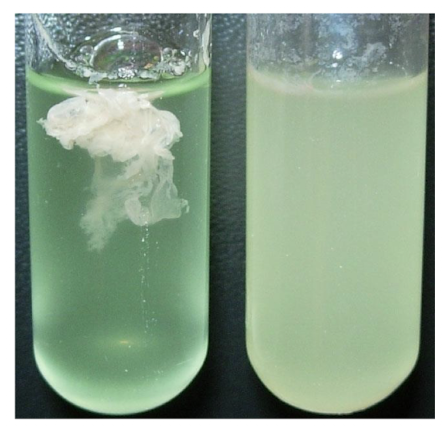
which of these organisms is an RSCV variant?
left
What causes the RSCV phenotype in P. aeruginosa?
overproduction of cyclic di-GMP
RSCV variants will _____ in liquid culture
auto aggregate
Cyclic-diGMP is involved in a switch to a _____ lifestyle
biofilm
Cyclic di-GMP is an _____ signaling molecule that affects _____
intracellular; surface attachment
what is the protein that MAKES cyclic-di-GMP
cyclase
what is the protein that BREAKS DOWN cyclic-di-GMP
phosphodiesterase
what is the active site domain of Cyclase?
GGDEF
what is the active site domain for phosphodiesterase?
EAL
Cyclase takes _____ and removes _____ to makes cyclic-di-GMP
2 GTPs; 2 PPi
Phosphodiesterases convert cyclic di-GMP into _____
2 GMP
Cyclases and Phosphodiesterases are sensitive to a number of _____ factors
environmental
in many species _____ cyclic-di-GMP is linked to increased _____
ELEVATED; cell surface adhesiveness (biofilm formation)
what are the 2 main loci that play a role in RSCV variant types?
pel and psl
what happens if you delete both a pel and psl loci from an RSCV variant?
no aggregation at all!
what happens if you remove EITHER pel or psl loci from an RSCV variant?
partial relief → some aggregation, but much less