Exam 3
 Call Kai
 Learn
Learn Practice Test
 Spaced Repetition
 Match
Match Flashcards
 Knowt Play
1/402

There's no tags or description
Looks like no tags are added yet.
Name | Mastery | Learn | Test | Matching | Spaced | Call with Kai |
|---|
No analytics yet
Send a link to your students to track their progress
403 Terms
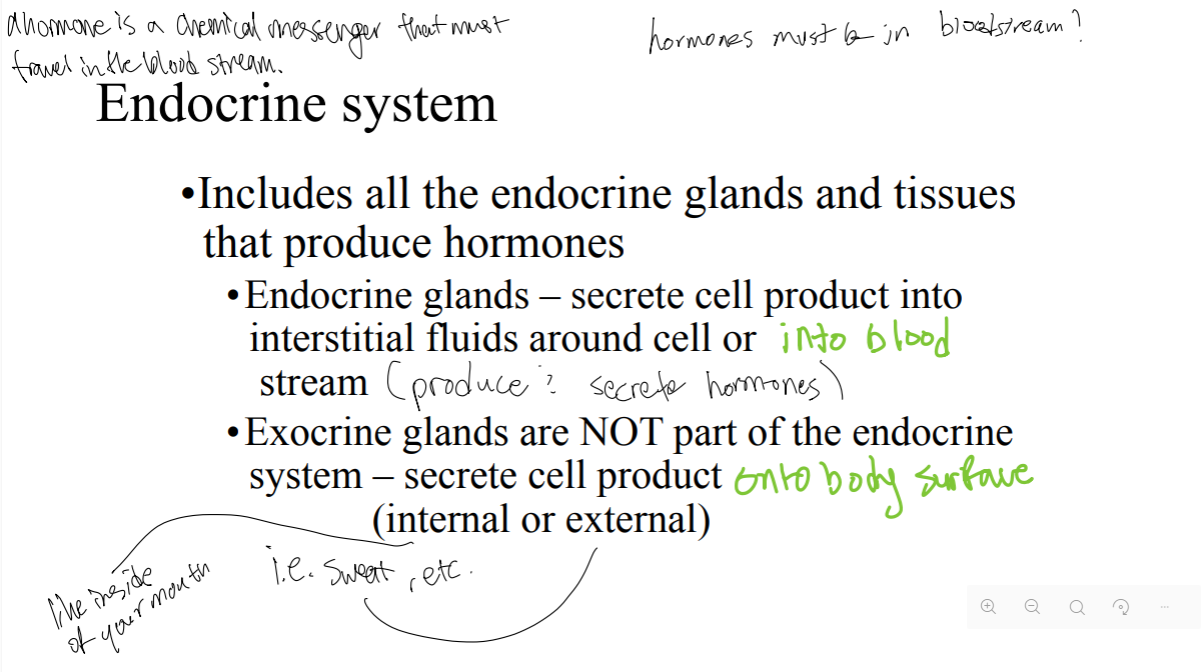
The endocrine system includes all the endocrine glands and tissues that produce ______.
hormones
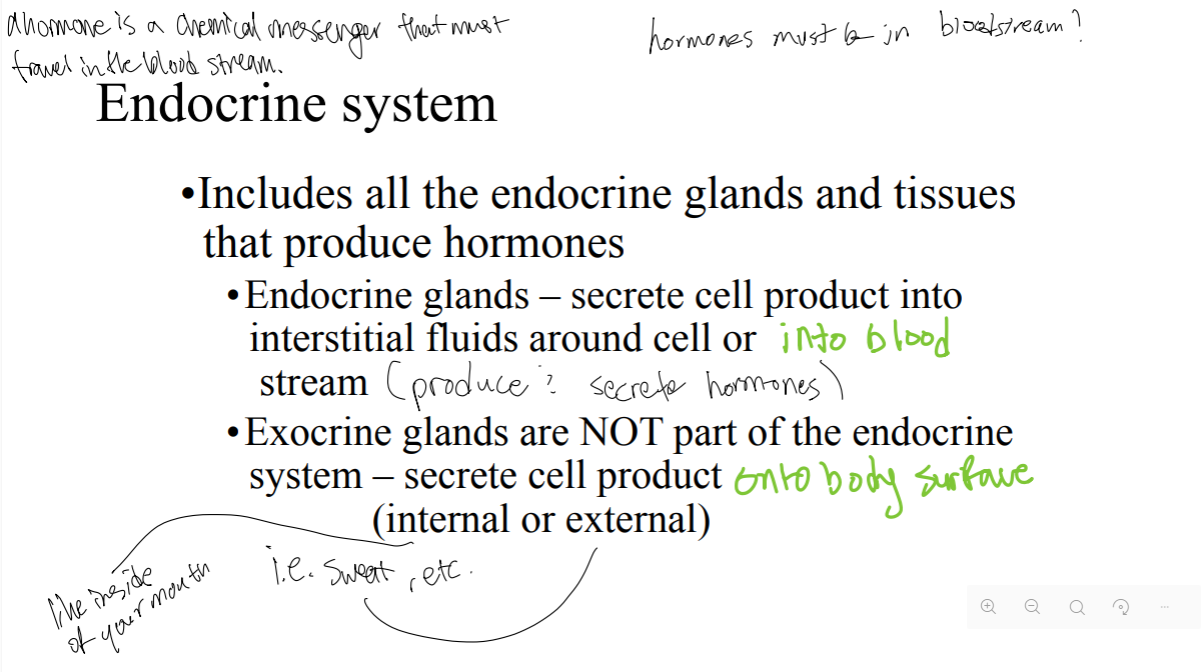
What is the difference between endocrine and exocrine glands?
Endocrine glands: Secrete cell product into interstitial fluids around cell or into the bloodstream
Exocrine glands: Not part of the endocrine system — secrete cell product onto body surface (internal or external).
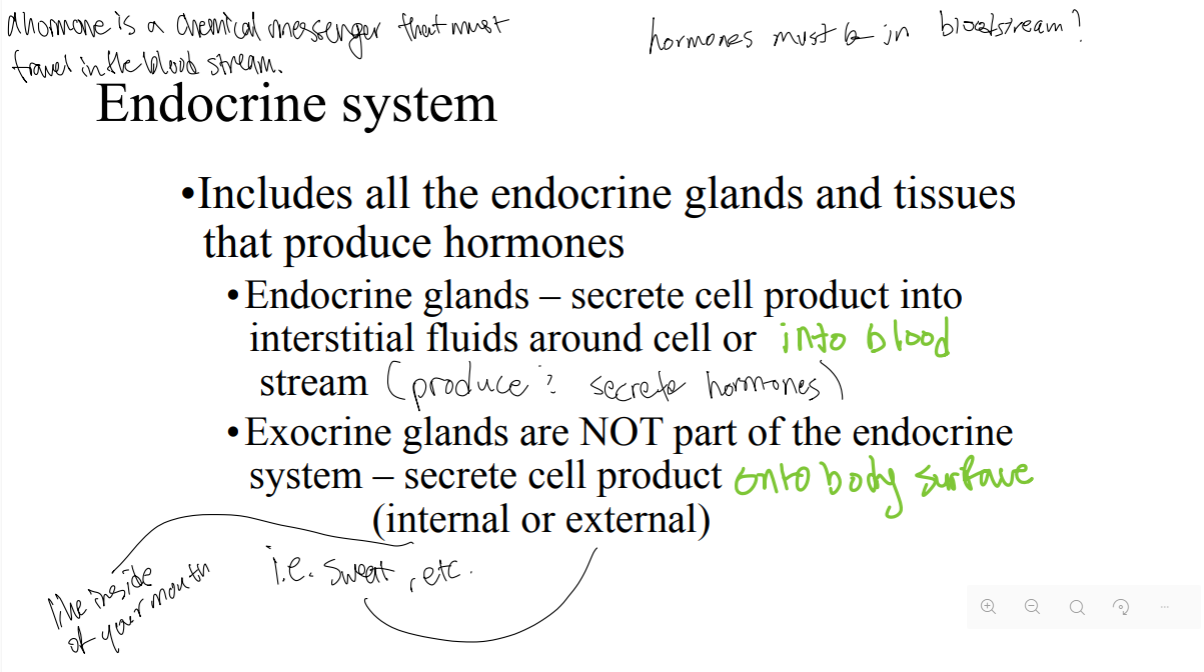
T/F: Exocrine glands are NOT apart of the endocrine system.
T
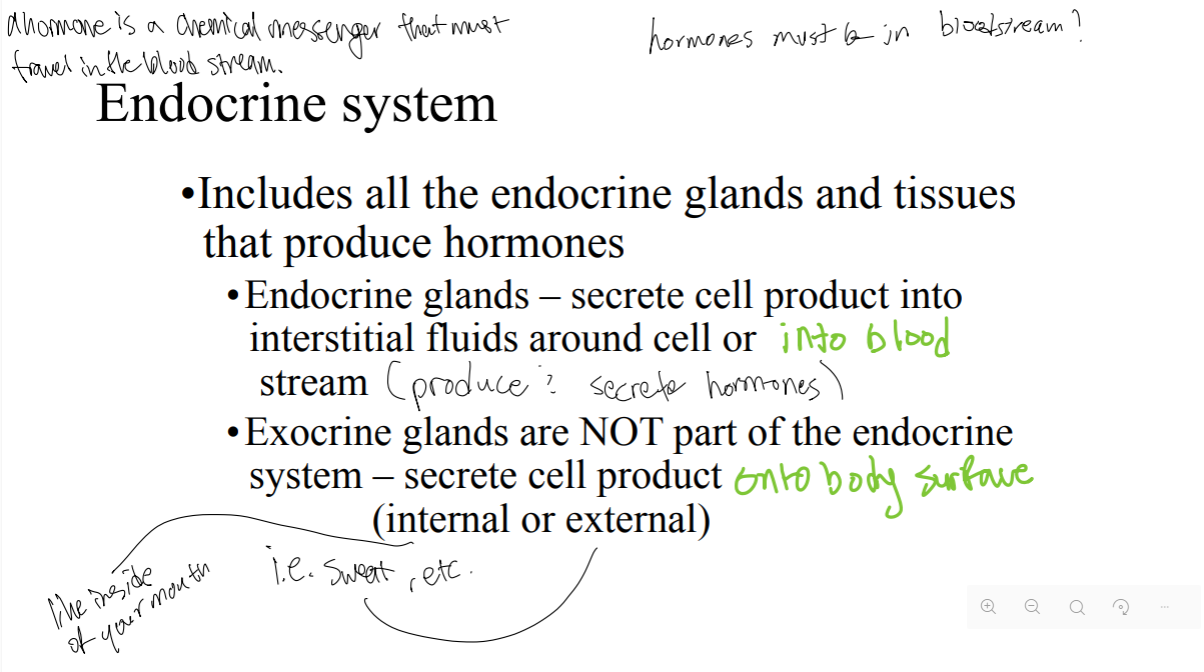
T/F: Exocrine glands are apart of the endocrine system.
F, they’re not.
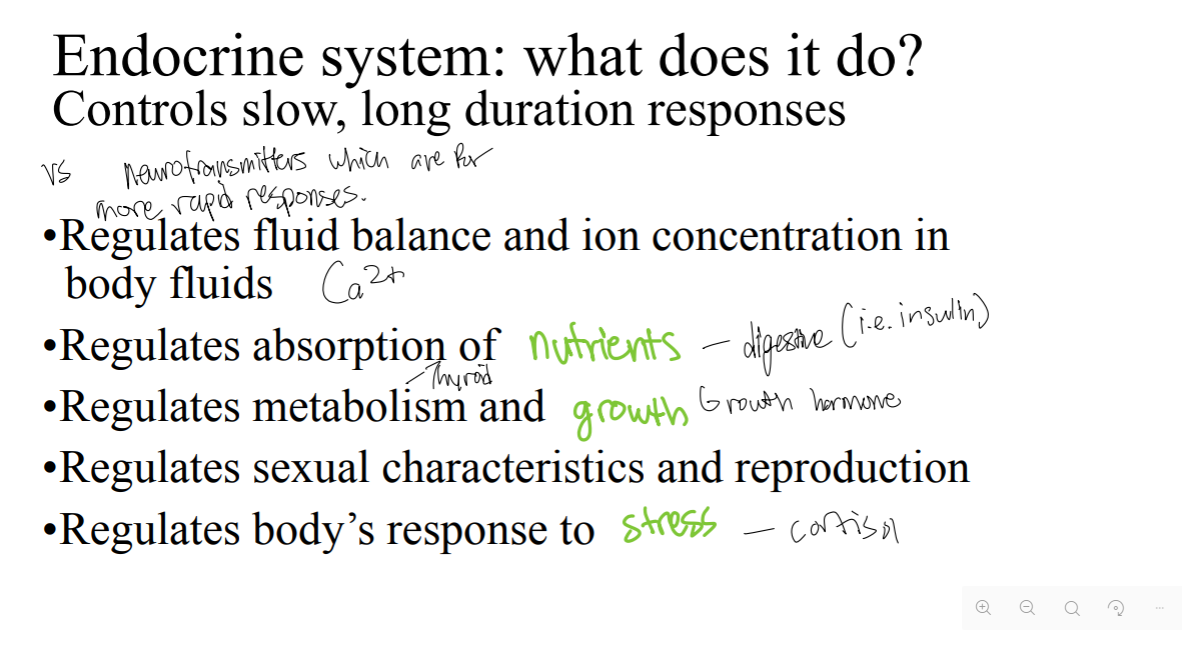
What does the endocrine system do and how does it compare to neurotransmitters?
Controls slow, long duration responses, versus neurotransmitters which are for more rapid responses!
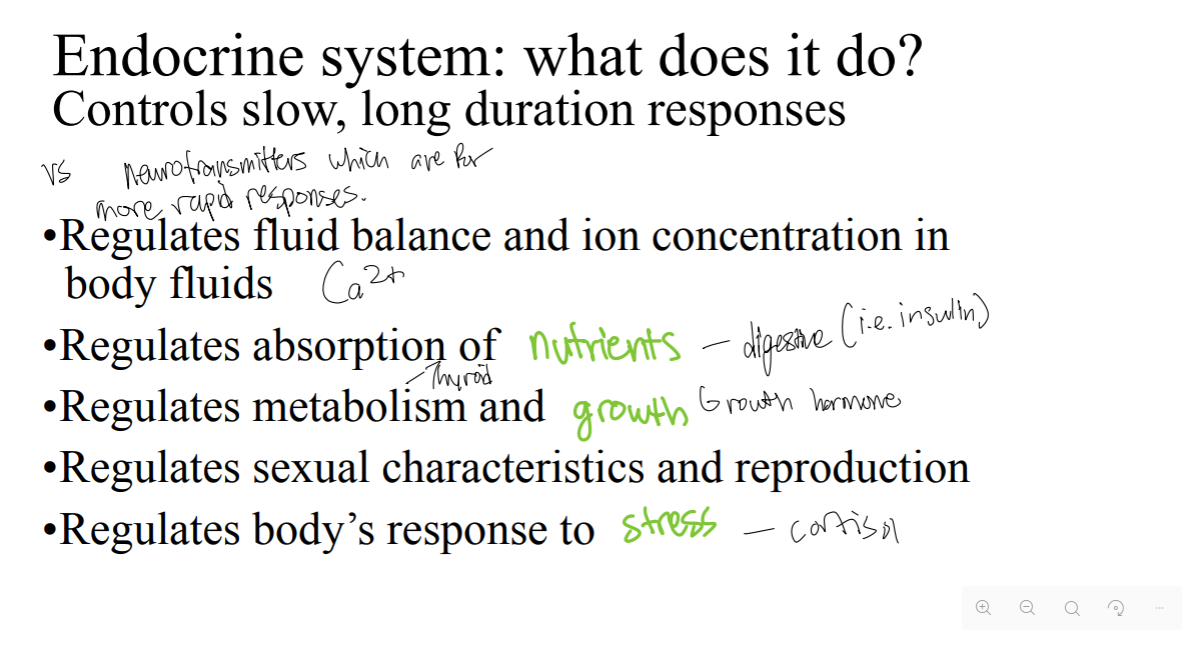
Roughly name the functions of the endocrine system, controlling slow, long duration responses.
Regulates fluid balance and ion concentration in body fluids (Ca2+)
Regulates absorption of nutrients, i.e. insulin
Regulates metabolism and growth like growth hormone
Regulates sexual characteristics and reproduction
Regulates body’s response to stress, like cortisol
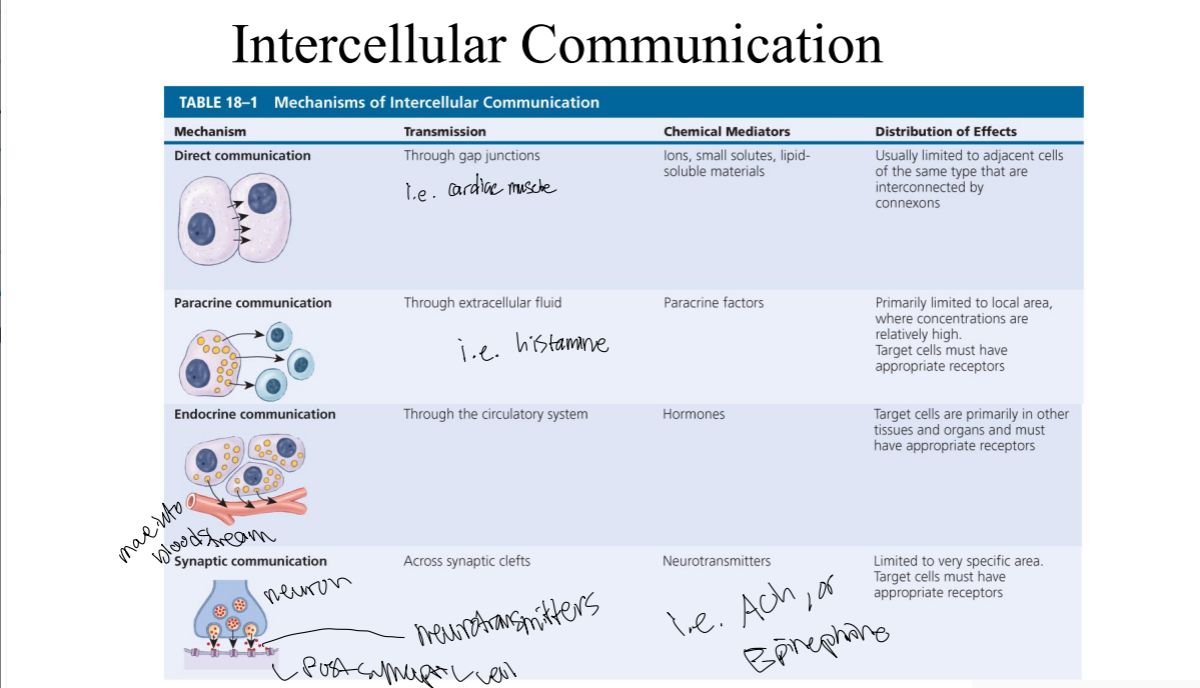
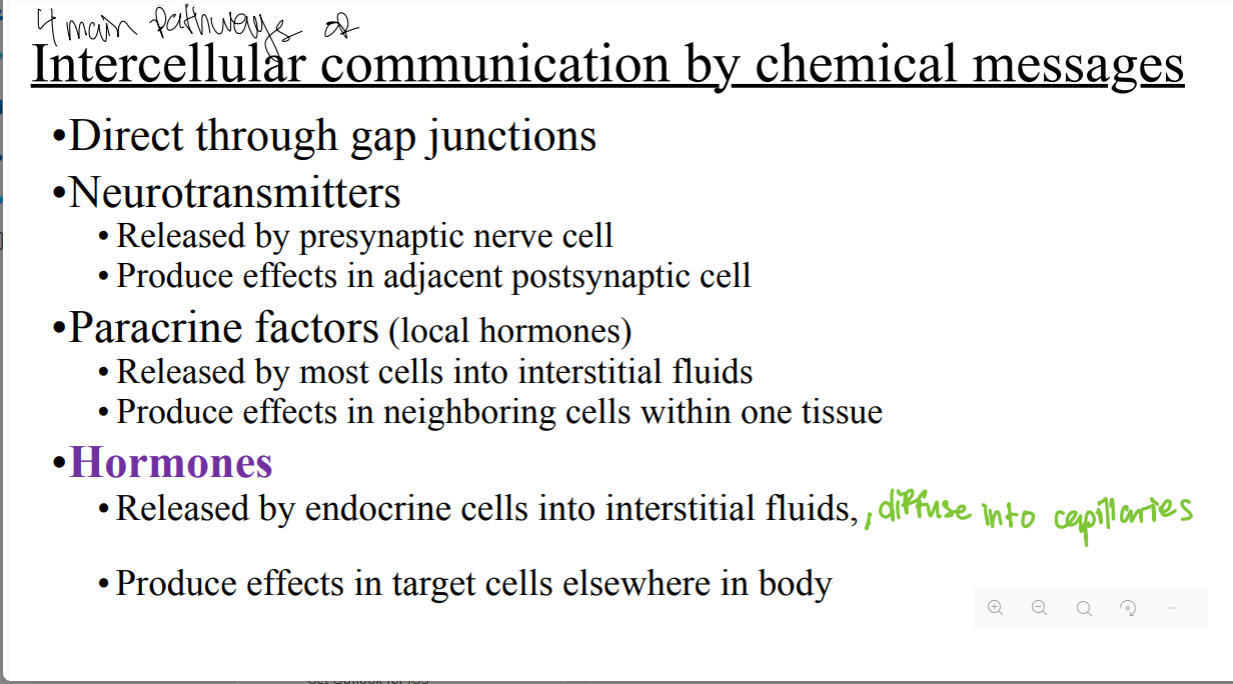
What are the 4 main pathways of intercellular communication by chemical messages?
Direct through gap junctions
Neurotransmitters
Released by presynaptic nerve cell
Produce effects in adjacent postsynaptic cell
Paracrine factors (local hormones)
Released by most cells into interstitial fluids
Produce effects in neighboring cells within one tissue
Hormones
Released by endocrine cells into interstitial fluids, diffuse into capillaries
Produce effects in target cells elsewhere in body
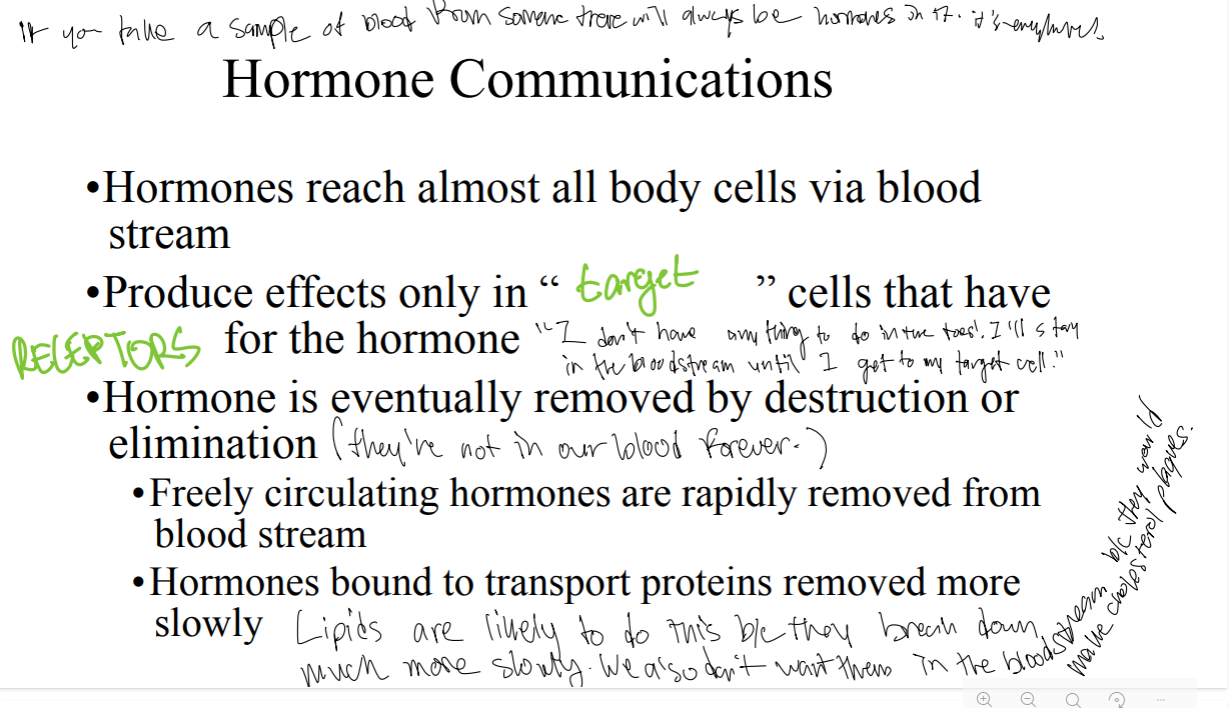
T/F: Hormones only reach certain body cells via blood stream.
F, hormones reach almost all body cells via blood stream
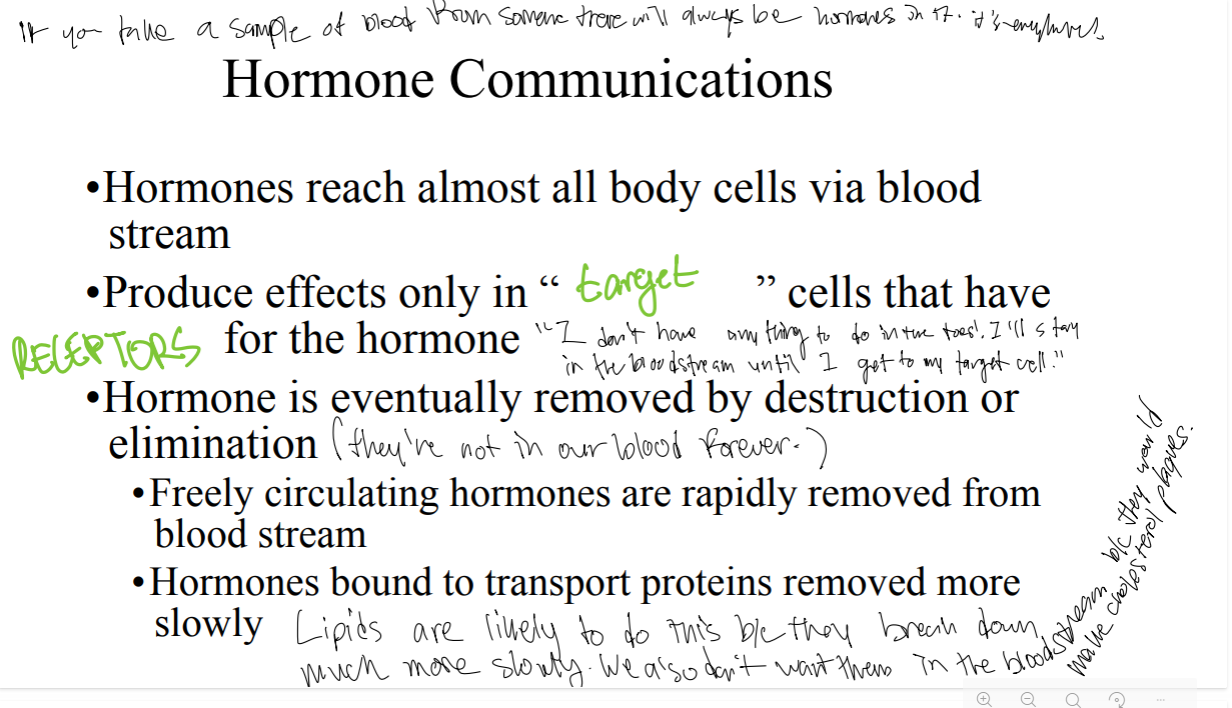
Hormones produce effects only in target cells that have ____ for the hormone.
receptors
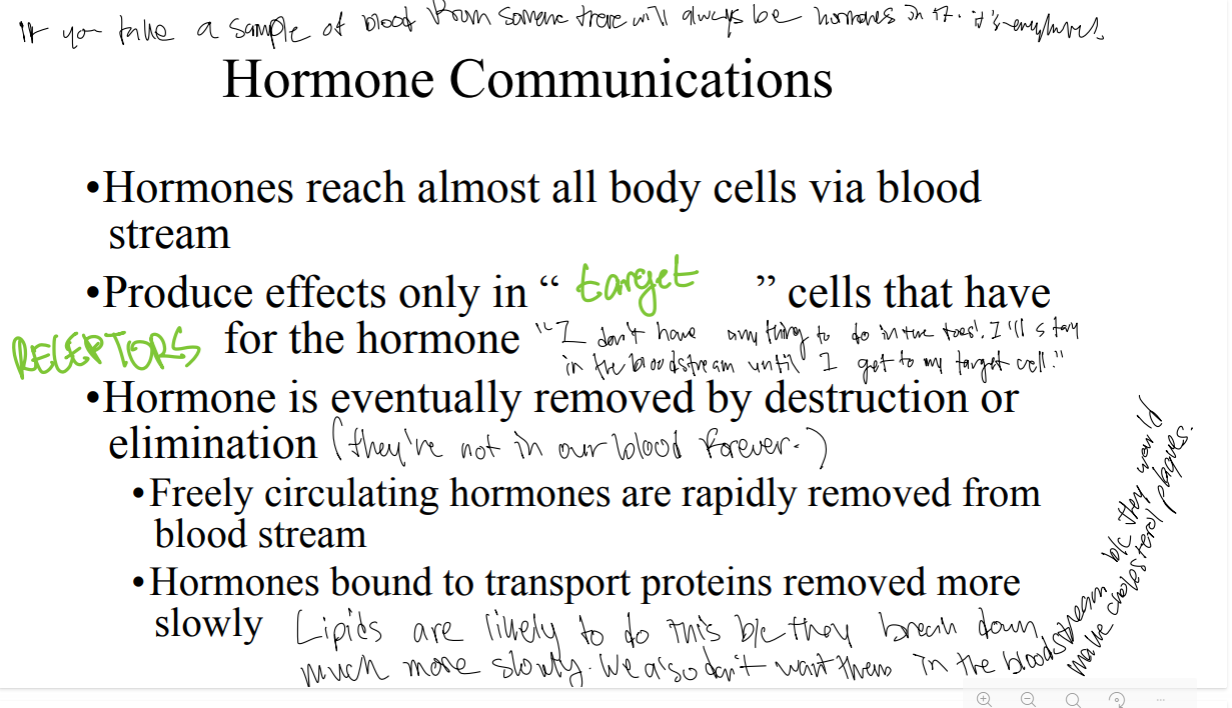
A hormone enters the bloodstream and says “I don’t have anything to do in the toes, I’m gonna stay in the bloodstream until I get to my target cell.” What principle of hormone communications is this describing?
Produce effects only in “target” cells that have receptors for the hormone.
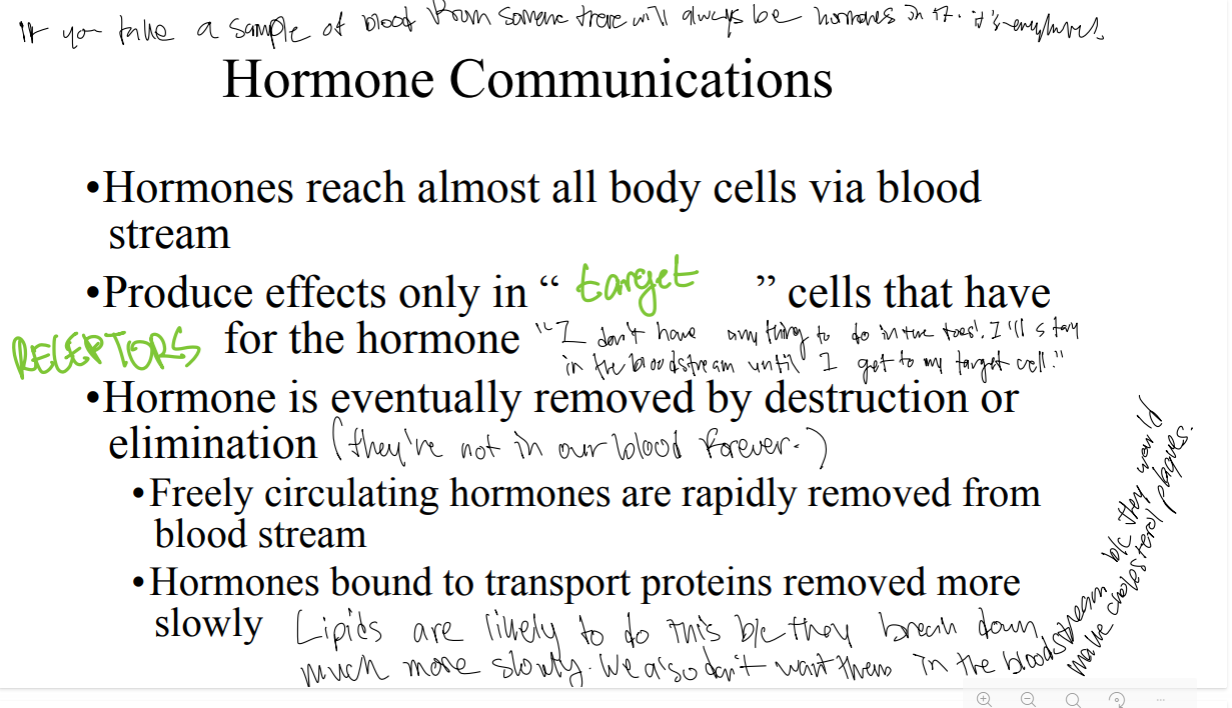
How are hormones usually removed in the blood stream?
Eventually removed by destruction or elimination (they’re not in our blood forever).
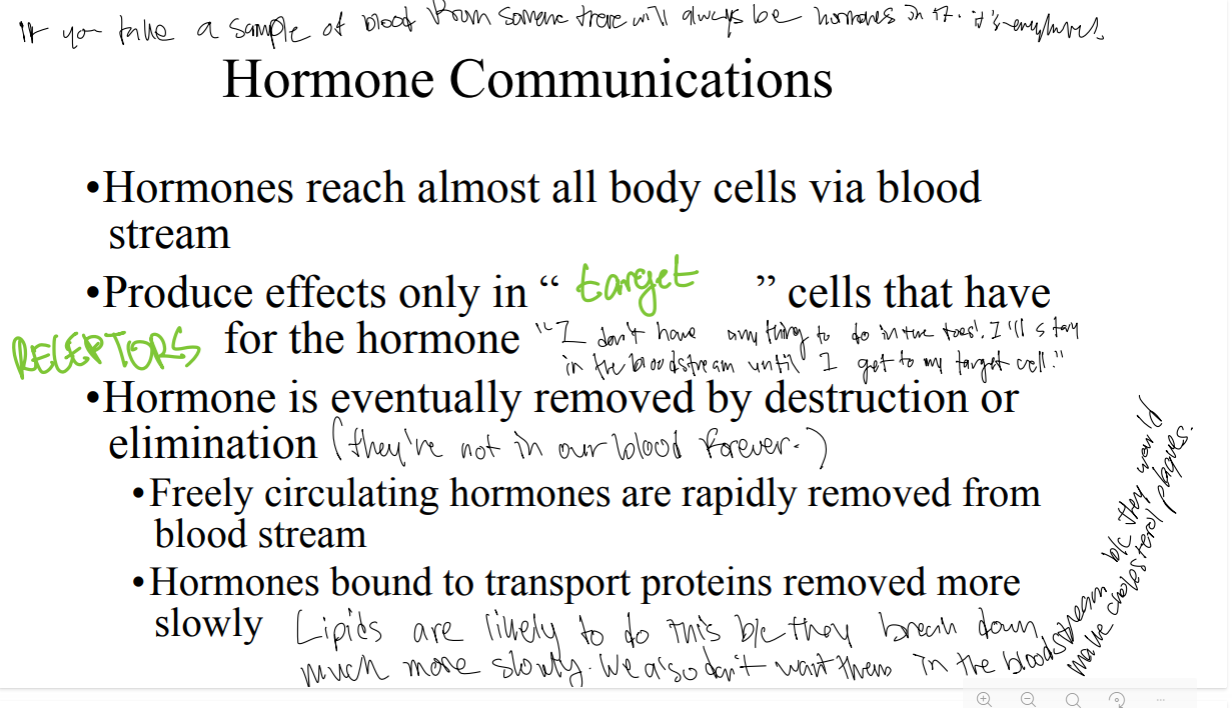
Hormones bound to transport proteins are removed more (quickly/slowly).
Slowly. Lipids are more likely to do this bc they break down much more slowly. We also don’t want them in the bloodstream bc they would make cholesterol plaques.
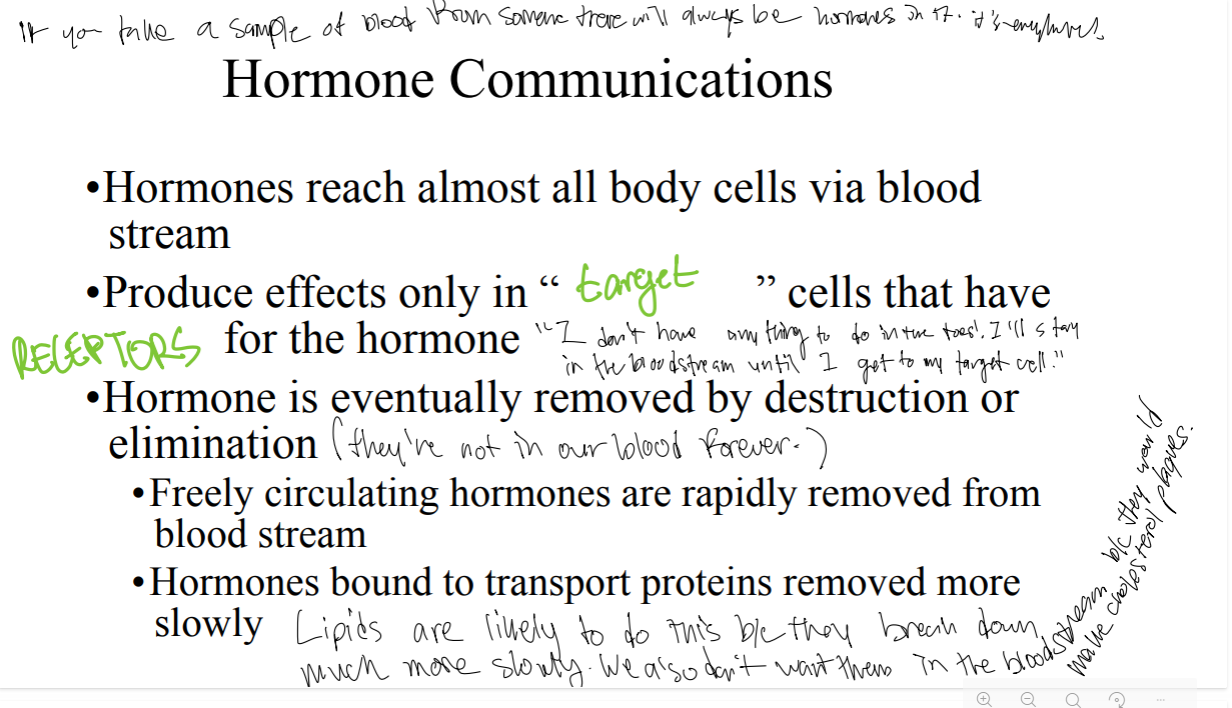
Why do lipid-based hormones get removed more slowly?
Bc hormones bound to transport proteins are removed more slowly and lipids are likely to do this bc they break down much more slowly. We also don’t want them in the bloodstream bc they would make cholesterol plaques.
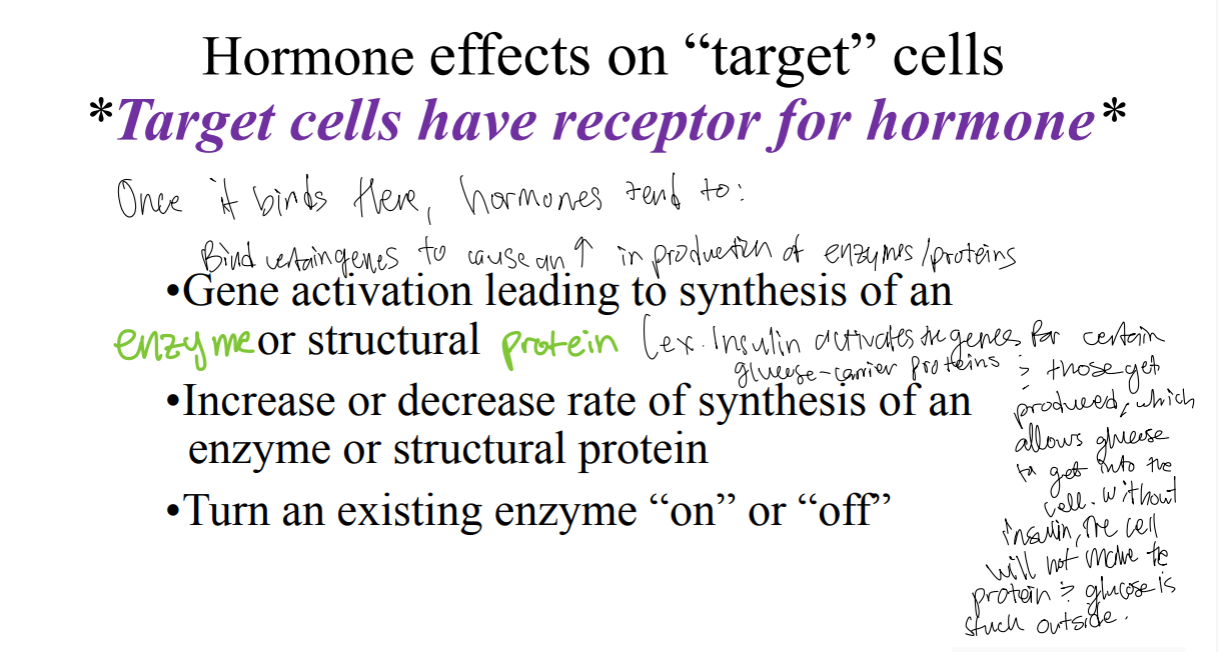
Once hormones bind to the target cell’s receptor for that hormone, what do the hormones tend to do?
Bind certain genes to cause an increase in production of enzymes/proteins (gene activation leading to synthesis of an enzyme or structural protein)
Increase or decrease rate of synthesis of an enzyme or structural protein
Turn an existing enzyme “on” or “off”
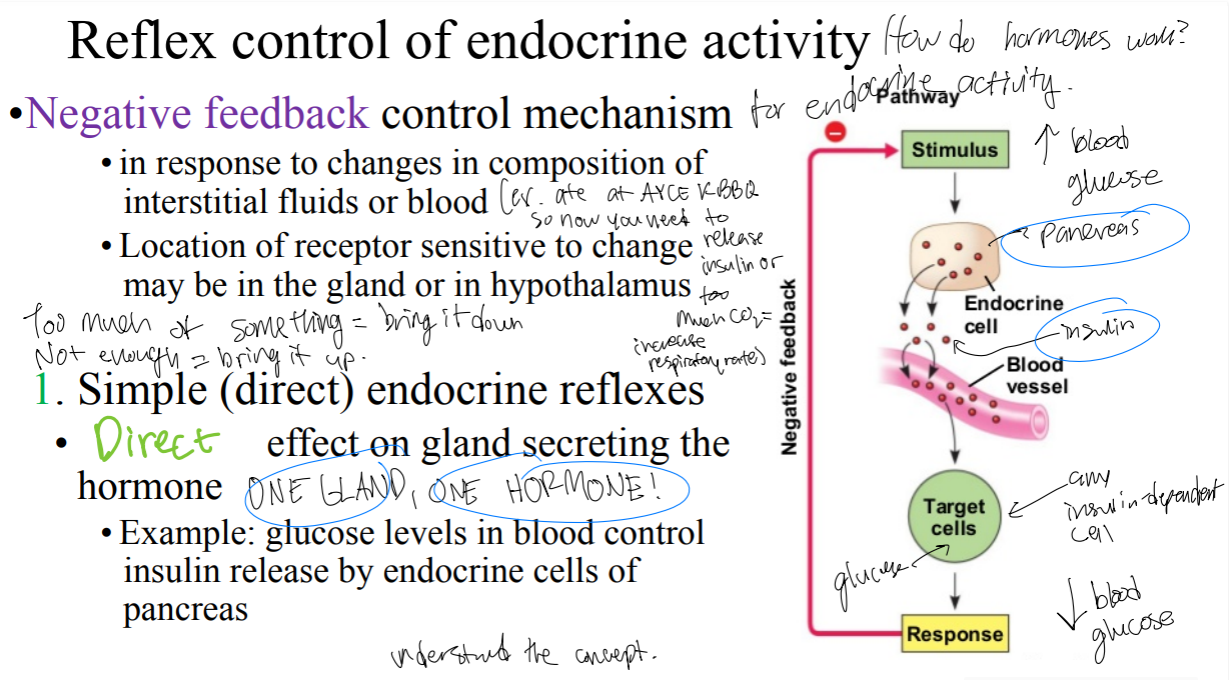
Endocrine activity has a negative feedback control mechanism. What does this entail?
control of endocrine activity are in response to changes in composition of interstitial fluids or blood
location of receptor sensitive to change may be in the gland or in hypothalamus
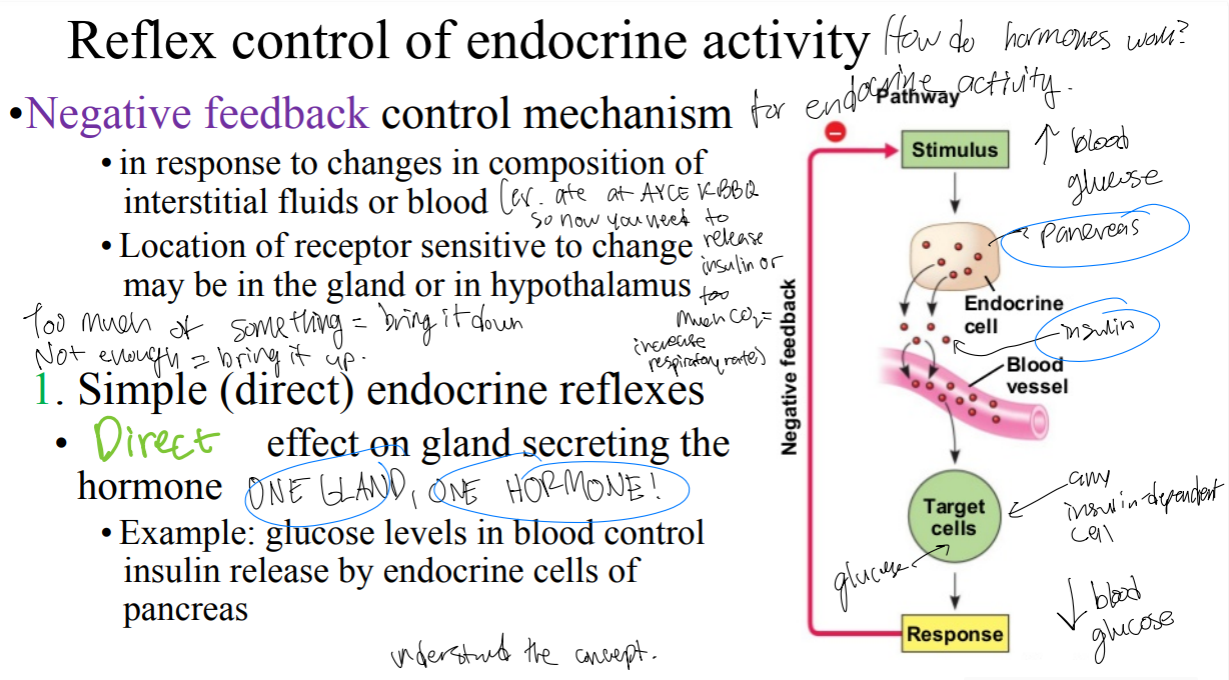
Isabelle just finished a massive KBBQ dinner. Define Negative Feedback using her body’s Insulin response as the example. Identify the 4 main components of the loop.
The KBBQ Loop Components:
Stimulus: High levels of glucose/amino acids in the blood after eating.
Sensor/Control Center: Beta cells in the pancreas detect the rise.
Effector: Insulin is released into the blood.
Response: Cells absorb the nutrients; blood levels fall.
Why it is "Negative": The resulting drop in blood nutrients "turns off" the production of insulin. The output shuts down the process that started it, preventing Isabelle's blood sugar from dropping dangerously low.
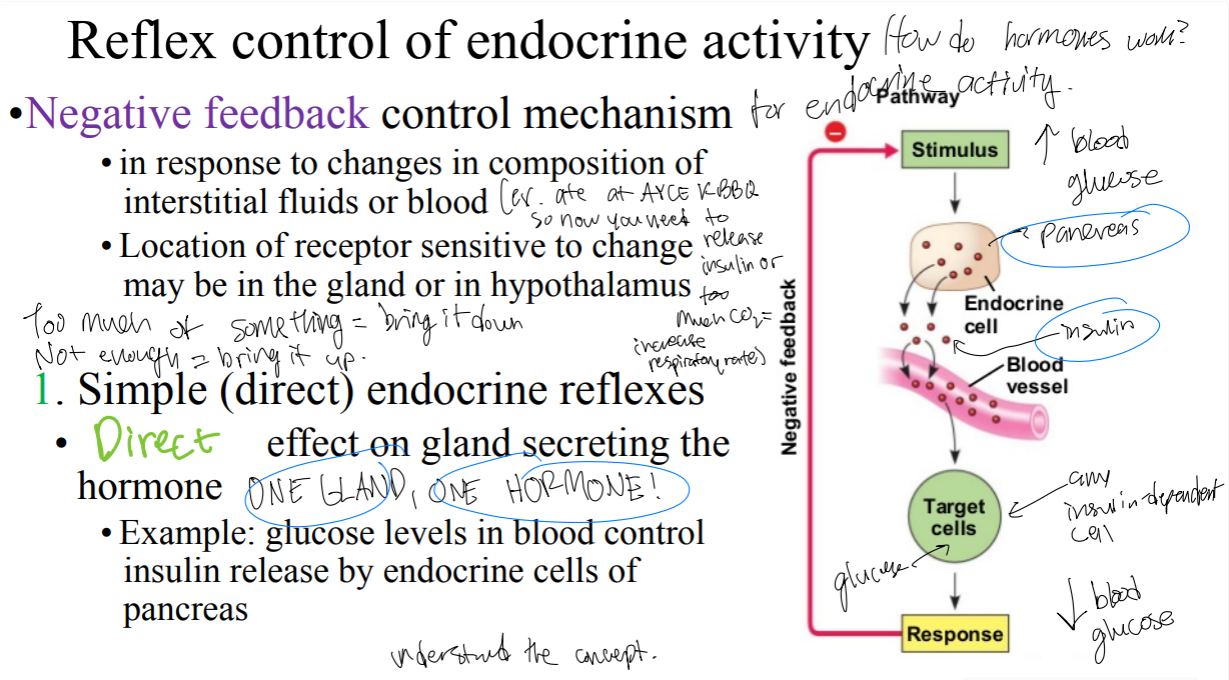
What is the difference between simple (direct) endocrine reflexes and complex (indirect) endocrine reflexes.
Simple (direct) endocrine reflexes: Direct effect on gland secreting the hormone (ONE GLAND, ONE HORMONE)
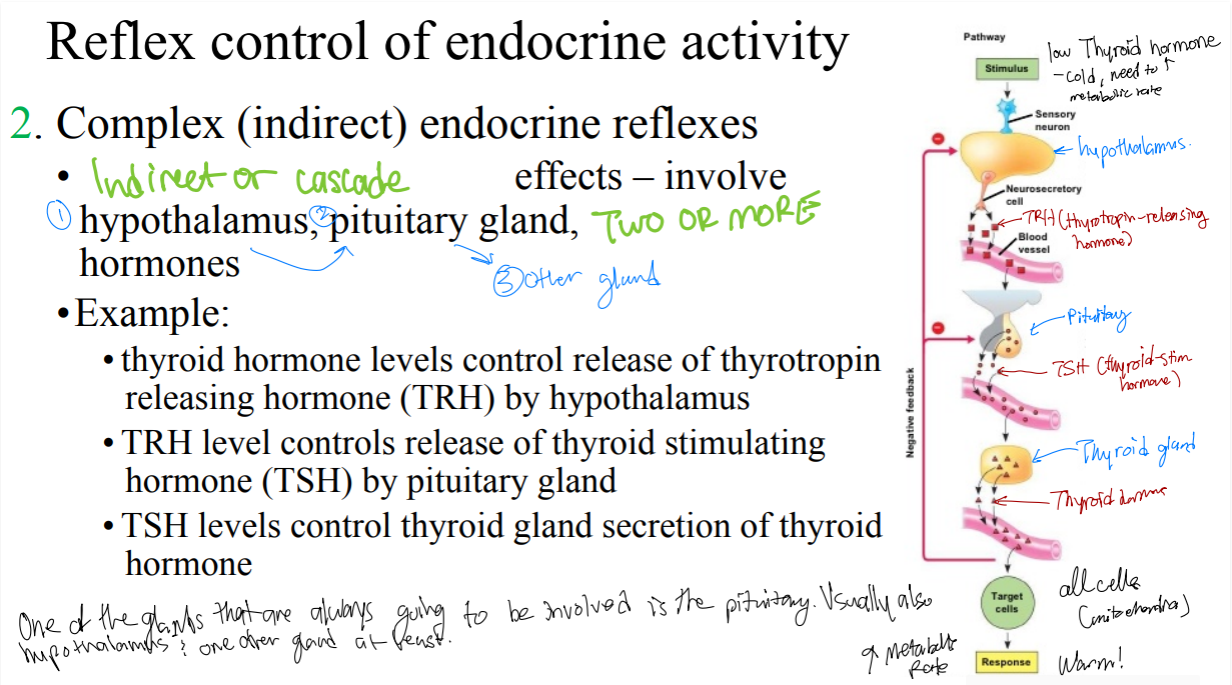
Complex (indirect) endocrine reflexes: Indirect or cascade effects — involve hypothalamus, pituitary gland. TWO OR MORE HORMONES.
Which of the following are NOT true about the endocrine system?
Products are chemical messengers
Controls slower duration processes than most other chemical messengers
Products must move through the bloodstream
Products diffuse from secreting endocrine gland to bind to receptors
Products diffuse from secreting endocrine gland to bind to receptors
If hormones move through the bloodstream, how do they “know” where to go to have their effect?
They move everywhere but only affect the target cells with receptors
How many hormones and glands are usually involved in complex (indirect or cascade) negative feedback hormone control?
Hypothalamus, pituitary and one other gland; two or more hormones
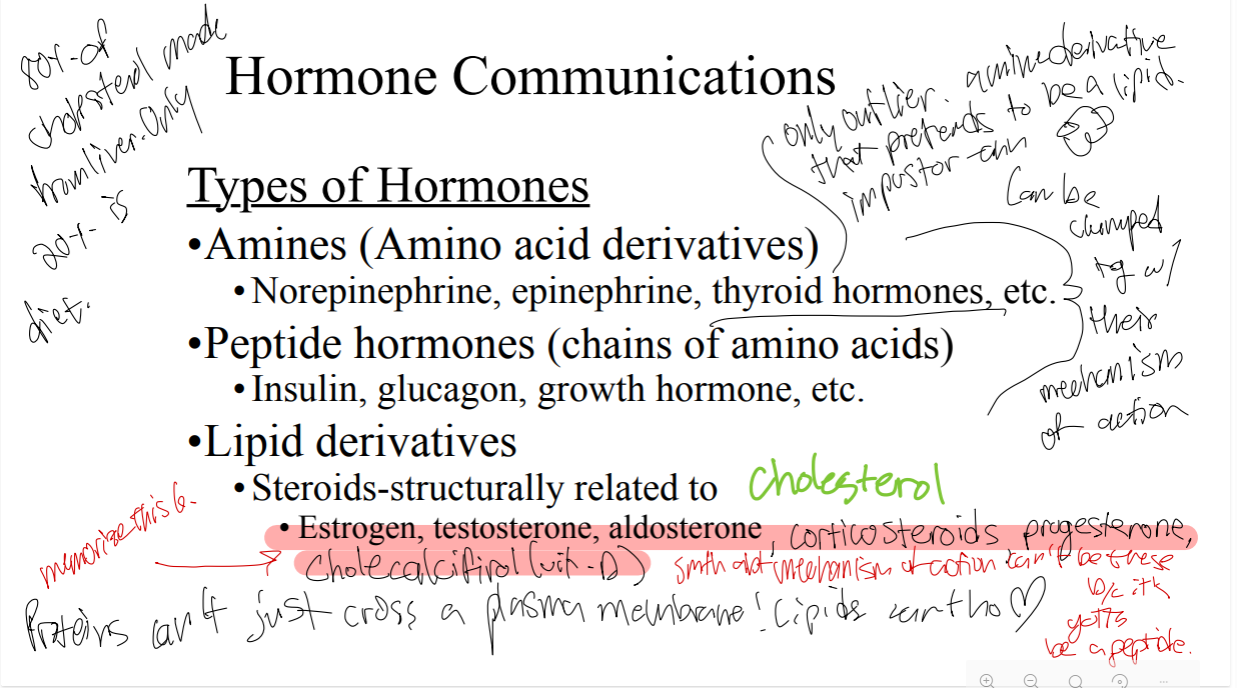
What are the 3 different types of hormones (just name them)?
Amines (Amino acid derivatives)
Peptide hormones (chains of amino acids)
Lipid derivatives
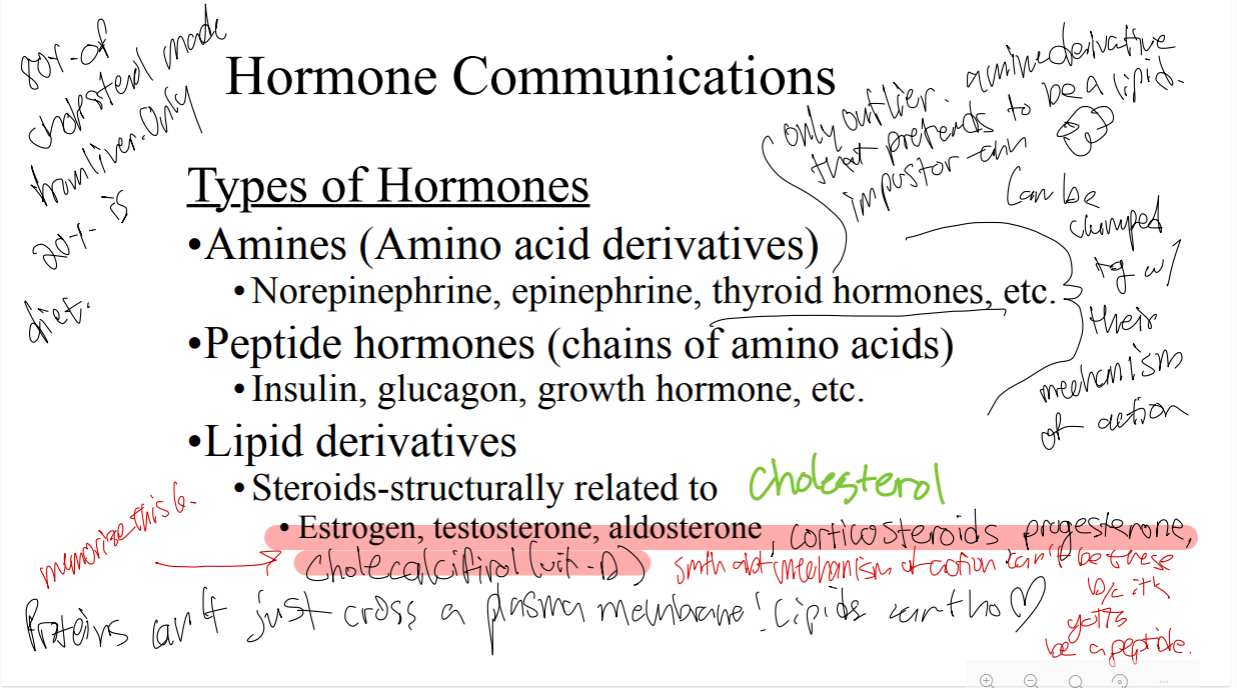
Norepinephrine, epinephrine, thyroid hormones, etc. are what type of hormones?
amines (amino acid derivatives)
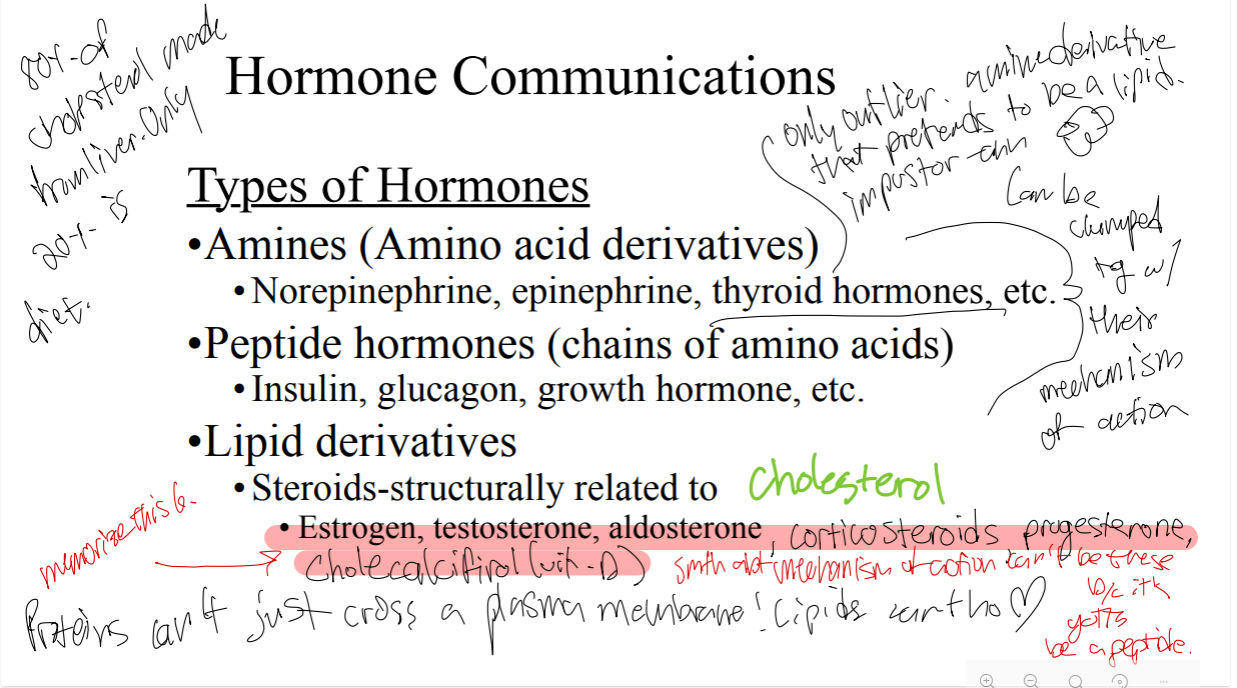
Insulin, glucagon, growth hormone, etc., are chains of amino acids, which means they are what type of hormone?
Peptide hormones
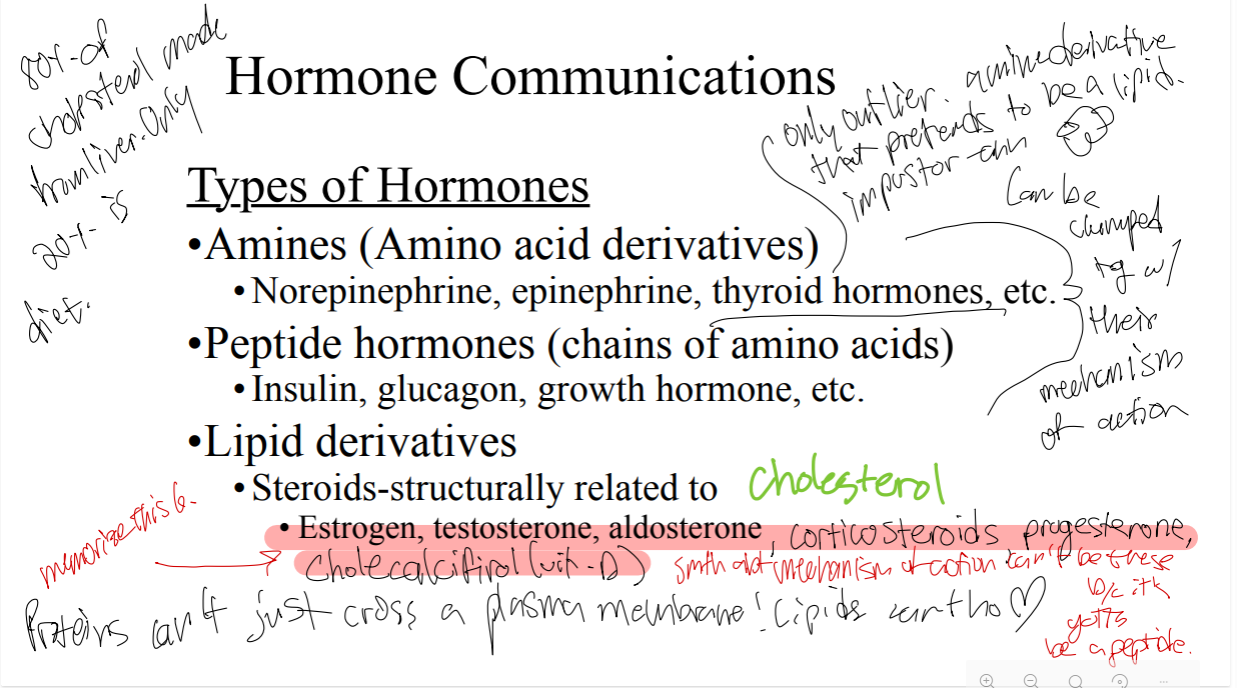
Estrogen, testosterone, aldosterone, corticosteroids, progesterone, cholecalcifirol are what type of hormones?
Lipid derivatives
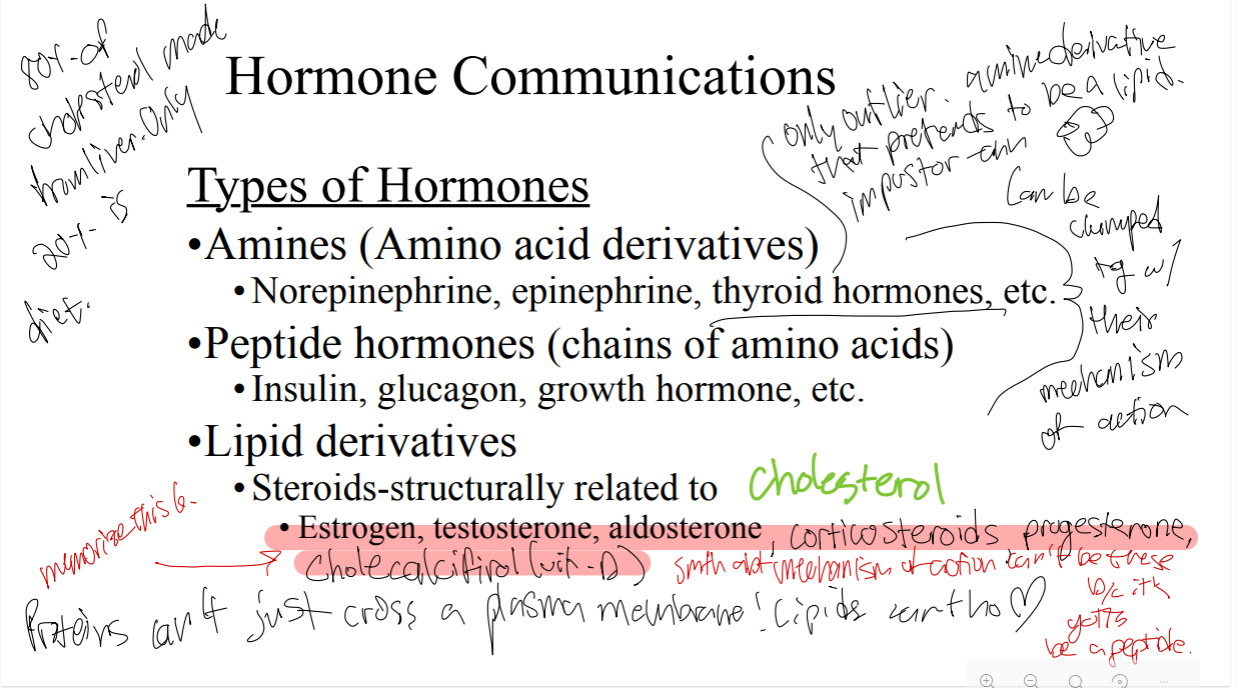
Steroids structurally related to cholesterol woudl be what type of hormones?
Lipid derivatives
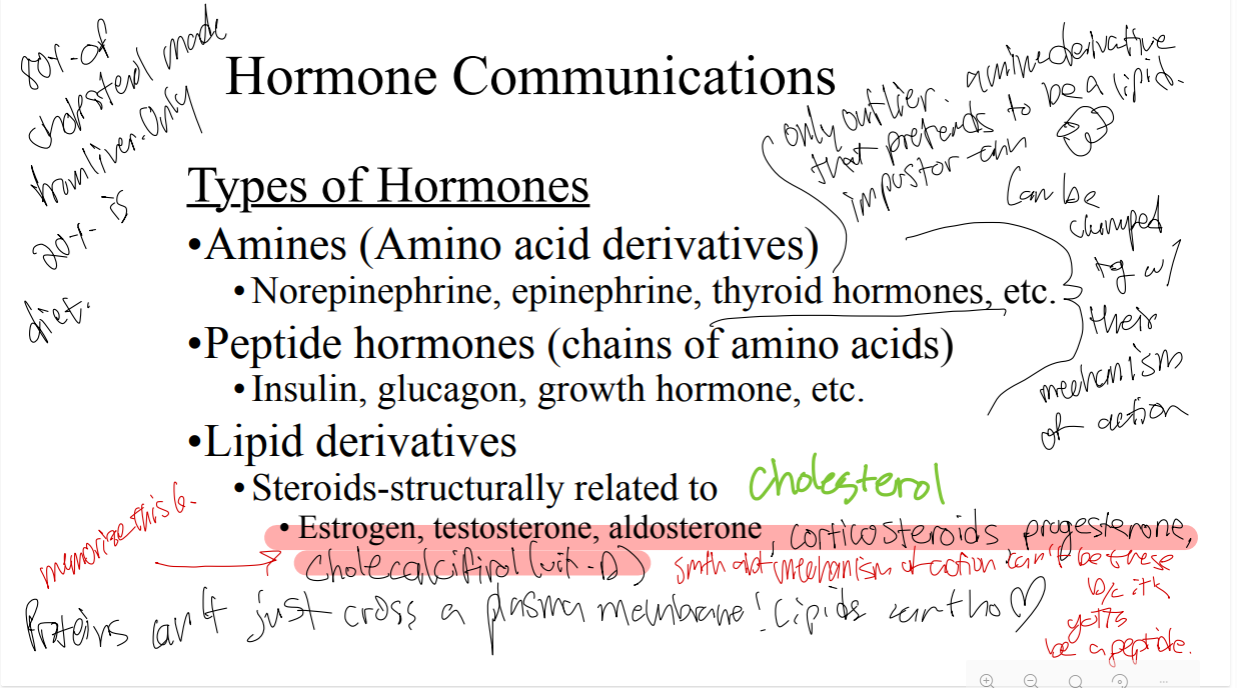
Name 6 lipid derivatives of hormones (yes, you must memorize this)
Estrogen
Testosterone
Aldosterone
Corticosteroids
Progesterone
Cholecalciferol
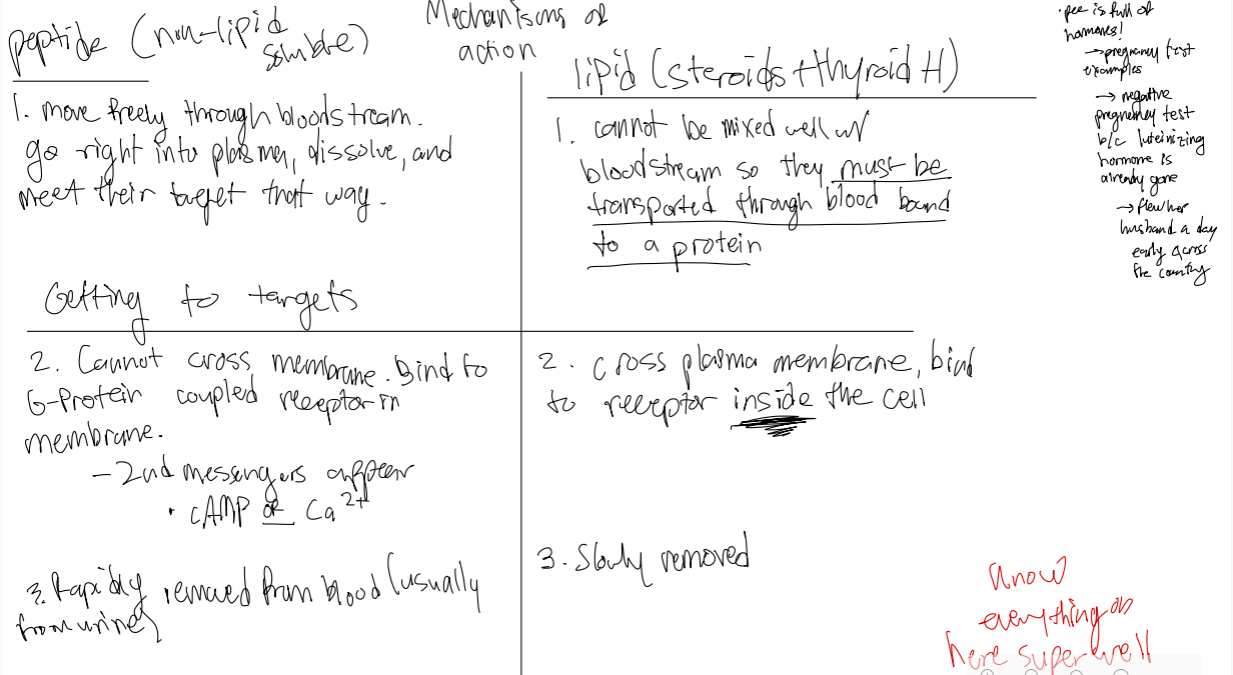
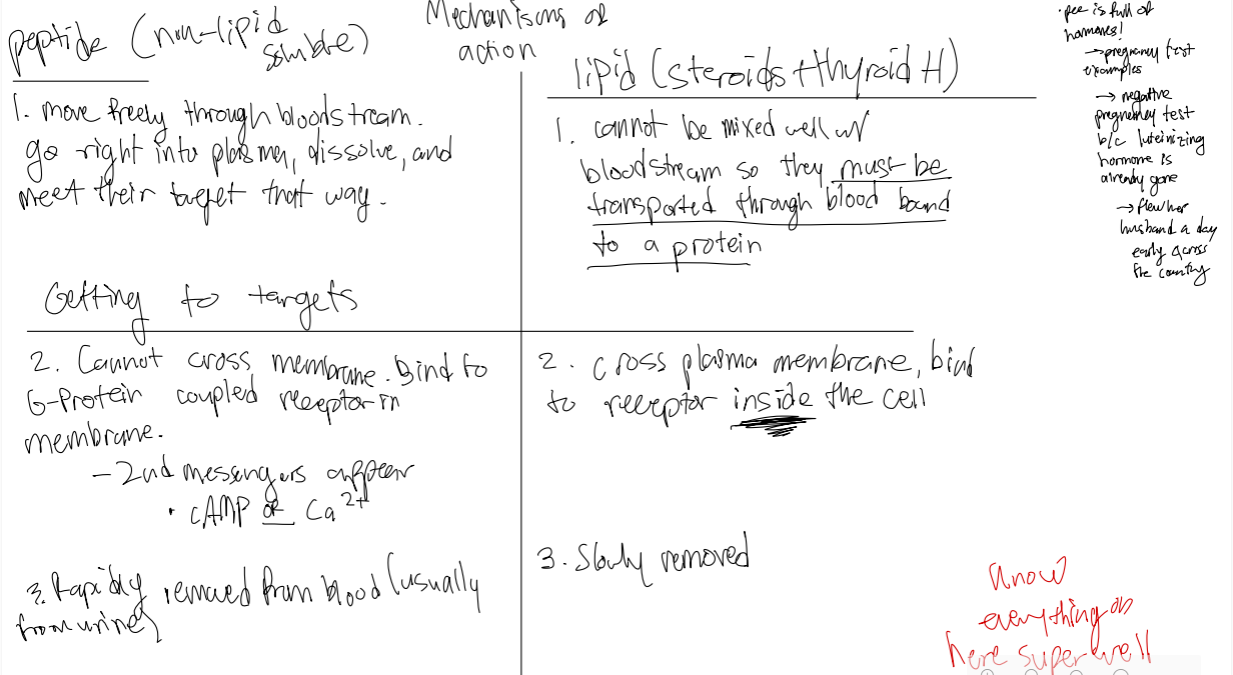
Describe the mechanism of actions for peptides.
Move freely through the bloodstream. Go right into the plasma, dissolve, and meet their target that way.
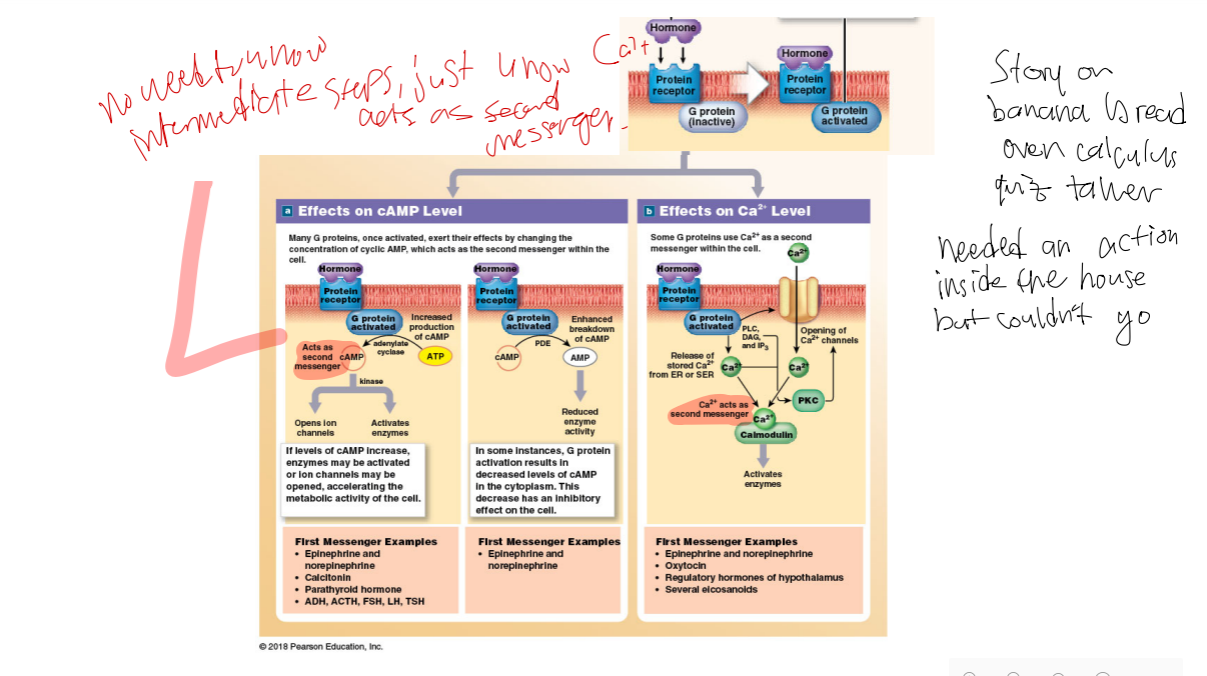
Cannot cross membrane, so they bind to G-protein coupled receptor in membrane.
2nd messengers appear like cAMP or Ca2+
Rapidly removed from blood (usually from urine)
Remember that Ca2+ acts as a second messenger
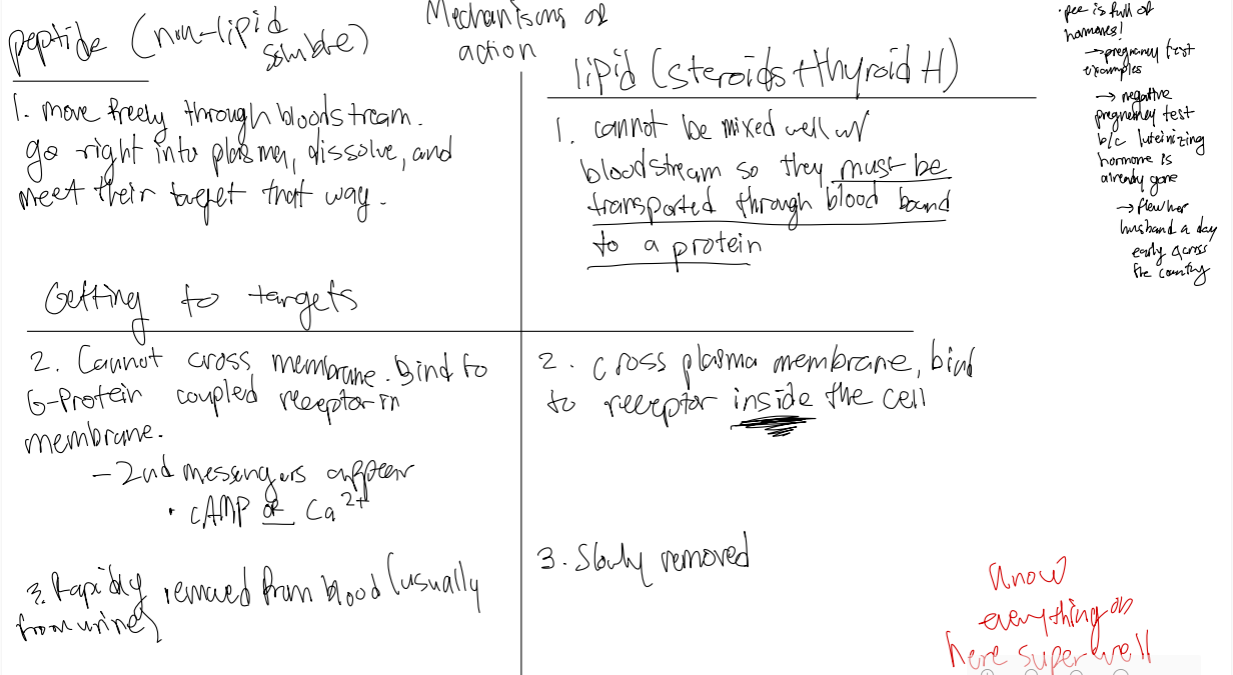
Describe the mechanism of actions for lipid (steroids + thyroid H).
Cannot be mixed well with bloodstream so they must be transported through blood bound to a protein
Cross plasma membrane, bind to receptor inside the cell
Slowly removed from the blood
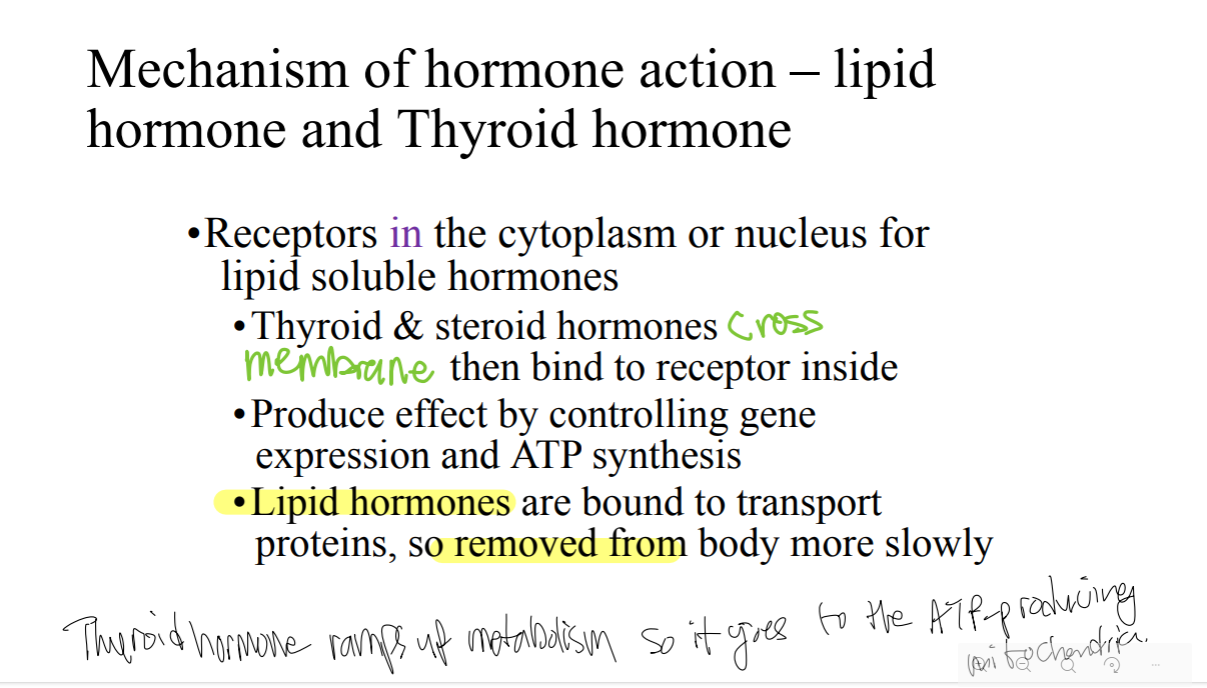
Lipid hormone and thyroid hormone produce effects by controlling what?
gene expression and ATP synthesis
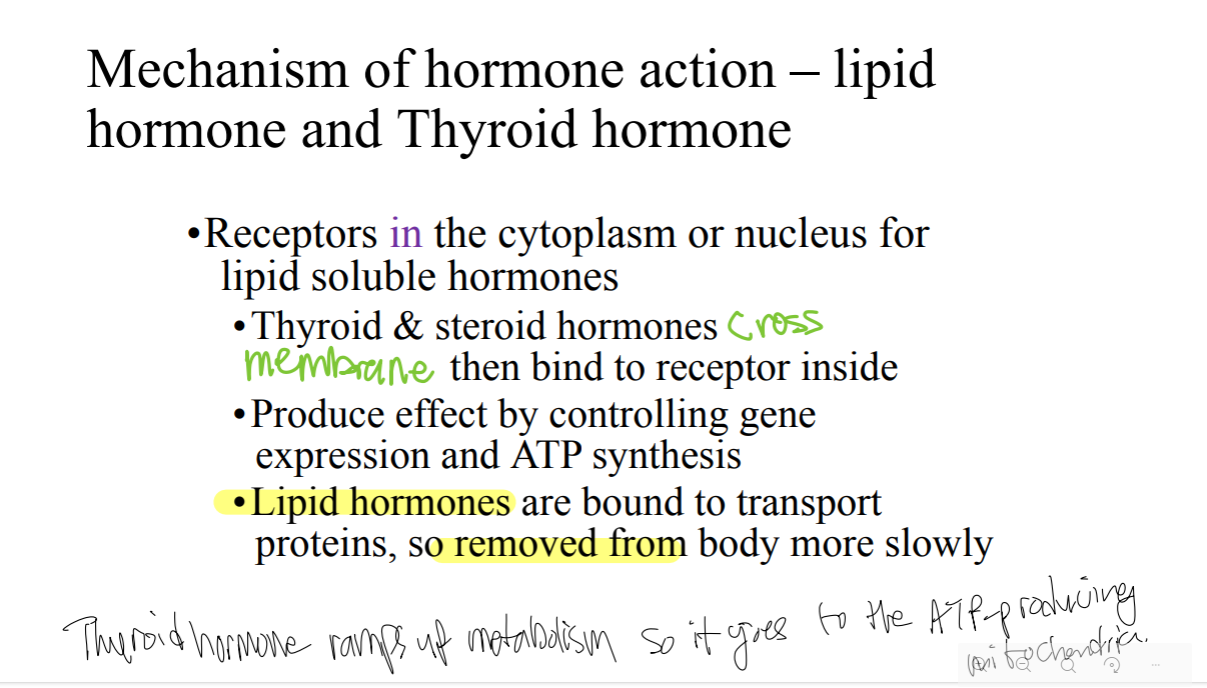
Why are lipid hormones removed from the body more slowly?
because they are bound to transport proteins
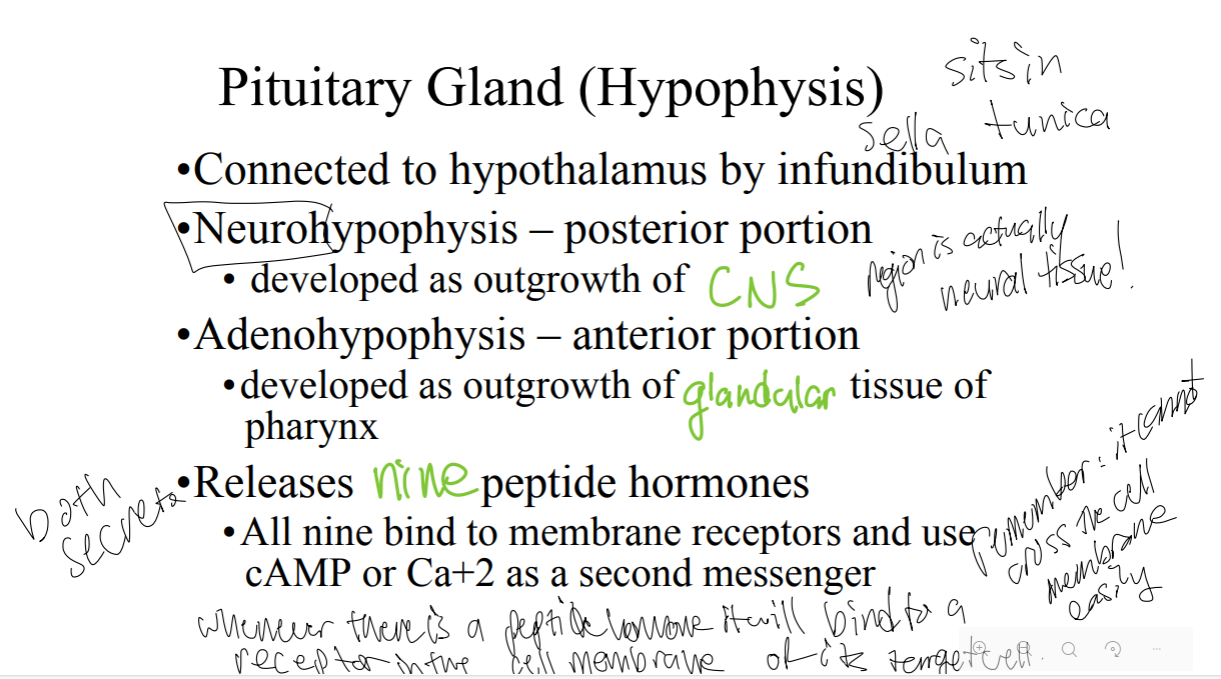
What is the neurohypophysis?
The posterior portion of the pituitary gland, developed as an outgrowth of CNS (so it’s actually made of neural tissue)
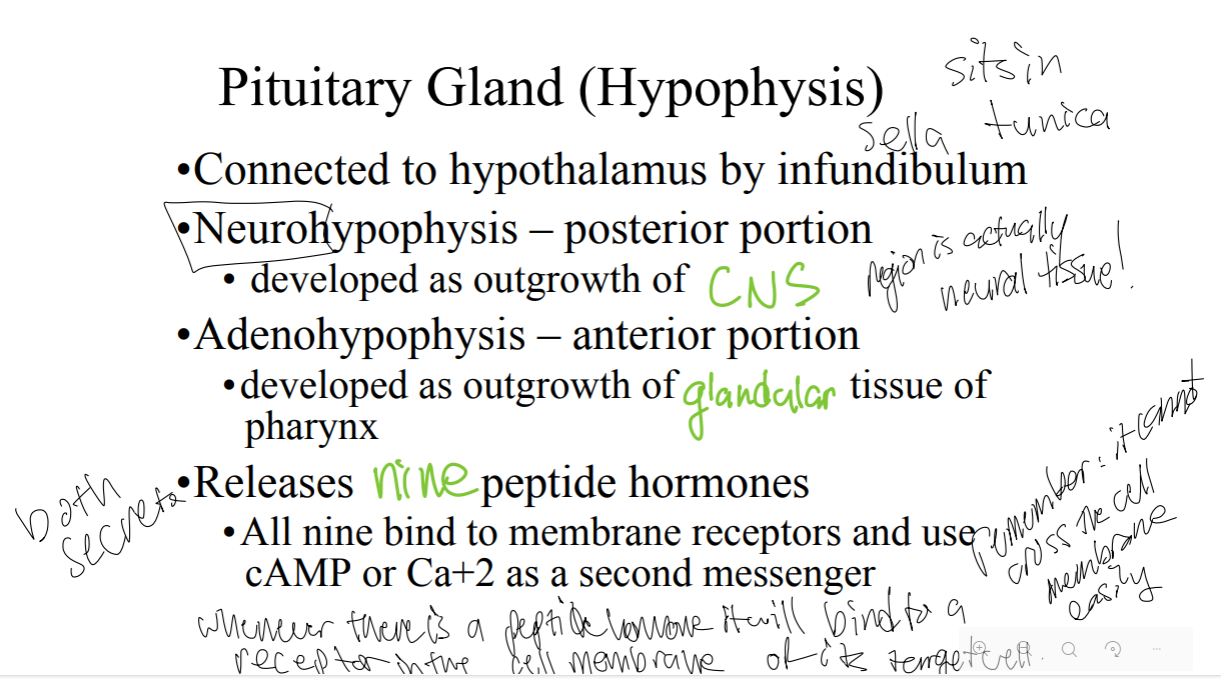
What is the adenohypophysis?
The anterior portion of the pituitary gland, developed as an outgrowth of glandular tissue of pharynx
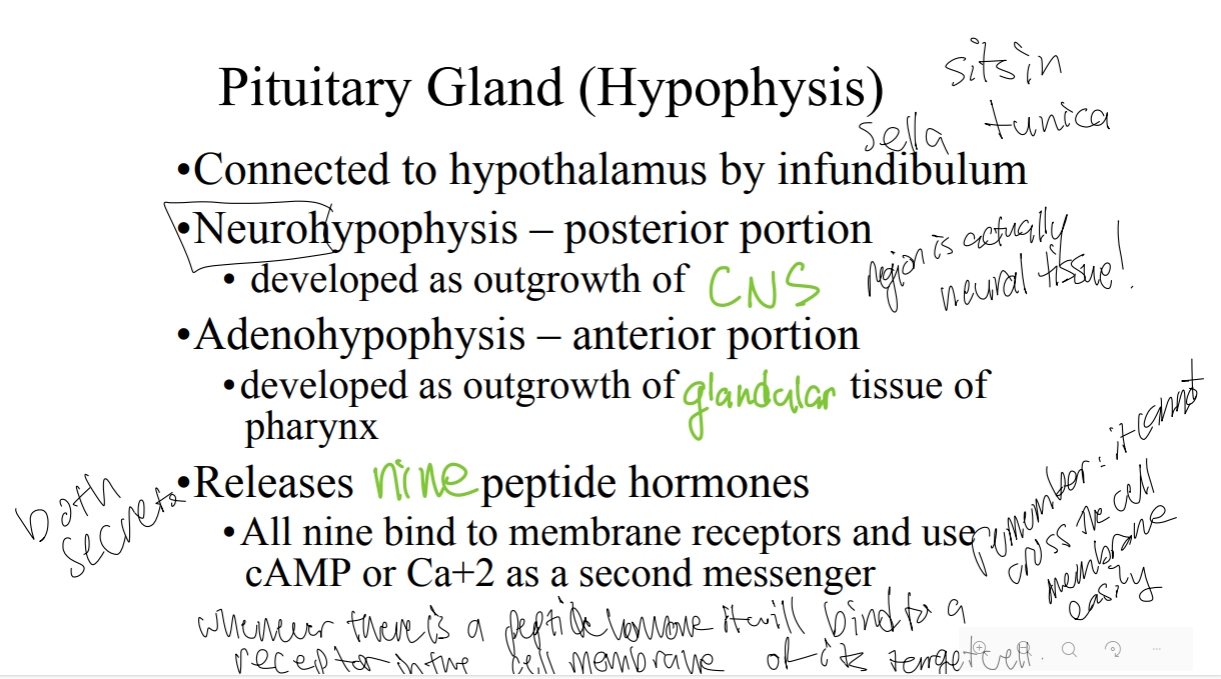
How many hormones (and what TYPE) does the pituitary gland (hypophysis) release?
9 peptide hormones. All 9 bind to membrane receptors and use cAMP or Ca2+ as a second messenger.
Whenever there is a peptide hormone, will it cross or not cross the cell membrane easily?
It will not cross the cell membrane easily, therefore it must bidn to a receptor in the cell membrane of its target cell.
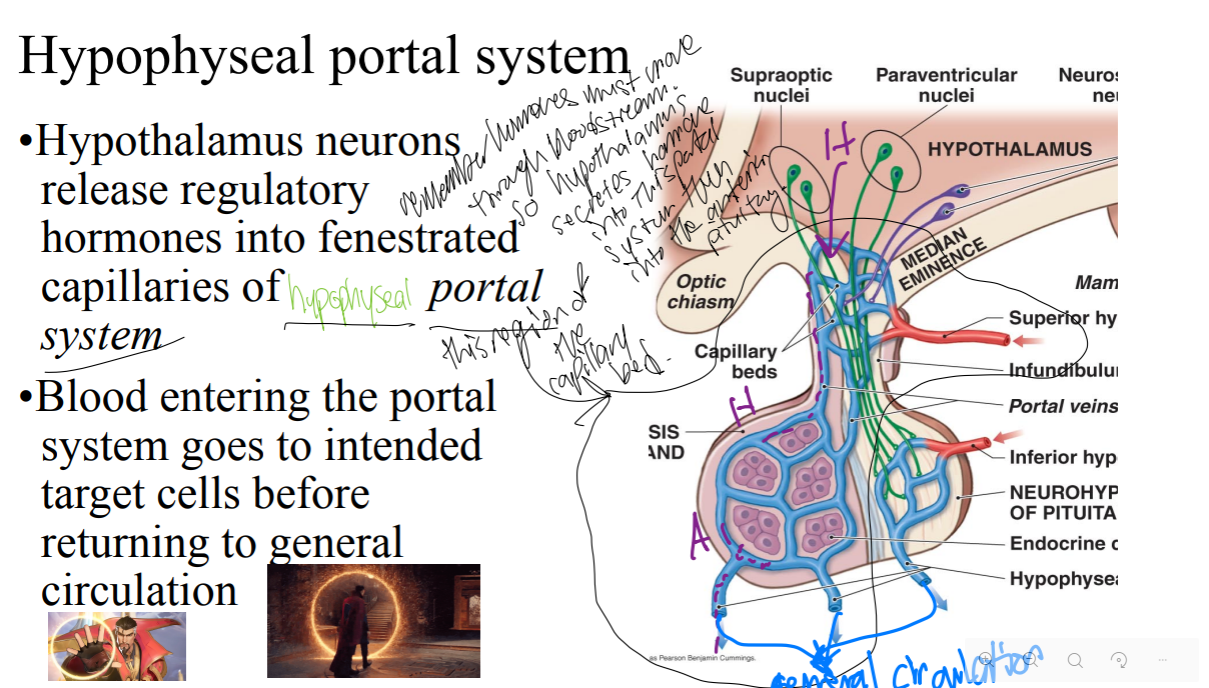
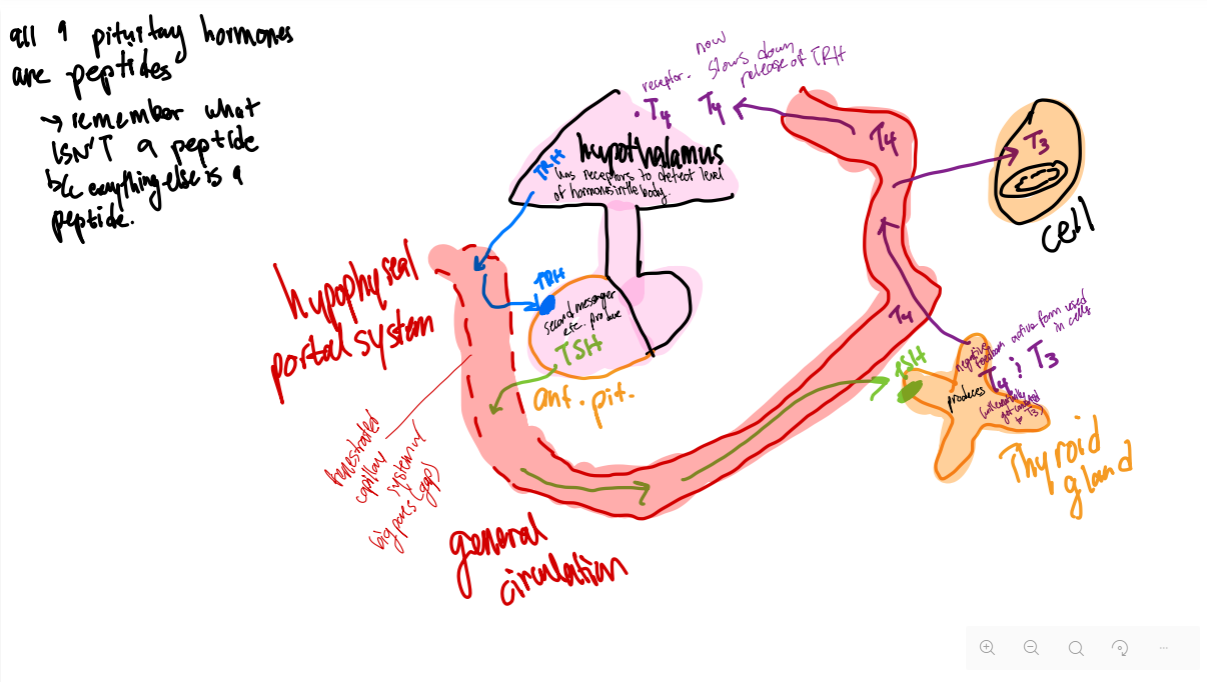
What is the hypophyseal portal system?
Hypothalamus neurons release regulatory hormones into fenestrated capillaries of hypophyseal portal system, which is a capillary bed region that in the pituitary gland where blood entering the portal system goes to intended target cells before returning to general circulation.
Remember that hormones must move through the bloodstream. So the hypothalamus secretes hormone into this portal system then into the anterior pituitary.
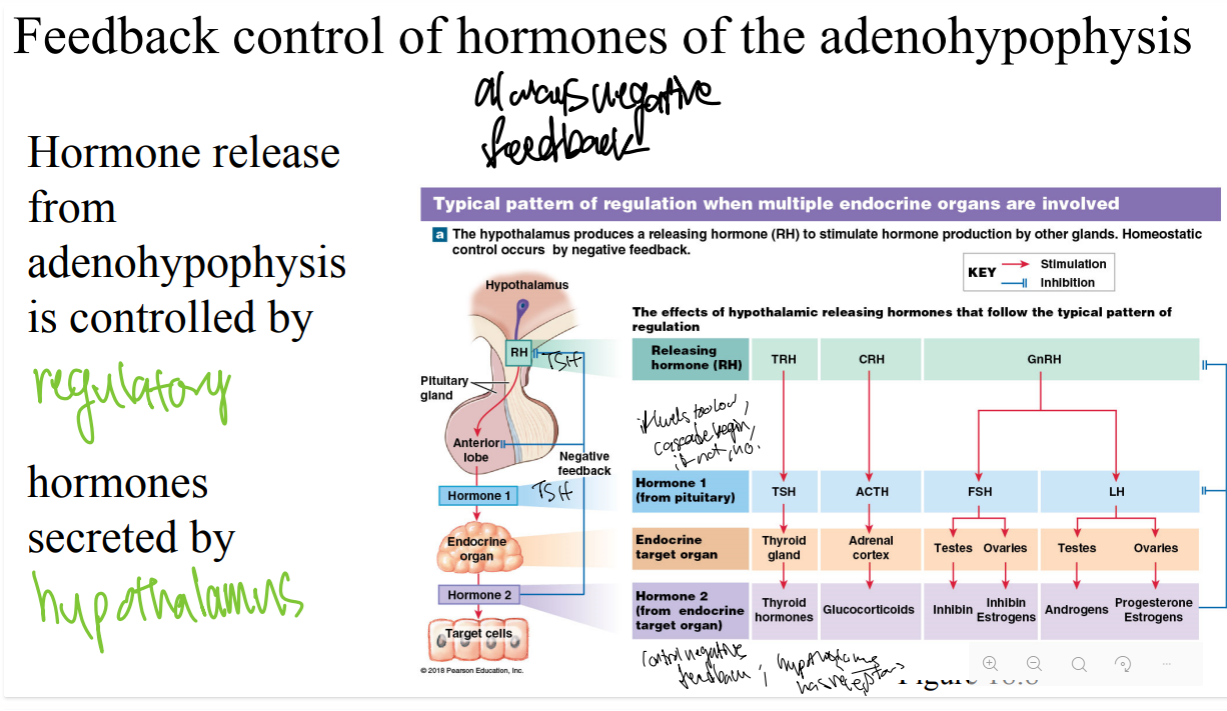
Hormone release from adenohypohysis is controlled by
regulatory hormones secreted by the hypothalamus
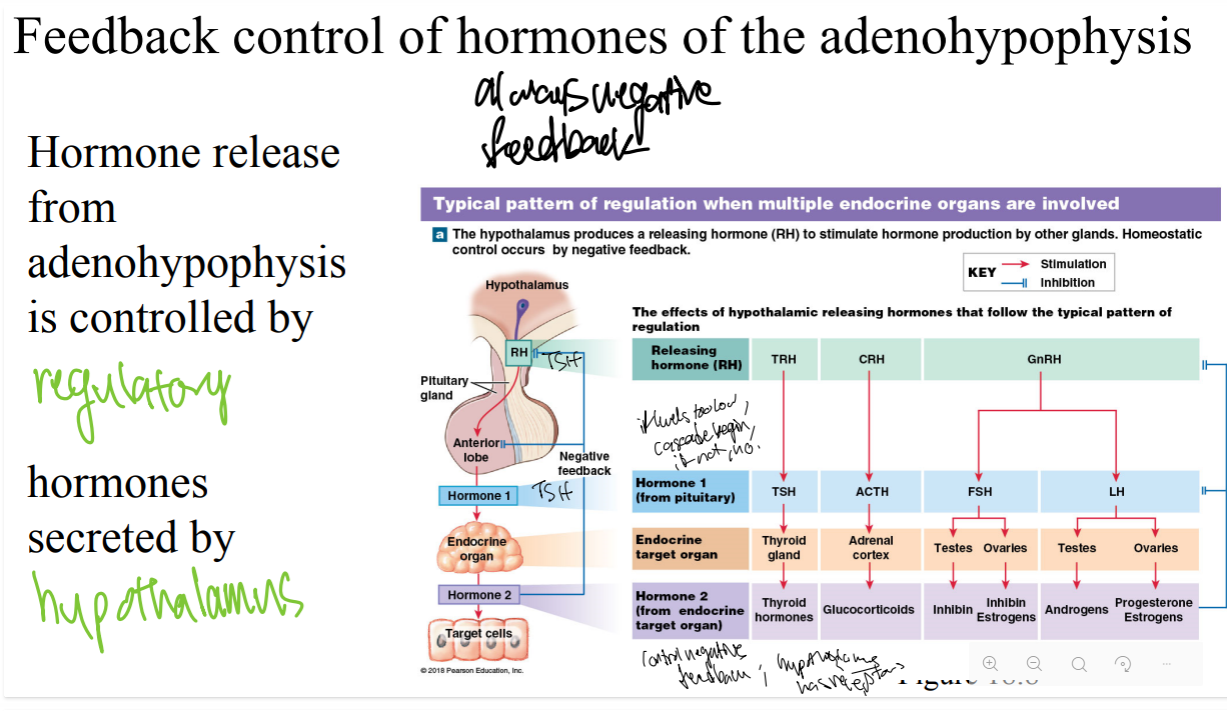
Hormones must move through the _____
bloodstream
Which of the following hormones would NOT utilize a 2nd messenger?
Insulin
TSH (Thyroid Stimulating Hormone)
Glucocorticoid
LH (Luteinizing Hormone)
Glucocorticoid (bc it is lipid soluble)
What does the hypophyseal portal system connect?
Hypothalamus to adenohypohysis
Which of the following hormones will cause target cells to get BIGGER?
somatomedin
A blood test with a high TSH level might indicate
a problem with thyroid gland causing low thyroid hormone levels
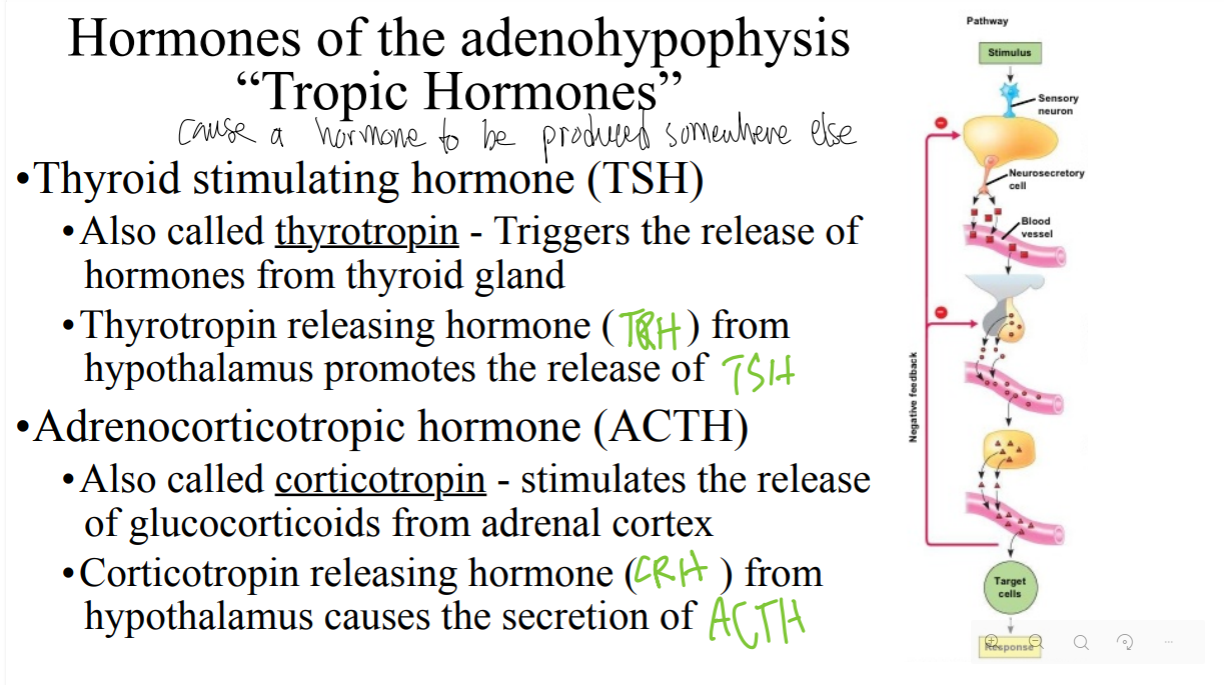
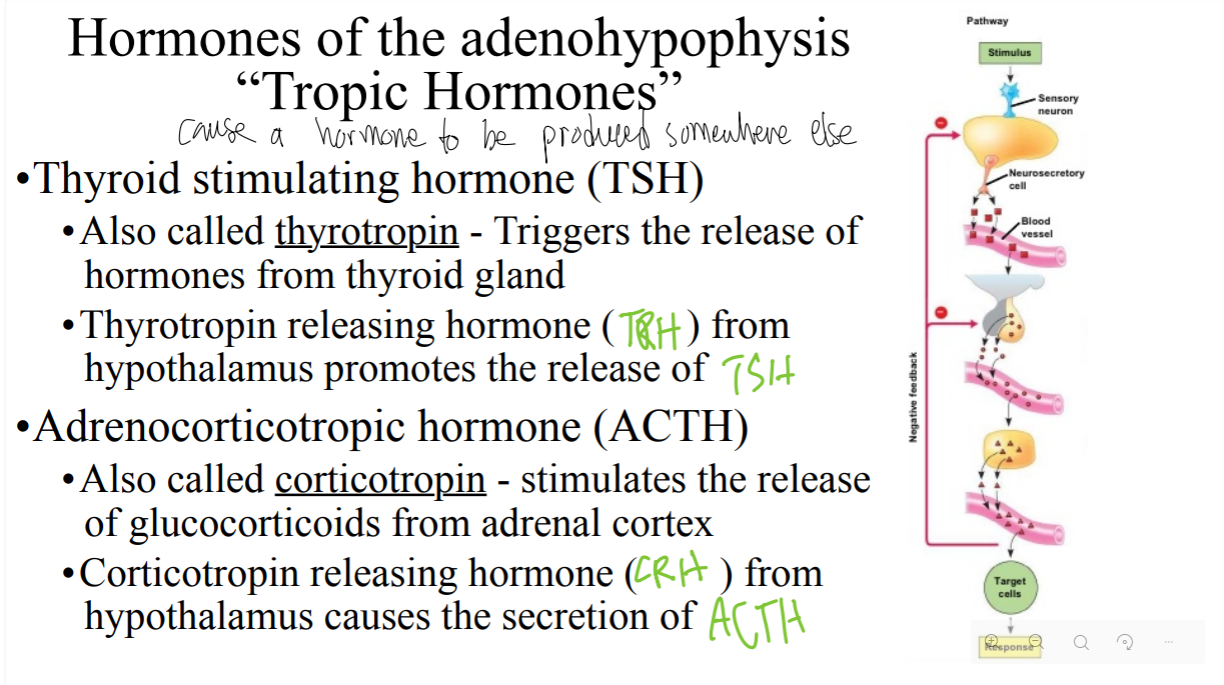
TSH is also called
thyrotropin
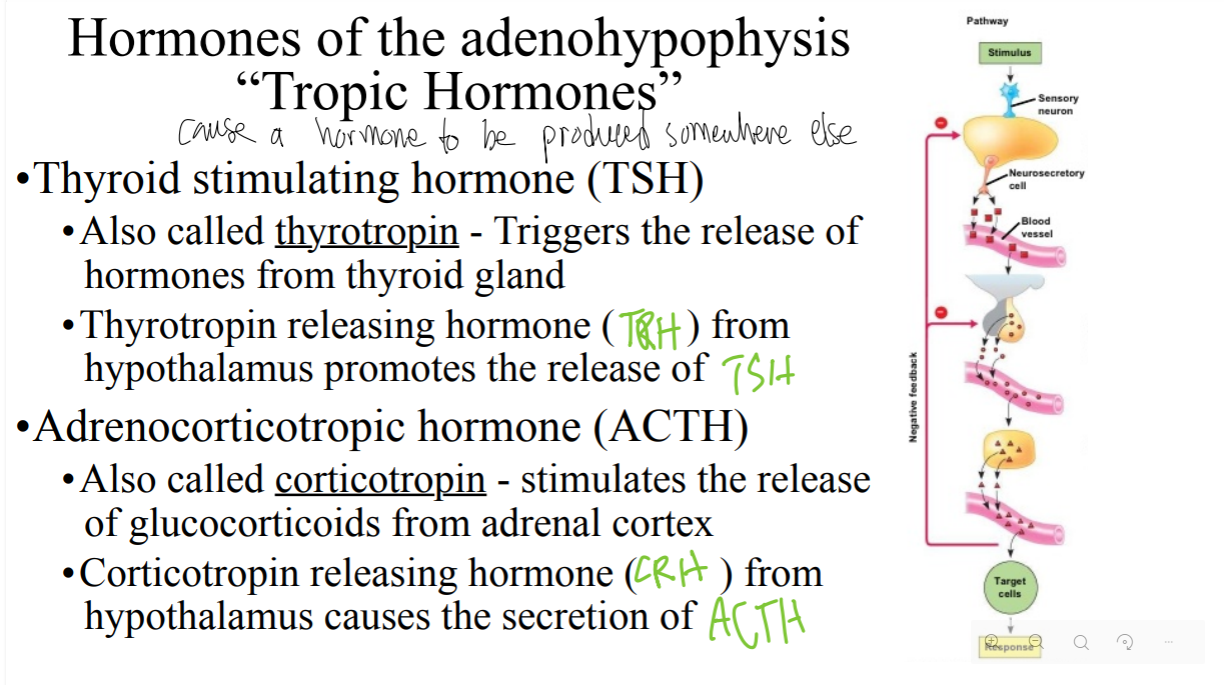
TSH is also called thyrotropin. What does it do?
Triggers the release of hormones from the thyroid gland
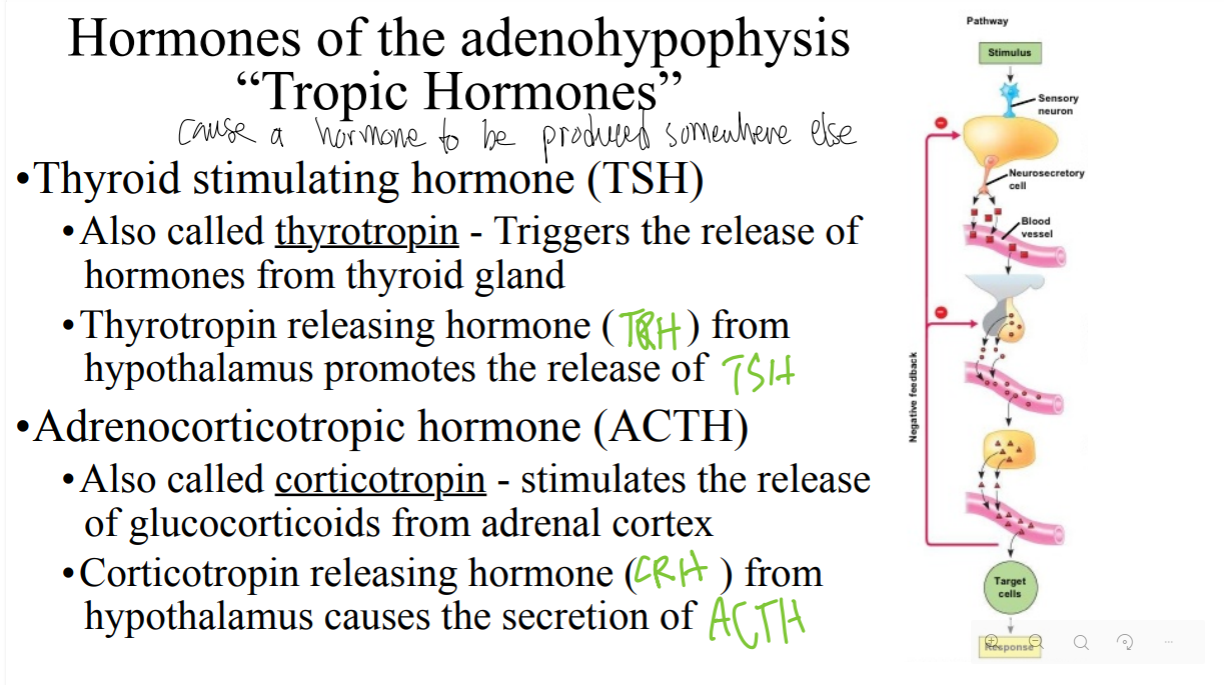
____ releasing hormone from hypothalamus promotes the release of TSH
Thyrotropin
Adrenocorticotropic hormone (ACTH) is also called
corticotropin
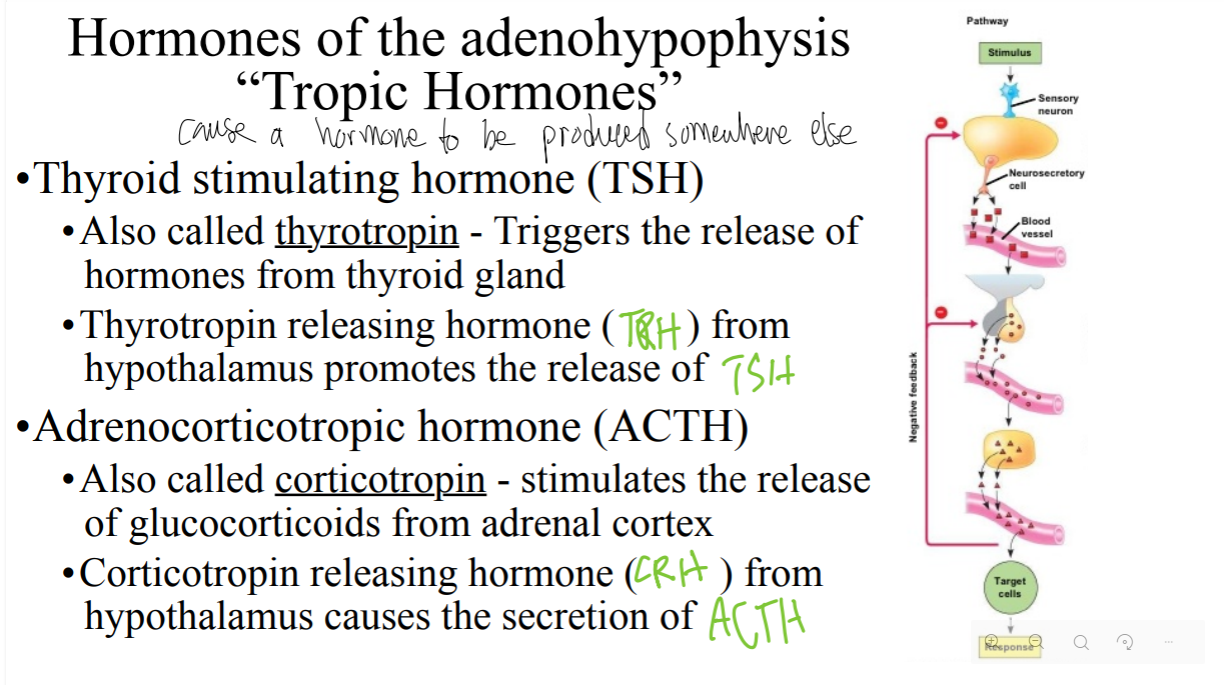
Adrenocorticotropic hormone (ACTH) is also called corticotropin. What does it do?
stimulates the release of glucocorticoids from adrenal cortex
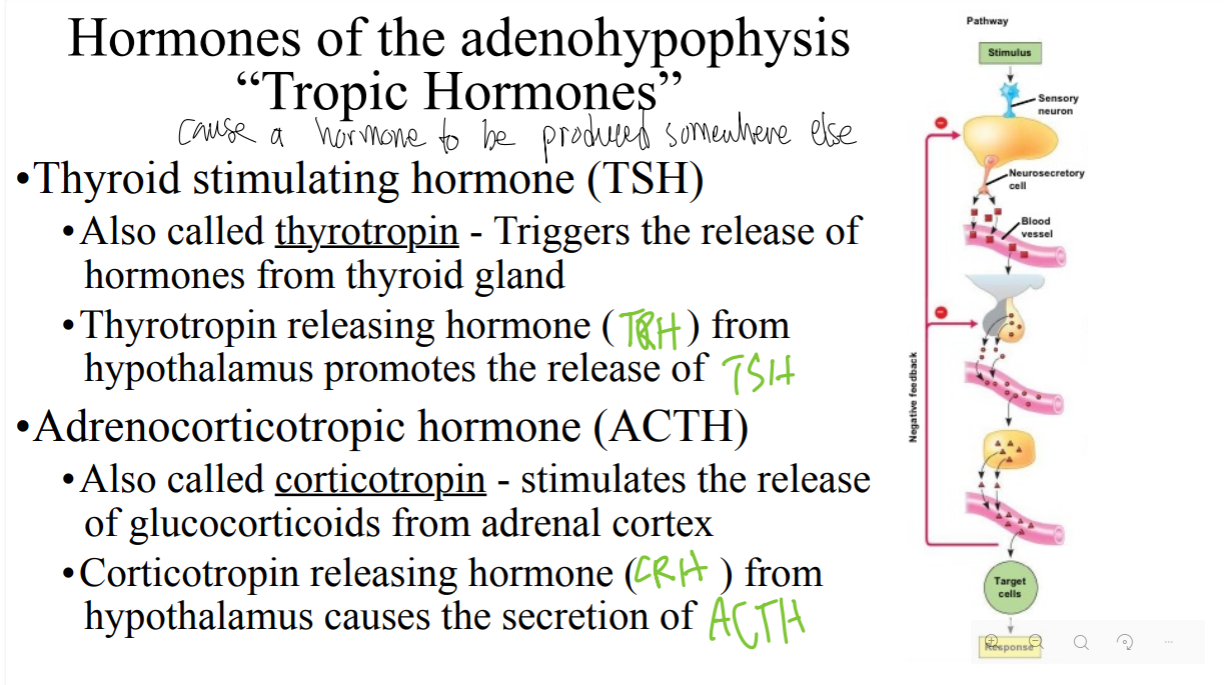
_____ releasing hormone from hypothalamus causes the secretion of ACTH
Corticotropin
T/F: All 9 pituitary hormones are lipids.
F, they are all PEPTIDES.
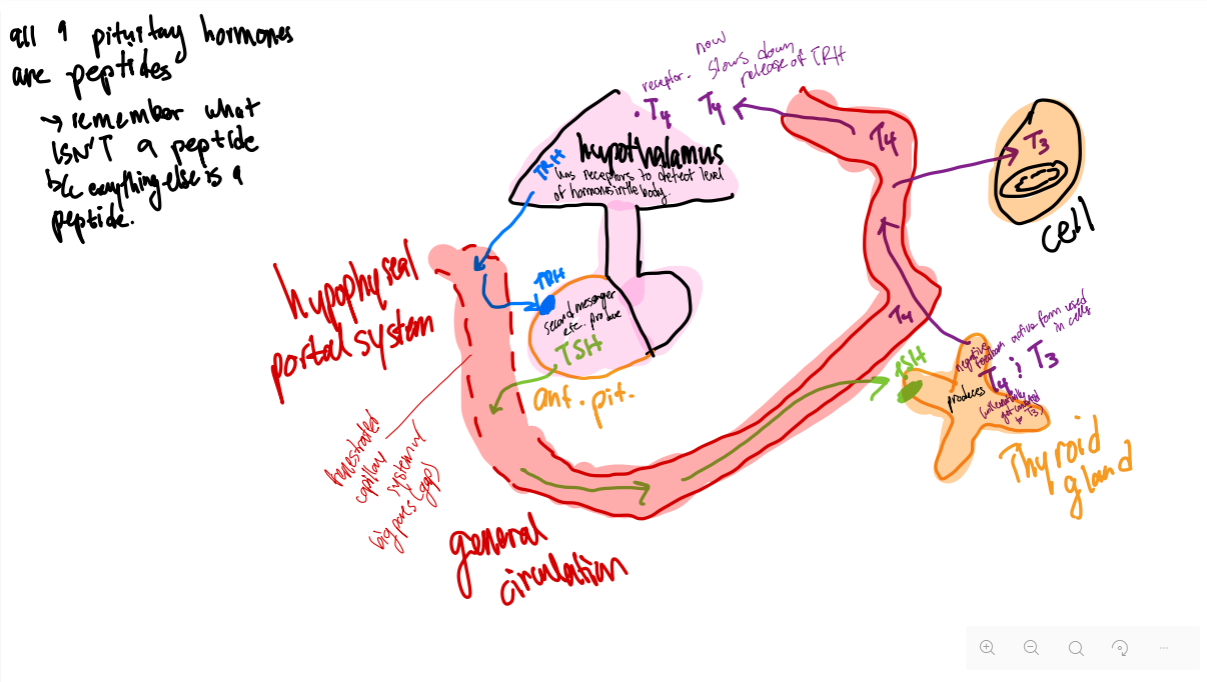
T/F: All 9 pituitary hormones are carbohydrates.
F, all 9 pituitary hormones are PEPTIDES
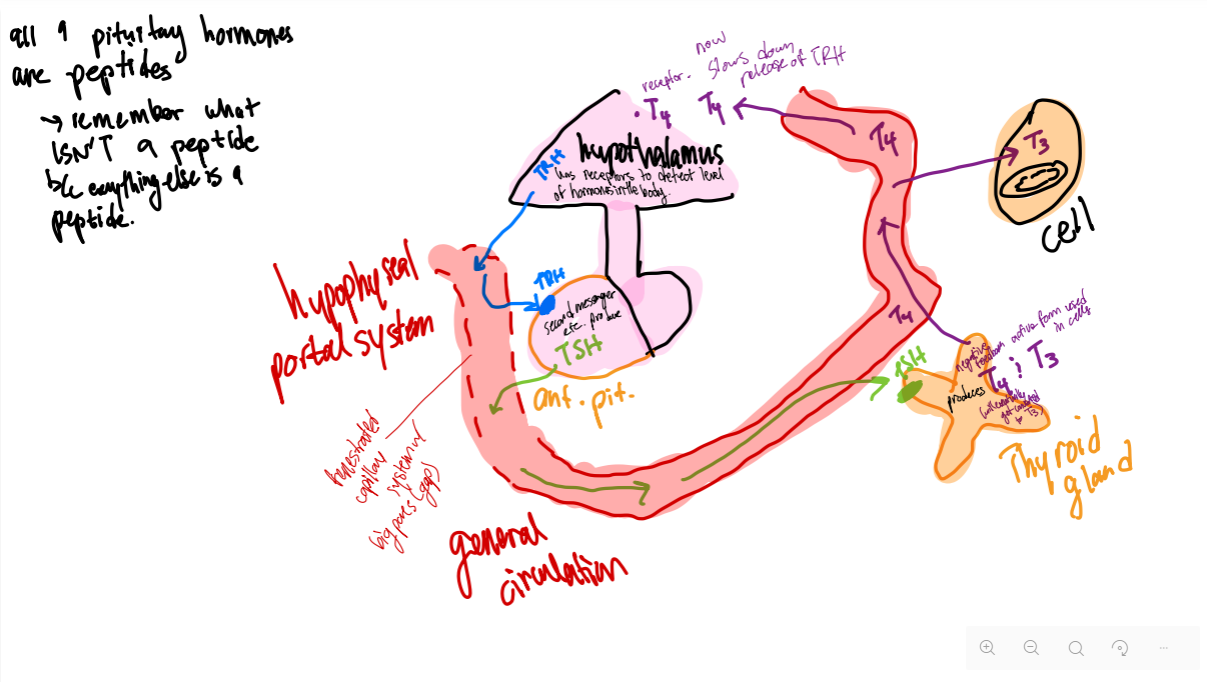
The hypothalamus has receptors to detect the level of _____ in the body.
Hormones
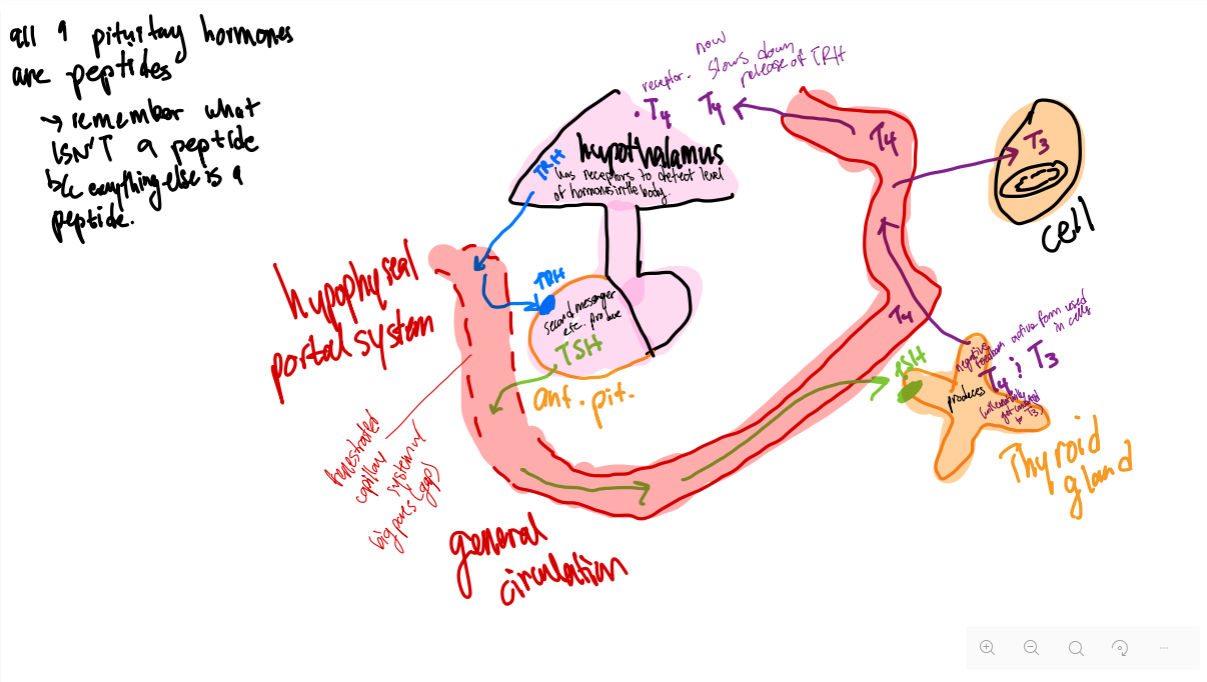
Describe this drawing
Name the hormones of the adenohypophysis
FLAGTOP
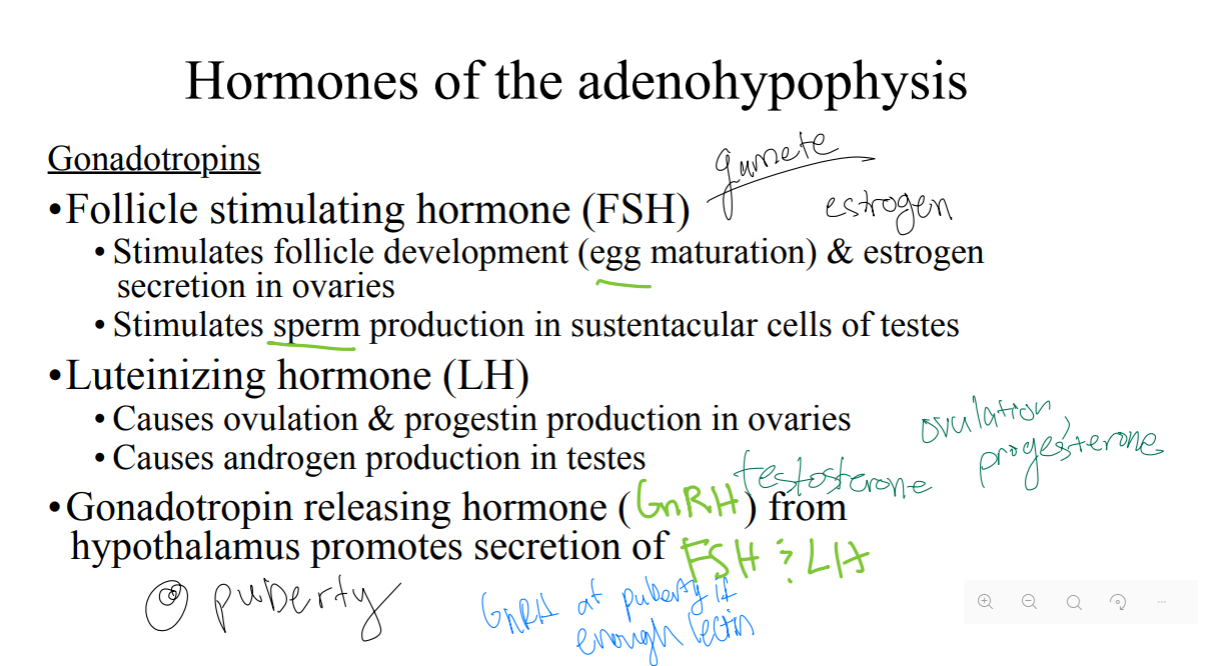
Describe what Follicle Stimulating Hormone does (FSH) and where it is secreted
Secreted out of adenohypophysis; stimulates follicle development (egg maturation) & estrogen secretion in ovaries. Stimulates sperm production in sustentacular cells of testes.
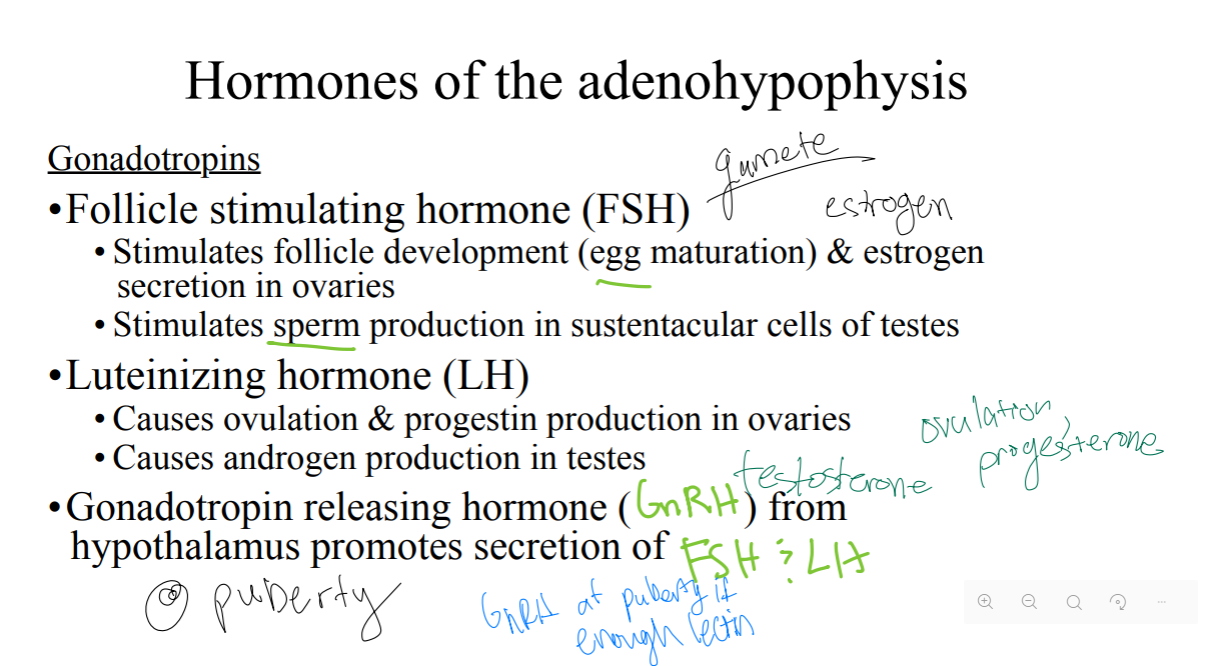
Which hormone is being described?
Secreted out of adenohypophysis; stimulates follicle development (egg maturation) & estrogen secretion in ovaries. Stimulates sperm production in sustentacular cells of testes.
Follicle stimulating hormone
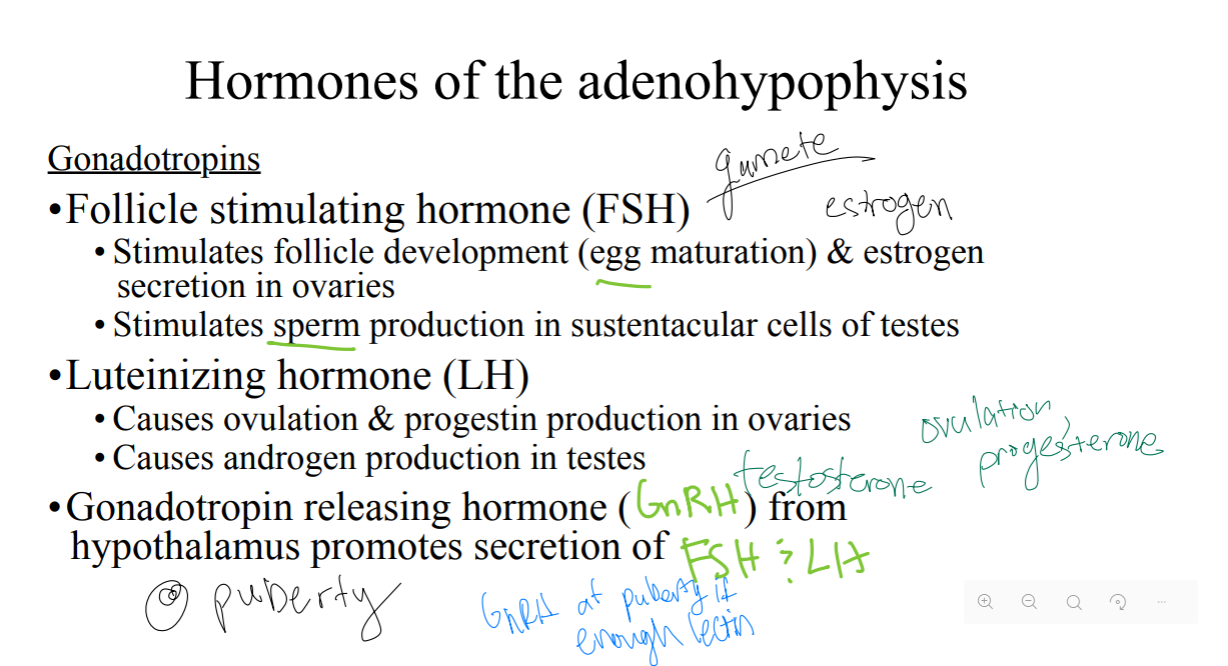
Describe what Luteinizing hormone does (LH) and where it is secreted
Secreted by Adenohypophysis; causes ovulation & progestin production in ovaries. Causes androgen production in testes
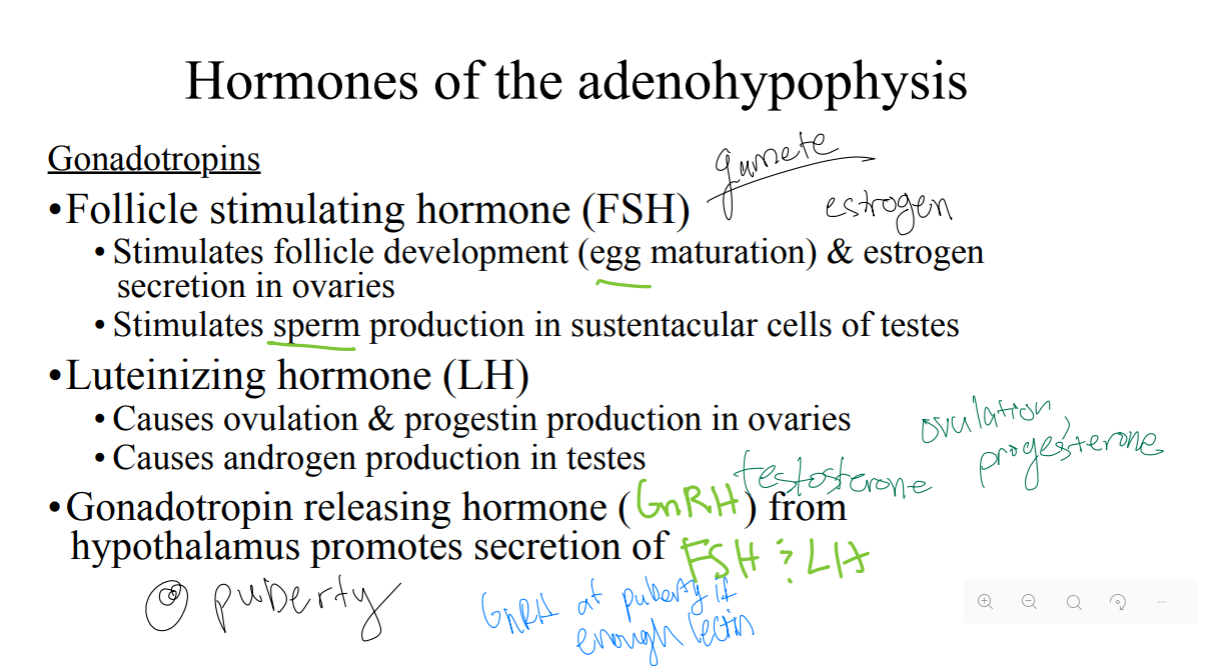
What hormone is being described?
Secreted by Adenohypophysis; causes ovulation & progestin production in ovaries. Causes androgen production in testes
Luteinizing Hormone (LH)
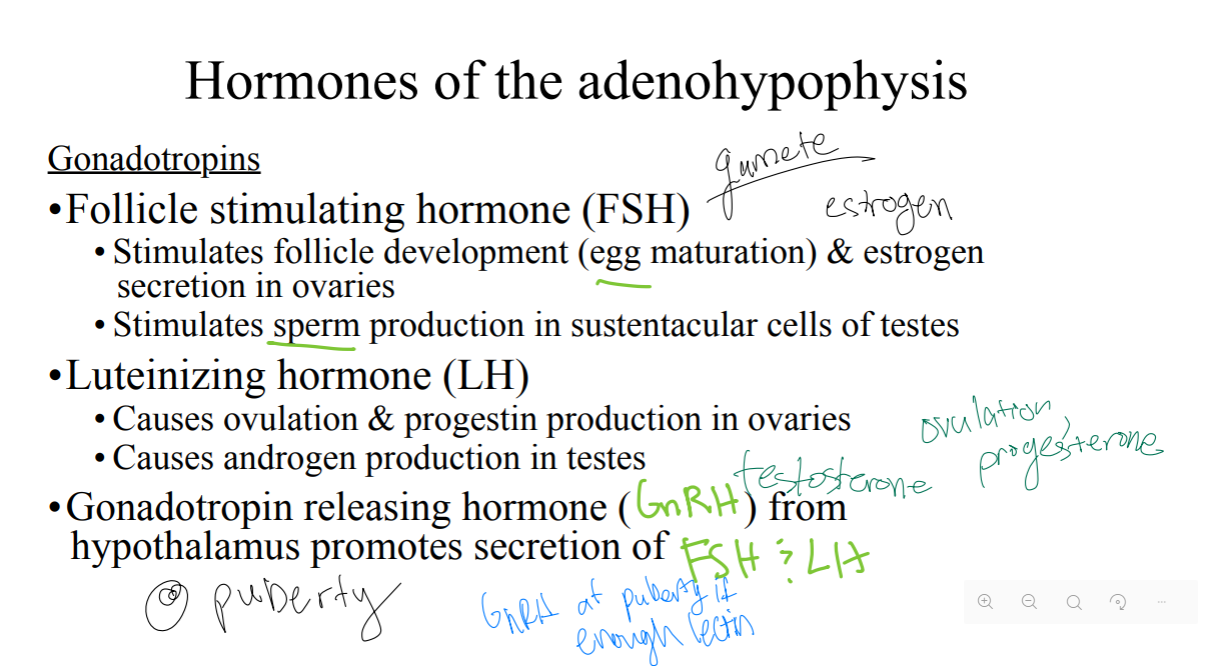
What is the difference between luteinizing hormone and follicle stimulating hormone?
FSH stimulates the growth of follicles (eggs) or sperm maturation, while LH triggers the release of an egg (ovulation) or stimulates testosterone production.
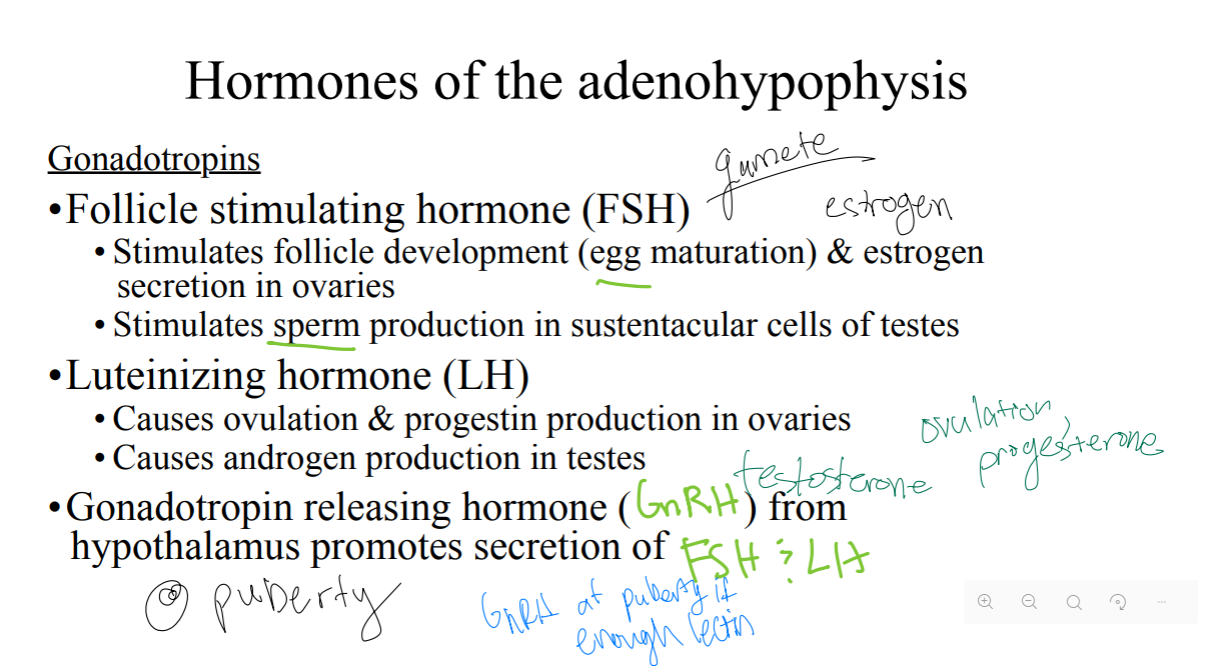
Gonadotropin releasing hormone (GnRH) from hypothalamus promotes the secretion of
FSH & LH
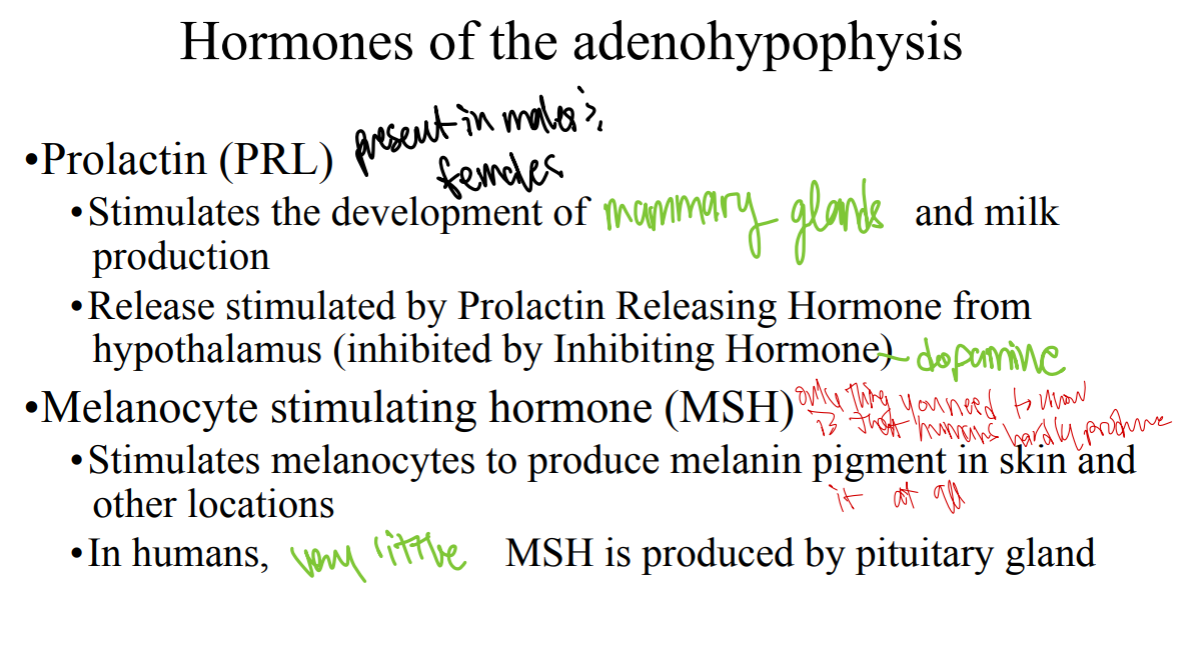
Describe what prolactin does (PRL) and where it is secreted
Secreted by adenohypophysis, stimulates the development of mammary glands and milk productin.
What hormone is being described?
Secreted by adenohypophysis, stimulates the development of mammary glands and milk productin.
Prolactin
T/F: Prolactin is only present in females.
F, prolactin is present in both males and females
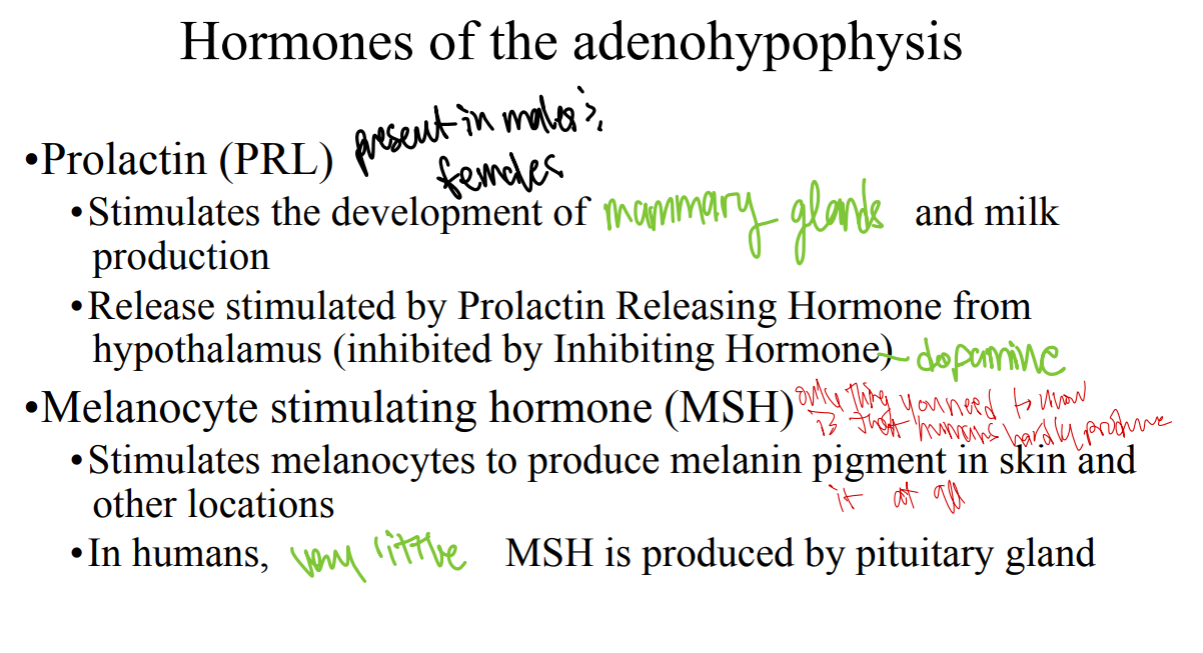
The release of prolactin from the hypothalamus can be inhibited by an inhibiting hormone such as
dopamine
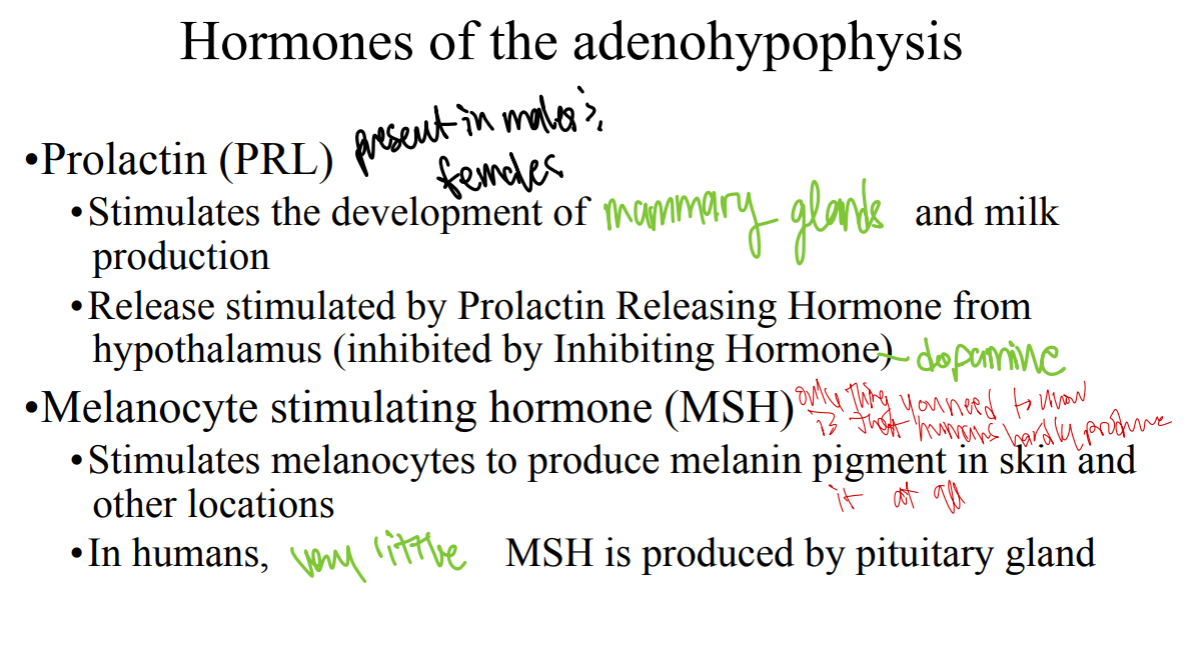
Describe melanocyte stimulating hormone (MSH) and where it is secreted
Secreted by adenohypophysis; stimulates melanocytes to produce melanin pigment in skin and other locations
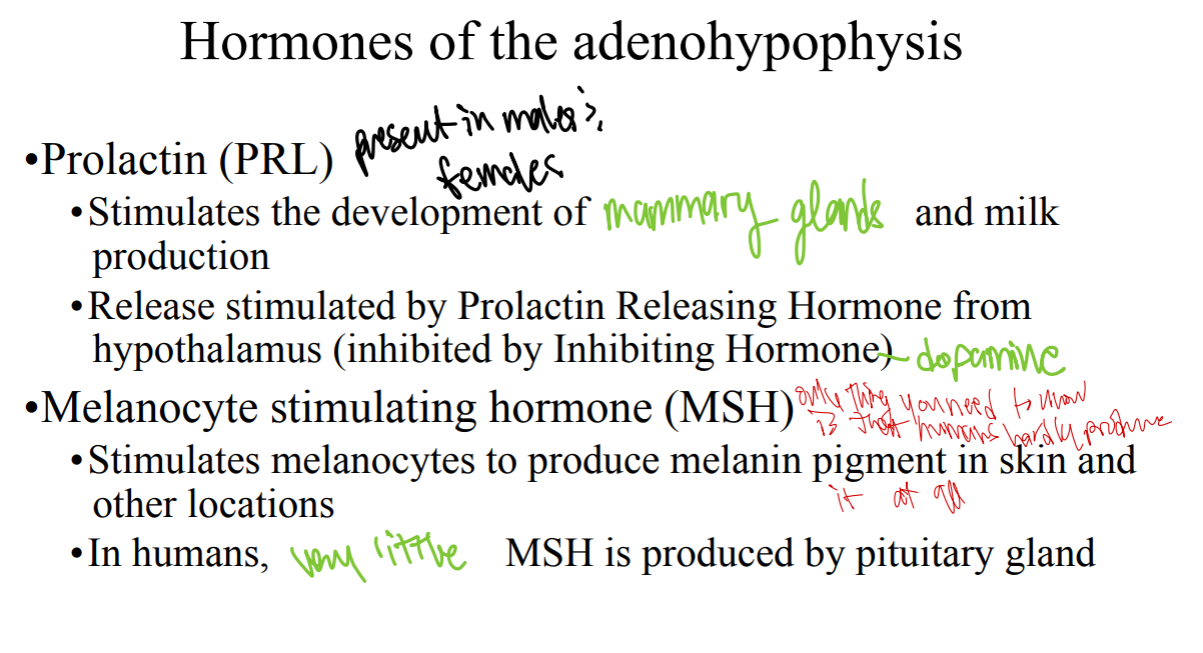
What hormone is being described?
Secreted by adenohypophysis; stimulates melanocytes to produce melanin pigment in skin and other locations
Melanocyte stimulating hormone
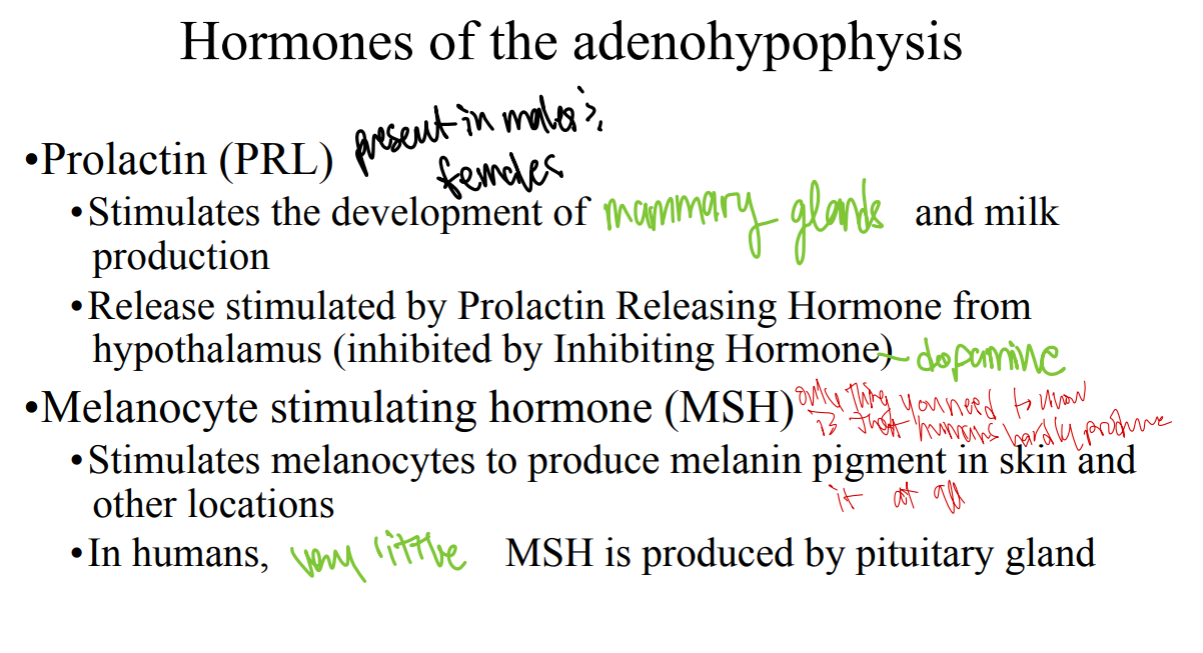
Which hormone do humans hardly produce at all?
melanocyte-stimulating hormone
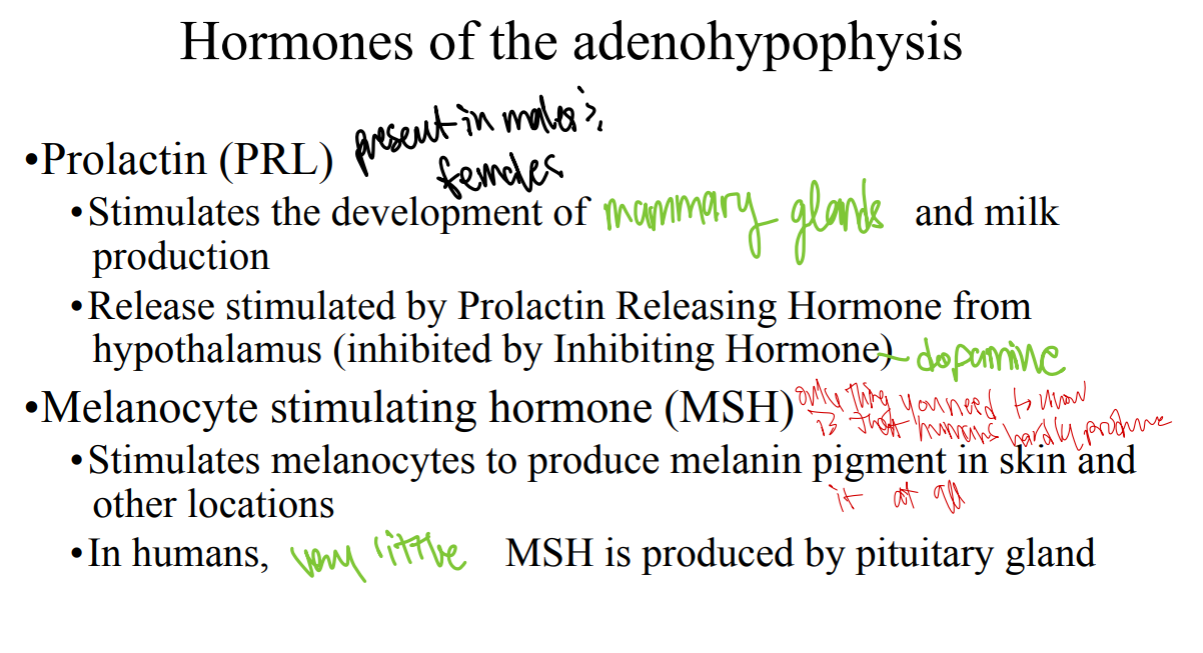
In humans, very little ___ (hormone) is produced by the pituitary gland
MSH
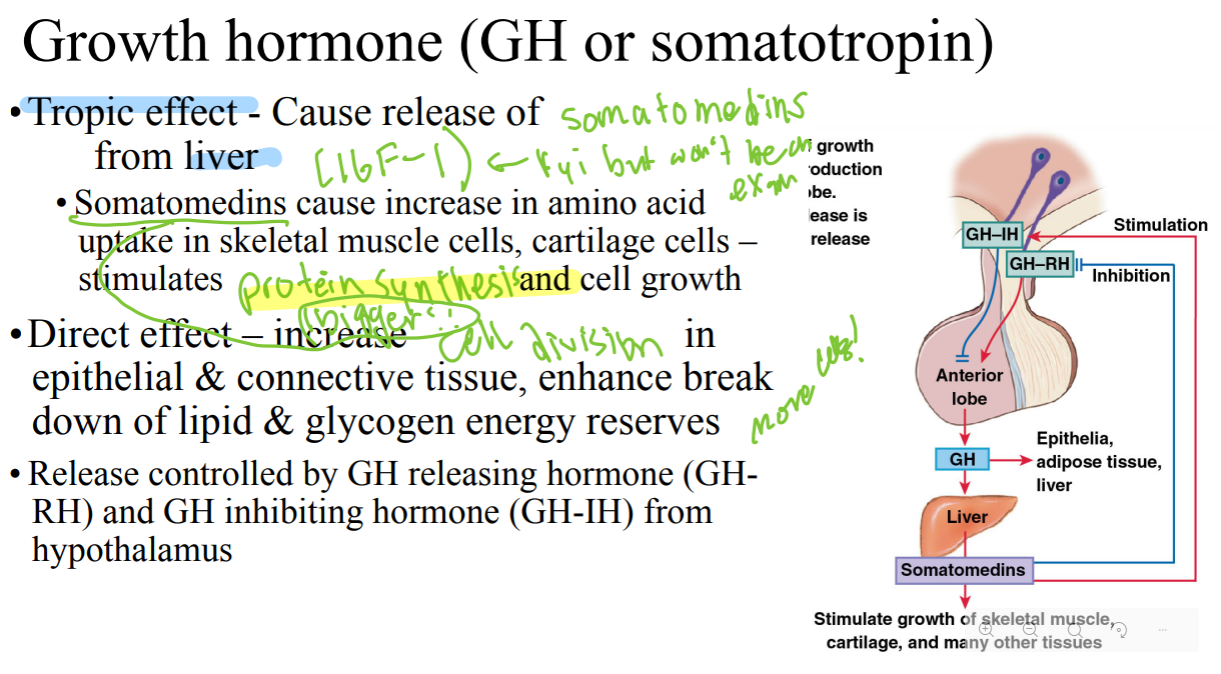
what does it mean to have a tropic effect?
A tropic effect refers to the action of a hormone that stimulates or regulates the activity of another endocrine gland. Instead of acting directly on body tissues (like muscles or liver), tropic hormones target endocrine glands to release their own hormones, thereby creating a cascading effect on the body.
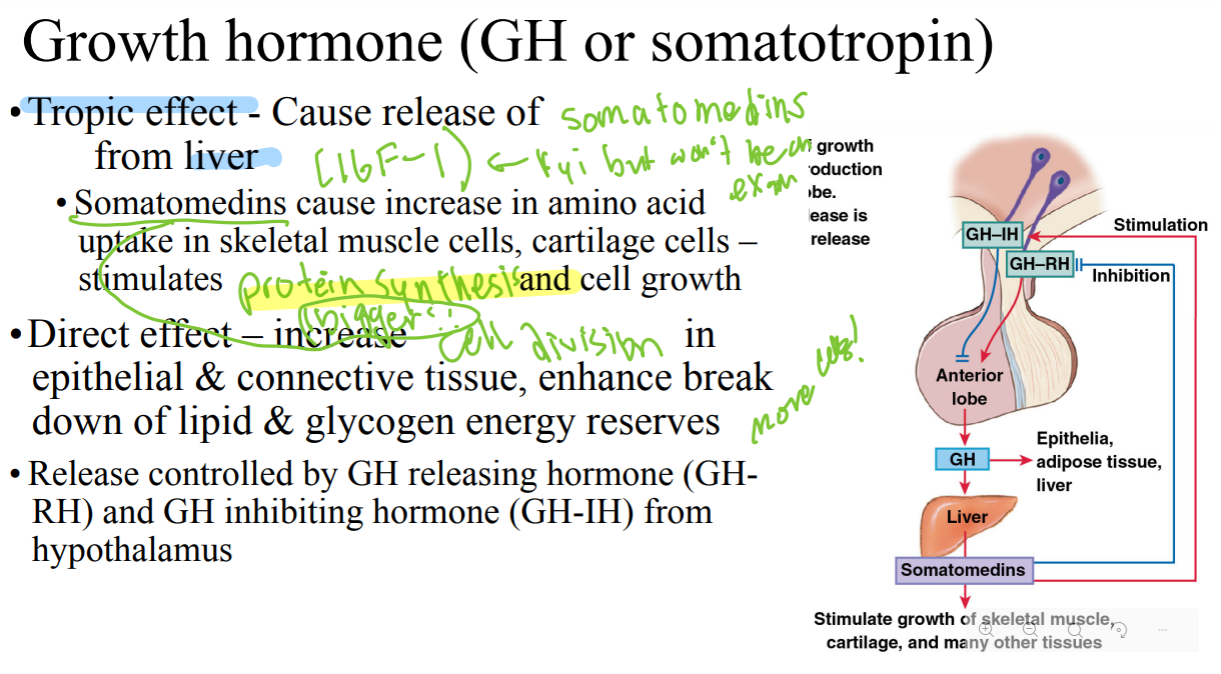
Growth hormone has a tropic effect, meaning what?
It causes the release of somatomedins from the liver
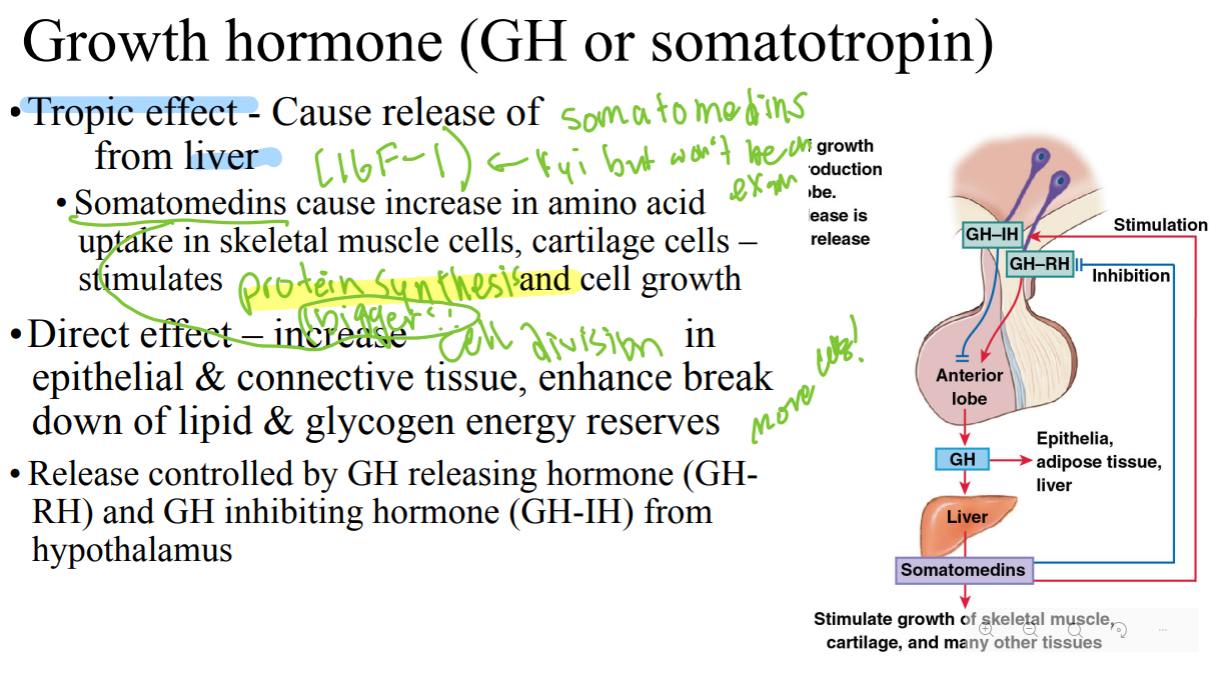
What hormone causes the release of somatomedins from the liver?
Growth hormone
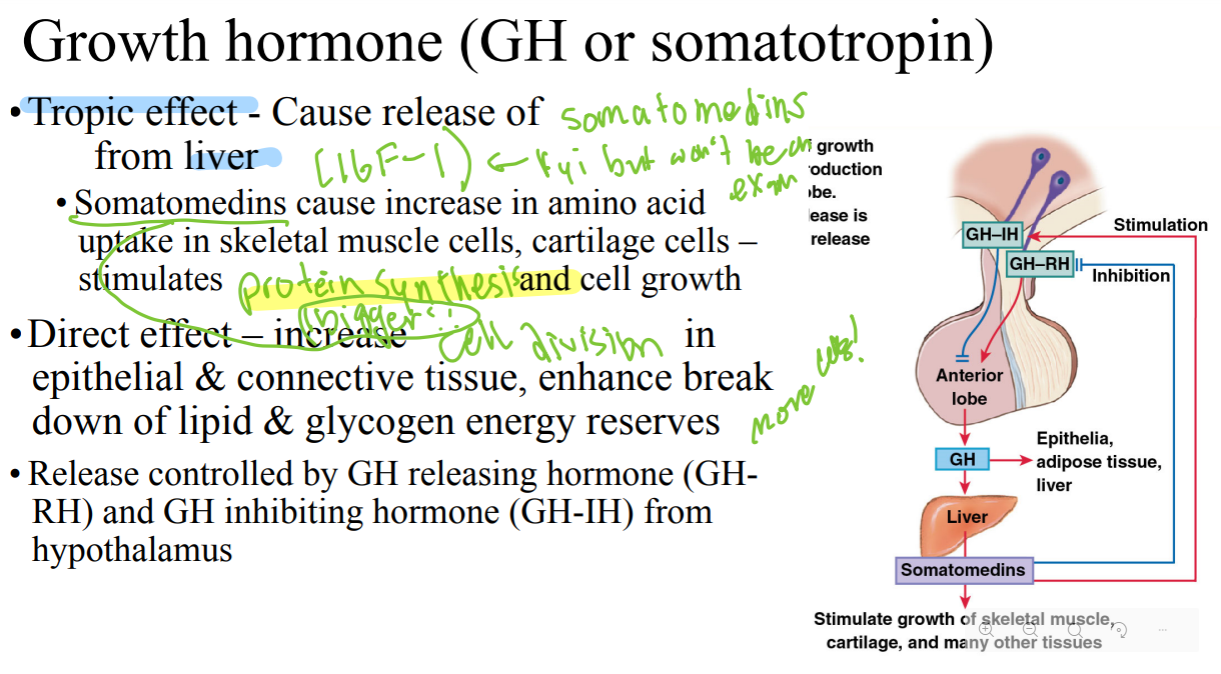
What is the tropic effect and direct effect of growth hormone?
Tropic Effect: Cause release of somatomedins from liver
Direct Effect: Increase cell division in epithelial and connective tissue, enhance break down of lipid & glycogen reserves
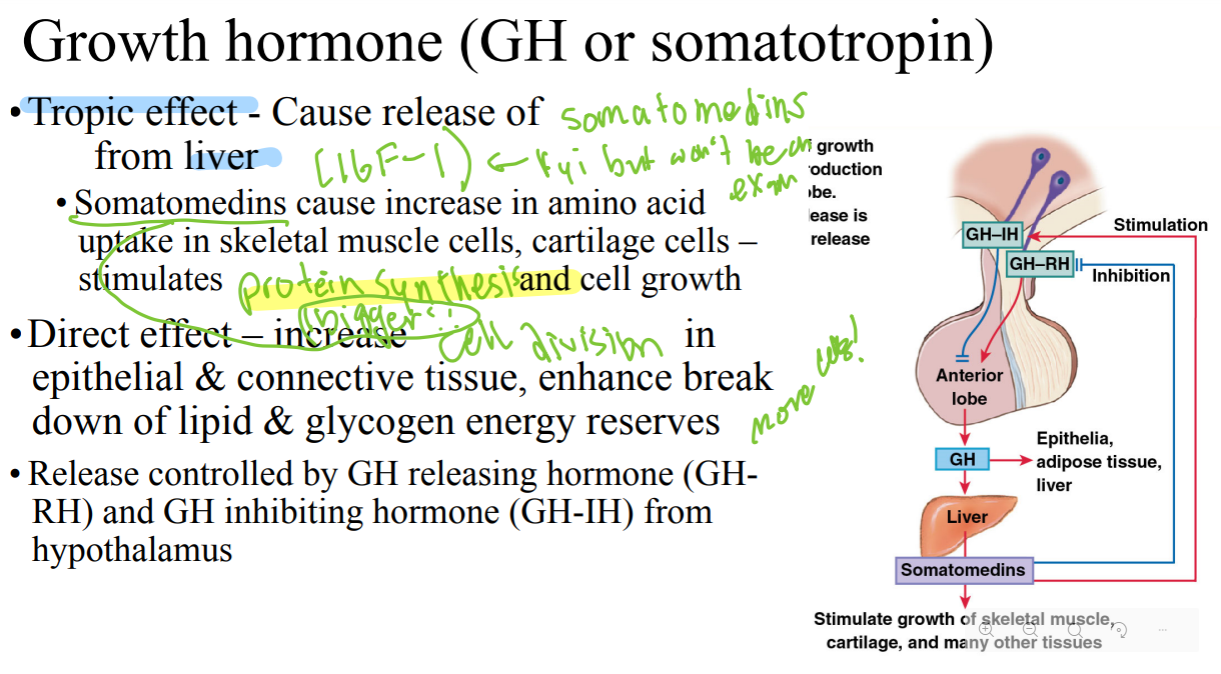
Growth hormone has a direct effect, meaning what?
Direct Effect: Increase cell division in epithelial and connective tissue, enhance break down of lipid & glycogen reserves
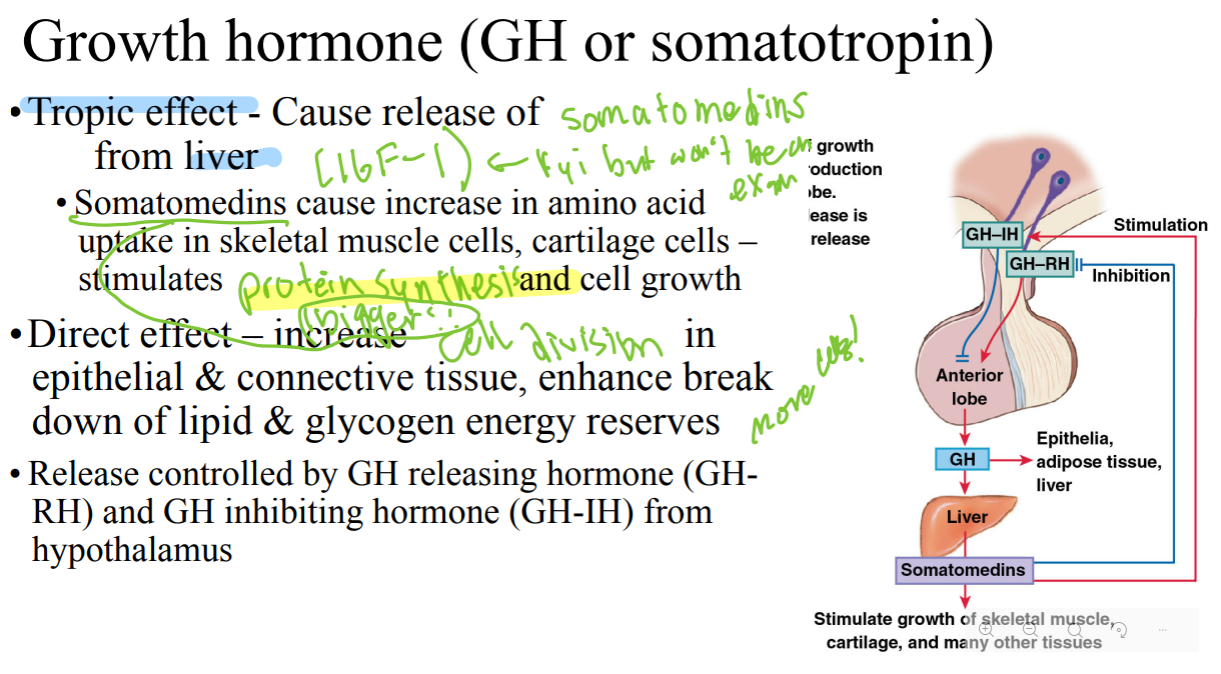
What do somatomedins do?
Cause an increase in amino acid uptake in skeletal muscle cells, cartilage cells — stimualtes protein synthesis and cell growth
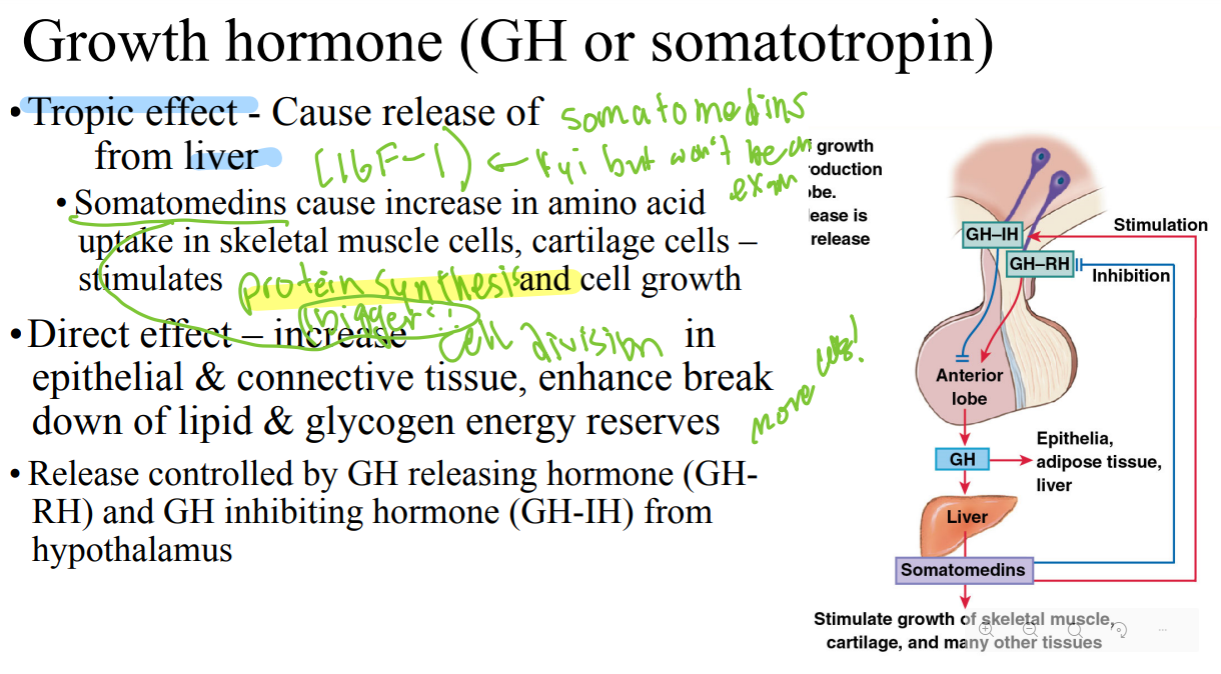
The release or inhibition of GH is controlled by
GH releasing hormone GH inhibiting hormone from hypothalamus
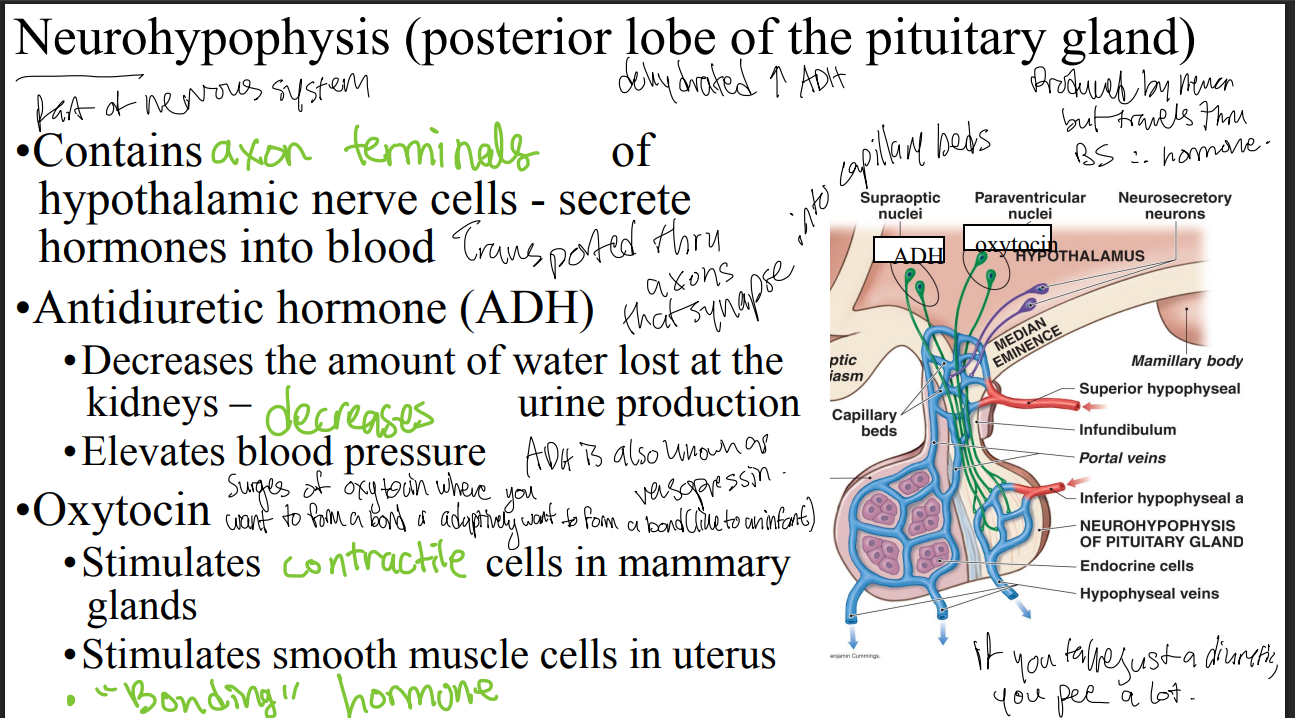
What hypophysis contains axon terminals of hypothalamic nerve cells - secrete hormones into blood?
Neurohypophysis
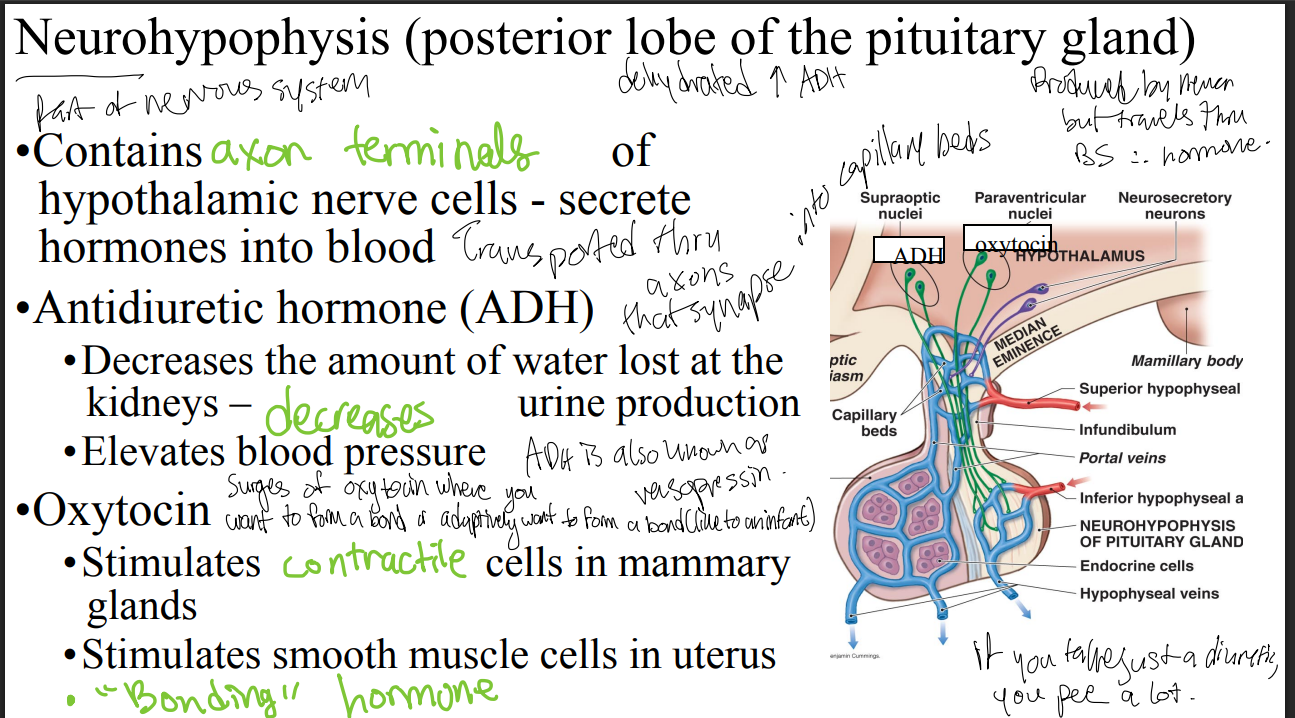
Why are hormones produced by the neurohypophysis considered a hormone if it’s produced by a neuron?
Because although it is produced by a neuron, it travels through the bloodstream.
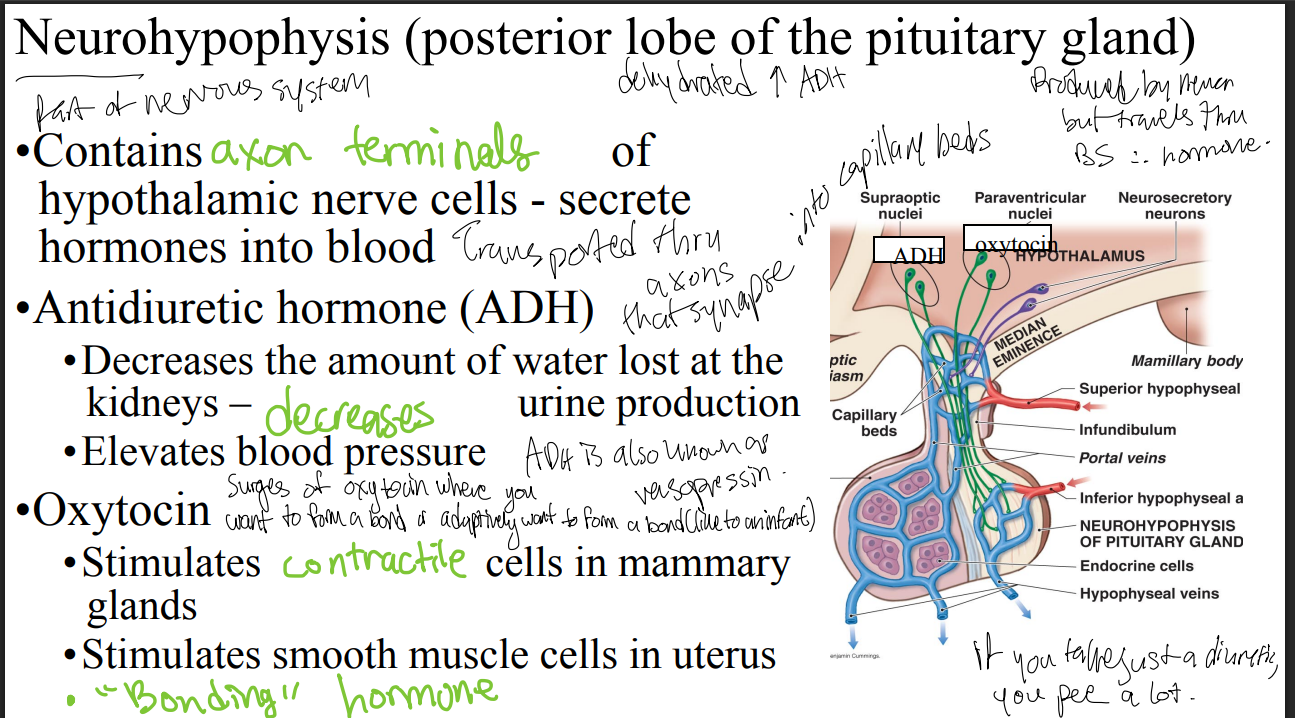
Hormones in the neurohypophysis are transported through axons that synapse into where?
capillary beds
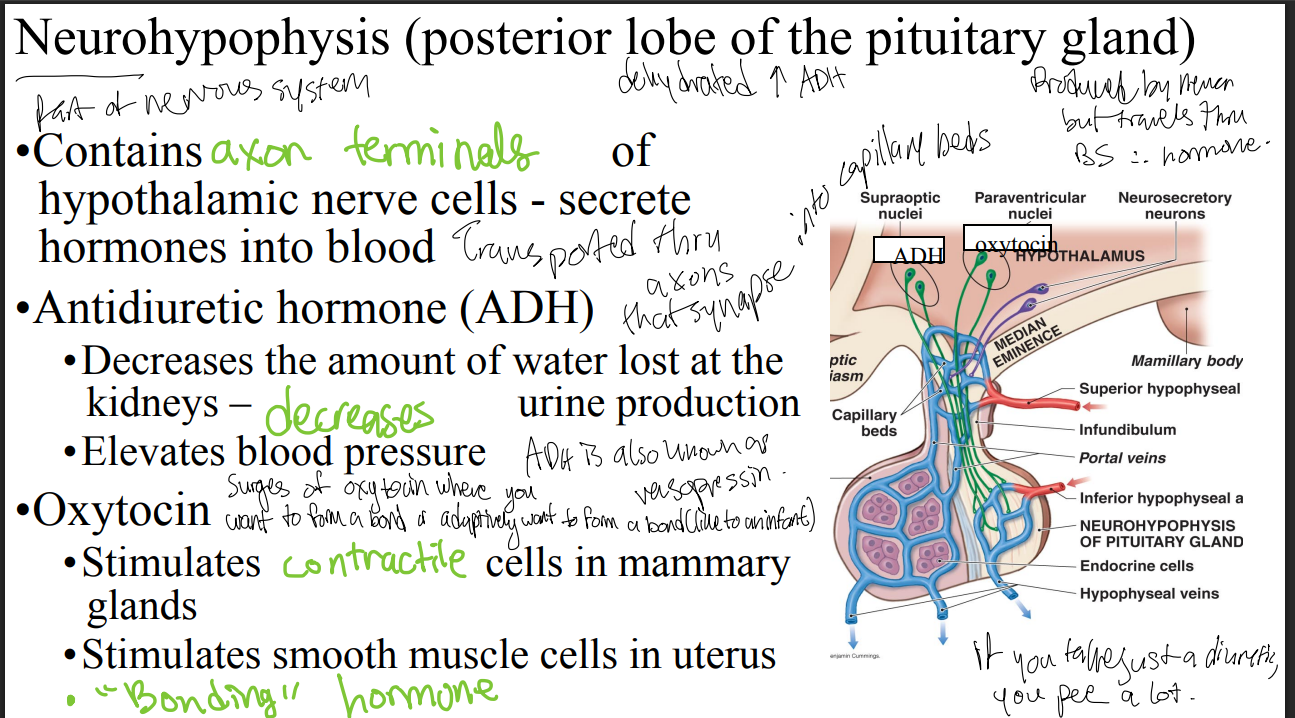
Describe the job of antidiuretic hormone and where it is secreted.
Secreted by neurohypophysis. Decreases the amount of water lost at the kidneys — decreases urine production, elevates blood pressure.
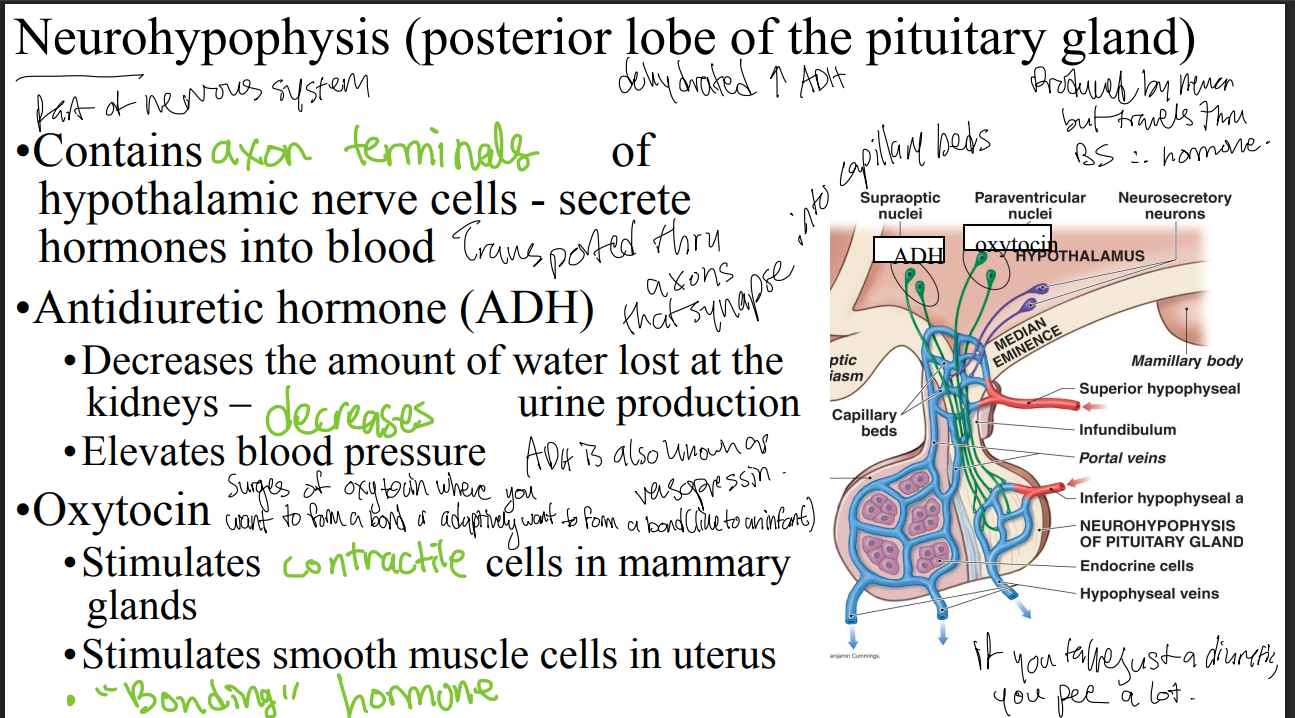
What hormone am I describing and where is it secreted?
Secreted by neurohypophysis.
Decreases the amount of water lost at the kidneys — decreases urine production, elevates blood pressure.
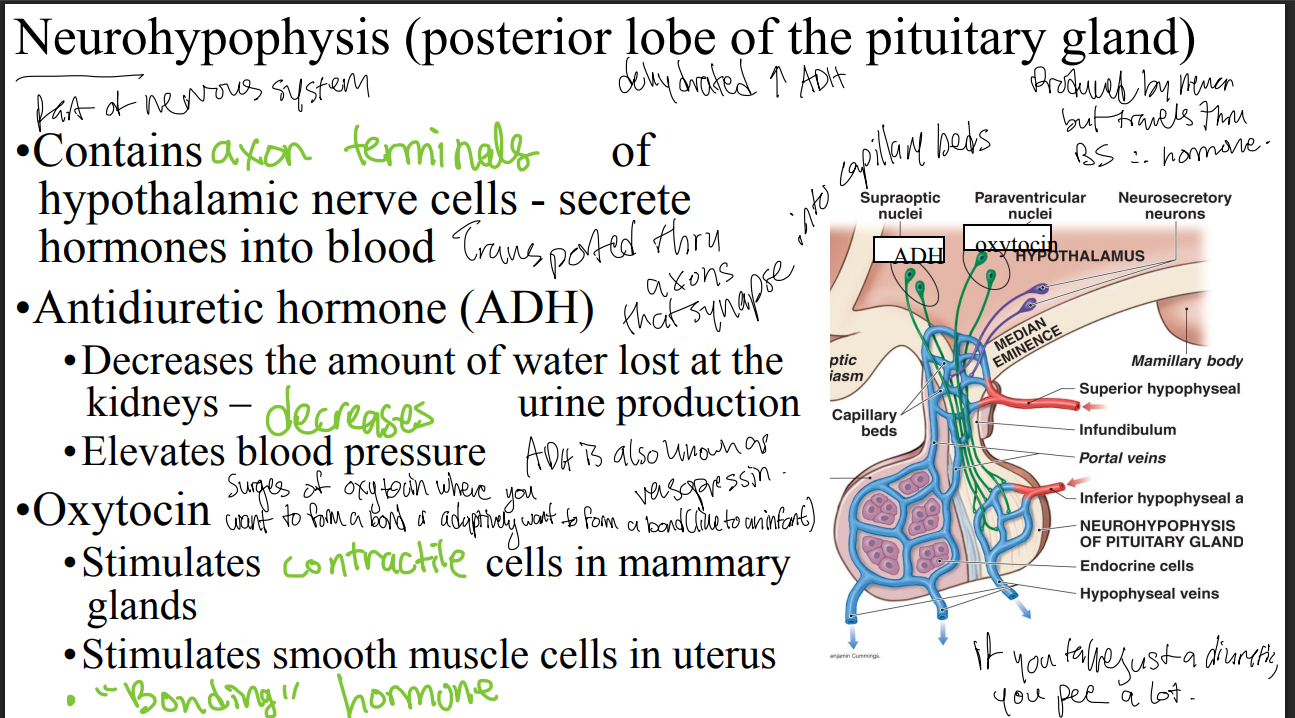
T/F: Antidiuretic hormone increases urine production.
F, it does the opposite.
Decreases the amount of water lost at the kidneys — decreases urine production, elevates blood pressure.
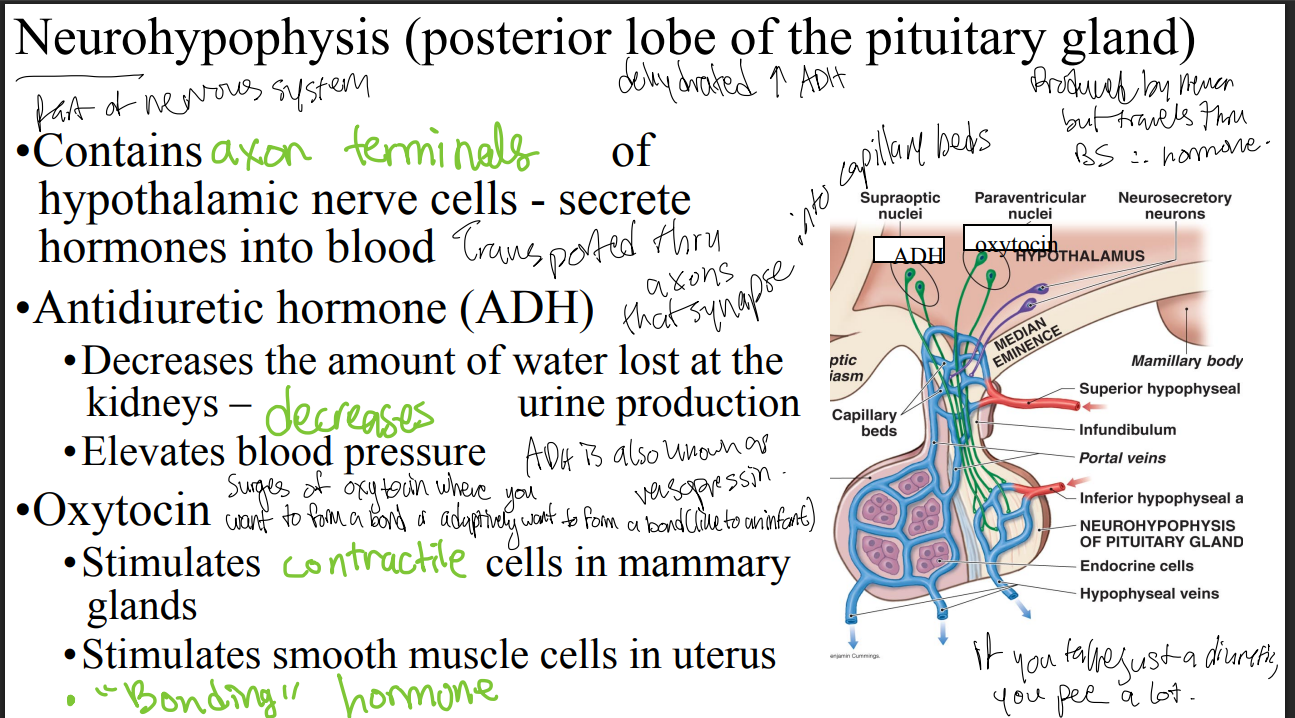
Describe the role of oxytocin and where it is secreted from.
Secreted from neurohypophysis; Oxytocin stimulates contractile cells in mammary glands, stimulates smooth muscle cells in uterus
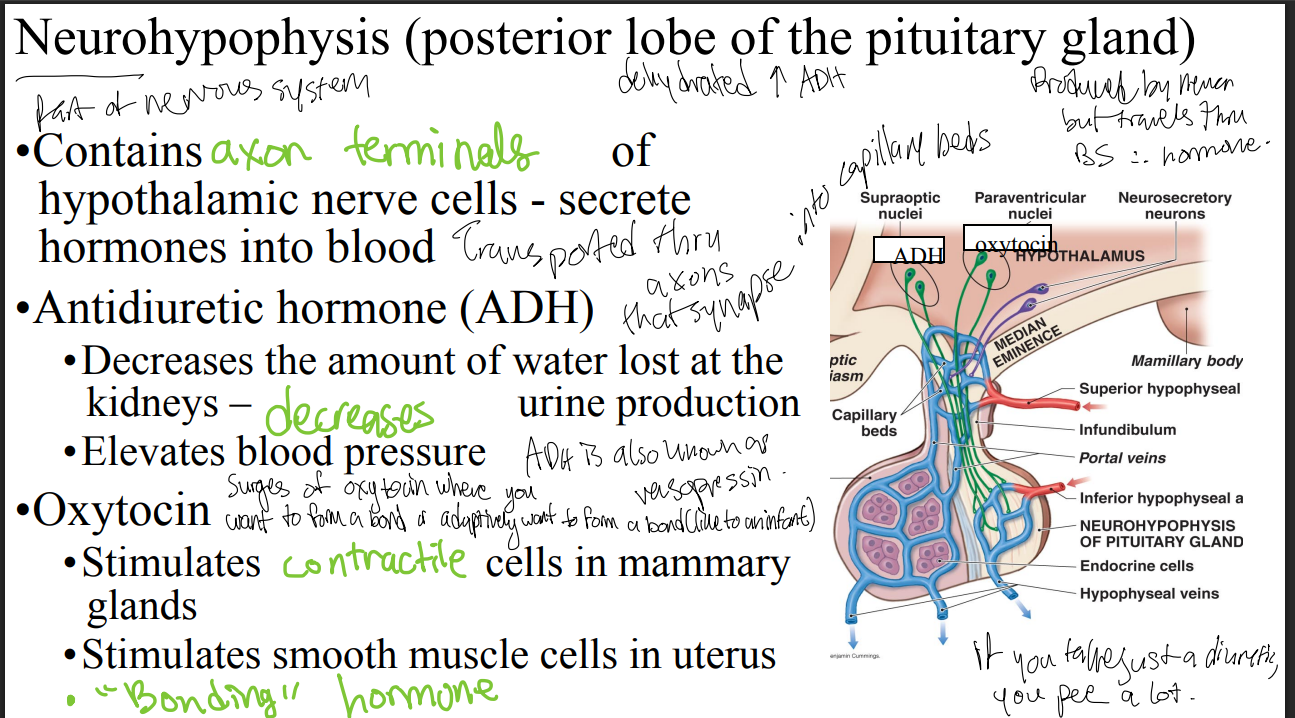
What hormone is being described?
Secreted from neurohypophysis; Oxytocin stimulates contractile cells in mammary glands, stimulates smooth muscle cells in uterus
Oxytocin
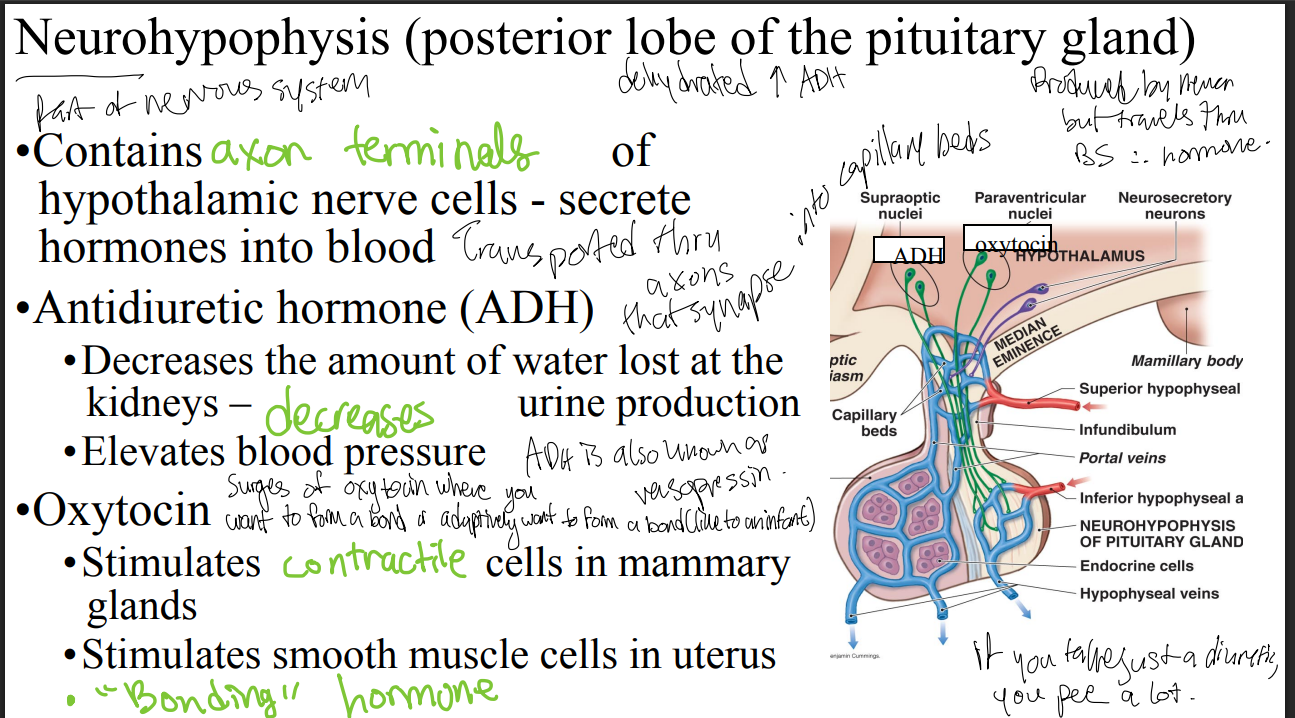
What is known as the bonding hormone?
Oxytocin
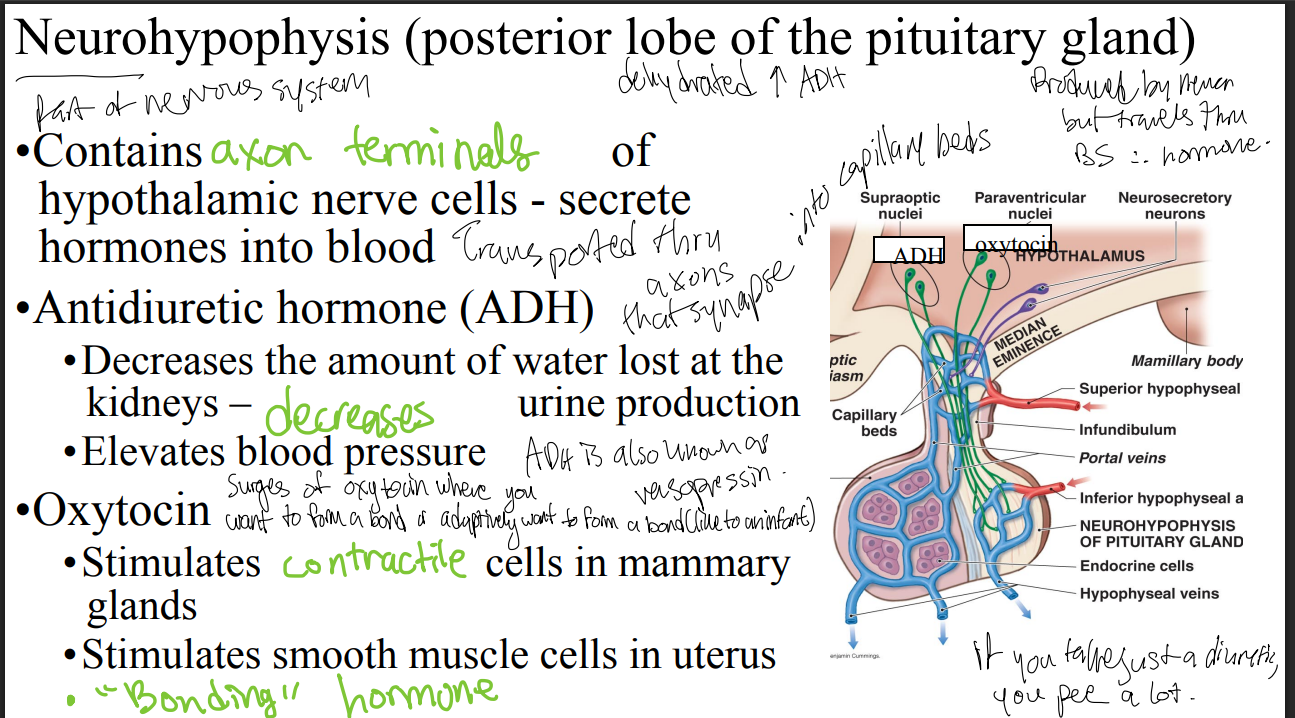
ADH is also known as
vasopressin
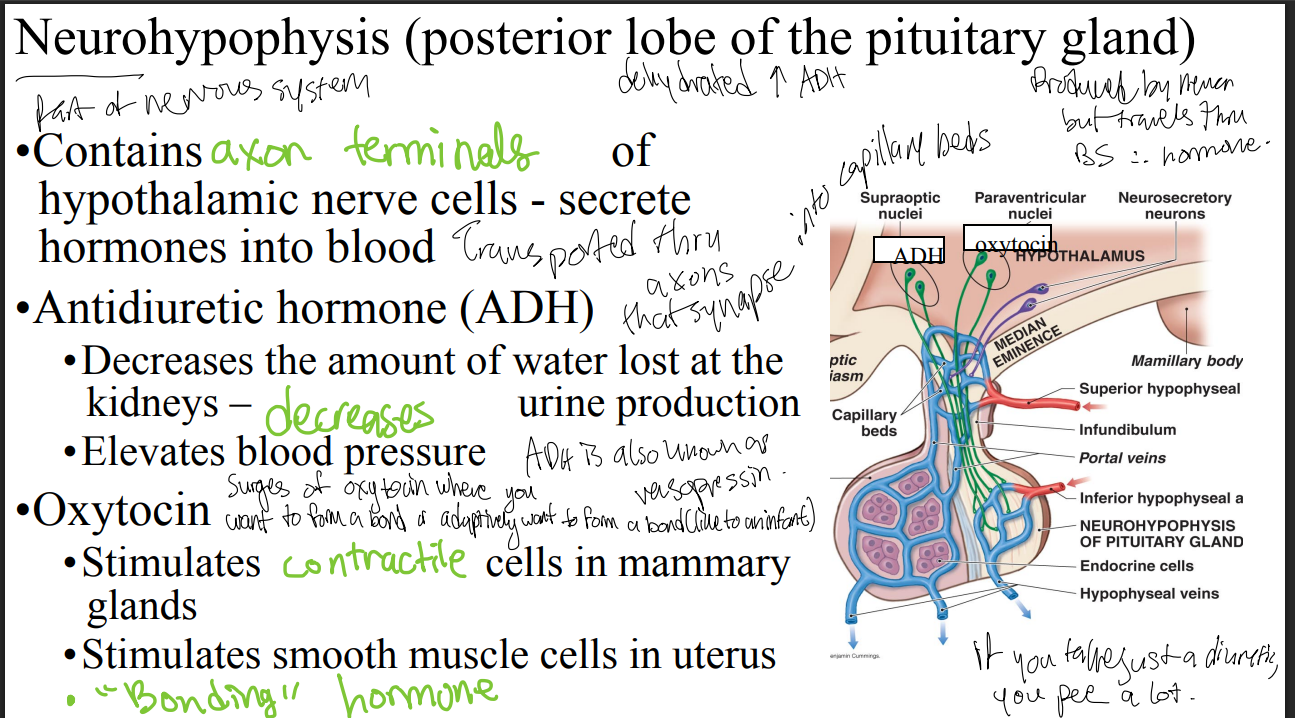
vasopressin is also known as
ADH

If someone takes a diuretic, what do you do more often?
pee
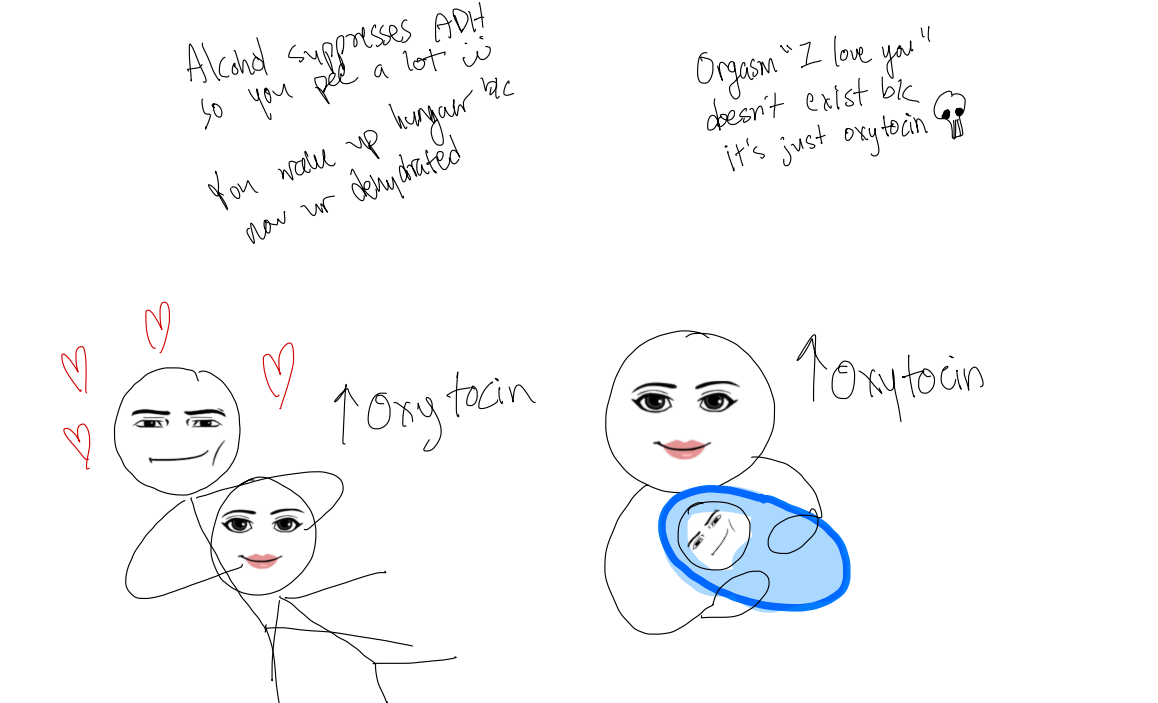
A person drinks a lot of alcohol, does alcohol suppress ADH or enhance it?
Suppresses ADH, meaning you pee a lot.
(antidiuretic hormone prevents you from peeing, so stopping the hormone from doing its job allows you to pee a lot)
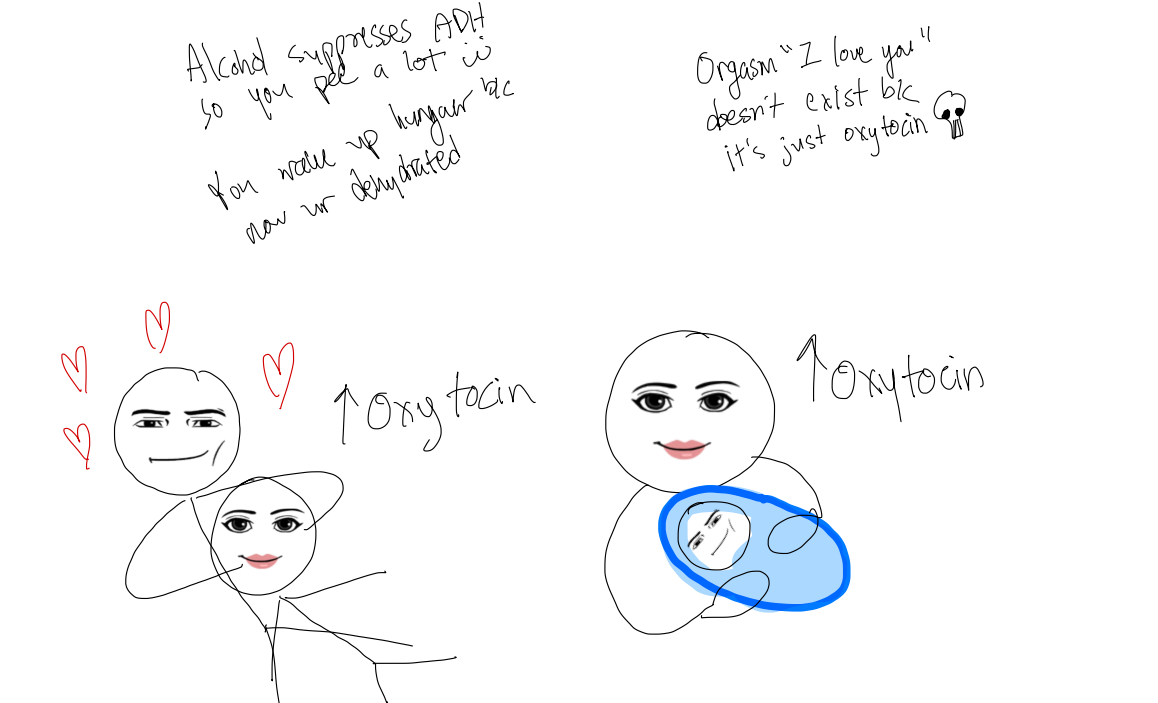
Alexis wakes up hungover from a party, why is she hungover in terms of hydration?
She’s dehydrated from the alcohol, which suppresses ADH (so she pees a lot)
What does anti diuretic hormone do in terms of urine production and blood pressure?
increases urine production and increases BP
Which hormone secreted from the thyroid gland decreases blood calcium levels?
Calcitonin
Which of the following would be expected with a tumor that causes hyperparathyroidism?
Levels of PTH would be elevated
Calcium levels in blood would become abnormally high
Bones would become weakened due to loss of calcium
All of the above are correct
All of the above are correct
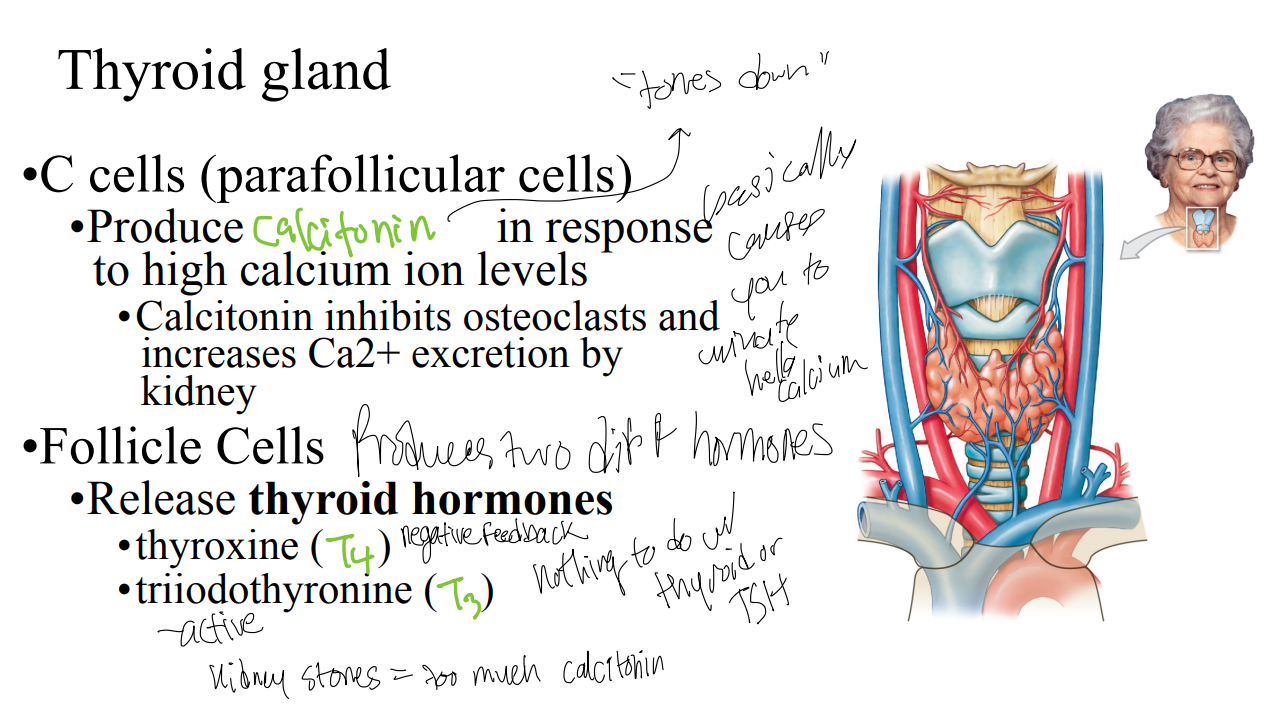
In the thyroid gland, what are C cells? What are they also called?
Also called parafollicular cells. Produce calcitonin in response to high calcium ion levels.
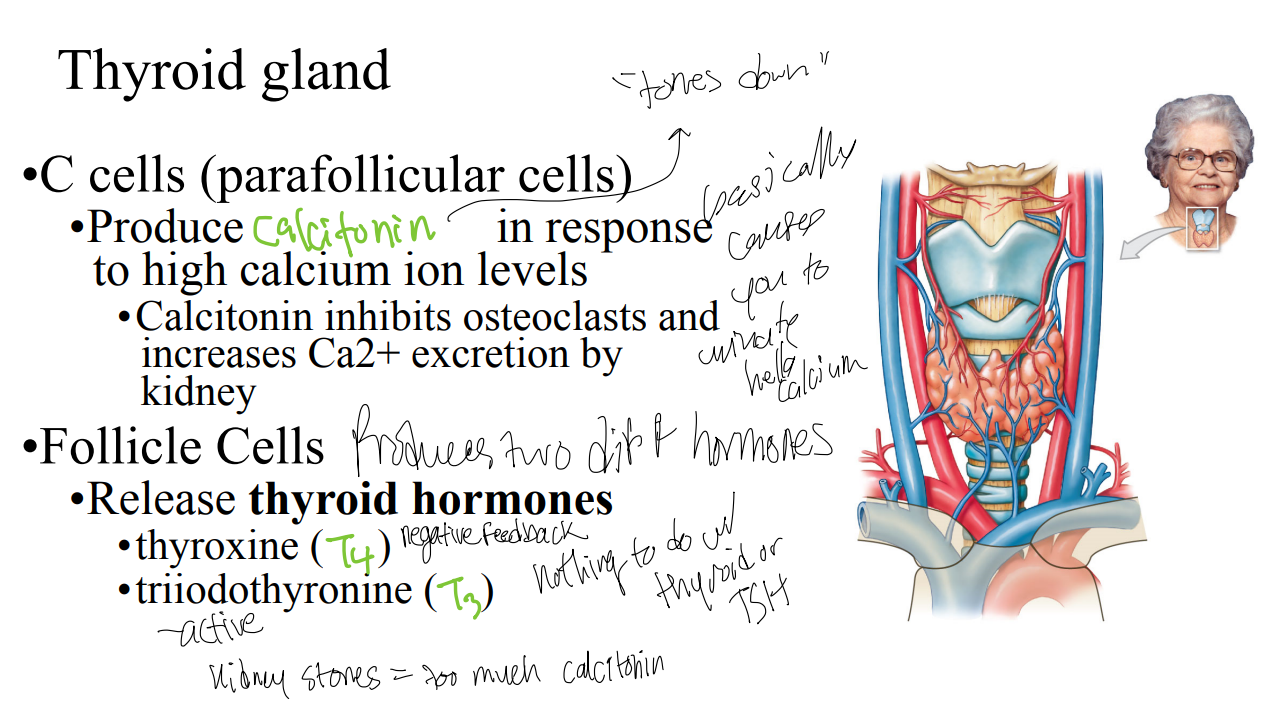
Calcitonin decreases blood calcium levels, but how?
Calcitonin inhibits osteoclasts and increases Ca2+ excretion by kidney
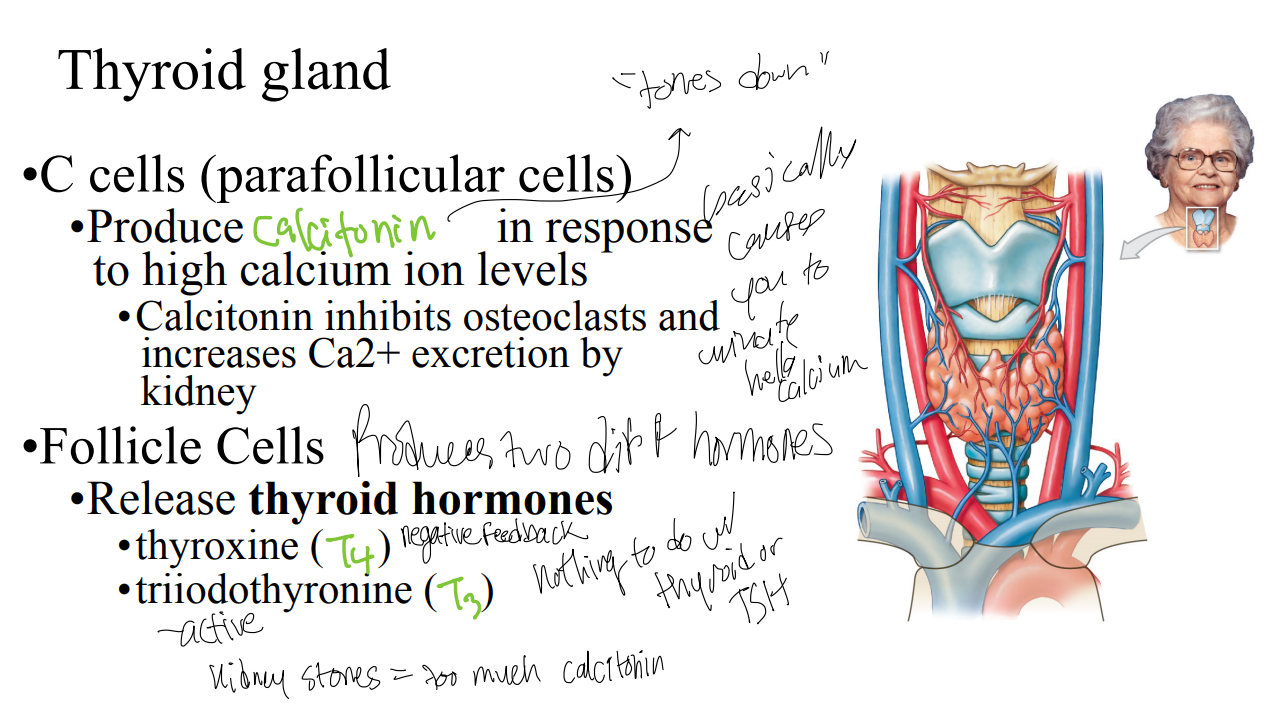
In the thyroid gland, what are follicle cells?
Produce two different hormones. Releases thyroid hormones Thyroxine (T4) and triiodothyronine (T3).
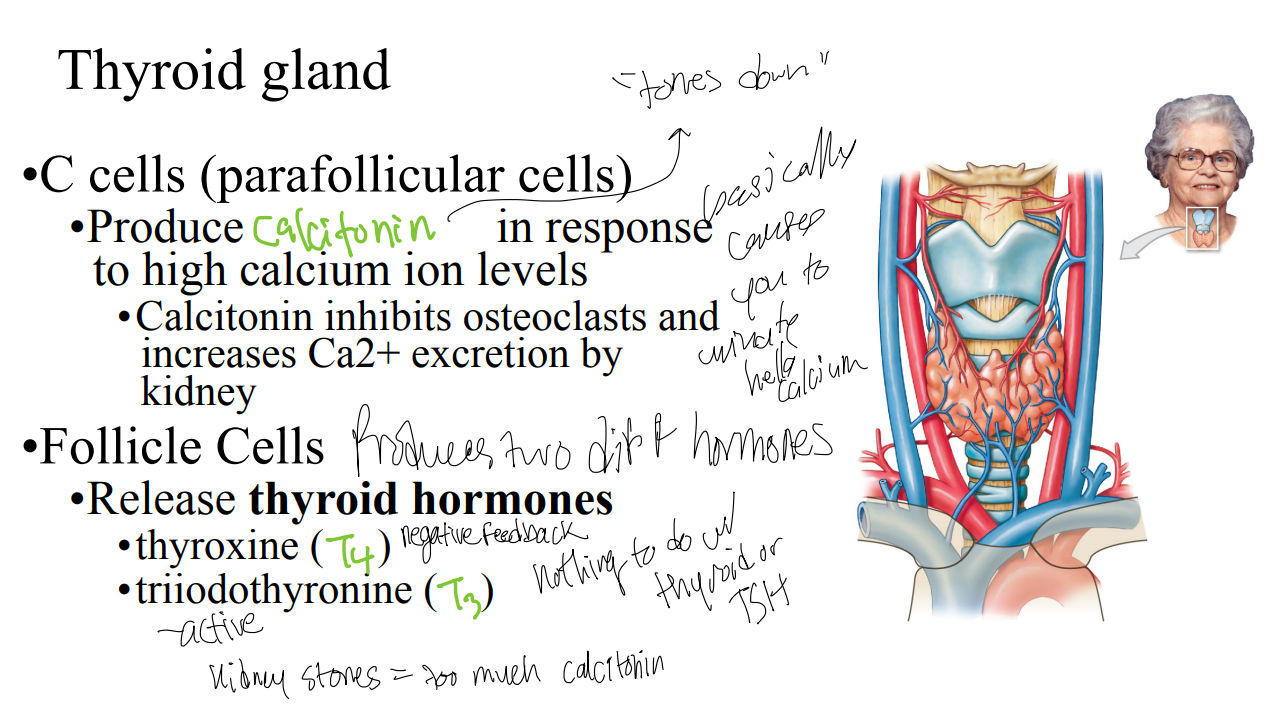
C Cells and Follicle Cells are associated with what gland?
Thyroid gland
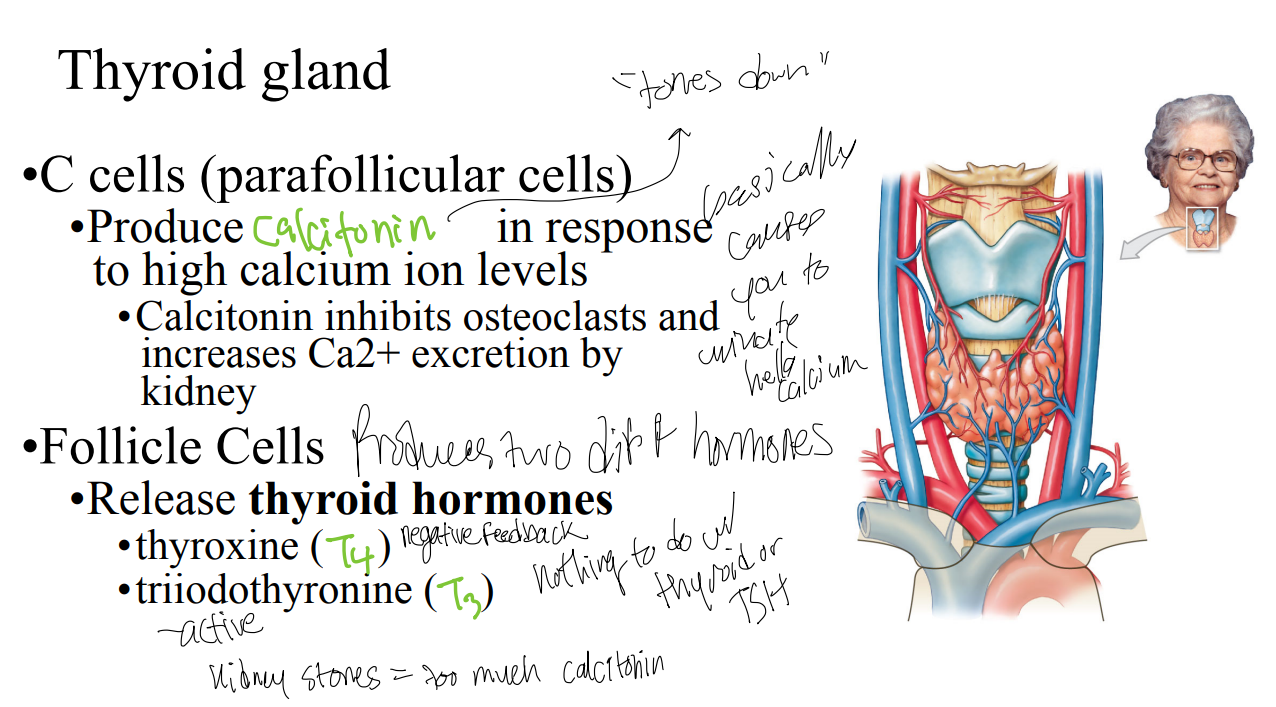
T/F: Thyroid-stimulating hormone does NOT have a relationship with thyroxine and triiodothyronine (thyroid hormones)
T, they have nothing to do with each other.
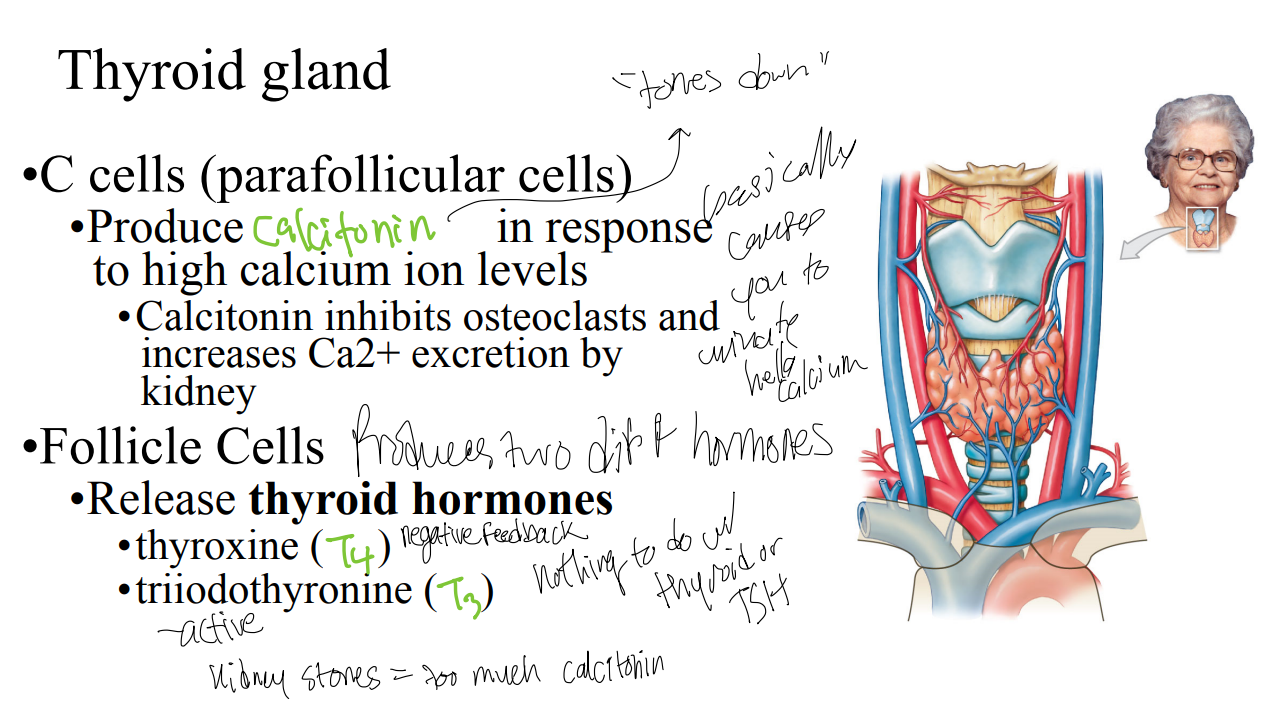
Which cells in the thyroid gland produce two different hormones, thyroxine (T4) and triiodothyronine (T3)?
Follicle cells
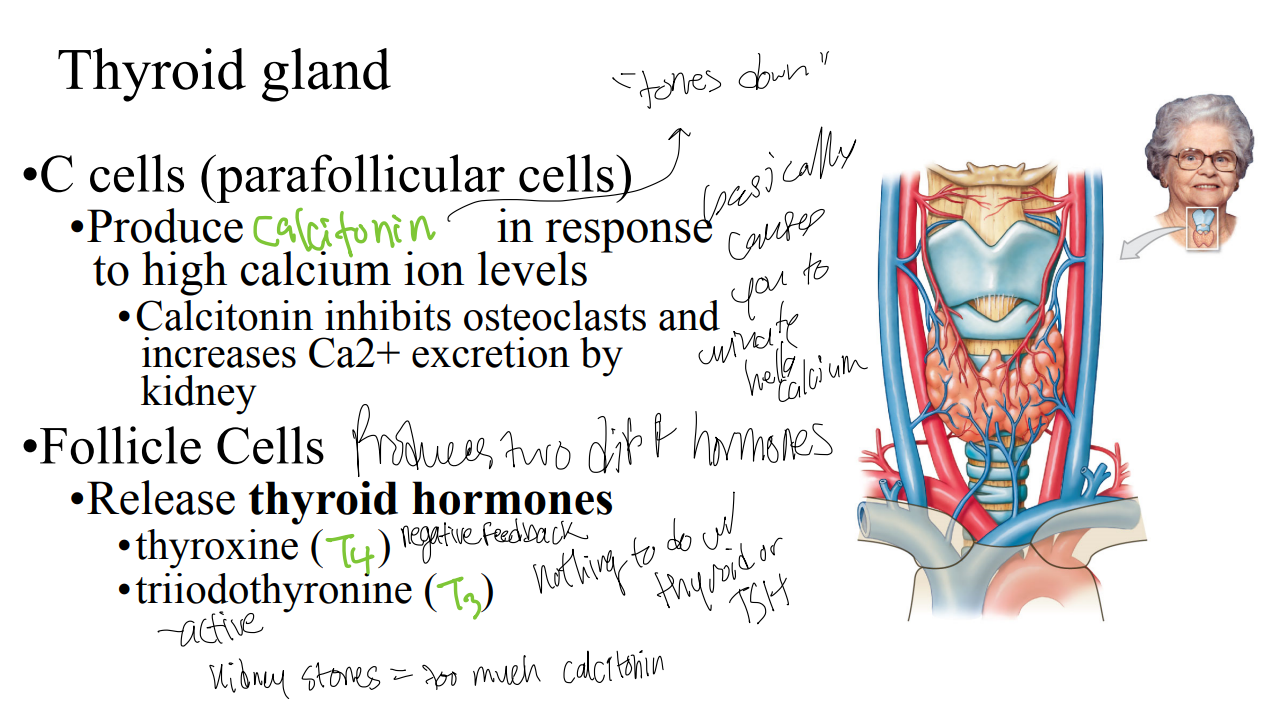
Which glands in the thyroid gland produce calcitonin?
C cells (parafollicular cells)
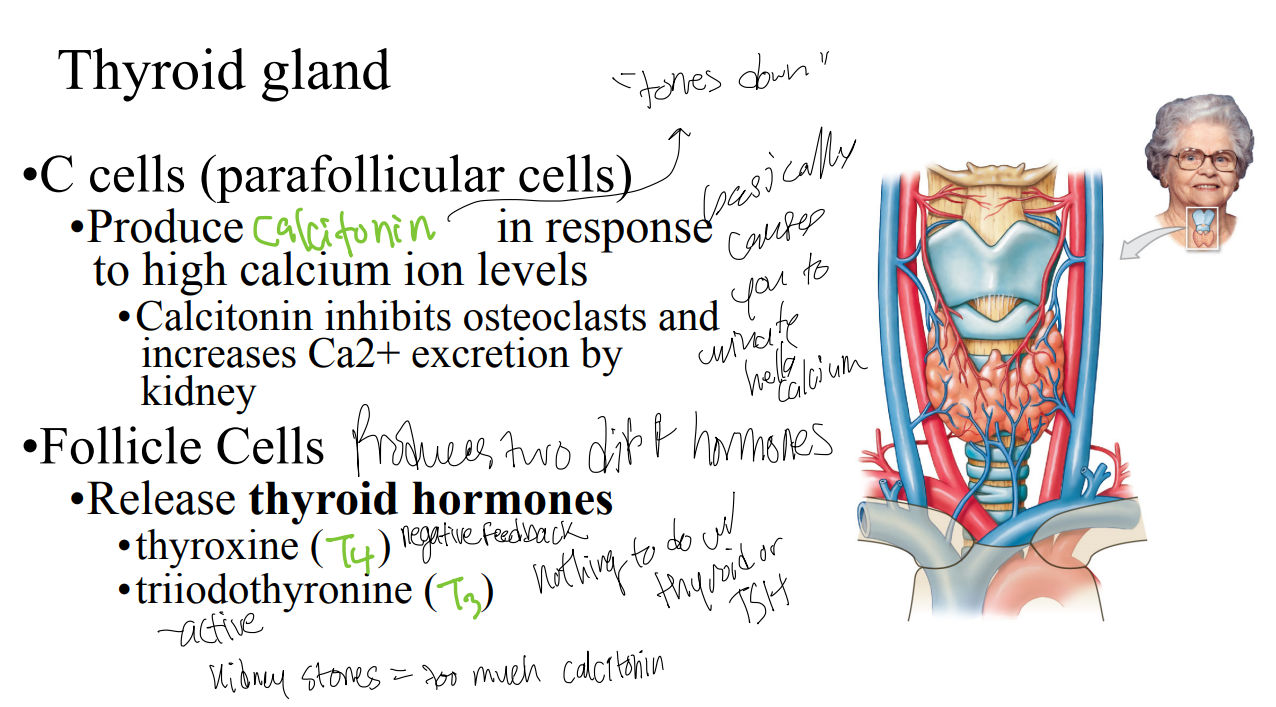
Which hormone, released by C cells, basically causes you to urinate hella calcium?
Calcitonin
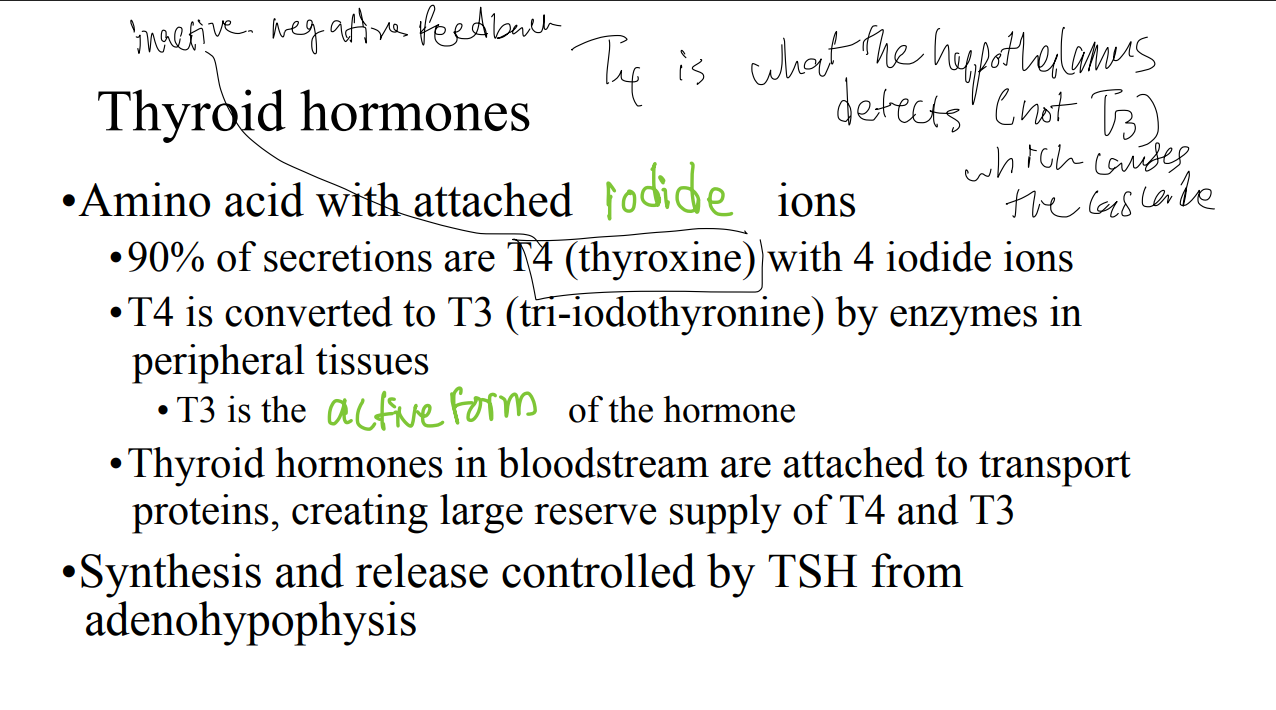
T/F: T4 is what the hypothalamus detects which causes the cascade.
T
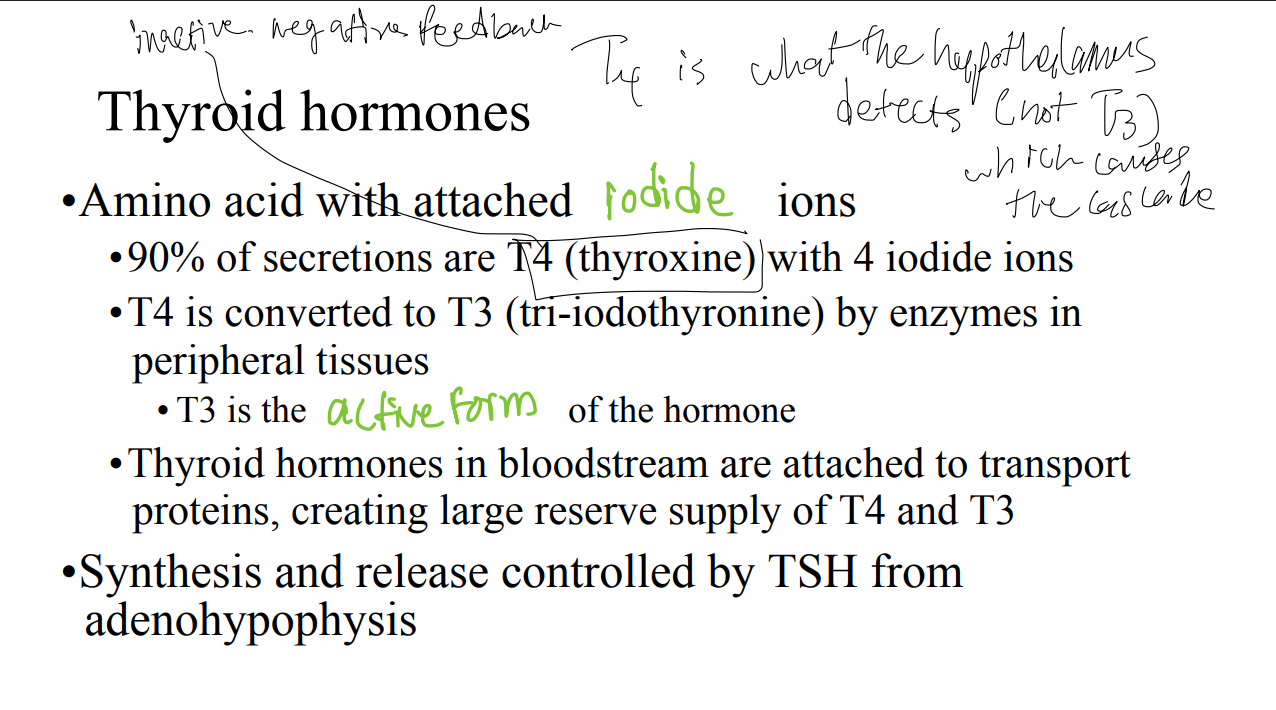
T/F: T3 is what the hypothalamus detects which causes the cascade.
F, it’s T4