Baron-Cohen et al. (Eye test)
 Call Kai
 Learn
Learn Practice Test
 Spaced Repetition
 Match
Match Flashcards
 Knowt Play
1/22

There's no tags or description
Looks like no tags are added yet.
Name | Mastery | Learn | Test | Matching | Spaced | Call with Kai |
|---|
No analytics yet
Send a link to your students to track their progress
23 Terms
theory of mind
the ability to determine the mental states of ourself and other people
→ people with ASD do not have a fully developed TOM → TOM deficit
social sensitivity
the ability to identify and understand social cues and contexts when interacting with others
→ how you understand other people’s feelings
background [2]
In 1997, the “reading the mind in the eyes” test was developed to assess theory of mind to discriminate between adults with Asperger's syndrome (AS) or high-functioning autism (HFA) adults and control adults
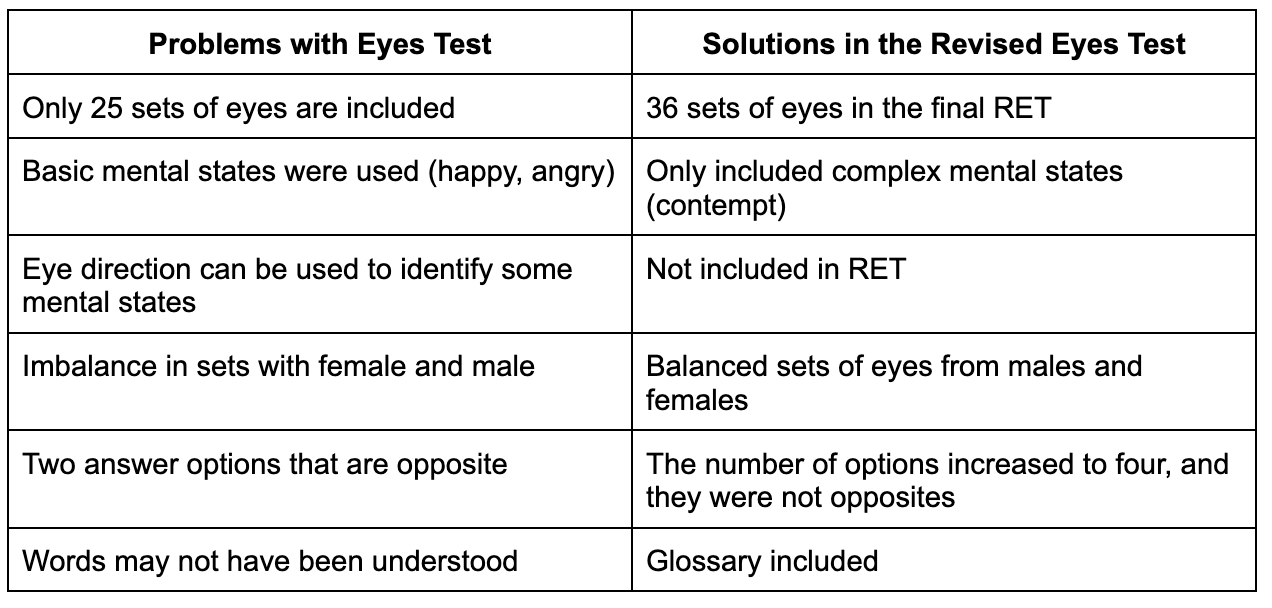
Researchers were unhappy with elements of og study so they upgraded their measures
changes to the test [6]
General aims
To investigate whether scores on the Autism Quotient and the Revised Eyes Test scores are negatively correlated
Aims for ASD Ps [2]
To investigate whether:
ASD adults score lower on the eyes test than other groups, as with previous version of the test
ASD adults score higher on the AQ test
Aims for neurotypical adults [2]
To investigate whether:
females score higher than males on the RET
males score higher than females on the AQ
research method
laboratory experiment
research design
independent measures, correlation
data collection technique
questionnaire: AQ test and RET test
IV
whether Ps have:
ASD or not
male or female
DV/co-variable
score on RET and AQ
Sample [4]
G1: ASD adults
15 male
volunteer sample
G2: general population control
122 neurotypical
opportunity sample from education classes and libraries
G3: students
103 students from cambridge uni → opportunity sample
53M & 50F
G4: IQ matched
14 with IQ matched with G1
random sampling
procedure: eye test development [5]
8 independent judges trial the test
items were accepted if target word is selected by 5/8 judges
items were rejected if the foil is selected by >2 judges
test were trialled on G2 & G3, items were accepted if >50% selected target word & <25% picked the same foil
4 items were rejected → 36 items on the RET
procedure: taking the test [4]
Ps take the RET individually in a quiet room
no time limit
G1, 2, 4 completed the AQ then read through the glossary and they can ask question if needed
G1 also identify the gender
controls [2]
test were administered in the same way (quiet condition + glossary)
all items are in the same size, black n white, with 4 options & three foils
ethical issues [2]
lack of understanding in the words/emotions can lead to distress
Ps in G2-4 may need referall for more detailed assessment if received extreme scores
results [6]
negative correlation (-0.53) between the AQ scores and the RET for all 3 groups
G1 scores significantly lower in the RET than other groups
no impairments in gender identification for G1
G1 scores significantly higher in AQ than G3 and 4
males scores higher on AQ than females
females score higher on RET than males
conclusions [2]
the RET is:
a more sensitive test for social intelligence than og test
can be used as measure for severity of autistic traits due to negative correlation to AQ
strengths [2]
reliability: high controls & standardisation
validity: due to changes made to the Eyes test- 4 options, equal female and male eye pairs shown, glossary provided to Ps
weaknesses [2]
validity: low mundane realism → in real-life, the eyes are not static and the picture do not reflect human emotions
generalisability: only males were used in the ASD group, this means that the study may not be able to generalise to females with ASD
I&D: individual vs situational
Supports individual side
-> ASD is an individual difference that can affect the performance of one person on the RET
I&D: Application
The RET can be used in schools to identify students who struggle with theory of mind skill -> suitable intervention to improve this skill