2.2.8 COGNITIVE Bias and Decision
 Call Kai
 Learn
Learn Practice Test
 Spaced Repetition
 Match
Match Flashcards
 Knowt Play
1/43

Earn XP
Description and Tags
Analyse how biases are defined against standards of rationality a) Norms, bounded rationality, adaptive value, ecological rationality Understand the fundamentals of expected utility theory b) Utility vs Value, Expected Utility Theory, E = U*p, uncertainty in decision making Understand how heuristics exploit environmental structure c) Recognition heuristic (and when it works) Critique the idea that biases are flaws in reasoning d) Confirmation bias and positive test strategies, Wason's 2-4-6 task, communicative interpretation of the Linda problem Recognise dual-process theories e) System 1 / System 2
Name | Mastery | Learn | Test | Matching | Spaced | Call with Kai |
|---|
No analytics yet
Send a link to your students to track their progress
44 Terms
rational choice theory (RCT)
several versions of RCT but most indicate that to be rational one will calculate costs and benefits
therefore rational decisions → wld maximise the benefit e.g. economic agents shld maximise value or utility
norms are considered an important aspect of rationality
rationality
is a set of norms
be consistent → coherence
correspond to reality → correspondence
norms = rules of action or thought which define optimality
nobody can agree on a complete set of norms for reasoning
fairness norms + rational choice theory (Opp,2013)
not line with a narrow concept of rational choice theory (Opp, 2013) as they do not maximise benefits rather the benefits rather than the benefit is shared
norms fall short of explaining RCT and so shld norm following be argued as irrational
two biases
availability bias
framing bias
availability bias
over-estimating the frequency of plane crashes (rare or memorable events)
framing bias
switching your decision based on the question framing (e.g. would you buy another ticket if you dropped it on the way to the cinema vs if you dropped £10 on the way to the cinema)
coherence error
correspondence error
violates norms of rationality
which errors correspond to the biases
coherence
correspondence
coherence error corresponds to…
framing bias
correspondence error corresponds to…
availability bias
rationality + probability
to make rational decisions in situations of uncertaintly we may be expected to understand probability
maximise expected value
linda task
linda task:
linda is 31yo, single, outspoken, v bright. she studied philosophy at uni. as a student, she was deeply concerned w issues of discrimination and social justice, and also participated in anti war demonstrations.
which is more likely:
linda is a bank teller
linda is a bank teller and is active in the feminist movement
Tversky et al., (1983)
violation of norm and conjuction fallacy
option two must be less likely than option one bc option 2 is a subset of option 1, and option 2 requires two things to be true whilst option 1 only 1
most ppl intuit option 2 is the answer, in defiance of the norms, specifically the laws of probability.
most Ps make a conjunction fallacy as they have made error in reasoning by assuming that specific conditions are more probable than a single, more general condition
stanford grad school of business error on linda task
made 85% error on linda task despite having taken several advanced courses in probability, stats, and decision theory
conjunction fallacy
an error made where ppl judge that the probability of A + B events occuring is more likely than A occuring, despite that fact adding more info = lower prob
decision calculus
how we shld make rational decisions:
logical
probabilities
systematic consideration of all options
probability and decision making: two key considerations
value and utility
why it is difficult to make decisions
future uncertain
need to assess potential risks and benefits
choose a course of action to increase the chance of a positive outcome
need to use knowledge to estimate probabilities of future events
rationality: probability based on…
value
rationality, probability based on value. in monetary terms:
expected value `(value investment will have in future)
good bet is one for which the expected value is greater than the amount invested
bad bet is one for which the expected value is less than the amount invested
rational choice wld be to maximise expected value
tendency of ppl to accept a sure outcome over a riskier outcome = risk aversion
monetary value NOT always most important factor in dec making
expected utility theory
theory of decision under risk/uncertainty
each option leads to one set of outcomes
where p is known
individuals place subjective value utility on outcomes
EU = weighted avg of satisfaction from possible outcomes
w accumulating evidence, EUT became a theory of norms (model of how ppl ought to choose) and rationality
Bernoulli (1738)
suggests that the value of a gamble to an individual =/= to its expected monetary value
developments in non-expected utility theory
behaviour not always in like w EUT- does that make us irrational decision makers?
expected utility theory + rationality
calculating the option with the highest expected utility is a decision making method
rational decision making = assume choose option that maximises our utilit
value = utility? true or false
value is not utility
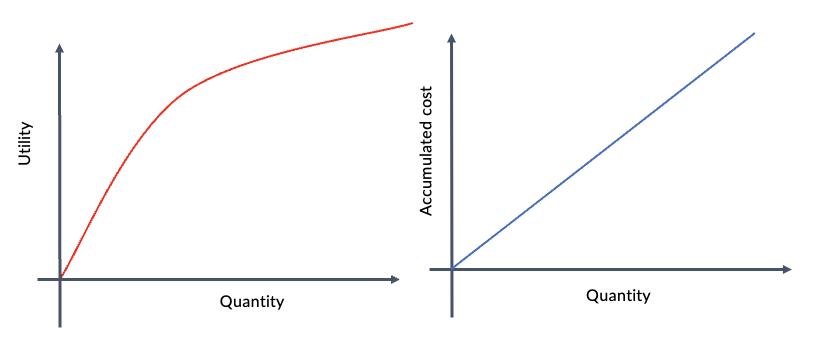
marginal utility
the additional satisfaction gained by a unit of goods/services
the diminishing marginal utility of wealth
as amt of money one has increases, each addition to ones fortune becomes less important, from a personal, subjective pov
an extra 1000 means little to Bill Gates, quite a lot for uni student
why is value not the same as utility?
bc of marginal utility
and
utility is compressed with respect to value (u do not enjoy 10 pizzas 10x more than 1 pizza, altho 10 pizzas costs 10x more than 1 pizza)
utility = how much u enjoy/prefer it- the degree to which it contributes to overall wellbeing/satisfies ur desires
one way of measuring utility is willingness to pay
according to EUT, ppl shld behave to maximise expected utility
utility
how much u enjoy/prefer it- the degree to which it contributes to overall wellbeing/satisfies ur desires
utility =/= value example
option a: coin flip- heads win £1k, tails win 0
option b: no coin flip = £499
expected value b = 499, expected value a = 500, but most will still opt for b
utility attached to first 499 greater than additional 501
what effects expectation?
uncertainty
uncertainty effects expectation- thought example
if wld pay 10 for pizza, how much wld u pay for
10% chance to win a pizza
a pizza which had a 1/100 chance of making u sick
calculating expected utility
E = p x U
Expected Utility (E) =
Probability (P) x Utility (U)
calculating expected utility under multiple options
E = p1 x u1 + p2 x u2, etc
EU (E) needs to exceed cost
effect of uncertainty
everything is uncertain, question is how much
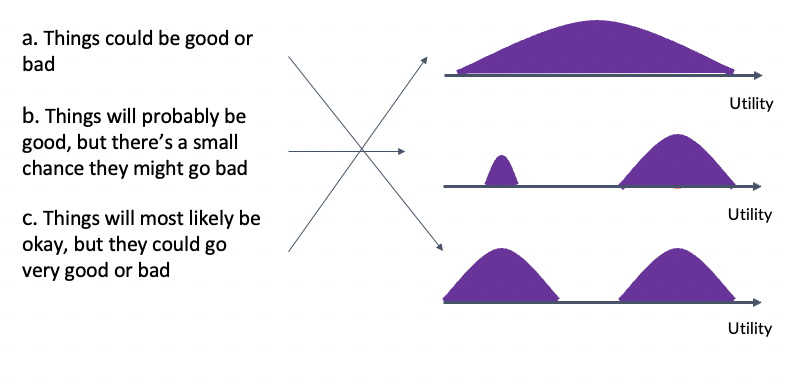
uncertain neutrally = 2 low and high normal distributions of utility
probably be good, small chance go bad = tiny nd over low, regular nd over high
probably be ok, but cld go very good or bad- giant, flatter nd over whole u graph
do we use norms, probabilities and EU in real world decision making?
evidence suggests we are not as rational as we are not very proficient at probability, and we do not always choose the optimal outcomer