Unit 2.1 Intro to Chem for Biologists
 Call Kai
 Learn
Learn Practice Test
 Spaced Repetition
 Match
Match Flashcards
 Knowt Play
1/98

There's no tags or description
Looks like no tags are added yet.
Name | Mastery | Learn | Test | Matching | Spaced | Call with Kai |
|---|
No analytics yet
Send a link to your students to track their progress
99 Terms
Define matter
Anything that has mass and takes up space
What is ‘matter’ made up of?
Atoms
What are atoms made up of? What are their 3 names?
Made up of subatomic particles; Neutrons, protons, and electrons
Define Neutron, where its location, and its charge
A subatomic particle; found in the nucleus of the atom; neutrally charge
Define proton, its location, and its charge
A subatomic particle; found in the nucleus of the atom; positively charged
Define electron, its location, and its charge
A subatomic particle; found orbiting around the nucleus of an atom; negatively charged
Define ion
An atom that carries a positive or negative electric charge as a result of having lost or gained 1 or more electrons
Do atoms have a charge? Why or why not?
Atoms do not have a net electric charge. They are electrically neutral because their number of protons (+) is equal to the number of electrons (-) so they cancel each other out
What are 2 similarities between atoms and ions?
They both have protons and neutrons inside their nucleus and have electrons outside orbiting the nucleus
What is the main difference between atoms and ions?
Atoms have no overall charge while ions are electrically charged
What do ions want to achieve by either gaining or losing electrons?
Stability through an octet configuration
What is an anion and what makes it so?
A negatively charged ion that has more electrons (-) than protons (+)
What is a cation and what makes it so?
A positively charged ion that has more protons (+) than electrons (-)
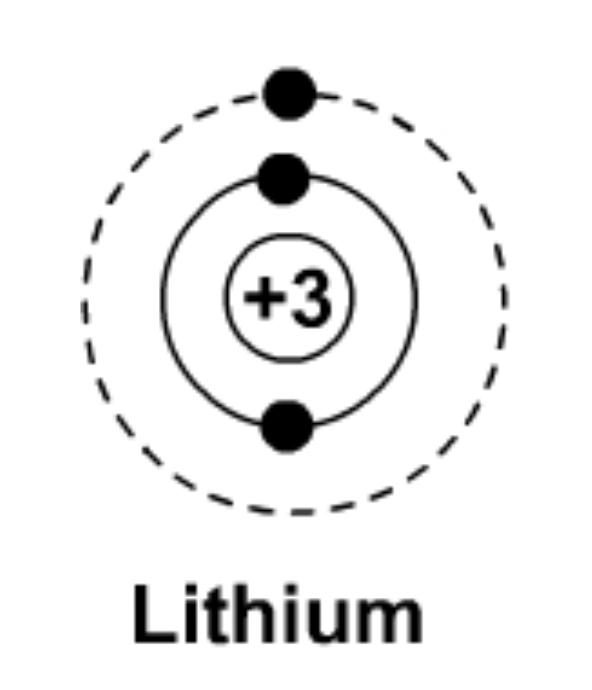
Lithium has an atomic number of 3. Draw its Bohr Diagram
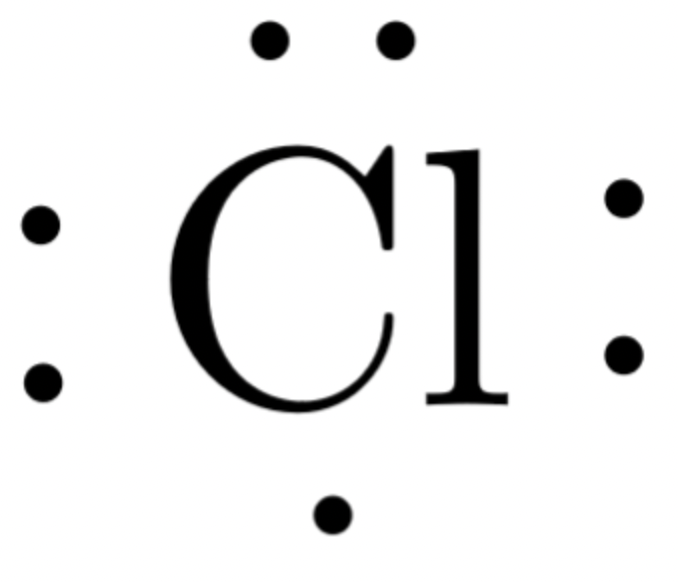
Chlorine has an atomic number of 17. Draw its Lewis diagram
What is different about how Lewis Diagrams are drawn compared to Bohr Diagrams?
Lewis diagrams only show the valence electrons
How do we find the number of neutrons for an element?
Atomic mass - atomic number
What is a good simile for electrons?
Electrons move in orbits around the nucleus like planets revolving around the sun
What is the proper name for electrons orbits?
Electron shells
Can electrons exist between orbits?
No
Can electrons move up or down from one orbit to another?
Yes
Is there a maximum number of electrons that can exist on different shells? What is that number?
Yes. First shell only holds 2. Subsequent shells can hold 8
When are electrons most stable? What does this mean for them?
Most stable at lower energy when they are closer to the nucleus. Means electrons are always trying to occupy the lowest orbits they can find
How do electrons fill their shells? (direction)
Start from the nucleus and work outwards
In the short written form of Bohr diagrams, how would you write it for Carbon?
C)e2-)4e-
Define valence electron
The number of electrons in the outermost (last) shell
What is important about valence electrons between atoms?
Electrons in the outer shell will determine how the element will react with other atoms to form chemical bonds in biological molecules
What happens when 8 valence electrons are achieved?
The atom becomes optimally stable and inert- meaning it does not want to take part in chemical reactions
When looking at a Lewis diagram, what is easy to see and why is this useful?
Can see only the valence electrons and thus make it easier to see how they might reaction with other atoms
What are the 10 chemical families on the periodic table?
Alkali metals, alkali earth metals, transition metals, post-transition metals, metalloids, reactive nonmetals, halogens, noble gases, lanthanides, and actinides
Which family are the most chemically stable elements? Why?
Noble gases; these elements naturally possess their max number of valence electrons. They are extremely non-reactive and tend not to form compounds
What is the octet rule? Why is it great for atoms?
Having 8 electrons in the outer shell; atoms bond to achieve the same configuration as noble gases and become chemically stable. Atoms bond to gain/lose/share electrons in their outer shell so they will end up with 8 valence electrons
What is the main thing to remember about ions versus atoms?
An ion is an atom in which the total number of electrons (-) is not equal to the total number of protons (+)
What is the quick definition of anion?
An atom that has gained electrons (-) to become stable and is now negatively charged
What is the quick definition of cation?
An atom that has last lost electrons (-) and is now positively charged
What is chemical bonding and why is it important?
When atoms join up with other atoms; only way life is possible
What are the 2 categories of chemical bonding?
Intramolecular bonds and intermolecular bonds
Where do intramolecular bonds occur?
Bonds within molecules. Atoms bond resulting in a compound called a molecule. Intramolecular bonds occur within the molecule
What are the 3 types of intramolecular bonds?
Ionic bonds
Covalent bonds
Polar covalent bonds
Define ionic bonds
Bonds that form when one atom transfers electrons to another atom resulting in both atoms ending up with a stable electron arrangement in their outer shell
Between which two families do ionic bonds usually form between?
Metals and non-metals
What kind of charges “attract” each other to form ionic bonds?
Opposite charges, + and -
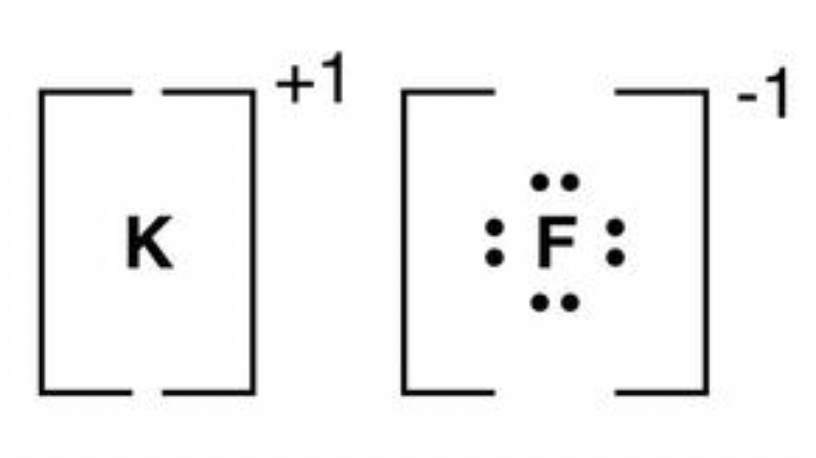
Draw the Lewis diagram after Potassium and Fluorine form an ionic bond
What is a covalent bond?
When two or more non-metals share one or more pairs of electrons so that both end up with a stable electron arrangement in their outer orbit
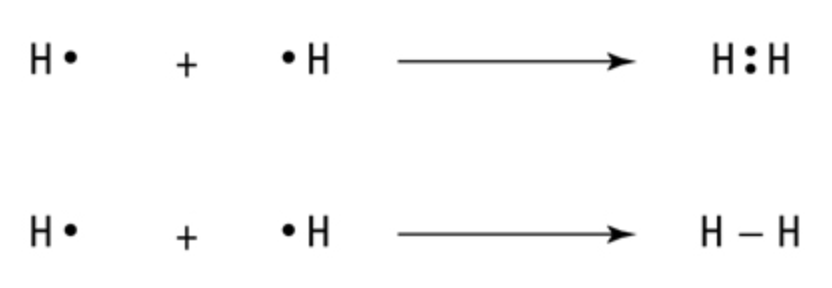
Draw the Lewis Diagram for a covalent bond between two Hydrogen atoms
Define polar covalent bond
Formed when there is an unequal sharing of valence electrons between atoms in the pair with one pulling harder on the electrons than the other. Results in different ends of the molecule having different electric charges.
Polar covalent bonds result in “two poles”. What does this mean?
The molecule is said to be a dipole meaning one end is slightly positive and the other end is slightly negative (the atoms that pull the hardest on the negative electrons will become the more negative pole)
Define electronegativity
Atoms differ in their ability to attract electrons in a chemical bond and this measure is called electronegativity
What molecule is an example of a polar covalent bond?
Water! Oxygen has a higher electronegativity value so it pulls harder on the electrons than Hydrogen does. Brings electrons closer to the Oxygen nucleus thus making the Oxygen end slightly more negative and the Hydrogen regions slightly more positive
What are intermolecular bonds?
Chemical bonds between molecules
Which is stronger- intramolecular bonds or intermolecular bonds?
Intramolecular bonds are stronger
How do intermolecular bonds relate to “state”?
These bonds between molecules determine the physical state of molecular substances; the bonds are broken when a substance undergoes a change of state (e.g. solid to liquid, liquid to gas)
What are the 3 types of intermolecular bonds and what is their name?
London forces
Dipole-dipole forces
Hydrogen bonding; called Van der Waals forces
What describes London Forces? What is the strength of this bond?
Hold non-polar molecules together
Weakest strength
What describes dipole-dipole forces? What is the strength of this bond?
Hold polar molecules together
Medium strength
What 1 thing describes hydrogen bonding of intermolecular bonding? What is the strength of this bond?
Formed between the electropositive hydrogen dipole and an electronegative dipole of either oxygen, chlorine, OR fluorine
Strongest strength
What is an example of a London force in intermolecular bonds?
CH4. Methane
What is an example of dipole-dipole foces in intermolecular bonds?
HCl. Hydrochloric acid
What is an example of hydrogen bonding in intermolecular bonds?
Pure distilled water
What are 3 important things to remember about water?
It is a universal solvent because of its ability to dissolve many ionic and polar compounds, it has a boiling point of 100oC, and a freezing point of 0oC
What are the 4 types of biochemical reactions?
Hydrolysis
Condensation/dehydration synthesis
Oxidation & reduction
Neutralization
What is hydrolysis?
Using water to help break down molecules
In a written chemical equation, what goes on what side?
Reactants are on the left and products are on the right
What is a condensation/dehydration synthesis reaction?
Reaction that occurs when two molecules combine to form one molecule. Opposite of hydrolysis. Water is removed in the synthesis of the new molecule (water is a product not a reactant)
What is a oxidation & reduction reaction? What is the common name for it?
Process of losing electrons is called oxidation; process of gaining electrons is called reduction. An electron transfer between two substances always involves a reduction of one and an oxidation of the other. Also called a “redox reaction”
What is a mnemonic device for remembering oxidation and reduction?
OIL RIG. Oxidation is less, reduction is gain
What is an example of a redox reaction?
Cellular respiration! Glucose + Oxygen → CO2 + water + energy. Transfer of electrons from glucose helps the cell to make high-energy molecules (ATP) which is used to do work!
What is a neutralization reaction? Where is this always happening?
Reaction of an acid and a base to produce water and salt. Happens when an acid and a base with equal concentrations and equal volumes react. Happening continuously within your cells!
Define ionization
Disassociation of a molecule into ions. E.g. H2O → OH- + H+
What is pure water?
Water that has been treated to remove impurities like minerals, bacteria, chemicals, and other contaminants. Result is almost 100% H2O molecules
What is an acid?
When dissolved in water, it increases the concentration of hydrogen ions (H+)
What are 4 properties of an acidic solution?
Sour taste, conducts electricity, turns litmus paper red, and a pH below 7
What is a base?
When dissolved in water, increases the concentration of hydroxide ions (OH-)
What are the 4 properties of a basic solution?
Bitter taste, slippery feel, turns litmus paper blue, and a pH above 7
Is pure water acidic or basic?
Neither, it’s neutral; contains and equal number of H+ and OH- ions
What is a pH scale?
Method of expressing hydrogen ion concentration. [H+] in mol/L. Measured logarithmically so each increment is a tenfold different. Scale of 0-14. Pure water is a 7 because it’s neutral
Describe acids and bases and their strength
Can be classified as either strong or weak depending on the degree to which they ionize when dissolved in water. Strong ones ionize completely; weak ones only partially ionize
For weak acids and bases, in an equation what does a double arrow mean?
Means the reactions are reversible.
What is an equilibrium concentration?
A state when the rate or forward reaction in a chemical reaction becomes equal to the rate of backward reaction. There is no change in the products and reactants and it seems that the reaction has stopped
Are most organic acids and bases strong or weak?
Weak
In a neutralization reaction, where does the water comes from? Where does the salt come from?
Water comes from the H+ and OH- ions in the solution; salt comes from the metal cation and non-metal anions in the solution
What would happen if a strong acid and a strong base with equal concentrations and volumes were mixed? What would be the products? What would be the pH?
H+ ions in the acid and OH- ions in the base would ionize/dissociate and react completely with each other
Products would be salt and water.
pH would be neutral at 7
Neutralization reactions do what? Why is this crucial?
Regulate the pH of the internal environment; determines the speed and direction of many critical biological reactions
What are acid-base buffers?
Solutions that are able to maintain nearly constant pH levels in spite of fluctuating environmental conditions.
How do acid-base buffers work?
By taking up excess H+ and OH- ions thus neutralizing excess acid or base
In the human body, what are 3 examples of acid-base buffers?
Proteins, amino acids, and carbonic acid
Where is the carbonic acid-bicarbonate buffer and what is its function?
Located in blood and extracellular fluid. Maintain and optimal 7.4 pH. If changes by even 0.2-0.4 pH it can be fatal. Contains acid and base so it can neutralize conditions that are either too acidic or too basic. Formed by the reaction of CO2 with H2O to form carbonic acid which then ionizes to form bicarbonate and a hydrogen ion. *Reversible
Covalent bonds form between atoms of-
Non-metals
Explain the polar covalent nature of water molecules
The oxygen in the molecule is more electronegative than the hydrogen so a dipole is formed with an area that is more negative (near the oxygen) and an area that is more positive (near the hydrogen atom)
Protein + H2O →
Amino acid + amino acid
Amino acid + amino acid →
Protein + H2O
Oxidation is the loss of electrons and the gain of-
Oxygen
Reduction is the gain of electrons and the loss of-
Oxygen
Pure water contains H2O molecules as well as tiny numbers of-
H+ and OH- ions
The H+ and OH- ions in water are produced through the natural process of-
Ionization
These ions in the water create the properties of-
An acid and a base
When an equal acid and an equal base react together, what 2 things happen?
A neutralization reaction occurs
Water and salt are produced
The carbonic acid-bicarbonate buffer contains both-
An acid and a base
How is the carbonic acid-bicarbonate buffer formed?
Reaction of CO2 with H2O to form carbonic acid
Ionizes to form bicarbonate and an H+ ion