Average and Marginal Cost Functions
 Call Kai
 Learn
Learn Practice Test
 Spaced Repetition
 Match
Match Flashcards
 Knowt Play
1/3

Earn XP
Name | Mastery | Learn | Test | Matching | Spaced | Call with Kai |
|---|
No analytics yet
Send a link to your students to track their progress
4 Terms
Given that the total cost function is C(Q), give some properties of it?
-Q is a continuous variable, meaning it can take any positive number, in theory of course
-C’(Q) > 0, meaning it slopes upwards.
-C’’(Q) > 0, meaning it is accelerating upwards.
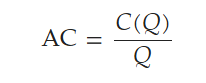
Given C(Q) is the total cost function, what is the average cost function? Give some properties of it.
-Average cost found by total cost divided by output. Thus:
-The slope of the AC falls and then increases thereafter.
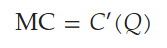
Given C(Q) is the total cost function, what is the marginal cost function?
-Very simple. And we have stated this is an upward sloping line.
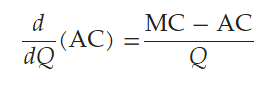
How can we prove that MC - AC always has the same sign as the slope of the AC curve?
-Differentiating the average cost function: C(Q)/Q with respect to Q, and substituting MC = C’(Q) and C(Q) = Q x AC, we get this.
-Because Q>0, the slope of the AC curve will always have the same sign as MC - AC.