Cell Bio Test Review
 Call Kai
 Learn
Learn Practice Test
 Spaced Repetition
 Match
Match Flashcards
 Knowt Play
1/95

There's no tags or description
Looks like no tags are added yet.
Name | Mastery | Learn | Test | Matching | Spaced | Call with Kai |
|---|
No analytics yet
Send a link to your students to track their progress
96 Terms
Photosynthesis equation
6CO2 + 6H2O + light —> glucose + 6O2
How is photosynthesis a redox reaction?
6CO2 —> C6H12O6 (reduction: adding of molecules)
6H2O —> 6O2 (oxidation: removal of molecules)
is photosynthesis anabolic or catabolic
Anabolic, it builds up a glucose molecule
Is photosynthesis endergonic or exogonic?
Endergonic (light is used as a reactant and is NOT produced)
Organ, Tissue, and Organelle of photosynthesis
Leaves, Mesophyll, Chloroplasts
Granum
“stacks of coins” in chloroplasts. One “coin” is called a thylakoid. Used to capture sunlight
Thylakoid
individual “coins” of Granum in chloroplast. Capture light
Stroma
Background fluid of chloroplasts. Glucose is synthesized in this region.
Where is stage 1 (light dependent) located in photosynthesis?
Thylakoids of Grana
What are the inputs/outputs in stage 1 of photosynthesis (light dependent)
Input: Light, water
Output: Oxygen, ATP, NADPH
Where does stage 2 (light independent) of photosynthesis happen?
Stroma
What are the inputs/outputs in stage 2 (light independent) of photosynthesis?
Input: CO2, ATP, NADPH
Output: Glucose
What is NADPH
Coenzyme that is responsible for carrying electrons and energy from the granum to the strona. It usually acts like a coenzyme, but when it loses its H+ ion, it is not a coenzyme anymore.
Stomate (stoma)
Pore-like things, usually on leafs of plants. They exchange carbon dioxide and oxygen in the atmosphere.
What is the main purpose of stage 1 of photosynthesis? (light dependent)
Produce ATP and NADPH to be used in stage 2
Photons
packets of energy that form waves
Violet has a short or long wavelegnth? And does it have high or low energy?
Short, high energy
Red has a short or long wavelegnth? And does it have high or low energy?
Long wavelegnth, low energy
Plants absorb mainly which colors
Red mostly, but some violet and blue as well.
Why do photosynthetic pigments absorb mostly red?
Red has the lowest energy out of the colors, so it won’t denature these pigments (made of protein)
Chlorophyll a
Main pigment. Reflects dark green, absorbs violet, blue, and red
Chlorophyll b
Antenna pigment. Reflects yellow-green, absorbs blue & orange
Carotenoids
Antenna pigment made of these two—
Carotene: reflects orange, absorbs blue
Xanthophyll: reflects yellow, absorbs blue
Photosystem 2
Comes first in the cycle. 3 parts: 1. Reaction center: made of chlorophyll a (P680) 2. Pigment complex: made of chlorophyll b and carotenoids. Helps to absorb more light and balance out work. 3. Primary electron acceptor and ETC. This system’s goal is to make ATP
Photosystem 1
Comes after photosystem 2. 3 Parts: 1. Reaction center: made of chlorophyll a (P700) 2. Pigment complex: made of chlorophyll b and carotenoids. Helps to absorb light and balance work. 3. Promary electron acceptor and ETC. This system’s goal is to make NADPH.
Photosystems, step by step
water is split in the presence of light. Oxygen and electrons are released.
Oxygen moves to stomate and exits the plant
Electrons are “boosted” to high potential energy as chloroplast pigments absorb sunlight
Electrons travel down the ETC and are utilized to make ATP or NADPH, depending on which photosystem you’re in.
Calvin Cycle/C3 Pathway/Light Independent stages:
Carbon fixation
Reduction
RuBP regeneration
Carbon Fixation
CO2 attaches to 5-carbon RuBP by the enzyme RUBISCO. This results in a 6-carbon molecule which is quickly split into two 3-carbon molecules. (3PG)
Reduction
ATP and NADPH are used to rearrange 3PG into G3P, which is used to make organic molecules based on the plants’ needs. This G3P molecule leaves the calvin cycle, but remains in the stroma, where it can be used to make glucose, or something else.
Regeneration of RuBP
Some G3P remains in the carbon cycle, and it is eventually converted back to RuBP. ATP is needed, since it goes from a 3-carbon molecule to a 5-carbon RuBP molecule. The cycle can then repeat again, since it all starts with a RuBP molecule.
C3 plants
experience good growing conditions
C4 plants
experience medium-stress conditions (ex corn). They have both C3 and C4 pathways, but in different cells of the lead. C4 plants first use the C4 pathway, since it is on the outer part of the leaves, but they can fall back and use the C3 pathway if needed.
CAM Plants
experience high-stress conditions (ex cacti) Slow growth rate. Stomates only open during the night.
Photorespiration
In hot, dry climates, stoma must close to avoid wilting. Therefore, it cannot get carbon dioxide, and oxygen builds up. O2 combines with RuBP, leading to the production of CO2. No ATP or carbohydrates are produced from this process.
Why is RUBISCO the problem in photorespiration?
RUBISCO accepts O2 and CO2 both. During a drought, RUBISCO starts to accept only oxygen, since there is a lack of CO2. Without the carbon from CO2, it becomes impossible to make any carbohydrates from this process
C4 pathway
Occurs in mesophyll cells. 3-carbon PEP reactions with carbon dioxide to produce a 4-carbon oxaloacetate molecule. This oxaloacetate molecule is converted into malate. This malate is decarboxylated, and it loses a CO2, which enters the Calvin cycle. After decarboxylation of malate, pyruvate is formed, and it is converted back into PEP using ATP.
PEP Carboxylase
Enzyme that controls the first step in the C4 pathway. It will not accept oxygen like RUBISCO does, so it will never be able to do photorespiration.
Palisade Mesophyll
main photosynthetic tissue in C3 plants. It lies towards the outer part of the leaf, and it is loaded with chloroplasts and elongated so that sunlight can pass fewer cell walls and penetrate easier. Coorelated with thick leaves.
Kranz Anatomy in C4 Plants
Stomates on both sides of the leaf, Gigantic bundle-sheath cells, compacted mesophyll tissue. These characteristics help them prepare for drought.
CAM Photosynthesis
Both pathways are in the same cell. C4 Pathway at night, when stomates are open. C3 pathway during the day, when stomates are closed. Helps to conserve water. They store mallate in their Large Central Vacuoles until sunrise. Then, mallate goes back to the chloroplast, where it goes through the calvin cycle to make glucose.
2 stages of the cell cycle
Interphase (includes several stages), and Mitotic stage (indluces mitosis and cytokenesis)
Interphase Phases
G1, S, G2
What is mitosis
division of the NUCLEUS. In this process, cells are CLONED (asexual). The purpose is to grow, replace old cells, and heal wounds.
Cytokenesis
Division of the CYTOPLASM. Starts with the clevage furrow pinching cells apart. Actin microfilaments are used in animal cells to divide into two cells.
G1 Phase of interphase
The growing stage in the cell. Organelles are active and are synthesizing proteins, lipids, and carbs coming from the rough ER, smooth ER, and Golgi Body, respectively. Also, enough energy is built up during this phase to power through the rest of the cell cycle.
S Phase of Interphase
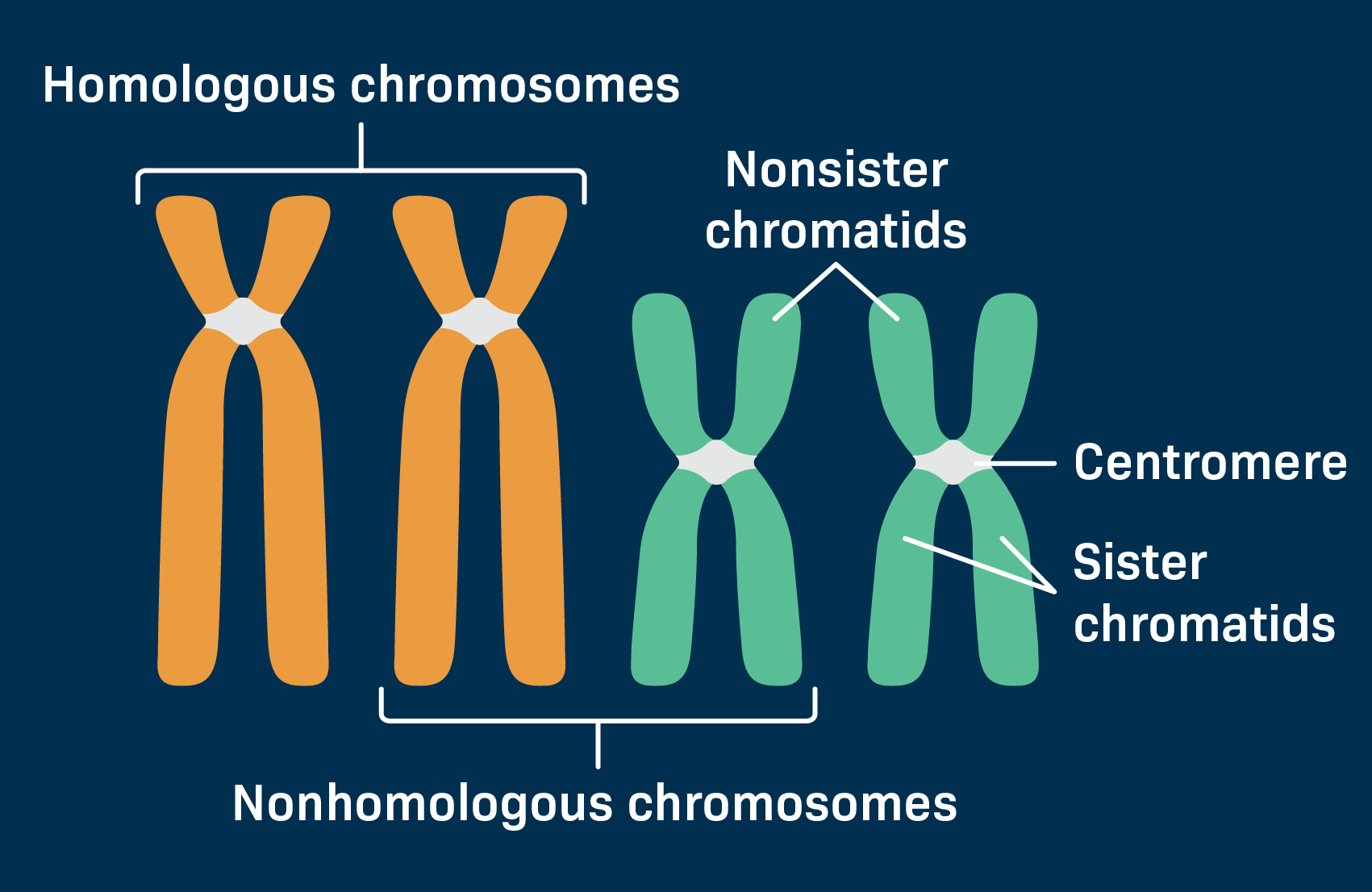
Doubling the amount of DNA. By the end of this phase, sister chromatids are technically made.
G2 Phase
The cell is getting ready to divide. During this phase, the cell synthesizes proteins such as tubulin, that go into microtubules that make up the mitotic spindle that guide chromosomes through cell division.
Acronym for remembering order of cell cycle
IPPMAT
Chromatin
granular genetic material seen in the nucleus. Eventually turns into Chromosomes during the cell cycle.
histones
Special proteins that combine with genetic material to make chromosomes.
Centromere
The point in which sister chromatids meet and form an “X”. The crossing point is the centromere.
kinetochore Protein Complex
It’s purpose is to connect to the mitotic spindle during prometaphase, and seperate daughter chromosomes during anaphase.
Humans have how many DIPLOID chromosomes
46
Humans have how many HAPLOIDS?
23
How is a karyotype made?
White blood cells from a blood sample are obtained. They are subjected to a slightly hypotonic solution so that cells slightly swell. Specific chemicals are used to stain the chromosomes and show specific bonding patterns. They are then fixed in time by a fixative during the metaphase, because during this phase, chromosomes are already lined up and organized.
Where are diploids seen?
In all regular body cells. Each cell has 46 chromosomes.
Where do we see halpoids?
Gametes. 23 chromosomes, which combine with the other parent’s 23.
Centrosome
Microtubule organizing center that makes the mitotic spindle
Centrioles
Only found in animal cells. These are barrel-shaped systems of microtubules.
Prophase
Longest phase within mitosis. Nuclear envelope and nucleolus disappear, chromatin turns into chromosomes, mitotic spindle starts to appear.
Prometaphase
Kinetochore protein complexes of each chromosome become attached to the microtubules of the mitotic spindle, guiding the chromosomes along the right paths.
Metaphase
Chromosomes line up along the equator of the cell by their centromeres.
Kinetochore microtubules
attach to kinetochore protein complexes on chromosomes. Gets shorter during anaphase to pull sister chromosomes to the poles.
Polar microtubules
Do not attach to the kinetochore protein complexes, but rather run between chromosomes. Gets longer during anaphase so that more space is created.
Anaphase
Shortest phase of mitosis and entire cell cycle. Sister chromarids seperate and form daughter chromosomes with 1 chromatid each. Then they move to opposite poles of the cells and are pushed/guided by the shortening kinetochore microtubules, while polar microtubules lengthen and make more space to turn one cell into two.
Telophase
nucleus and nucleolus reappear, chromosomes go back to chromatid, mitotic spindle disappears. Simutaneously during telophase, cytokenesis happens.
cytokenesis in animal cells
Clevage furrow uses actin microfilaments to pinch cells apart.
cytokenesis in plant cells
Golgi body produces a bunch of carbohydrates that form cellulose which makes up the cell plate, and it works its way from the inside out, to divide the cells.
Benign
non-canerous, encapsulated, not actively dividing. Could become cancerous though
Maligant
cancerous tumors, not encapsulated, actively dividing.
Metastasis
Advanced cancer. Often times, cancer has spread to other parts of the body, and this can happen if a part of the tumor breaks off and is moved somewhere else.
Proto-Oncogenes
Promote cell division. If they become mutated, they can become oncogenes
Oncogenes
associated with cancer, unable to stop promoting cell division
P53 Gene
Normal, tumor supressing gene. Says to stop dividing, but if mutated, it cannot tell it to stop.
Binary Fission
asexual reproduction seen in prokaryotes. “Splitting into two”
Chemotherapy and radiation cancer treatment
aims to destroy the mitotic spindle.
Taxol
Comes from Pacific Yew Tree, and it produces way more microtubules than necessary which confuses the cancer cell chromosomes, which kills them
Vinblastine + Vincristine
Comes from madagascar perriwinkle, they work best against lymphomas and lukemias, both working to destroy the mitotic spindle.
When sister chromatids seperate, does the number of chromosomes change?
No, but the amount of DNA inside of each does change.
During meiosis, do homologous chromosome pairs reduce?
Yes, they reduce by 1/2. The other half comes from the other parent
How can some bacteria do photosynthesis
Some have thyllakoids
In C4 plants, where is the only location where glucose can be produced?
Massive bundle sheath cells.
Locus
Location of a gene on a chromosome
tetrad
another name for homologous pair of chromosomes. (4 chromosomes total)
Synapsis
Members of a homologous chromosome pair lines up and makes contact with the other. (Prophase I)
Chiasma
A point of crossing over/overlap between non-sister chromatids (Prophase I)
Crossing over
Responsible for getting 4 genetically distinct daughter cells (Prophase I)
Interphase I of Meiosis
G1 (growth), S (DNA doubles), and G2 (second growth phase, prepare for cell division)
Prophase I of Meiosis
The same as mitosis, except there will be a homologous pair of chromosomes (matched pair) instead of loose chromosomes like mitosis.
Metaphase I of Meiosis
Homologous chromosome pairs line up. There’s no centromere in mitosis, so they line up by the dividing plain of the cell.
Anaphase I of Meiosis
Homologous chromosome pairs seperate. Sister chromosomes stay together, and this is when genetic material goes from diploid to haploid.
Telophase I of Meiosis
Similar events to mitosis.
Interphase II of Meiosis
If it does happen, S phase cannot happen (DNA duplication)
Prophase II - Telophase II
Exactly the same events as mitosis.
Plasmids
Prokaryotic genetic material that is able to spontaneously join or seperate from the one (and only) chromosome in prokaryotic organisms. This allows for genetics to be slightly altered, leading to some genetic diversity.