7.2 Language & Ecological Systems Theory & Development of Play • Adolescent Egocentrism & Social Clock & ACEs & Identity Development
 Call Kai
 Learn
Learn Practice Test
 Spaced Repetition
 Match
Match Flashcards
 Knowt Play
1/23

There's no tags or description
Looks like no tags are added yet.
Name | Mastery | Learn | Test | Matching | Spaced | Call with Kai | Chat |
|---|
No analytics yet
Send a link to your students to track their progress
24 Terms
Phonemes
the smallest, most basic unit of sound in a language that carries distinct meaning. They are the functional building blocks of speech—such as the /k/, /æ/, and /t/ sounds in "cat"—that distinguish one word from another. English uses approximately 44 different phonemes.
Morphemes
defined as the smallest unit of language that carries1 meaning. Morphemes are the building blocks of words, consisting of root words (e.g., "cat"), prefixes (e.g., "un-"), or suffixes (e.g., "-ed"). They are distinct from phonemes (smallest sound units) because they must convey specific meaning.
Semantics
refers to the set of rules used to derive meaning from morphemes, words, and sentences in a given language. It focuses on the literal meaning, or the "what" of communication, such as understanding that adding "-ed" to a verb indicates past tense. It is distinct from syntax, which governs word order.
Syntax
refers to the specific rules, principles, and processes that govern how words and phrases are combined to form grammatically correct, sensible sentences in a language. It focuses on the structural arrangement, such as word order, rather than the meaning (semantics).
Telegraphic Speech
a stage in language development, occurring around 18–30 months, where children use two-word, phrase-based utterances containing only essential content words (nouns/verbs) while omitting articles, prepositions, and conjunctions. Similar to a "telegram," it conveys meaning concisely, such as "Go car" or "More juice".
Overgeneralization
a cognitive distortion where an individual views a single negative event as an unchangeable, universal pattern of defeat. It involves drawing broad, absolute, and inaccurate conclusions ("always," "never") from limited evidence. This pattern is central to anxiety and depression.
Linguistic Determinism
the strong hypothesis proposed by Benjamin Lee Whorf that language dictates or determines the way we think, perceive, and understand the world. It suggests that the structure and vocabulary of a language constrain, limit, or shape cognitive processes.
Linguistic Relativity
the Sapir-Whorf hypothesis, is the concept that language shapes, influences, or limits human thought, cognition, and perception of reality. Rather than determining thought entirely, it suggests that the language we speak influences how we interpret the world and categorize experiences.
Ecological Systems Theory
An individual’s development emerges from interconnected environmental systems
—> explaining that child development is influenced by five nested, interacting environmental systems ranging from immediate settings (family) to broad cultural contexts. It emphasizes a holistic view, showing how individuals shape and are shaped by their surroundings over time.
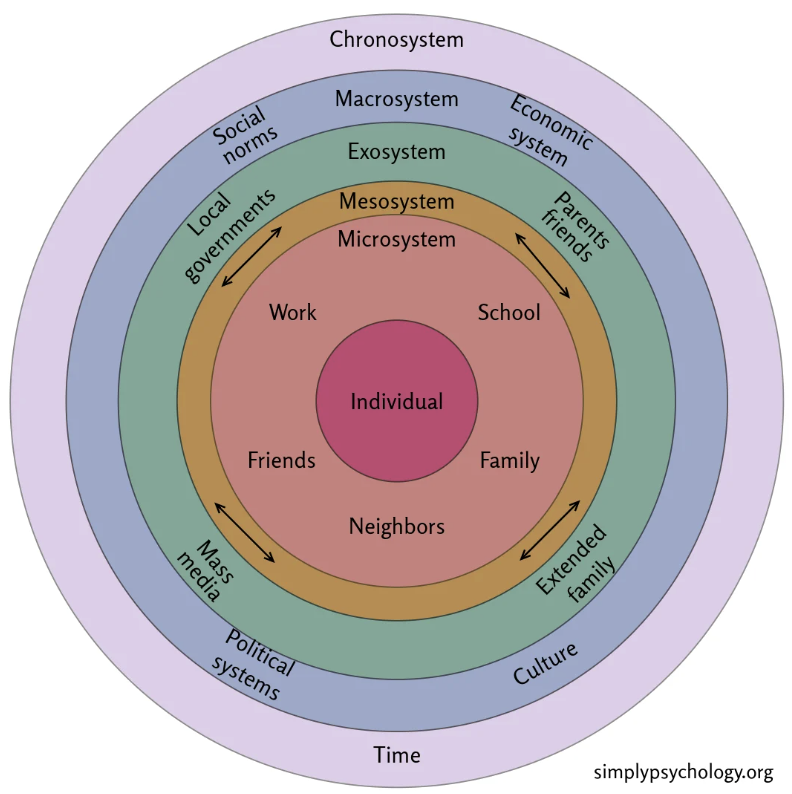
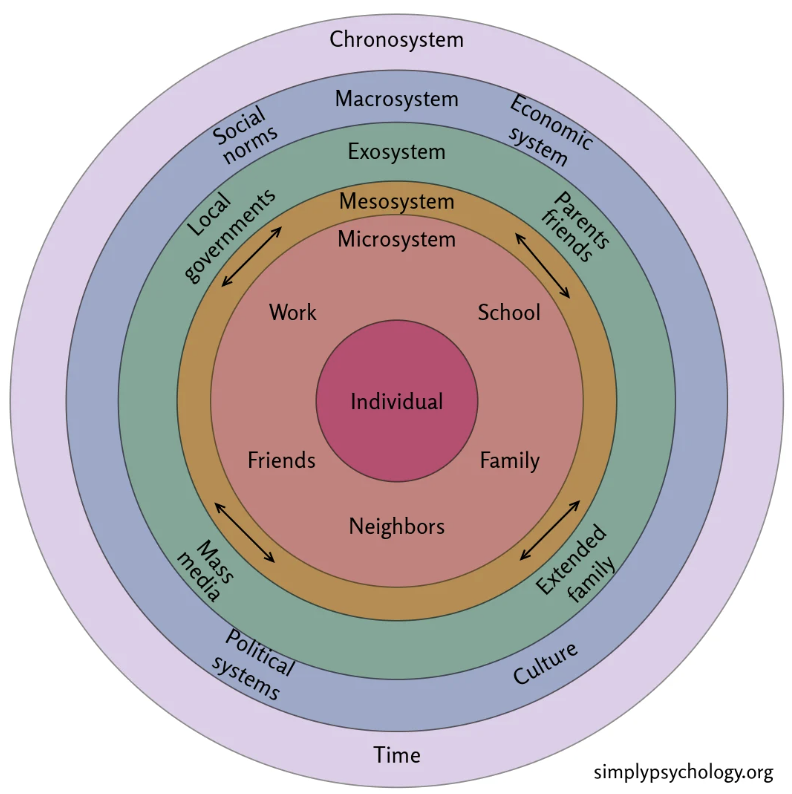
Microsystem
immediate environment and direct relationships (family, school, daycare, peers)
relationships are bi-directional, child isn’t just a passive recipient but an active contributor
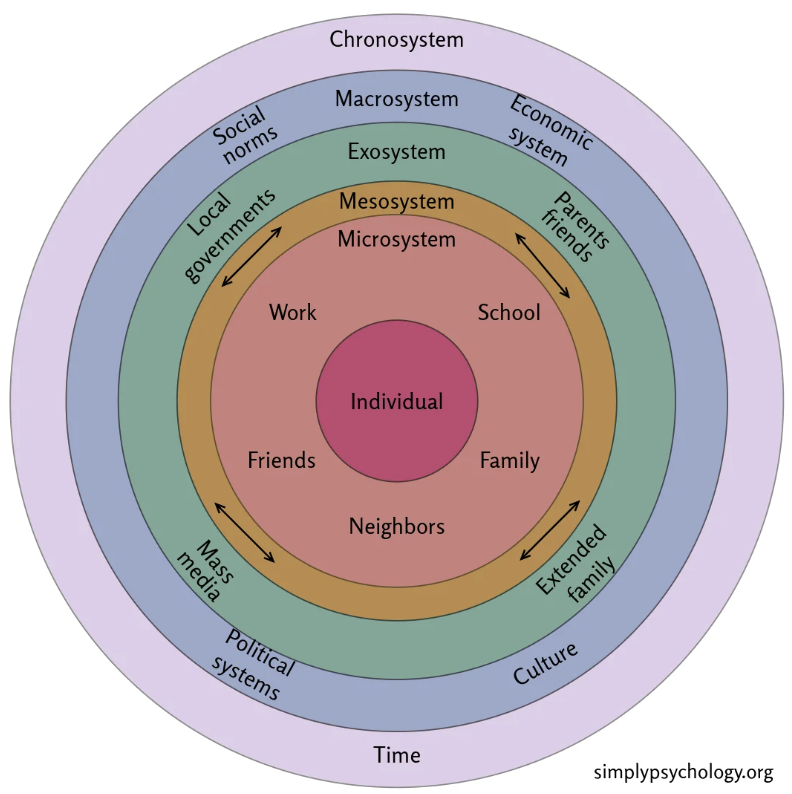
Mesosystem
Connections between microsystems (ex: parent-teacher communication)
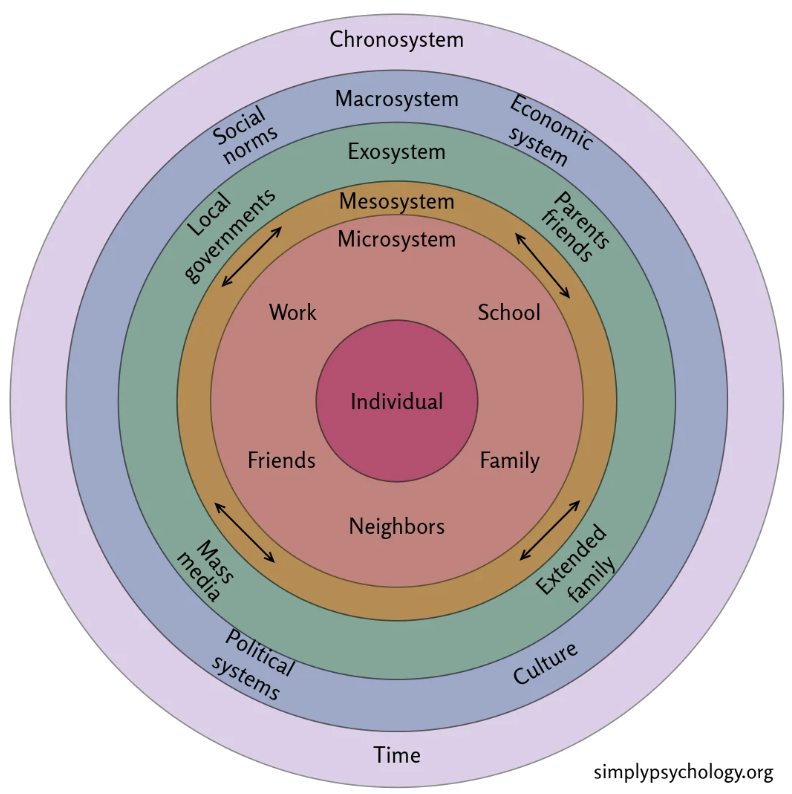
Exosystem
indirect influences (parent’s work stress, community resources, extended family network)
local gov, family friends, mass media —> influences microsystems
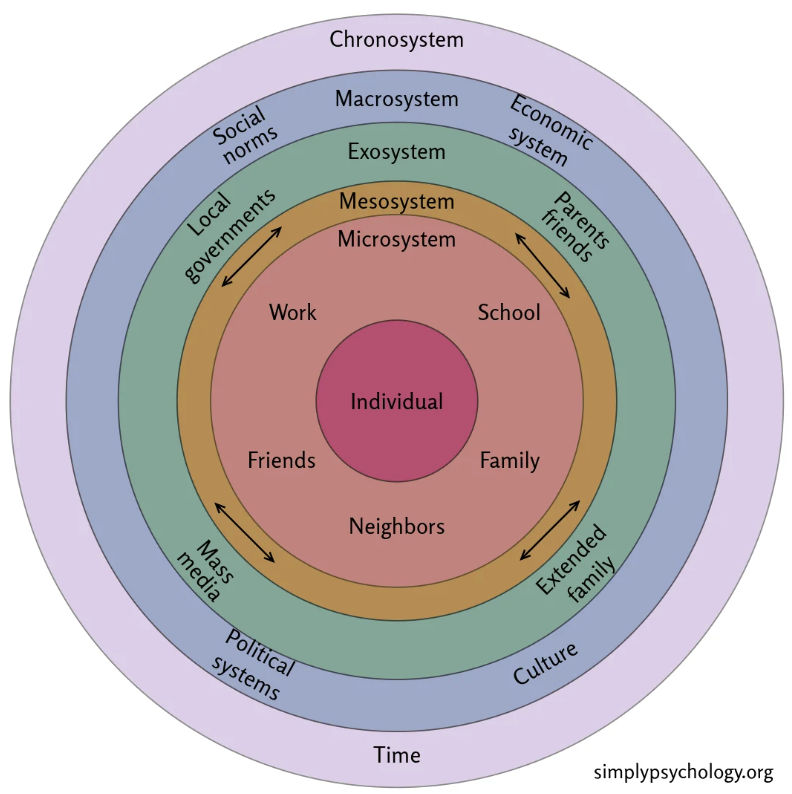
Macrosystem
the outermost layer of Urie Bronfenbrenner’s Ecological Systems Theory, representing the broad cultural context, societal values, laws, ideologies, and economic systems that indirectly shape an individual's development
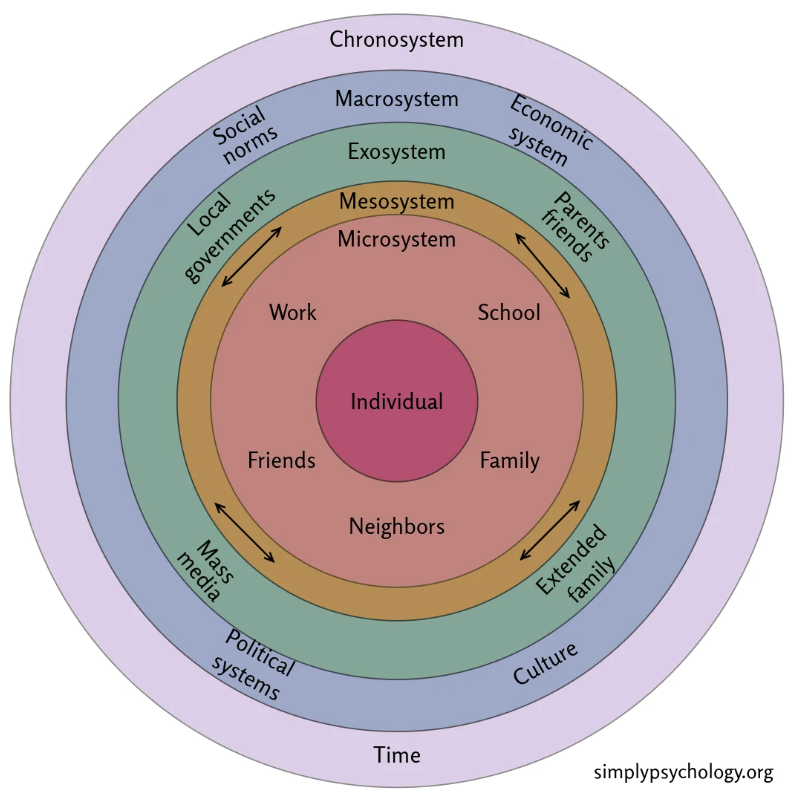
Chronosystem
time dimension: life transitions, historical events (pandemics, wars), & societal changes
predictable (starting school) or unpredictable (parental divorce)
Parallel Play
children play near others, but not together —> helps learn to play with others
2-3 years old
Prentend Play
a cognitive development activity where children use imagination to create scenarios, act out roles, and use objects to represent other things, typically emerging around age two and peaking at ages three to five. It is crucial for building symbolic thinking, social skills, and theory of mind.
Imaginary Audience
people have the mistaken impression that “everyone is watching me all the time”
adolescents construct imaginary situations —> the imagined reactions of others form the audience
Personal Fable
adolescent’s belief that they are the center of attention & completely unique
their feelings are unique and no one can experience such deep emotions
causes them to think that rules that apply to others don’t apply to them
they feel invulnerable and immortal —> lack impulse control
Social Clock
norms that determine the ages that life events happen
starting school, leaving home, getting married, having kids, retiring
Adverse Childhood Experiences (ACEs)
Negative experiences (usually traumatic events) occurring from 1-17 years of age
cause: mental health conditions, chronic health problems, and/or substance use disorder
signs: fear of others, frequent nightmares, bedwetting, changes in mood, avoiding situations or events related to trauma, difficulty sleeping, showing affection, and learning in school
Achievement (of Identity)
based on James Marcia’s theory, is the final stage of identity development where adolescents have explored various alternatives (crisis) and made firm commitments to specific values, beliefs, and goals. It represents a stable, autonomous sense of self achieved after active exploration.
Context: It is the successful resolution of Erikson's "Identity vs. Role Confusion" stage.
Diffusion (of Identity)
often in adolescence, characterized by a lack of firm commitments to personal values, beliefs, or career goals, combined with little to no exploration of these options. It is one of James Marcia's four identity statuses, representing a state of low exploration and low commitment.
Foreclosure (of Identity)
a state of identity development where an adolescent makes a firm commitment to values, beliefs, or a future career, typically imposed by parents or authority figures, without undergoing a personal exploration or "crisis" phase. It represents high commitment and low exploration, often leading to a rigid identity.
Moratorium (of identity)
a state of active identity exploration, characteristic of adolescence (based on Erik Erikson's and James Marcia's theories), where an individual is in crisis, experimenting with roles, beliefs, and values without having made a firm, final commitment to a specific identity. It is a "time-out" from adult responsibilities to explore possibilities.