3.1.2.2 the mole & avogadro’s constant
 Call Kai
 Learn
Learn Practice Test
 Spaced Repetition
 Match
Match Flashcards
 Knowt Play
1/22

There's no tags or description
Looks like no tags are added yet.
Name | Mastery | Learn | Test | Matching | Spaced | Call with Kai |
|---|
No analytics yet
Send a link to your students to track their progress
23 Terms
give the basic volume conversions
1 dm = 10cm → 1dm³ = 1000cm³
1 m = 10 dm → 1m³ = 1000dm³
1m³ = 1000000cm³
what is the mole?
a unit to measure an amount of substance
what is 1 mole?
the amount of substance that contains 6.022×10²³ particles (the same number of particles as there are carbon atoms in 12.0 grams of carbon)
why is the mole a useful quantity?
because one mole of a substance always contains the same number of entities of the substance
give the equation to calculate the number of particles or moles in a substance
number of particles = avogadro constant x number of moles
what can the ‘number of particles’ refer to?
number of:
atoms
molecules
or ions
what is the Avogadro’s constant known as?
L
how can you calculate the number of ions in a substance?
calculate number of particles using AC x moles
calculate number of ions present in substance eg in NaCl there are 2 present as there is one Na⁺ + one Cl⁻
multiply number of particles by number of ions
give the equation to calculate moles
moles (mol) = mass (g)/Mr
if a substance is a liquid how may its mass be determined?
by using its volume + density
give the equation linking density, mass + volume including units
mass (g) = density (gcm⁻³) x volume (cm³)
having a balanced symbol equation gives you what?
the ratio of molecules in the reaction
what can you use the ratio of molecules for?
once you know the moles of one of the species, you can deduce the moles of the other species in the reaction using the ratio
eg using the equation N₂ + 3H₂ → 2NH₃, calculate how many moles of hydrogen + ammonia we would have if there was 5 moles of nitrogen
hydrogen → 15 mol
ammonia → 10 mol
because the ratio is 1 : 3 : 2
why can’t you compare the mass to mass ratio to work out other masses rather than the moles to moles ratio?
because the mass of each molecule will be different
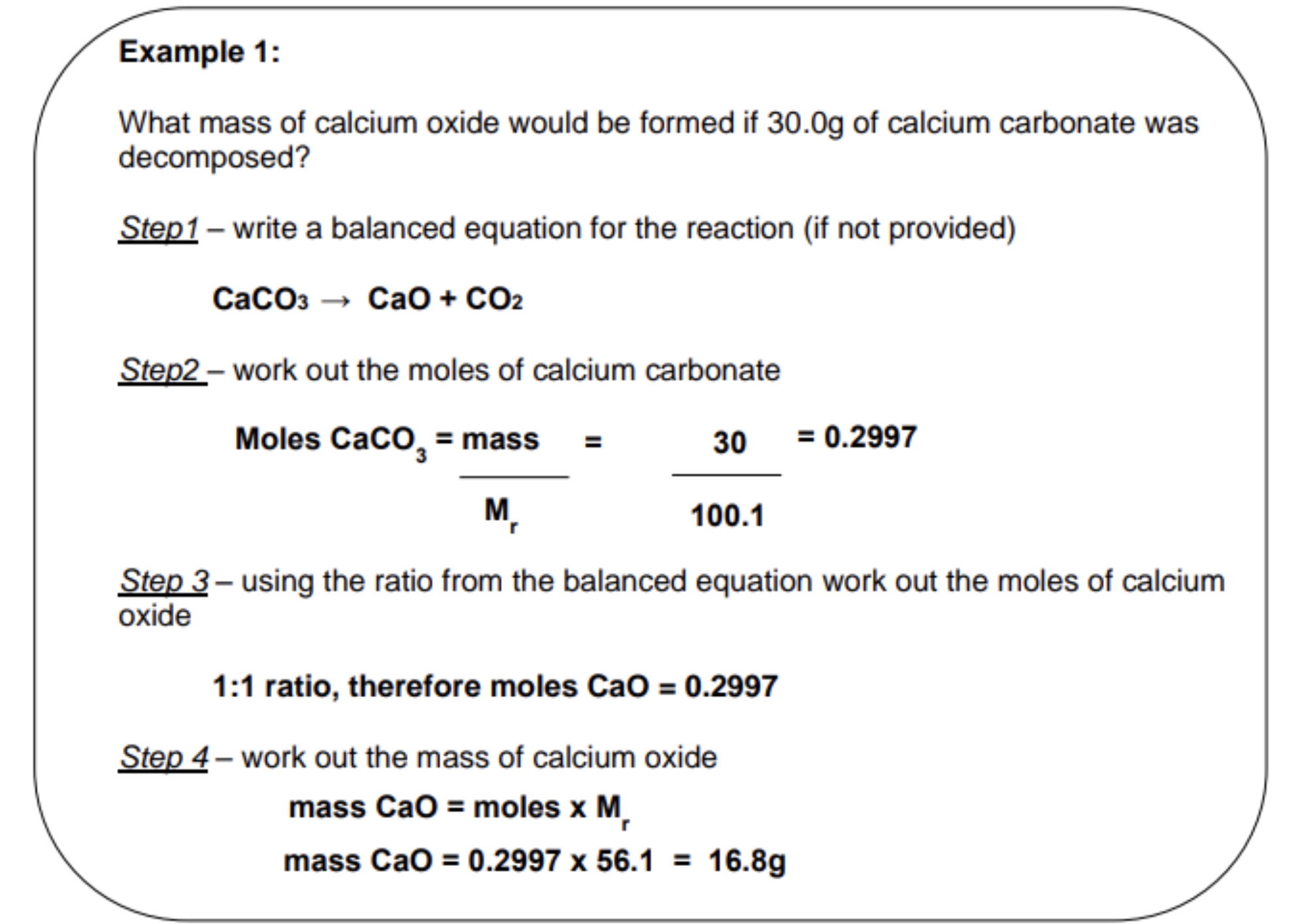
what mass of calcium oxide would be formed if 30.0g of calcium carbonate was decomposed? outline the steps
mass of calcium oxide = 16.8g
when calculating reacting masses, if not stated how many sig figs should you give the answer to?
3 sig figs
in chemical reactions one of the reagents is usually ______ and one is usually in ______
limiting
excess (more than necessary)
where do you need to work out which reagent is in excess?
in calculations
the reagent not in excess is known as the what?
the limiting reagent
how do you figure out which reactant is the limiting reagent?
look at one of the reactants + the mole to mole ratio
see if the number of mols ‘fits into’ the ratio → if it is in excess or there’s not enough it
eg if the ratio of the reactants (Ca + O₂) is 2 : 1 and there is 10 moles of Ca and 2 moles of O₂ then the reacting reagent is oxygen as there should be 5 mols of it
once you have figured out the limiting reactant how do you work out the number of moles of the product?
using the limiting reagent (NOT the one in excess) → work out the moles using the ratio
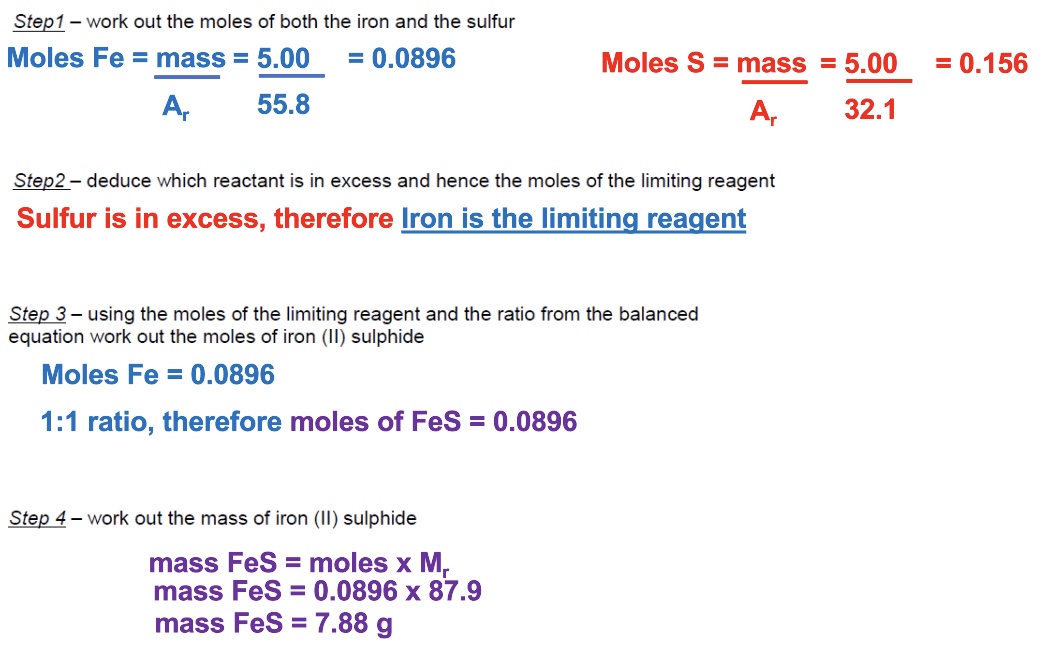
5.00g of iron + 5.00g of sulphur are heated together to form iron (II) sulphide. what is the maximum mass of iron (II) sulphide that can be formed? outline the steps
limiting reactant is iron (sulphur is in excess)
→ the mass of iron sulphide is 7.99g