Required practical 1 - Stationary Waves on a String
 Call Kai
 Learn
Learn Practice Test
 Spaced Repetition
 Match
Match Flashcards
 Knowt Play
1/10

There's no tags or description
Looks like no tags are added yet.
Name | Mastery | Learn | Test | Matching | Spaced | Call with Kai |
|---|
No analytics yet
Send a link to your students to track their progress
11 Terms
Apparatus and equipment for experiment
Signal generator: To create the frequency needed to induce waves on the string.
Vibration generator: Connects to the string to produce vibrations.
Stand and pulley system: To support the string and apply tension.
Wooden bridge: To adjust the length of the vibrating section of the string.
100g masses with holder: To create tension in the string (9.81 N when using 100g).
Metre ruler: To measure the vibrating length of the string.
1.5m long string: Used to produce the waves.
Balance: To measure the mass of the string for calculating mass per unit length.
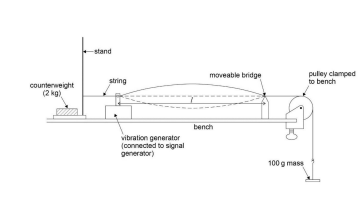
Step 1 of experiment
Set up the apparatus as shown in the diagram
Step 2 of experiment
Adjust the length l so that it is 1.000m, measured using the metre ruler.
Step 3 of experiment
Adjust Frequency: Increase the frequency using the signal generator until the string vibrates at the first harmonic. This is the lowest frequency at which a stationary wave forms on the string, creating a single loop. Record the frequency f.
Step 4 of experiment
Reduce l by 0.100m and adjust f again until it oscillates at the first harmonic
Step 5 of experiment
Repeat the experiment twice more and find and record the mean f for each l.
Step 6 of experiment
Measure the mass of the string on the balance and record it.
Graph
Plot a graph of the mean value of f against 1/l and draw a line of best fit. The wave speed will be two times the gradient.
λ = 2l ⇒ v = 2fl = 2/ 1/l => 2G where G is the gradient.
Calculations
The tension of the string is equal to the weight of the hanging mass (if 100g, 0.981N) and its mass per unit length can be found by dividing the mass of the string by its length (1.5m).
The speed of the wave is also given by v = T/√μ which can be compared to the value obtained by the graph.
Safety
The stand could topple over and cause injury so a counterweight can be used if it is deemed unstable.
Improvements + notes
The experiment can be repeated with different masses to change the tension and different thicknesses of string to change the mass per unit length in order to investigate the effect of changing these parameters.
An oscilloscope can be used to verify the signal generator’s readings.
The signal generator should be left for about 20 minutes to stabilise.